– A day’s notes

Here are the scraps I collected on Thursday, February 28th.

1. From the viewing deck at the pool, during the swim team rally, I can look over the coach’s shoulder and see the words she has printed out in these colors on a sheet of white office paper:

FAST

SMOOTH

HUNGRY

STRONG

2. In the locker room, I come around the corner from the changing area to the mirrored vanity area, and I see one thing I expect to see — a woman with a blow dryer — and one thing I do not expect to see — another woman seated at the vanity, with a laptop open in front of her. Grace is dilly-dallying, so I have at least 10 seconds to figure out the scene. Under Laptop Woman’s chair is a Barnes & Noble bag bursting with paper. On the vanity counter are check stubs and W-2 forms. She holds and examines a W-2 form. She keys numbers on the keyboard as she looks at the form in her hand. Although it’s warm and humid in the locker room, she wears a coat over her street clothes, which is strange, because she looks as though she is set up to sit there for a while. Why is she doing her taxes, or someone’s taxes, in the locker room? Is she making good use of time as she waits? Does she carry the bag of receipts with her everywhere, in case she has an hour of free time?

3. The Trader Joe’s flyer offers Organic Instant Oatmeal for $2.99. The same flyer offers a “tub” of “washed, peeled, and most importantly chopped” Mirepoix for $2.99, so that “you can focus on your next culinary creation knowing that these ingredients are at the ready.”

Fast. Portable. Instant and at the ready. Is this how our days go?

– After coffee

Cal Newport at Study Hacks pored over interviews with 10 major nonfiction writers (Ted Conover, Susan Orlean, and others) to extract information about their habits. He’s mainly interested in how they schedule their work days. Most get up early and start no later than 8:30 a.m. A ritual, involving the New York Times, precedes writing for several of them. So does coffee, “lots of coffee.”

His data illuminate more than his cohort’s coffee drinking. Check out his graphs and commentary, and perhaps you’ll “Schedule Your Writing Like a Professional Writer.”

The coffee, at least, I can manage.

—-

Thanks to Jimmy for the link.

– Before coffee

Coffee cup drawing

I like talking to Leslie Sills, my daughter Grace’s art teacher, about process. She’s a sculptor and a writer, so inevitably we get to how making objects and making prose are alike, and unlike.

Once, in a discussion on finding time to do self-generated work, amidst teaching and other commitments, Leslie said, “Before coffee.”

“What?”

She elaborated: “I heard Katherine Patterson speak at the Brookline Library about her work. She said, “Write before coffee.”” Leslie has tried, and keeps returning to, this simple advice.

Intrigued, I tried, too. Many times in the last fews months I’ve gotten up about an hour before I normally would (time varies depending on weekday or weekend) and done some writing while I waited for the coffee to drip.

Here’s a long hand-written piece from early Sunday, October 28, presented to you as is:

So, then a hundred, then 50 more black birds, so black there was a bluish oily tinge to tail and head feathers swooped and circled into our backyard this morning, into Isaac’s, into Gail’s, and pecked for a few minutes in the grass. All the while, they were cackling together almost screaming. But not crows, not big enough to be crows. They must see well, to be able to see between grass blades the insects they peck at. They look purposeful: taking steps, peering down as if seeking, zeroing in, pecking.

When they first arrived, I saw them (I was looking out kitchen window) swoop in an arc from beyond Isaac’s house, in the air around his garage, some made stops in our Norway maple that’s on the property line, before hopping as solid as a stone or fleet as a bullet down onto our grass.

Bird squad. Bird squadron. Bird squads.

As if sensing a signal, the ones scouting the east end of our backyard lifted off and circled away. Hastily. As if being pulled by threads or by a signal that they senses second after, others took off a flew, too. In the crowd, there was a kind of order, even though I felt a kind of compressed hysteria in watching them.

Why did they arrive so swiftly, and from where? Were they hopping from yard to yard, satisfied to get one or two bugs per bird in each yard? Incessant moving, incessant feeding to fuel the movement, a cycle that cannot stop.

This must happen every fall and around this time. I remember in the fall of 2001 — only six years ago? — being home with Eli, and noticing the same pattern with the black birds. They swooped in, blanketed the front lawn, chattering and hunting, and then swooping away. It was ominous, marring, on a beautiful October afternoon. Eli said, “The birds know something. Because they’re in the air, they know what’s coming before we do.”

The terrorist attacks of 9-11 were on all our minds. Eli, only nine years, imagined the birds, like planes, in the air, sensing a familiar pattern (planes fly up there, “we” (birds) fly down here) altered, and knowing that something had changed and was changing, yet not being able to predict what.

And when it happened? Was it another fire for them — treetops burning, cracking, popping and falling — acre after acre — or was their familiarity with buildings and glass enough to tell them that this event was remarkable, something that doesn’t happen.

I couldn’t have written this at night, when there often is more free time to write, because the birds would not have presented themselves to me.

I doubt I could have written this before coffee, because the having of coffee makes me sharper, more thoughtful, deliberate. With coffee, would my mind have wandered to where it ended up?

—–

The image is from Grillboy’s Coffee Cup Project.

– Eight things

It’s nice that there is still room in life for firsts, even though so many of the firsts are way behind me. I’ve been tagged. While I don’t feel a frisson exactly, I do feel a little flutter.

Yes, I’ll dance to this meme. Here is my list of eight things about me.

1. I was born in Massachusetts; I went to college in Massachusetts; and I have lived my adult life in Massachusetts. I feel self-conscious about this sometimes, as if I have failed to do some adult thing that most adults do, that is, move away. At the first meeting of my class last week, I asked the students to say where they’re from, what they do at MIT (where I am newly teaching), and what makes them them. The 17 students in my group hail from across the U.S. and the globe: Texas, China, Ohio, California, Thailand, Tennessee, Korea, New York, Mauritius, and Florida. I am the only person in our group from Massachusetts.

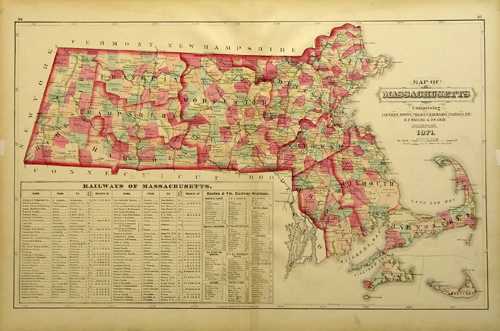
Massachusetts 1871

2. My four brothers and sisters — Michael, Sally, Emily, and Brian — all live in the 617 area code, as I do. You could say we are clannish.

3. I only like vegetarian and cooked shellfish sushi. No tuna or octopus for me.

4. I prefer novels by the Brontes to ones by Virginia Woolf.

5. I’ve never had a celebrity crush on the lead singer (Mick, Bono, Bruce, etc.). I have always liked the guitar player (Pete Anderson) or drummer (Charlie Watts).

6. Salty over sweet.

7. Although I am neutral when it comes to animals, dogs seem to like me immediately, crawling into my lap shortly after meeting me, and cats seem to hate me immediately, attacking me even unprovoked.

8. When I was in high school, I sent some poems to Seventeen magazine, and the editor wrote a personal note back to me on the rejection form letter. These are good, but too complicated and dark for our readers. It was a compliment, and I took it as encouragement. One poem was about the peeling of rose petals away from the bud and the speaker’s disappointment of discovering, when she got to the absence at the center, that she had destroyed beauty and found nothing.

In turn, I tag my people Brian, Jimmy, Ave Lydia, Marcia, and Laura, and also Lee Houck, whom I don’t know, because I like his blog and chapbook.

—–

The image of the 1871 Massachusetts map is via Grace Galleries. Thank you.

– Walk 500 miles

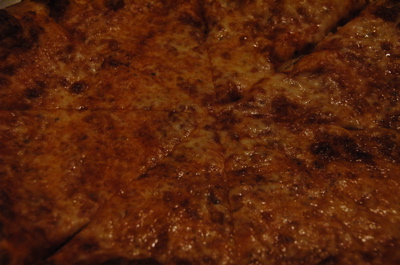
Does this look good to you?

Pizza slice

What would you do to get some? Walk 500 miles? Pass up tickets to the World Series? Give up your spring break?

If not those, then could the promise of pizza get you to show up at a meeting?

Not me. I’ve noticed, however, that this is a lure for students. A huge one. Right now I’m dividing my time between two different colleges, which are so different that I’d think the students at them would be motivated by different rewards, yet I notice a striking prevalence of the words FREE PIZZA on posters and chalkboards announcing club meetings, grammar workshops, and support groups.

Does it work? If you offer a snack to someone to get them to ingest, oh, comma rules, will he stick around long enough to learn how to fix his comma splices?

I’m skeptical.

Around the time I turned 40, I said to my children, as they waited impatiently for the usual Friday night delivery: “I’m so done with pizza.” Really, I’ve had enough. Because I’m not into pizza, if I offered it to students, there would be something condescending in that. I like comma rules, but I doubt that they do, so the pizza would be a cheap trick. A manipulation.

So what if I tempted them with something that tempts me too? Good olives. A roasted potato. Grilled flank steak from a recipe my friend Marcia gave me years ago. Walnuts. Almonds.

(Picture that poster. FREE ALMONDS.)

I’m interested in these questions of motivation. It takes empathy and creativity to persuade people to do what they don’t actually want to do. Yet, we keep relying on the same tired old tricks.

The blog Motivation Matters at Education Week has been covering the cash incentives that schools offer K-12 students to apply themselves to various tasks: reading, enrolling in AP courses, completing homework. Recently, Ken Bushwiller reported that panelists at the American Economic Association’s annual meeting demonstrated that “giving students incentives was not very effective.”

Alex Kjerjulf, a self-identified Chief Happiness Officer, considers the contemporary workplace and claims, “Many people don’t feel motivated at work, and there’s a very simple explanation for this: The motivational techniques used by most managers don’t work.” His blog post, which includes a vivid illustration, is titled, “Why Motivation by Pizza Doesn’t Work.”

Kjerjulf discusses extrinsic and intrinsic rewards and comes down firmly on the side of helping people find their own internal motivation. What is it that employees deeply want to do? (Hint:”eat pizza” is not the answer.)

What is it, I wonder, that students deeply want to do at school? More specifically, what is it that they want to do in my writing class?

Steven Reiss, a professor of psychology at Ohio State University, argues that there are more than the two kinds of motivation: “It’s all a matter of individual differences. Different people are motivated in different ways.” His research has theorized 16 basic desires.

This is news to me. Reiss’s findings seem sound. When I think about motivating students to undertake the assignments in my course, however, I could become overwhelmed trying to design incentives for all their human differences. This one might be motivated by pizza, that one by cash, he by the stuff itself, and she by acclaim.

Just as one person cannot be all things to all people, one teacher cannot design all rewards for all students.

Does that leave me back at square one? Hmm, maybe. How about this, though? I’ll offer them free almonds. Well, not really almonds. What if I offered them the promise of the same rewards that motivate me? A chance to talk about writing with other smart people. Good questions. Stuff worth reading. Moments of writing together. A little time, here and there, to get to know something about each other. Mutual support for the long haul and the steps we take alone.

Not everyone will bite, but some will. And there will be plenty for me.

—–

Thank you, Eli Guterman, for putting aside your dinner for five minutes to take the pizza picture. And thanks to a YouTube member for the clip of The Proclaimers doing an acoustic version of “I’m Gonna Be,” which includes the unforgettable line: “I would walk 500 miles and I would walk 500 more.” I love it.

– Desperate measures

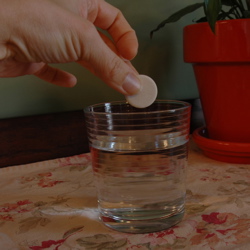
Hand, tablet, waterThis week Eli was sick with a cold. On Thursday, one of my tutors apologized for bringing her sickness to work. On Friday, one of my colleagues brought along her obviously sick child to a staff meeting.

Such occurrences don’t bother me. I figure that my persistent exposure to germs are an occupational hazard of both parenting and teaching. I don’t use hand sanitizer. I abide by the five-second rule and sometimes eat things that have fallen on the floor. I do not fear touching doorknobs. I’ll drink out of another person’s water glass, if offered. You can drink out of mine, if you like.

This morning I woke with a cough, a deep chest one. Right now I have two part-time jobs that together add up to more than one, and fatigue is my new tag-along. My guard is down. The palace has been invaded.

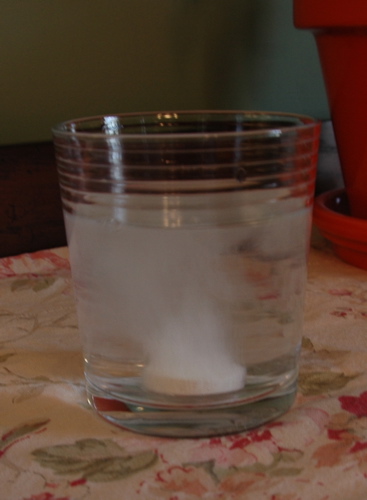
It might be too late, but I’ll try anything. Eli and my mother are recommending AirBorne, a packet of so-called immunity boosters in a fizzing tablet. Normally I eschew such remedies, preferring chemicals and a nap.

FizzzzzzzThis item has a homey list of ingredients, however, which sound as though they were grown in someone’s yard: lonicera, forsythia, ginger, schizonepeta (what’s this?), echinacea, and other herbal names. It looks and tastes like Alka-Seltzer. L’chaim, everybody.

– Two pages a day

Before a committee meeting, two of my colleagues were commiserating about publishing and the tenure process. It turns out, however, that their frustrations were more with writing itself — and finding time for it — than with the vagaries of the academic publishing scene.

Colleague A: I’m teaching. I’ve got the committee. I’m commuting.

Colleague B: And I’m working on my house.

Colleague A: Yeah, where do we find the time? When do we get our writing done?

Colleague B: In the summer.

Colleague A: That’s right. [He nods grimly.] In the summer.

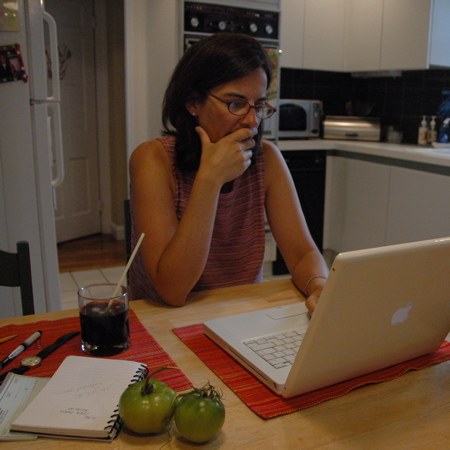
Summer is free time when you work in education. And free time seems to be writing time. I look forward to it, too. Here’s me, at the kitchen table last summer (writing, perhaps about green tomatoes).

Jane writing

There are, indeed, longer stretches of uninterrupted time when school’s out. Plus, there’s iced coffee. It’s ideal writing time.

It’s not, however, the only writing time. There’s free time during the semester, too. There’s just less of it. One must write and rewrite in smaller bits. A few years ago, my friend Leanne, in a coach-like way, said to me, “Kokernak, give me two pages a day.” Two pages a day I can do. You do the math: Over 10 days or so, that might add up to what Annie Lamott calls a “down draft.” (Just get it down.) I’ve tested, and I keep testing, Leanne’s advice. It works. I’ve also discovered that you can revise essays, articles, and poems in 30 and 60-minute chunks and make progress.

Lately I’ve been reading a fairly new blog, called Write to Done, that Jimmy turned me on to. Not only is it a really readable writing blog (why are those so hard to find?), it’s useful. Are you distracted? Are you having trouble, as we all occasionally do, maintaining your daily practice as a writer (or a painter, designer, composer, or even runner)? Are you tending e-mail more than you are your poetry? (We’re all susceptible.) Then click on his category for “Writing Habits.” Go there; go there now.

And then you can get back to your writing.

—–

This picture was taken by someone with the last name Guterman. I’m not sure who.