On the shelf over my desk at work there is a picture of me at around age 11 sitting on my parents’ bed and practicing my flute. My mother gave me this snapshot in a small lucite frame, along with some other childhood artifacts, when I turned 40.
Sometimes I look at that photograph to remind myself, “That’s me.” My hair is long. I smile. No doubt I had the room to myself, so I could practice. This was before my father built an addition on our house, so solitude was at a premium in our small house with seven people living there.
More and more, this seems important: to look back on the self before it became adult and look for some pure thing. Even 10 years ago, I would have disparaged (in my mind) others doing this. I believed — and rationally I still know this is true — that the self is mutable and changes every day that we are alive. Today marks the day that I am who I am.
Adult life is both full of and fragmented by responsibility to others. This is especially true as a parent and amplified by being a teacher on top of it. The nurturing of the potential of others feels like where a lot of my energy and mental overhead go.
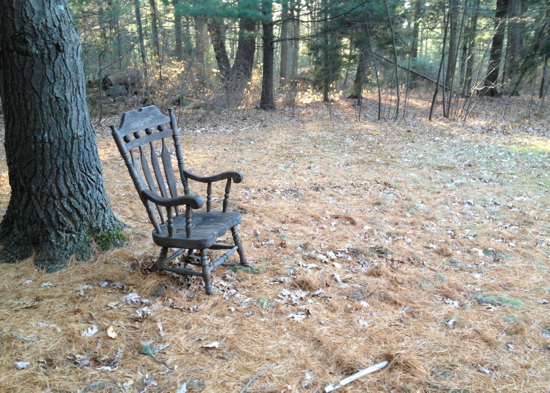
Solitary chair, Cunningham Park, Milton, 11.29.2013
Not all of it goes there. In the past few or several years, my egotistical thoughts and fantasies have become more important to me, as if they are getting unburied with the pressure of time. This is probably some adult developmental stage, and if I knew more about classical psychology or if I were in therapy, I could describe myself to me in a framework.
In my own thoughts, I am like an adolescent: who I am? what will I become? what can I accomplish that is significant?
But I am an adult too, and I remind myself that my life is well underway. The horizon doesn’t shimmer so much with promise as it does with the quiet light of certainty.
Roaring self resists. I document the accepting side of my thoughts, and a lioness stirs and says, “No. It cannot all have been written yet or done.” Promise is not only for Eli, Lydia, and Grace. Promise is not only for the college students I know for a semester or two.
These thoughts have been vividly alive in the last few months because I seem to have reached some limits. Certainly, limits can be overcome or gotten around, but to some degree I am trying to talk myself into learning to live with them and thereby retreating from the challenges they present.
If I don’t run, I won’t ever feel like an inadequate runner. If I cease my skating lessons, I can satisfy myself as a recreational skater. If I content myself with being a satisfactory writing teacher, I will quiet the desire for more authority, more prominence, greater effect. If I write only for myself and my students, I may marvel at how the written word can connect one person to another.
A smaller space might be enough. I could ease into a respectable old age.
I wonder therefore if my reflections on myself as child and adolescent are a way to carve out a space for myself alone, or a self before so many responsibilities grew in my life. “What did you want, Jane?” I can ask her, and only she can answer. The thing is, did she know?
Or, did she know, but she feared to say or do it?
It’s so coy to end on a question. If a student ended an essay or a major section of a paper with a question, I would call him/her out on it. “A reader wants to know what *you* think.”
The child in me is all desire: I want everything that I have ever wanted. The adult in me, all reason: prioritize, defer, and accept limitations (your own and others’).
 leaf stitch word