For the love of laundry (and other domestic arts)

With an itch to tackle a pile of clutter, though maybe not ready yet to throw out, shred, or burn every school paper I ever wrote or diary I ever kept, on Saturday I tackled my closet, the laundry, and unfinished sewing projects. Jimmy joined me, and between the two of us we put together nine bags of giveaways of outgrown clothes (or, in our case, out-thinned clothes) and unloved shoes.

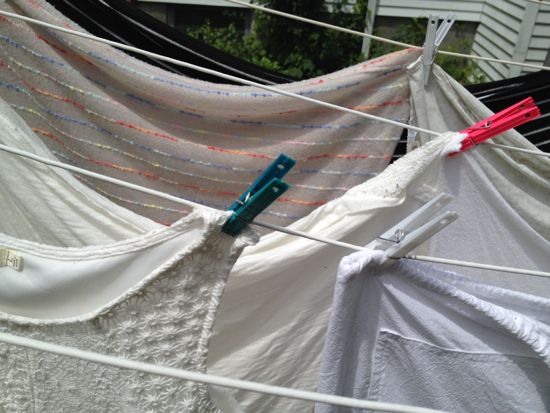
This led to my confronting the over-flowing basket of “gentle wash and line dry only” clothes near the washer. There were four loads of sweaters, blouses, linen pants, bras, winter gloves, and bathing suits. With very little room on the drying rack for that many items, I borrowed my neighbor’s outdoor clothes line.
laundry

I don’t think I’ve hung up clothes outside since I was 15. That was a chore I never minded when I was young and lived with my parents and siblings. There were numerous physical and spatial challenges — how to get more than a whole load on the line; how to pin items in a chain, attaching one item to the next; and how to get sheets on the line without first dragging them on the ground. Plus, it smelled good: soap, cotton, and the sun on the grass.

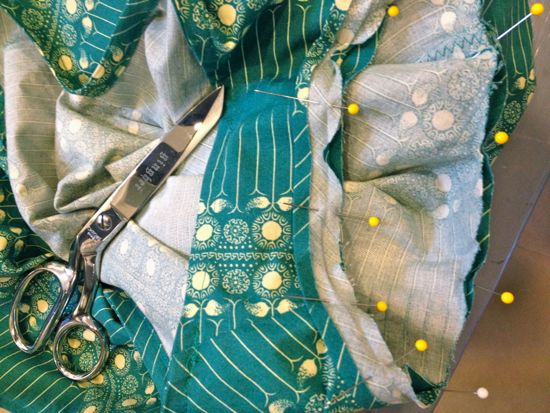
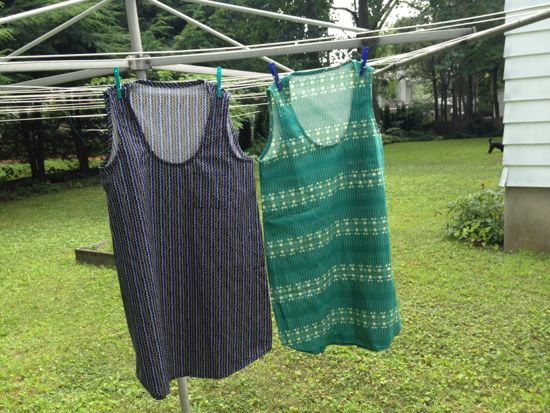
Last summer Lydia and I took a sewing class, and when the end of summer bumped into the start of the school year, we put our unfinished jumpers aside. The hardest part remained, to edge the neckline and armholes with bias-cut binding. Lots of pinning! Over the past year, when I’ve walked by the sewing machine and noticed the folded green and blue fabric of our works in progress, regret pinched at me. We got so far! And then we stopped.
sewing1

Today I re-started — so much activation energy there, especially because I was starting at the hardest, least rewarding part — and got into a rhythm with the pinning, sewing, ironing, pinning, and sewing again. I thought about all the activities I enjoy in my free time or ones that are necessary for civilized survival, like laundry and straightening. Maybe if I had been a different person, I would have professionalized my love of sewing or even organizing abilities.

A couple of weeks ago, at the skating rink, I went around and around a few times with one of my skating friends there. He told me about replacing his hot water heater in his house on his own. (Note: he is not a plumber.) He remarked that he wished he had discovered his talent for machines when younger; maybe his career choice (law) would have been different, he wondered aloud.

There is so much pressure to take what one enjoys and make it into the way one makes a living. I’d like to blame it entirely on Do What You Love, The Money Will Follow (Dell, 1989), but many other books and career experts have made the same assertion. I do believe a person should be suited to her occupation, but it’s too much pressure to imagine being in love, every day, with everything that goes into work.

sewing2

And why does work have to be the source of our love? What does love even mean in this context? I feel suited to my job, effective in it, well matched to my colleagues, and deeply interested in my students’ intellectual development, especially when it comes to writing and public speaking. But not every day is lived at the pitch of excitement. There are not many moments of flow.

There were many moments of flow in laundry hanging, closet cleaning, and dress sewing this weekend. I had the time to watch my hands at work and to think other thoughts. I feel this way when skating (although I am not watching my hands), when tinkering or gardening, when writing. I don’t need to get paid for those. Such activities may be a source of contentment that makes the hard work of grading papers and preparing for class more sustainable.
sewing3


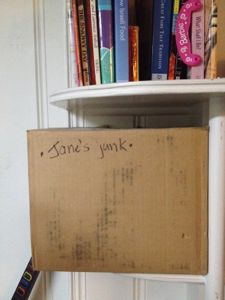
Jane’s junk: keep or torch?

box 1Even the neatest among us have loose ends stashed somewhere. A second closet full of clothes. An attic full of old furniture and toys. Paint cans in the basement. Old parts and garden tools in the garage. Out-of-battery watches in the bedside table. Hand-knit baby sweaters in the cedar chest.

They’ve been there for years, perhaps almost the whole time you’ve lived in that house, since your children were babies at least. You know where those leftovers  are: which box, which corner of the attic. In your mind there floats a vivid image of the folded stacks of baby clothes, the jumble of toys, the keepsakes wrapped in tissue.

Knowledge of them and their location is a weight. You want to get rid of them yet you are afraid that these items, which you haven’t needed in ten years, in twenty, will someday be needed.

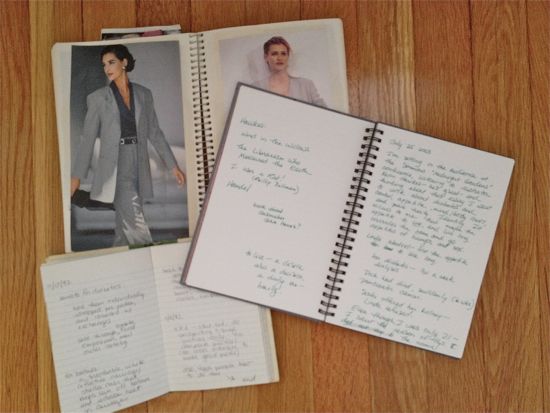
In my house, there is a box full of notebooks on a shelf in the basement. Calling the contents “Jane’s Junk” when I was consolidating them was easy. That they belonged to me was more important than what they were: stuff I had archived; ideas and observations I had recorded.

Here, a sketchbook in which I had rubber-cemented magazine and catalog images of clothes I liked. It was a wish book, for how I could look if I had the money or if I were a different person with a different body.

box 3

Even more, there are notebooks filled with dated entries. One captures ideas:

11-9-90: Company that takes all store returns, then returns in bulks to the stores. (Name ideas from Jimmy: Take Me Back or Return to Sender.)

12-7-90: There are ice cream shops, and frozen yogurt shops. Why not pudding shops? “Puddin’ Heads”

7-15-91: Story idea: Old woman in nursing home. Young woman comes in once a week to give knitting lessons. Makes old woman think she will not die as long as this continues — it’s like a hope holding her to earth. One week young woman does not come in.

1-20-92: Maps for the car that do not have to be folded — roll into a tube, or a window shade

11-8-92: Baking sweets without sugar, for local sale or catering. Or, a “sweet of the month club” for diabetics.

^Eventually sell to Harry & David.

2-24-93: “The Medical Consumer” — a consumer mag. to cover medical industry — does Consumer Reports already do this?

4-6-93: Christmas present for Brian. Call Yosemite gift shop. “Go Climb a Rock” t-shirt.

I never became an entrepreneur even though this little book is FILLED with random business and product ideas. I look back on these notes, and they have no present-day use. I have no plans to become one, ever. Good thing — I don’t see a pudding cafe generating a lot of business. Continue reading

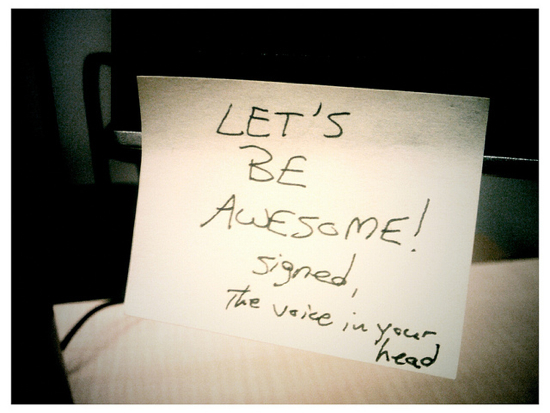
Imagine a point in the future when you will look back at this moment

be awesome

There is this notion of “anticipatory regret” that is supposed to make you avoid doing something bad by anticipating or imagining the negative consequences of the action. You know, you won’t lie if you imagine untangling yourself from the inevitable web of lies spun out of the first one.

Years ago, I read the novel Therapy by David Lodge. For a long time, I attributed to that novel a different, more positive take on anticipatory regret: that it can help you do something good and desired that you imagine feeling future sadness about if you don’t do it. As I remembered the plot, I recalled that the middle-aged Tubby, who was invited to go on a pilgrimage with his former sweetheart, goes with her because he imagines that someday he could deeply regret not going.

I recently re-read Therapy — which sadly does not hold up well, though I remember it as a shining moment in my history of reading pretty much all of Lodge’s novels up to a point — and, although Kierkegaard’s arguments about regret are part of Tubby’s inner calculus, I found nothing about anticipatory regret.

Perhaps the different take was and is my own.

—–

In the spring, for one of my classes I got into the habit of holding open office hours in a classroom, so students could drop in and talk to me about the assignment and, if they wished, sit for a while and write together. One time, 10 students showed up and stayed! Another time, only one did, but he stayed for two hours to work on his report. He would write, ask me a question, write again, say something out loud, write again, and so on. “What do you write?” he asked me at one point. This was an unexpected question, it being a computer science (writing) class and me so clearly not a computer scientist. Why would he, or any CS student, care?

I hemmed. I hawed. “I have written some essays… tried my hand at poetry… last summer wrote a story.”

“What about a book?”

“Well, a while ago I started working on a novel, but then I stopped because I thought it might not be so good for my mental health.”

“What do you mean?” He was still looking at his own screen, writing.

“Like, the story was too close to home. I wondered if I should be getting my thinking in order instead of projecting it all on a novel.” As I was saying this, it sounded stupid to my own ears.

“THAT IS MESSED UP!” he exclaimed, kind of laughing. “That does not make any sense.”

I, sheepishly, “Well, it did to me, at the time. But, yeah.”

—–

You know, when you say something out loud, or you write it down, then you have to think about it.

—–

Continue reading