– That’s not a crow! That’s my grackle.

So much for it being crow season.  The birds in the yard right now are grackles.  They swarm and sound like they do in this YouTuber’s yard:

Eerie, huh?  More eerie than the cawing of crows, which is how I figured out I was wrong about that.  Jimmy came home this evening while I was sitting in the kitchen with the window open, listening to the chatter and screech of hundreds of birds in the trees around the house and on the street.  He said, “Hear the crows?  Amazing.”  He added, “Your blog post didn’t capture the sound they make.”  The instant he said the words “crows” aloud, I realized I had gotten it wrong.  Crows caw.  So, I looked online and in the Sibley Guide to Birds until I figured out that what we’re annually witnessing is the migration of the common grackle.

Still, grackles or crows, the sound they make is like a shrieking call to pay attention, pay attention, pay attention, pay attention!

– Crow season

Jan sent me a link announcing new work by Vermont artist Carol MacDonald, in which she “examines the tradition of knitting through a variety of print-making techniques.”  I love it, especially that the featured image is “Red Skein I.”  (What is it about red yarn?)

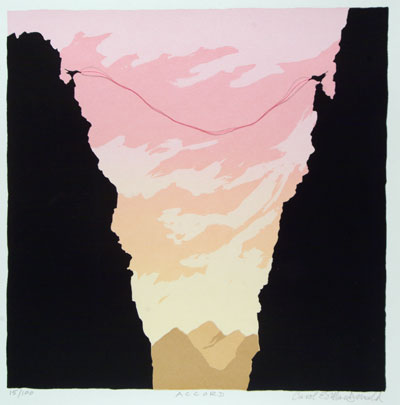
I looked deeper into MacDonald’s portfolio and found even more that I liked, especially her paintings and prints with crows as their subjects.  Her works have titles like “Convergence,” “Bearing Arms,” and “Resolve,” and they are more than portraits of crows.  There occasionally seems to be a bit of string in them, too:

"Accord," Carol MacDonald, silkscreen/thread

"Accord," Carol MacDonald, silkscreen/thread

It’s crow season again.  Yesterday and today, in the mild, fall weather, the crows are landing and taking off in the yard, again and again.  Continue reading

– Feels like this

In an essay, Patricia Hampl writes:

I was attracted too to the in-between position of the writer. More exactly, I was after the suspended state that comes with the act of writing: not happy, not sad; uncertain of the next turn, yet not lost; here, but really there, the there of an unmapped geography…

The elusive pleasure to be found in writing (and only in it, not the before of anticipation, not the after of accomplishment) is in following the drift, inkling your way toward meaning. (126)

I agree: not the before, not the after, the in.

And yesterday, walking to the train and having one of those imaginary conversations that I often do with those who populate my head, I said (internally and not out loud), “Didn’t you know that I am secretly a detective?”

And while I’m not actually a detective (yet how would you know?), I am when I’m writing.

___

Hampl, Patricia. “Other People’s Secrets.” The Business of Memory: The Art of Remembering in an Age of Forgetting, ed. Charles Baxter. St. Paul, MN, Graywolf Press: 1999. 116-131.

P.S. Thank you to Lowry Pei for recommending the essay, which is interesting in many ways.

– Daily wonders

Some of Tuesday’s unconnected moments:

A woman, riding her bicycle and standing up on the pedals, was smiling and crying, too.

Only one wing, still attached to the body, of a monarch butterfly rested on the sidewalk.  Uncrushed, it seemed fresh and recently alive.  Where was the other wing?

There were figure skates on the floor in someone’s office.

The girl on the bus, waiting at the front for her stop, asked the very boyish bus driver if this was his regular route.  I could tell they liked each other.  After she got off, he looked at her out the closed door.  She walked away from the bus for a few feet and then looked back.

Afternoon coffee was delicious, and I remembered to drink it while it was still hot.

– Japanese paper diet

In class, giving my students some advice on adding context to their scientific reports on Pfu DNA polymerase, I suggested that they return to their course texts.  “Make sure you digest the lab manual.”

I heard myself and smiled.  I looked around the table; some of them were smiling, too.

“I mean,” I said, “Make sure you read the lab manual carefully and digest the information in it. Please don’t actually eat it.”

The mind works associatively.  My verb/object error opened an unlikely file drawer in my head, one that contains moments from NBC’s 30 Rock.  Deciding to digress — and I rarely exploit my students as audience, but this time I did — I told them where my internal attention had landed.

Liz and Jenna

30 Rock: Liz and Jenna

“Did anyone see that 30 Rock episode where Jenna is on the Japanese paper diet?”

I looked around.  They waited; they smiled; no one said anything.  I continued.

“Jenna is one of the stars of a television comedy show, and she’s trying to lose weight.  All she eats is paper.  In the show it’s called the Japanese paper diet.” I paused.  “And so, after I told you to eat the lab manual, I pictured you all eating paper and thought of this.”

Students laughed.  It was so nice of them.

Later, in the van with Jimmy and the two girls, I share the classroom anecdote.  From the way back, Lydia hoots.  “Mom, it’s not called the Japanese paper diet!  It’s called the Japanese porn star diet!” Lydia, who also watches the show, is correct.

Oh, god.  I always meddle, unconsciously, with gags, stories, and jokes, and get them wrong.  My own twists make sense to me, but not usually to anyone else.

In this case, however, I’m so glad I misremembered the diet’s name (although I did remember the gist of the joke: Jenna was eating all the paper she wanted).  There are some things you can say to your students, and some you cannot.  To mention a porn star diet in a science writing class, in any class??  Totally inappropriate.  A paper diet, though?  Just quirky, I hope.

– Secret room dreams

I share an office with a few other writing teachers.  One of my office mates, T., recently told me about her adventures in flower pressing, and she gave me some petals.  Once curled and shaped, they are now paper thin and flat.

The pressed petals remind me of the bright, fallen, and wilted geranium petals on the floor of my room at Wellspring House, where I was in July for a week.  The boards of the floor were painted gray, and when I walked in the room I saw a scatter of droplets — pink, with white edges — under the window.  At first, without really thinking I thought they were painted fingernails.  Then on the wide sill I noticed the clay pot, the green furred and scalloped leaves.

There are geranium pots on our front steps at home, and these too, like T’s petals, remind me of my solitary and spare room at Wellspring.
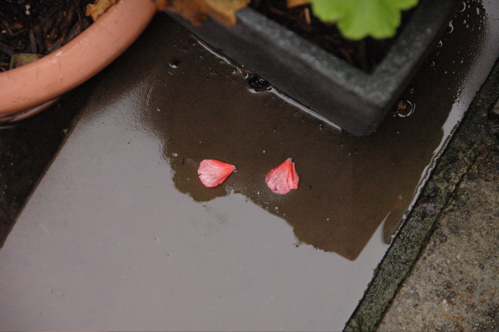
Petals, on steps after rain.

Petals, on steps after rain.

Thoughts of that room prompt memories of other loved rooms, especially two more: a dorm room, an office.  What do they have in common?  Why these three, and not so many others?

I make a diagram.  (Later Lydia sees it and asks, incredulous, “You made a Venn diagram because you were bored?”  I answer, “I made a Venn diagram because I was trying to figure something out.”  She laughs kindly.)

Each room had its own wonderful qualities.  The dorm room: a big closet and a typewriter.  The office: a view into the greenhouse behind the Isabella Stewart Gardner Museum.  The room at Wellspring was named after Emily Dickinson, and then there were the petals decorating the floor and catching my eye.

They shared some features too, and it must be these that cause me to consider them as a trio.  All three had a desk & chair, shelves, and a mirror.  They were intended for solo use, although I recall guests in each one.
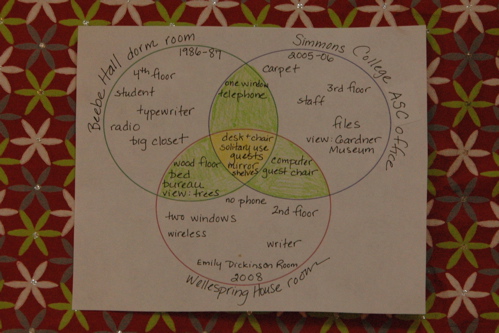
"Three Rooms" by J. Kokernak (Venn diagram)

"Three Rooms," by J. Kokernak, 2008.

I am ruminating over the importance of these concrete details and what they mean now.  Each memory’s connection to my present life (and not my then student, staff, or retreater’s life) is what concerns me.

This exercise on the three rooms reminds me, too, of theme dreams (i.e., ones that recur).  Mine are about secret rooms.  In these dreams, I walk through a house I’ve lived in and find a door that I’ve never noticed before.  I open it, and inside is a room that presents an opportunity to me (space, activity, style), and sometimes to the people I live with.  Sometimes in one of my secret room dreams, I try to get another person’s attention: “Look, look at this!  The room we’ve been wanting!”  Sometimes in one of my secret room dreams, I close the door and keep its existence to myself.

About a dreamed secret room, Gillian Holloway, in The Complete Dream Book, claims that “This room has great possibilities… and represents a neglected potential in the dreamer’s life that the deeper mind is trying to reclaim” (155).

Are the three remembered rooms like secret dream rooms?  There seems to be some bounty there.
– Bodies are weird

These few lines are from a conversation that Jimmy and I had in our upstairs hallway this morning.  It happened to be about menstruation, but it just as easily could have been about sex, psychopharmacology, or even double-jointedness.

Jimmy: Bodies are weird.

Jane: That may be because we think of them weirdly.

Jimmy: And that would be because of our bodies.

Touché.

And speaking of bodies…

“Tethered to the Body,” an essay on my adjustment to wearing an insulin pump and its affect on my sense of (sexual) self, appears in the fall 2008 issue of Bellevue Literary Review. The full version is not online.  You can get the journal at bookstores, or you can e-mail me and I’ll send you a PDF.  In the meantime, here’s the first paragraph:

A $6,000 insulin pump with an on-board computer chip is not alluring.  Neither is the white mesh adhesive patch on my naked abdomen or the length of nylon tubing that connects the patch to the pump.  There is only illness, and there is no way to make that sexy.  After several years as a medical device wearer, I know.

– Destination: insight

In the car on the way to work, I was thinking through a demanding e-mail that I received. The sender or nature of the e-mail is not so important. We all get them occasionally. Someone wants something from you, and you start thinking about how to satisfy them, to give them what they desire, to soothe the irritant. (If you’re a teacher, this someone is often a student.) Why that impulse to bend?? Is it only to make peace? Maybe a certain kind of peace, which is more like resignation, is overrated.

I pulled into the parking lot. As I walked across campus, this insight emerged from the murk of my thoughts:

Another person’s ambition, especially when it aligns with conventional values (e.g., more money is desirable, rewards are necessary), can unproductively set a team or community’s agenda.

It’s good to know one’s own agenda. Protect it, not out of vanity, but because it may be fragile, and it needs you. And the team — or even the world — may need it too.

Thank you to my 30-minute commute.

– 100% me

Sunday night dinner. We’re all home. Chicken, salad, corn on the cob.

Jane: Who has homework?

Lydia: I have to write a poem.

Jane: About what?

Eli: It’s not about “anything.” That’s what all the seventh grade poems are about.

Lydia: It’s a one hundred percent me poem.

Jane: You’re a good poet.

Dinner ends; an hour passes. I return to the kitchen, and I see Lydia’s homework stack on the table. On the top, a poem.

100% Me Poem

I pick it up. Lydia’s there and lets me read it: part of her is this, part of her is that, and so on adding up to 100 percent. Under the poem, I see another piece of paper, a form that looks very teacherly, and which Lydia has thoroughly filled out.

100% Me Poem Rubric

Is it possible to score poorly on the 100% Me Poem, and get a… 60% ? Then, would a 12-year-old writer think that her self, and not her poem, was only a portion of what she thought was entire?

I like Lydia’s poem. I don’t love the rubric.

– Considering toast

Toast, from toastalicious.com

Toast, from toastalicious.com

I was thinking of a croissant with my coffee, but then I smelled toast. “Ah, toast.” This was as I got within 20 feet of the snack bar in my building at 9am this morning. I gave in to the toast impulse — I smelled it, I pictured it, I heard the sound of the word in my head — and it seemed foolish to get what I suddenly no longer wanted.

At my desk, I ate the toast. I drank water and sipped coffee but did not look at papers or compute while eating. I stared at the wall; I thought about toast.

Henry James said that “summer afternoon” are two of the most beautiful words in the English language. I cannot disagree. Yet, I’d like to add “toast” to a short list of beautiful, evocative words. Dr. Poppy, in her response to my post on snacks, reminded me of its sensuality and charm: “simple but… sustaining.”

And yet, I was thinking as I ate my toast, do writers always use toast as a detail to convey the same feeling? Is toast a cliché? Would it be possible to ruin toast for a reader, or at least subvert it?

Examples:

At the last minute, she put toast under the pillow. All night, her hand worried it and not the hardened blisters on her wrist.

Their naked bodies pressed together, only Donna’s toast came between them: scratchy, buttery, and smelling of last night’s onions.

Before he tucked the dead squirrel into the shoe box and interred it behind the dog house, Little Guy lay freshly made white toast in the box’s bottom. The toast’s firmness supported the stiff body; a smear of blood seeped into the surface crumbs.

The doctor recommended toast in the sneakers overnight, to deodorize them. “And soak those feet in vinegar, twice a day,” he added. Joe would try anything.

Would the reverse also work? Could you take a noun with negative associations attached to it — like pus or viscera — and make it lovely?

Hmm. It seems easier to try to ruin something than it is to repair or beautify something else.