– For your eyes only

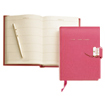
Pink locking diaryBound diaries and journals have not always been secured by a padlock or hidden between the boxspring and mattress. Thoreau and his Transcendentalist friends, in fact, often wrote them with the knowledge that they would be read, whether in their lifetimes or posthumously.

According to an article in the local Brookline TAB this week (11.1.07), which announces the publication of a new compilation of Thoreau’s journal entries called I to Myself (YUP 2007),

Keeping a journal to share with friends was a far more common activity for people of all educational levels in Thoreau’s era than today. “Back then almost everyone kept a journal, even farmers and definitely educated people,” says [Jeffrey S.] Cramer. People shared their journals. When Thoreau writes in his journal, you feel like he’s talking to you. In his journals he’s definitely writing to a reader.”

Verification for this remark appears in the chapter “Thoreau in His Journal” in the Cambridge Companion to Henry David Thoreau (CUP 1995). Yes, the Transcendentalists were devoted journal keepers who wrote, often, for each other. So were other Concord residents — clergy, teachers, naturalists, businessmen, lawyers, housewives, unmarried women, students, farmers (109) — writing in and keeping journals. About his own massive journals, which were circulated so often they became a kind of “lending library,” Bronson Alcott, the father of Louisa May, wrote that the collection:

…gathers up the fragments, and preserves in transcript, whatever there may be for future value & use, so that nothing of life shall be wantonly contemned or irretrievably lost…. The history of one human mind… would be a treasure of inconceivably more value to the world than all the systems which philosophers have built concerning the mind up to this day. (111)

I ask you, fellow bloggers, are we not participating in a grand tradition? Like our 18th and 19th century forebears, today’s electronic journals are also built on timeless topics — among more contemporary ones like restaurants, sex, movies, and baseball — such as these mentioned in the Cambridge Companion:

• domestic operations;
• reading records;
• travel narratives;
• business;
• notes on changes of seasons or weather;
• medical observations;
• flora and fauna;
• introspective registers;
• private histories;
• political or other social and institutional goings-on; and
• of course, combinations of several, perhaps many, of these. (108-109)

And none under lock and key.

—-

Image of pink diary from Smythson of Bond Street catalog.
– Does she or doesn’t she?

Remember that Miss Clairol ad, from a time when stylists were still called hairdressers?

This is about my hair, and how I don’t color it, and how, in response to pressures from various factions, I’m considering it. Yeah, it’s a digression from my usual blog topics, but it’s also about making a decision.

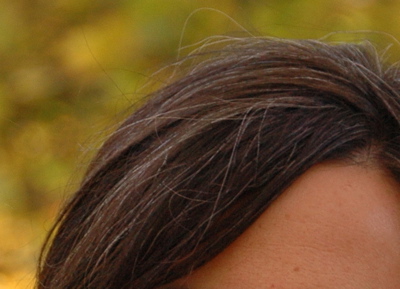
The first faction is myself as observer. Here’s what I see in the mirror every day, when my hair is dry. When it’s wet, it looks perfectly black and smooth.

Hair closeup

I actually kind of like it, except for the fly-aways (oh, what happened to the sleek, textureless hair of my 20s?), but I notice it. There’s no hiding it, even from myself.

The second faction is the woman who cuts my hair. The last time I got my haircut, she even… grimaced. “It’s time,” she said. I replied, trying to buy time: “Mmm, maybe next time.”

The third faction is made up of many people who, over the last few years, have said, every time they see me after a break of several weeks, “Wow, Jane, I’m just noticing that you’re getting a lot of grays.” Some have said, demurely, “silver.” Some, more truthfully, “white.”

A resistant faction, the practical me, doesn’t really want to start down that long, un-turn-backable path of coloring or foiling. If you have dark hair, that means maintenance visits every six to eight weeks to deal with the roots. Add the time for a haircut and blowdry, and that’s three hours at the salon! Not much of a self-pamperer, that makes me agitated just imagining it. There’s money on top of that.

Still, there is another faction — perhaps the über-faction — which is vanity, or audience internalized. Is my vanity in my hair remaining natural, or is my vanity in my person looking brighter or younger? I’m torn.

How do I proceed?

Step one, of a decision-making process, is, obviously, defining the problem or question, which I have done.

Step two is gathering information. Most of that information is in the hair photo, and what I know about the procedure and its costs.

Step three is seeking advice. I have turned directly to my reliable and thoughtful friends. Marcia appreciates the aesthetics of graying hair, but recommends her strategy, which is color now, and go gray at 50. Jan says she’s always liked dark hair with gray, but points out the annoying part of gray hair — the dry texture, its uncontrollability — and informs me that coloring takes care of that. Eli, although he is in the faction of people who have brought my gray hair to my attention — “Mom, your hair has a lot of white in it” — says, “Be your color.” From my friend James, with whom I talk about style of all kinds (writing, clothes, music, etc.), I received a measured response, full of examples, in which he recommends resisting pressure and doing what feels right, whatever that is: keep my gray hair if I like it or color it if that would be fun.

Those four answers contain factual and emotional information, but not a decision, which I guess is up to me. Damn.

Step four is taking more time to think about it. This isn’t surgery, so there’s no rush.

I could even put this one off forever.

—-

Digital hair closeup in daylight conditions — you can’t run, you can’t hide — by Eli.

– Slow down, you move too fast…

It is customary for Tom Cavanagh, the principal of the K-8 school in Brookline that Grace and Lydia attend and Eli graduated from, to begin his frequent e-letters to the school community with a quotation and a short thoughtful essay. This one hit my Inbox on a day in which I, and everyone who works with me in the writing center, had spent careening from tutorial to tutorial, task to task. The principal’s words spoke both to my conviction that everything we do in education is necessary and therefore hard to say “no” to, and to a hunch that we must allow ourselves a moment now and then to pause and take a breath. Please keep reading, courtesy of the man his students call, respectfully, “Mister Cavanagh.”

Chestnuts, a handful

—-

Season of mist and mellow fruitfulness!
Close bosom-friend of the maturing sun.

–John Keats, “To Autumn”

Several years ago, during a particularly hectic autumn, I was running from project to project and classroom to classroom. One afternoon I was racing up the stairs and as I came into the office, I told Mrs. Helen Hunt, my former secretary, that I wanted to quickly dictate a letter to her. As I waited impatiently in my office for her to come in, I made a quick phone call and shuffled some paper on my desk. When Mrs. Hunt came into my office and sat down, I immediately started dictating the letter. However, when I looked over at her, I realized that she was not taking the dictation. Instead she was staring serenely out the window seemingly in another world. Following her gaze, I looked out the window and saw that she was staring at the magisterial oak trees that canopy over my office.

“Aren’t the trees beautiful at this time of year?” she sighed.

“Yeah,” I said grudgingly and carried on with my dictation.

However, Mrs. Hunt was not quite ready to let go of the moment. She stood up and walked across to the window and said, “Come here, Tom.” Knowing it was useless to proceed with my agenda, I got up and stood next to her at the window. She pointed toward a small outgrowing maple tree on the knoll and pointed to the flame bushes that are outside Ms. Cherkerzian’s and Ms. Roses’s rooms, and she explained to me what each of them were. And then she walked over to the side window that points towards the Hoar Sanctuary and made me look at all the elms and oaks and maples blending in a colorful autumnal weave.

It was a lovely sight and I momentarily gave up my urge to get back to dictation. Finally sensing that she had my total attention, Mrs. Hunt said softly, “You know, Tom, it’s important to stop to see the beauty that’s around us and to really enjoy nature.” This incident was to me what is called a ‘teachable’ moment. And from that moment on I have tried — sometimes in vain — to remember to enjoy the extraordinary beauty that New England offers.

I share these thoughts with you because we are in the waning days of the most beautiful autumn of recent years. And, perhaps, many of you are like me: forced marching from one obligation to another and missing what is directly in front of our eyes. Below [in the principal’s letter] you will see a rapid-fire listing of various school events and programs. Many of them may make it on your calendar and you will find yourselves with more to do than time allows. Might I respectfully play the role of Mrs. Hunt and remind you not to let the seemingly interminable burdens of each day cause you to miss what’s in front of your very eyes. — Tom Cavanagh

—-

Today Eli and Lydia, at Arnold Arboretum, took turns with the camera, snapping shots to illustrate their principal’s essay, and occasionally posing for each other. The handful of horse chestnuts image, above, and the tree trunk & leaves picture, below, are by Eli.

Leaves, tree, shadows

– Master/Novice

Since writing the “Wide eyed” post on novices, I’ve been seeing references to newness everywhere.  (Is my unconscious attention looking for them?)

Shirin Neshat, a “visual artist who works primarily in video,” has produced a body of work — Passage (2001), for example — that has garnered prizes and earned permanent placement in the collections of the Guggenheim, the Whitney, and the British Museum (Collins 86).  Although such a project has risks, she’s at work on her first film-length project, an adaptation of a novel by Iranian writer Shahmush Parsipur.  Neshat tells interviewer Lauren Collins that she felt “compelled to make Women Without Men“:

“It got to a point that it was a biennial here, a biennial there,” she said… “I started to get really tired of it. I needed a project that would let me be alone, let me be a beginner again.  I wanted to hide from the art world.  There was a danger that I would lose persepective–the integrity, honesty, and naïveté being washed away.” She pounded her fist against her palm to illustrate a wave eroding the shore. (90)

Historian and cultural critic Jacques Barzun is about to turn 100.  His former student, Arthur Krystal, “first encountered” Barzun in 1970, when Krystal was 22 and a graduate student at Columbia where Barzun, then 62, was University Professor of History; in spite of many differences, the two “hit if off” (Krystal 100).  Remarking on Barzun’s reputation and many accomplishments, Krystal points out a quality in his now friend that differentiates his work, and his stance, from others’:

Barzun regards himself in many respects as an “amateur” (the Latin root, amator, means “lover”), someone who takes genuine pleasure in what he learns about.  More than any other historian of the past four generations, Barzun has stood for the seemingly contradictory ideas of scholarly rigor and unaffected enthusiasm. (94)

I see that my friend and colleague Jan Donley, a writer and teacher, has altered the title of her website’s page on teaching to call it “Learning.”  One of my favorite running conversations with Jan has been on the seeming contradiction of being inside and outside an experience at once.  We’ve talked, for example, about being present in a classroom moment while stepping outside it, so that one can deeply participate and get some perspective, simultaneously.  A kind of duality.  It’s hard, requiring a person to let go and remain steady at the same time.  Now I’m mulling over Jan’s suggestion that, to be a teacher (and a writer), one must be a learner, too.

Which reminds me of a conversation I had last Easter with my father, Stephen Kokernak, about students.  (He was a teacher, a more than good one, of high school math for almost four decades.)  I was venting to him and my sister Sally about how some of my freshman students were not stepping up to the plate: not doing the reading, not bringing the book or homework to class.  My father commiserated as a teacher, and also talked about his own habits in college.  Then he said (something like this): “You know, I think it wasn’t until I became teacher that I finally figured out how to be a student, when I had to learn how to learn.”

To be a master and a novice at once seems key for being a teacher, writer, filmmaker.  Does the inverse work?  To be a student — a learner — must there be opportunities for teaching?

—-

Sources:
Collins, Lauren.  “Voice of the Veil” (Shirin Neshat).  New Yorker, Oct. 22, 2007.  86-92.
Krystal, Arthur.  “Age of Reason” (Jacques Barzun).  New Yorker, Oct. 22, 2007. 94-103.

– This one goes to eleven.

At the end of the spring ’07 semester, my friend and colleague Lowry Pei and I were catching up and talking about some habits that should be basics for writing teachers. The next day Lowry suggested, by e-mail, that we generate a list. We opened a new Google document and became more purposeful. Our motivating idea was to (in LP’s words) “make the statements as direct and concrete as possible, make the list fit on (let’s say) a 3×5 card, hand it out: instant faculty development.” Soon, what started as a conversation became a deliberate collaboration; by the end of August, we had winnowed down and finished our compilation, and published it, simply, as a handout for faculty workshops.

And then we worked on it some more. Just a few days ago, to a broader audience, Tomorrow’s Professor published an expanded version of “11 Things You Could Start Doing Today for the Benefit of Your Students’ Writing.” May it be useful to you, if you teach.

– Oh, to draw!

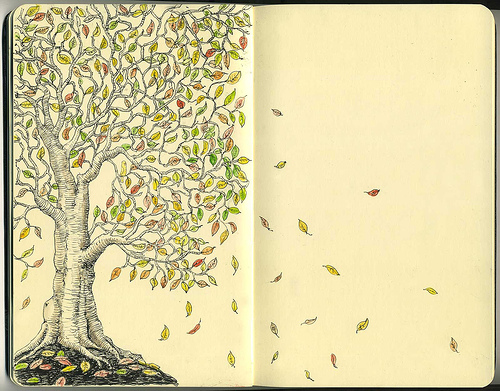
Today I’m wishing that my black notebooks — full of penciled words, notes to self, lists, names of books, phone numbers for contractors, half-baked ideas, found language, beginnings, and occasionally the pressed leaf of a plant I come across and want to remember — contained one thing as lovely as this:

“Autumn” by Mattias Adolfsson

“Autumn” by Mattias Adolfsson, http://mattiasa.blogspot.com

See more entrancing notebook images from various artists at the Moleskine Project. You might find yourself wishing my wish: to draw, and to do it well.

– Natatorium

At the pool where Grace swims, and where she learned to swim, I keep being mystified by the inscription that’s visible from the water and the gallery.

Three teaching obligations

“A parent is obligated to teach a child Torah, a trade and how to swim. Talmud, Kiddushin 29a.”

The first time I read it, years ago, I chuckled. What an unexpected combination: the Torah and “how to swim” in the same sentence? I have stared at and thought about the words many times. Now accustomed to them, I try to imagine a history in which the group of three represented the bedrock of a life: scripture, livelihood, and refreshment (or survival?). I’m not sure about the third thing.

Entering the Jewish community center yesterday, Grace said she’s disappointed in one aspect of the swim team: “They’re not teaching us anything.” What do you want them to teach you? “The side stroke,” she answered. Because she doesn’t know the side stroke yet, I guess that by “teach” she means “to introduce to something new.” Perhaps the new is what’s noticeable to her.

As I, however, sat on the bleachers on the pool deck and watched Grace swim with 24 other children, I marveled at the skill of the coach. He structures the hour; he gives directions; he explains the strokes as he demonstrates the moves with his own body; he repeats what he just said; he responds to questions; he encourages the swimmers to keep moving, moving, moving; he gives on-the-spot feedback like “Kick from the hip, not the knee”; he keeps order; and he walks the perimeter, offering encouragement: “Grace, that’s a beautiful stroke. Keep going. Move. Finish on the wall. Everyone, finish on the wall.”

That’s teaching in action. (And isn’t it a pleasure to watch others teach?) The swimmers practice what they know, become more deliberate, deepen their knowledge, and persist, lap after lap.

As I write this, I wonder, suddenly, if the third thing — “how to swim” — has to do with the teaching of the body. Teaching the Torah seems to be an intellectual and spiritual task. Teaching a trade has something to do with the practical. And learning how to swim is about conducting the self, the physical one, buoyantly and alone.
First arm upFour limbs in waterArm up, again

– Wide eyed

Girl raising hand, with enthusiasmAt a conference of developmental educators today, I learned something from one of the speakers. If a person is a novice — a student was given as the example — that person could be considered “unconsciously incompetent.” If a person is an expert — a professor was given as the example — that person could be considered “unconsciously competent.”

Not having heard this pairing of “unconscious” with variants of competence before, I looked them up in a web search. These phrases are used commonly, in more fields than higher education. (Laparoscopy is one.)

And while I do not want to be treated, should it ever come to that, by an inexperienced laparoscopist, I’ve always found it fun to be a novice, and to teach them. Not unconscious, not incompetent. More like conscious, and on our way to somewhere we haven’t yet reached.

– 4 a.m. and random

Grace woke up at 2:51 a.m., went to the bathroom, and said to me from the hall, “I can’t sleep.” I sat with her, and, proving that she can sleep, she was deep into it by a few minutes after 3. And I’m awake.

I tried to go back to sleep. First, I breathed and counted. Then I got up, went down to the living room, and picked up a book. I read a chapter. Then I started looking at my feet, as fascinated by them as an adolescent is. (Are we in an adolescent state when awake at night?) Then I noticed the camera where Lydia had left it, and I wondered if I could take pictures, even without my glasses on. I tried. I couldn’t really see too much in the viewfinder to aim for quality. All I could do was aim.

Feet at 4 a.m.Then I wondered: What if I accidentally took a “good” picture — would it count? Eventually, I would put my glasses back on, and be able to judge my own picture, choose it, crop it, sharpen it, etc., and then say it was good (or not) and all that would be part of what makes it good. However, what if I never put my glasses back on? What if I were blind? And then I started wondering if a person can be a photographer or watercolorist (some medium without a tactile-ness) if you cannot see. Could you be a musician if you cannot hear? Well, you probably could learn to take pictures and compose music and even play music — do the mechanical things. But, you couldn’t experience feedback: see and judge your own pictures, hear and judge your own playing. Could you, though, get some sort of human “guide dog” to give you the feedback, and teach you how to incorporate that feedback? And, if so, could you still be an artist? You’ll be distant from your own feedback — actually, it won’t be your own feedback; it’d be someone else’s.

But, what if you could tell that “guide dog” (or, “artist’s guide”?) what you wanted from your pictures or your music, and they could be trained, by you, to give you a kind of direction in your feedback that’s precisely what you want?

But, you could never test their feedback.

Chair at 4 a.m.What if you decided to trust that feedback giver, and abandon that urge to test, and relinquish those aspects of making something to your guide? (A guide that you, originally, guided?)

Now it’s after 5 and almost time for the house to wake up. You’ll understand if the pictures, and thoughts, are unfinished.

– Plants do what plants do.

These are rhizome and root bundles of the Christmas fern, and, having sat in the package for a few months, they are as dry as straw.

Fern rhizomes

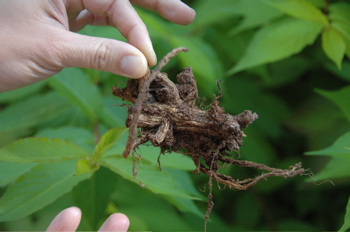
This is the parched rhizome of a bleeding heart.

Bleeding heart root

I have a few of each, packed in peat moss in plastic bags and waiting, on deck, in the garage. All the season-end gardening work, but for the laying down of some hay around the newly divided day lilies and hostas and the transplanted daphne, is done, and I feel restless to do some more. But not restless to buy some more. Why I didn’t plant these, when I bought them in early July, I’m not sure. The rhythms of summer gardening are different from the fall ones: There’s so much labor at the beginning that a person tires by late June and slows down. It was easy to buy these — that takes no energy — but I must have lost my momentum by the time I got home.

Summer gardening seems to fan out expansively in front of the gardener, and some leisure naturally occurs. I don’t fight that. Fall gardening has a deadline built in, and the cooler weather and shorter days motivate me — this happens naturally, too — to tidy things up and shepherd the plants into hibernation. I pause, once in a while, to look and enjoy, yet the pleasure is sharpened by my knowing that the display days are numbered.

At the moment I feel a little burst of energy to plant something, but not foolishly. There’s not much time for green foliage with moist roots to establish themselves out of the pot and in a new habitat. So, I’ll try these shriveled, woody packs of DNA, and I’ll see if some insulating dirt and a long, winter sleep will revive them, come spring.

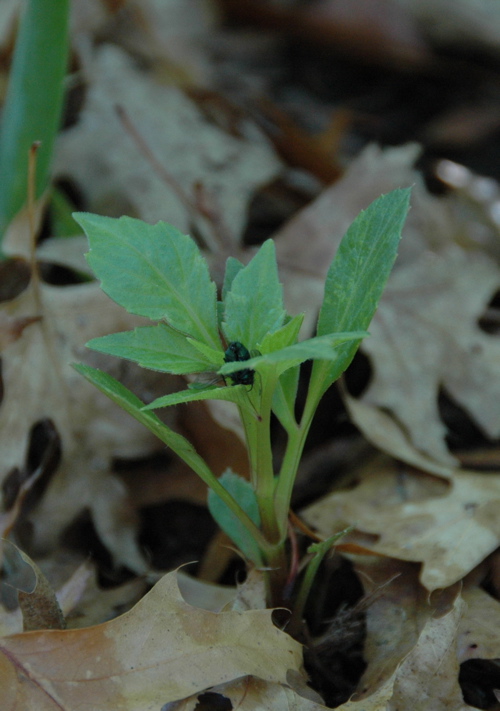
Dahlia surpriseIt could happen. Yearly, I am surprised when what are supposed to be annuals in zone 6 (greater Boston), like chrysanthemums, come back, after I’ve left them to decay and mulch. Once in a while, a stray dahlia, springing up from the leftover bit of tuber I must have left behind when I dug some out, pokes through. In fact, just today I noticed one emerging among fallen leaves. Doesn’t it know it’s October 14?

Guest photographer: Jimmy Guterman. Customarily our specialist in candid shots, today he agreed to photograph the standing still.