– Passalongs: from their houses, to mine

No one is required to give credit to the source of the plants in a yard, although those sources are likely numerous: previous owner of the home, local nursery, hardware chain’s garden department, botanical society’s annual sale, mail order catalog, and other gardens.

The offspring of plants from other gardens are called “passalongs.” In the purest sense, passalong describes plants that are difficult to find and purchase through the usual sources and therefore must be propagated from a piece of an existing plant in an established garden. Passalong Cover(See Bender & Rushing’s Passalong Plants for lively essays on these heirlooms.) Some gardeners use the term, simply, to describe plants divided and shared among friends and neighbors.
In my yard, I have thriving raspberry canes, clematis vines, hydrangea bush, and ajuga spreads that started from cuttings originated in other gardens. All of these plants are standards I could find at a nursery, but they’re dearer to me because as I tend them I feel, in a way, as if I’m tending my connection to their givers.

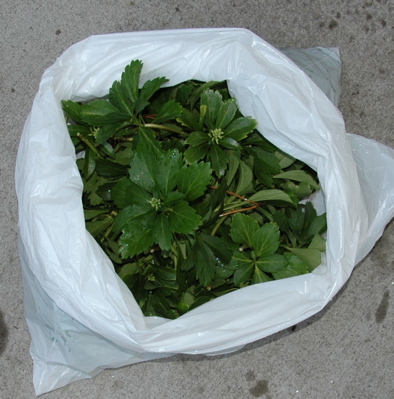
Last weekend, at my parents’ house, I deliberately harvested my own passalongs from their yard, 100 cuttings from a swath of pachysandra alongside their garage. Years ago I read, although I don’t recall where, that you can slice off the top few inches of a pachysandra stem, throw a whole bunch in a plastic bag, Pachy Greenhouseadd a cup of water, seal the bag, and then wait several days for the severed stems to root in this makeshift greenhouse. This project is motivated by a wish to transplant some growing thing from my parents’ yard to mine and also by a very blank space in an alley between my house and Bob & Mary’s fence.
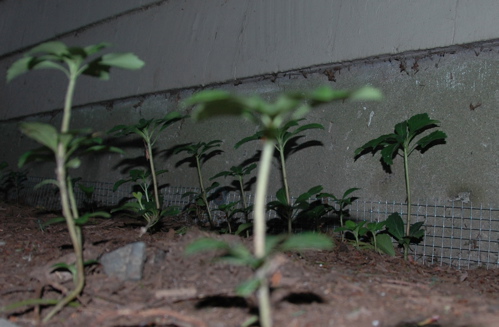
The blank space, in fact, was once filled by my own lush pachysandra patch, bought in an immense quantity in flats from Home Depot, and then planted one compact dirt-and-root cube at a time in soil enriched with dried manure and then mulched over. They lived quite nicely in their shady, neglected conditions, and probably would have ad infinitum if not for the “rodent intervention,” i.e., rat barrier, recommended and then installed by an “urban wildlife expert,” i.e., exterminator. In one afternoon, he and his partner, with a friendly Golden Lab keeping them company, dug up the pachys to get at the foundation, to which they tacked a long, foot-wide roll of wire mesh. Only a few stems Pachy Trees struggled back from leftover bits the following spring.
Will this experiment work? Will the cuttings root in their garbage bag greenhouse? Will this decimated pachysandra patch rise up and fill in? In a few weeks, I’ll know.
– Roam, if you want to

I’ve been going nowhere with a poem I’ve been trying to write, about, of all things, a dirty bar of soap, since this blog began. I had this vague idea about dirt as unavoidable, in a concrete way, of course, but also in a more figurative way, with “dirt” standing in for, um, global injustices. War, for example. The few lines I had put together felt wooden and unsurprising, as if I were assembling a puzzle from a picture on a box. In other words, I was stating the obvious even to myself.

Today I sat down to free write for 30 minutes. I did what my seven-year-old daughter, Grace, tells me to do when she asks for a story and I protest that I don’t have one to tell; she says, “Just say something. Then follow your words.” Her first grade teacher was on to something; this works. Don’t plan; just begin.

I began with the insistent image: dirty bar of soap. And then I meandered. I’ll share an excerpt from my travels:

Dirt dried in the grooves… Bar of soap is dried out, too. Old, unusable, like a piece of soap you’d find in a beach house in May, after many months of that house being closed for the fall, winter, and spring. The soap left in the metal dish in the stall shower, or outdoors in the shower attached to the back of the house and boxed in, for privacy, with fencing. The soap is so dried it has long cracks in it, as if wood. Wet it, and it takes a long moment to activate, to feel slippery in your hand. Slippery is something you’d read in a poem about sex, and this will be one about a dirty and dried bar of soap… Funny, dirty goes with sex. Sex goes with slippery, too, but slippery doesn’t really go with dirty. Dirty is gritty; I see that word and I feel grime in my hands, grit, fine sand, dust. A kind of dirty that starts with the soil, with particles, not with, say, the juice of dripping fruit that has dried on your hand, or chocolate…, or paint… Dirt is less processed a mess; it hasn’t been transformed into something else first before it gets on you, and you feel it.

It blows on, rubs on, sifts, floats down. It could be mud that later dries. It could then dissolve off, in the water of the tub, and then drain out along with. But still it wants to stay: it settles on the bottom of the tub, in a line of silt toward the drain, up high on the tub walls around the bubble line. To get rid of it, use more water. Spray with direction and force. Or find something clean, like a cloth or rag, to swipe at it, rub it down, rub it on to the cloth — transfer.

There is no getting rid of it, ever. Just as no energy is ever created or lost, neither is any dirt…

We collect dust, dirt. Even as we sweep it from the front hall out the front door, dirt from the garden or sidewalk is jumping onto sandals and riding back in.

We try to get it out, as far from the house as we can, by filling the sink or tub with water and soaking it off us. Water pulls some away from our skin… and delivers it down the pipes, under the yard, under the road, down to the parkway, through town via a network of pipes and pumps, to tanks, and back, somehow, to earth, dumped in cleaned loads onto hills, in rivers, on the banks. It creeps back. It creeps back always.

It remains too. Under our nails. In the corners of rooms. Along the thresholds of doors that open in from the outside. In the grooves between the worn floor boards. In the incised word “Dove” in this bar of soap. It’s in my hand; I pick it up, turning the tap. I clean you, child, with the dirty.

I like what I came across as I roamed: the words “transform” and “transfer” appearing in adjacent paragraphs, and the discovery that no dirt is ever created or lost. Dirt sloughs off; dirt creeps back; dirt remains.

– Found: two-line dialogue

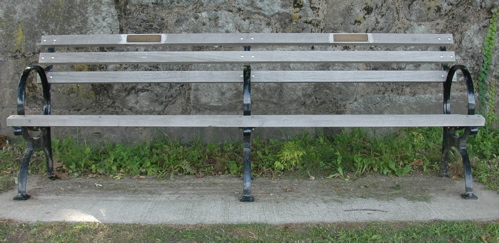
The Brookline Reservoir is ringed by a gravel path. Along the path are benches, on many of which are affixed small brass tribute plates, evidence of some past fundraiser, I guess. Most of the inscriptions are some version of this: In memory of Paul Smith. With love from Elaine, Mike, and Kim.

There are exceptions. One bench inscription says, “Don’t walk by.” That stopped me.

And then there’s the talking bench. Bench dialogueWell, it doesn’t actually burst into speech. However, one plaque has something to say to the other.

Read from the left…

“do you think they’ll sit down?” –Bobbi Davis

… to the right:

“yes, I hope so.” –Stan Davis

These few words, the punctuation, and the names suggest an entire relationship. I picture the ghost of Bobbi, the fun one, easily agitated, leaning forward and speaking emphatically to the ghost of Stan, mild, taking life as it comes, sitting back.

Think about how so many pairs of people you know — whether spouses, sisters, best friends, or characters in a favorite story — can be distilled into the particular lines that they play out over and over again. The cronies who made the gift to memorialize the Davises apparently knew these two well enough to choose and write down a couple of lines that could make strangers known to passers-by.

– Back story: essay on parenting

A few days after I met her, at my friend Pam’s 60th birthday party, I got an e-mail from Amy, who, with her husband, Marc, runs Equally Shared Parenting, a website that offers encouragement to and shares resources with parents who “have made (or wish to make) a conscious decision to share equally in the raising of their children, household chores, breadwinning, and time for recreation.” At the party, Jimmy and I had talked to Amy and Marc about our travails in this sphere.In her e-mail, Amy wrote “We enjoyed talking with you, and remember that you felt you were just about equal in the raising of your children,” and invited us to write an essay for their site.

I accepted.

And then I fretted for a day or two. Could I portray our life with children honestly, showing our ongoing yet imperfect attempts to share the work and the rewards, and still fit into the model that Amy and Marc’s project promotes?

I kept returning to that phrase “just about equal” from the e-mail invitation. That became a kind of mantra as I was writing. Those are three truthful words that describe both the shortcomings and the achievements of Jimmy and me as parents. And, even though I shaped the piece around one particular aspect of parenting, the emotional one, those three words — given to me, really, by the editor — motivated my work on the draft and revisions.

ESP published “Family Dance Party” in July.

– Notes: more than flotsam and jetsam?

Doctors take notes. Nurses. Therapists, especially during the first meeting. Journalists. (During the Q&A after his talk at the Wesleyan Writers Conference in June, George Packer remarked that “facing his notebooks,” each time he returns to his desk at home in NY after leaving Iraq, is “daunting.”)

Right now I’m reading the 16th in Peter Robinson’s Inspector Banks series, Piece of My Heart, and I’m reminded that note-taking is also a constant activity in the police procedural. Detective Inspector Chadwick interviews Rick Hayes, the promoter of a concert at which a young woman has been knifed to death. During the short scene, almost all of Chadwick’s gestures have to do with his notebook:

[He] dutifully made a note of the names after checking the spelling (21).

Chadwick scribbled something on his pad, shielding it from Hayes (21).

He made a note, and then looked directly at Hayes (23).

Chadwick jotted something down. He could tell that Hayes was craning his neck trying to read it, so he rested his hands over the words when he had finished (24).

Real detectives, and not just fictional ones, rely on their notebooks just as much as Chadwick does. In fact, they’re trained to use their notebooks. A few pages from the General Orders of the Hong Kong Police Force, Chapter 53: Police Notebooks (a neat find that turned up in a Google search) instruct officers in a method for keeping the daily notebook. This is an excerpt of just the items that caught my eye:

An officer will make a fresh entry in his notebook at the commencement of each duty shift, detailing the date, time and particulars of the duty allocated to him.

Notes shall be kept in chronological order and shall be made in indelible blue or black ink.

An officer shall write legibly. If any deletion, alteration or addition is made, a line shall be drawn through the original entry in such a manner that it remains legible and shall be signed by the officer concerned or the person whose statement is being recorded.

An officer shall not erase or attempt to erase any entry in his notebook.

An officer shall not remove from his notebook any page or any part thereof, unless he is in court and is expressly directed to do so by a judge or magistrate.

I took a look at some of my own notebooks from over the years, not really journals (I don’t reflect so much as capture) and yet not as complete and orderly as a police notebook should be. Still, I seem to have collected a lot of… evidence.

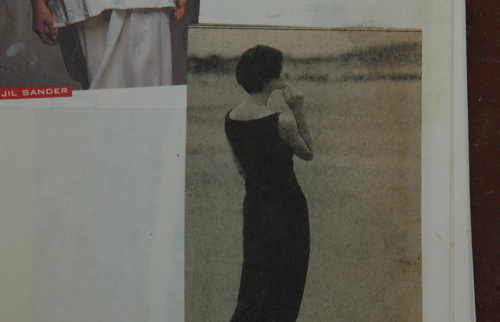
From the late 1980s, when I sewed a lot more than I do now, and therefore dreamed more of it, too, there is an entirely visual collection. I was constantly on the look-out then, when reading catalogs and magazines, for clothing shapes that attracted me. I used rubber cement to paste a lot of these items, like this one, into a small sketchbook.

Dress with long curve

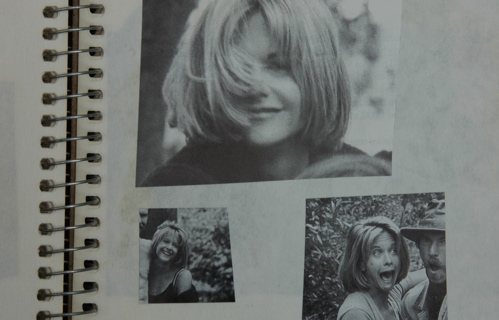
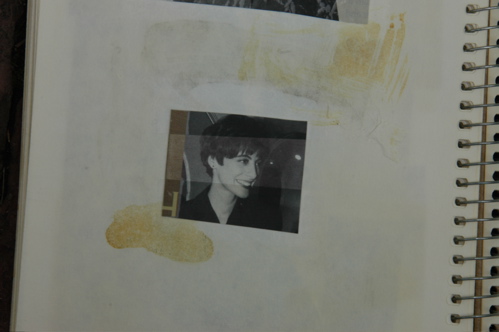
Around the same time, my friend Sybil and I were conducting an ongoing investigation into The Perfect Haircut. She had a manila envelope full of pictures sliced from news, celebrity, and women’s magazines; I kept a folder for ones under consideration. We occasionally traded pictures, and so some of mine ended up in her envelope and some of hers ended up pasted in the back of my clothing notebook. Here are two favorites (the first set is from a profile on Meg Ryan, actor; the second one shows just the head of Inez Someone, who was then a well-known French model):

Meg Ryan hair

Inez hair

All along, I’ve been keeping more notes than images. Most are traces of random thoughts, like this, from my notebook than spanned 1993-94:

Virtue. People are looking for virtue in the weirdest places. Exercising. Not eating (“I’m so good — I skipped dessert.”) Saving money. Hoarding vacation and sick days.

On the same page, after a few spaces, I scrawled a separate bit:

Privacy issue. Why are people so concerned about sharing their consumer and financial information and yet be so willing to talk about family problems and sex life w/ anyone who’ll listen?

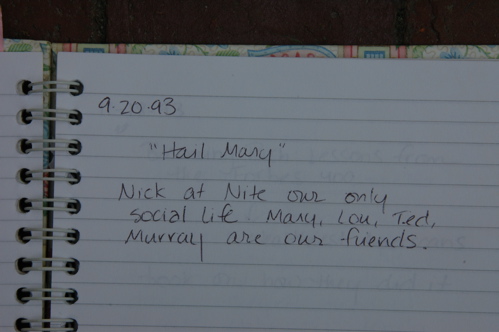
The entries are not all dated, but this one is:

Mary Tyler Moore show

(Over the years, other shows have supplied me with “friends”: Northern Exposure, ER, and, of course, Friends. )

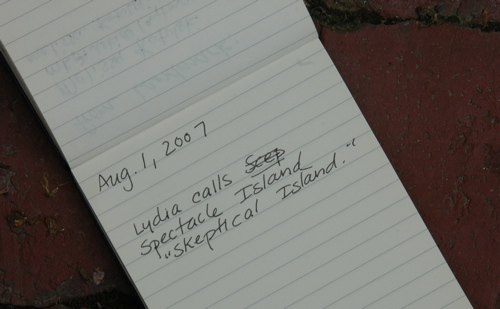
Yesterday I went with Lydia, her pal, and Toshika on a daytrip to three of the Boston Harbor Islands, sanctuaries that are less-visited parts of our city than, say, the Esplanade or the Public Gardens, perhaps because of the boat trip. I’ll argue that, because of the boat trip, as well as their scrappy, beachy beauty, the islands are a wonderful destination (and only ten dollars for an all-day boat ticket). I took one note, below. Will it help me remember yesterday, as all the above excerpts help me remember other yesterdays? Will it be useful to me somehow, someday?

Skeptical Island

There’s one thing I know from reading police detective novels, and from keeping my own hoard of scraps: You never know which bit, later, will emerge as a clue, as THE clue.

– Find your questions

Last week I attended some excellent professional development workshops at the Landmark School. Derek Pierce, the faculty member who taught “Teaching the Analytical Essay,” got us to do some of the writing exercises he uses with his high school students. I found the following one really fruitful, and I promise that it’s as useful for a poet, essayist, scholar, or novelist as it is for the student writer.

1. Take 20 minutes or so and write down 25 personal questions that occur to you. The task is to create or discover ones that are significant, provocative, idiosyncratic. Any question is valid. Try not to second guess yourself; keep writing. [Alternatively, you could take a few days and try to come up with 100 questions; Pierce does this with his students.] Questions generated by participants in our group were unique to each person: One fellow was curious about a dog’s sense of smell; an older woman landed on several concerns circling around loss. Here are a few of mine:

  • How can I find more time to work on my writing when I spend so much time helping others with theirs?
  • Why do I have to ruminate over everything?
  • Why do I prefer writing tutoring over classroom teaching?
  • What is the history of The Miseries, the two islands off the coast of Salem?

2. Go back to your long list of personal questions and underline three or four themes or patterns you notice. Here are mine:

  • my writing — fiction and poetry
  • teaching
  • time & energy — managing

3. Go back again to your long list of personal questions and circle the top five.

4. From the top five, write down the two questions you feel most interested and invested in answering. (You don’t have to know why; just feel it.) Here are mine:

  • What is the history of The Miseries?
  • Why is tutoring considered a lesser art than teaching?

5. Now, choose one question (it could be from the two; it could be from the original long list) that you think stands above all the others in its significance to you. Write it down. This is your Power Question. Here’s mine:

  • What is the history of The Miseries?

6. Take a moment and reflect, in a hundred or so words, why you chose the question. What could you discover about yourself in pursuing an answer to your Power Question?

I wrote this:

I just learned about these islands and their purpose — I was instantly intrigued: by the name, the function, and the possibilities for making something unexpected out of a slight, marginal thing. Islands — so close to the shore but so far — keeping what you want at a distance, but also perhaps keeping what you don’t want at a distance?

About the relevance of this writing exercise and the inquiries that come of it, Derek Pierce said: “Anything is researchable.”

– Right words, right time

Work continues on the revision of an essay that’s really important to me. It’s getting closer to coherence, meaning, and shape, but it’s not exactly… singing.

Sometimes you come across the words of wisdom from another writer, right when you need to read them. The weekly issue of the Grub Street e-mail newsletter hit my inbox, with this remark in the banner:

The story is always better than your ability to write it. My belief about this is that if you ever get to the point that you think you’ve done a story justice, you’re in the wrong business. ~Robin McKinley

Substitute “essay” for “story,” and this comforts me. Perhaps reaching for the essay (the vision of the essay?) is what makes the writing go.

And who is Robin McKinley? I don’t know. But his/her words make me want to know more.

– Frustration flowers

After frustrating telephone encounters with three people — spouse, friend, and contractor — I had a lot of energy looking for an outlet.

“I need some plants.” No premeditating, that’s what it came to.

So I went to our local nursery, Allandale Farm. Without much of a strategy, I grabbed several lantana, because I know them. Then I saw some dark purpley flowers whose petals were the same size as the plant’s green leaves, near a table tent that was lettered “Shade Plants,” and I took those. The tag in the pot calls them “torenia.” I nostalgically bought some coleus, remembering how, at age eight, we grew them under the tutelage of our third grade teacher, Mrs. Doyle, who showed us how to pinch back a leaf, so that two would grow in its place.

I nestled them together at the edge of the driveway, near a bare patch in a perennial border and a surplus bag of pine spruce mulch:

Frustration Flowers

This was a few days ago. I haven’t put the annuals in the ground yet. I like looking at the possibility that they represent; I haven’t diminished their lovely cluster by digging them separately into the dirt.

Is this a tale about how a person can take anger and turn it into beauty? No. The point is that anger and frustration are urges that need a place to go and something to do. Another person might take an ax and split wood; I can picture one of my sisters throwing herself into a cleaning fury. A screamer would scream. You might write.

– Beginning with a few details

The details get me started.

At a community garden I see a variety of baptisia, or wild indigo, and have to get one and find a patch for it. In the tub, after a child has sat on the edge and washed her feet, I notice a dirty bar of Dove soap; the words “dirty bar of soap” seem to leap into consciousness and clamor. They seed a poem, currently in progress.

I like compact words and their solid sounds. “Leaf,” “stitch,” and “word” are multi-purpose, with many meanings and applications each, and, because I’m practical, I like that. All function as nouns and verbs, too. These words are enough to capture something about me and launch this project.

Because I spend more time writing, professionally and personally, than I do gardening or sewing, this blog will be more about the composition of words than it will be about gardens and garments. Do you see how all three — leaf, stitch, and word — are components of books? Still, doing one kind of physical and creative labor links to doing another kind. My consternation with the spring garden, for example, reminds me of my uneasiness with a shapeless, thin draft. I’m sure I’ll write in a way that unveils these intersections.

The challenge of what to do with my materials keeps me going. So a blog begins, with the merest of pieces: title, thumbnail, statement, and a first post. Already, the question “what to do next with three five-cent words?” provokes me.