– From one, many

Still not ready to face the empty space in my backyard, even though there’s a small assembly of shrubs and groundcovers standing in line and waiting to be planted, I put the gloves and the old shoes on yesterday and headed out anyway. There is (now, was) a clump of irises in the front that could stand dividing.

I have more been a planter and tender than propagator, and aside from splitting up some hostas, my experience making two or more plants from one is slim indeed. I turned to the web for guidance, and I found instructions, with pictures (even better), by Todd Meier at Fine Gardening magazine.

After about an hour of loosening and then prying the clump from the ground, slicing the rhizomes, untangling the hairy roots, and clipping back the greenery to a third so that each cluster of leaves had rhizomes and roots, I found myself with 26 “new” irises to plant. 26 New IrisesI counted and photographed them, then stacked them on the board I cut them on. A neighbor walked by with her dog. “What are those, onions?”
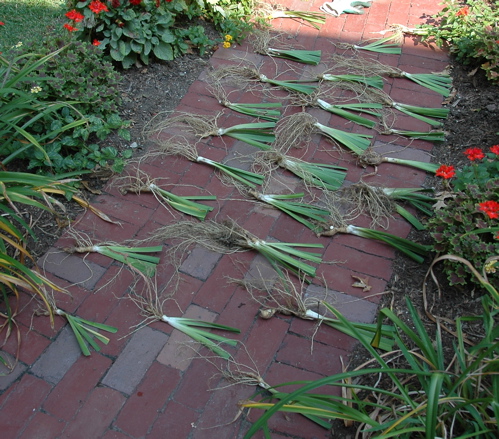
“Nope. Irises. I just dug them up and divided them.”

She has seen me work in the yard many times before; I wonder if dog walkers hold all the lore in the neighborhood. “You seem so knowledgeable.”

“Not really. I had to go on the web and find instructions how to do this, and it was pretty easy.” Besides, she’s a doctor and high up in the commonwealth’s public health department, keeping us all immunized, responding to epidemics and other threats. That seems like knowledge, to me. What I’m doing seems like the careful following of instructions.

“Oh, still,” she says. The dog leads her away. I go back to the task.

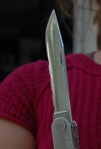
At least 15 years ago, I consulted with a counselor at Radcliffe Career Services. Before the appointment, I had filled out a bunch of questionnaires and completed the Myers-Briggs. Knife iconOne exercise was to make, simply, a list of 20 activities I enjoyed. High up on my list was “cutting things,” along with, of course, writing, drinking coffee, and knitting. The counselor was perplexed: “What are we supposed to do with this, ‘cutting things’?” I replied that I didn’t know; it was her exercise, not mine. She had a good nature and laughed. And, even though I have failed, since then, to find a job involving all of the top 10 items on that list, it remains true that any activity involving a knife or sharp scissors is a good one, according to me.
– Blank page fear

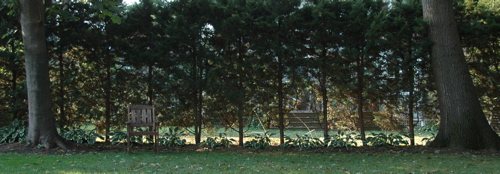
This is the view from my kitchen window. Besides the neighbor’s row of junipers and our drooping hostas, this is the least planted spot in the yard. In the eight years we’ve lived here, since we took down a rotted white picket fence along the back and dug out clots of brush, I’ve stood at the sink and looked and looked and looked at this empty space. Blank space with chairI can’t say that I’ve spent much time imagining what I would plant there; it’s been mostly a focal point for daydreaming about other things. Once in a while, I’ve moved the chair or a bench into view, just to alter the scene a bit. Suddenly, recently, I tired of an empty that’s too empty, and I decided to plant.

Days later, in front of the outdoor cashier booth at the Dennis Agway, with shrubs and ground covers in a wagon behind me and Jimmy having gone to get the car, I said to the woman behind the counter and to Bob who advised me on the plants, “I’m hesitating. I… I have this blank space in my yard and I think I’m afraid to plant it.”

She nods. “Oh, yeah.”

Bob, who I’ve discovered is a retired social studies teacher and now full-time gardener, says, “We all feel it.”

“You just have to put something in the ground.”Half Face 2

“Dig it in.”

“Yeah. Hey? See what happens.”

We all seem resigned to this, and nod at each other. I sign my credit card receipt; Bob wheels the plants out to the car; and I’m on my way.

– Eat the green

Backyard farmers have been harvesting ripe, yielding-to-the-touch tomatoes for a few weeks now. There are still plenty of greenish ones on the vine or a kitchen windowsill, hanging out there, awaiting more sun and their own readiness. Some will ripen; some will not.

The gardener, and the eater too, seek the ideal — a ripe, tart and sweet, dripping tomato that matches the memory of a tomato enjoyed, sliced and salted on a plate, in the shady backyard of youth. Waiting for it, they miss today’s chance to eat something very delicious indeed.

Last year, after school started and summer segued into fall, my neighbor Susan gave up on the last of her tomato plants and handed a cache of the stubborn green ones to me. In August, I had eaten a tastebud-altering fried green tomato BLT at a cafe in Oak Bluffs, Martha’s Vineyard. Wanting to replicate the meal, I leafed through cookbooks in the house. In the index of Mark Bittman’s How to Cook Everything, under “Tomato(es),” I discovered two for “green”: pan-fried, and salsa.

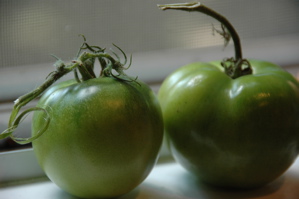
Green tomatoesAbout the green tomato salsa, Jimmy said, “This is one of the ten best things I have eaten in my life.” The kids and my friend Julie and I sat around the kitchen table in the afternoon with tortilla chips and, when they were gone, spoons, and ate it all. Last week, after fruitlessly searching for unripe tomatoes at the Newton Farmers’ Market, my friend Pam gave me the only one she had. Later, I called Susan, who was such a reliable supplier last summer, and cadged another one. From that tiny yield, I fried enough for two BLTs, and a little extra taste for the cook.

Resist perfectionism: Stop thinking of those green tomatoes on overgrown, leggy vines as works in progress. Pick them; prepare and eat them. Recipes are here. The experience might make you wonder, as Jimmy did as we cleaned up the sandwich mess, “What does ‘done’ mean?”

[Photo credit: Eli Guterman.]

– What it takes to unmake

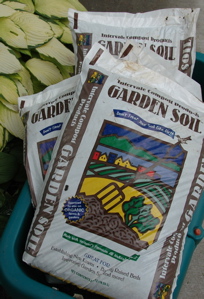
On Sunday, I bought dirt, four heavy bags of it. Dirt(Why are dirt and mulch packed wet inside their bags, turning 10 pounds of organic matter into 40 pounds? Seeing that there is no “life” to dirt or mulch — in fact, that it is dead and decomposing matter is kind of the point — the moisture seems a frill, a cosmetic enhancement of sorts.) Wanting to be my own woman, and not appear to be flirting with the outdoorsy, interestingly-tattoed guy at Allandale, I rejected his offer of help with the dirt. As soon as I got the first sack of it perched on my shoulder to carry it across the gravel parking lot to my car, I regretted my unproductive pride. It hurts to be my age and carry that much dirt. Four times. When I reached home, I tiptoed into Bob & Mary’s fenced yard and borrowed a child’s play wagon to cart it from the driveway around to the back.

Last week I offered Eli and his pal Arthur $50 each, plus lunch from Domino’s, to take down our old, metal swingset. Shortly after we bought and installed it, in 1999, the company went out of business. So, over the years, as parts broke, we just removed them, leaving an empty space where, e.g., the gondola once was. In June, one of the young guys who cuts our lawn was chasing his coworker around on a power mower and crashed into the swingset, permanently crimping one of the support legs. Although I pleasantly brought this infraction to the attention of the landscape company owner, it felt pushy to demand redress, seeing that Jimmy and I had known for a while anyway that the swingset was on its last leg and that we would have to dismantle it soon.

While adults are gearing up for fall and back-to-school tasks, children are at loose ends: Camp has ended, family vacation has been endured, and hanging around has lost its June flavor. This, to me, is a perfect time for chores, and only recently did it occur to me that my children are old enough to tackle big ones, Eli puts his back into it.the kinds you might think of hiring someone for: painting, digging, purging, and heavy lifting.

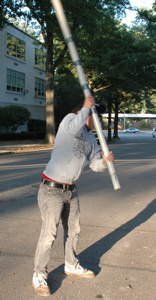
It took two fourteen-year-old boys — the Demolition Department — two days to take down the swingset. On day one they dug the legs out of the ground and disconnected them from the anchors, and on day two they unbolted all the pieces. They worked unsupervised, figuring out the tools and the problems as they went. A hammer and a couple of wrenches were all they needed until the end, when rusted-together sections of the main horizontal crossbar resisted their muscle power. I brought out a hacksaw, and then a power saw. Thirty minutes of application yielded only some shallow grooves in the metal. They put their heads together, ignored common sense, and took turns standing the 12 foot pipe on its end and then letting it go so that it would crash against an old maple. This loosened the rust, but not enough. When last I looked, Eli and Arthur were standing in the road, with the pipe on its end, getting read to let it go onto the pavement. “Boys,” I thought, and left them to their own devices. It worked.

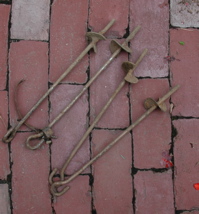
Four anchorsMy bargain with them did not require them to dig up the swing anchors and patch the holes. That task fell to me, but it’s the kind of thing I like to do anyway. The first of the four anchors was a struggle, because I was still working out my removal method: digging around it, cutting tree roots, prying out stones, and shimmying it while unscrewing. Only in extracting all four from the ground did I become confident in how safe they make a swingset. There really was no way the back-and-forth of a swinger would ever have gathered enough force to jerk them out of the ground. And now they’re out, unmoored and, like old teeth, their usefulness used up, so we’ll throw them out.

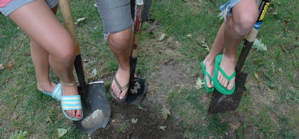
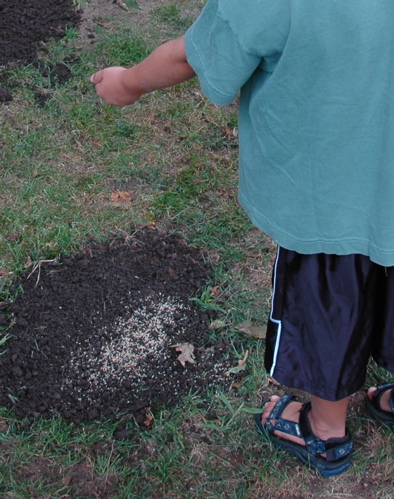
The Girl Squad — Lydia, Mary, and Carolina — were talked into spading up the dirt in the packed down ruts as I harvested all the loose stones and put them into a little rain ditch I’m making under a downspout. Girl SquadThey went on to bigger and better things (surfing videos on Youtube) while I emptied and spread the dirt. Another helper, five-year-old George, joined me just when it was time to spread some grass seed, and I showed him how to sprinkle the seed and then spray with water. I asked George how long he thinks it’ll take before the grass seed sprouts; he paused, and answered seriously, “About seven days.”

Helper and circleRight now there are seven neat, dark circles of dirt and a newly open space in the backyard. Many hours of effort of seven human beings went into undoing a structure that took two men (Jimmy and my father) a whole day to construct. There were costs as well: $120 labor ($50 x 2 teenagers + 20% tip); $21.85 (Domino’s pizza order + $3 tip); and $25.96 ($6.69 x 4 bags dirt). Total: $167.81.

And these are how our late summer days go.

– Passalongs: from their houses, to mine

No one is required to give credit to the source of the plants in a yard, although those sources are likely numerous: previous owner of the home, local nursery, hardware chain’s garden department, botanical society’s annual sale, mail order catalog, and other gardens.

The offspring of plants from other gardens are called “passalongs.” In the purest sense, passalong describes plants that are difficult to find and purchase through the usual sources and therefore must be propagated from a piece of an existing plant in an established garden. Passalong Cover(See Bender & Rushing’s Passalong Plants for lively essays on these heirlooms.) Some gardeners use the term, simply, to describe plants divided and shared among friends and neighbors.

In my yard, I have thriving raspberry canes, clematis vines, hydrangea bush, and ajuga spreads that started from cuttings originated in other gardens. All of these plants are standards I could find at a nursery, but they’re dearer to me because as I tend them I feel, in a way, as if I’m tending my connection to their givers.

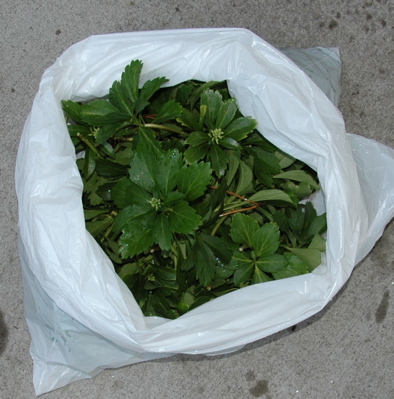
Last weekend, at my parents’ house, I deliberately harvested my own passalongs from their yard, 100 cuttings from a swath of pachysandra alongside their garage. Years ago I read, although I don’t recall where, that you can slice off the top few inches of a pachysandra stem, throw a whole bunch in a plastic bag, Pachy Greenhouseadd a cup of water, seal the bag, and then wait several days for the severed stems to root in this makeshift greenhouse. This project is motivated by a wish to transplant some growing thing from my parents’ yard to mine and also by a very blank space in an alley between my house and Bob & Mary’s fence.

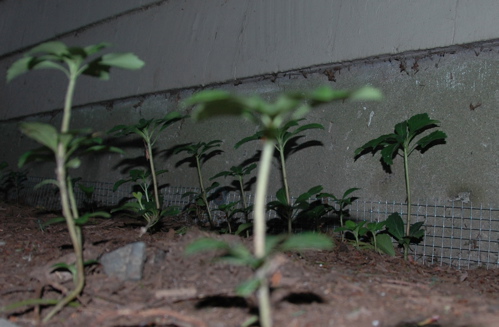
The blank space, in fact, was once filled by my own lush pachysandra patch, bought in an immense quantity in flats from Home Depot, and then planted one compact dirt-and-root cube at a time in soil enriched with dried manure and then mulched over. They lived quite nicely in their shady, neglected conditions, and probably would have ad infinitum if not for the “rodent intervention,” i.e., rat barrier, recommended and then installed by an “urban wildlife expert,” i.e., exterminator. In one afternoon, he and his partner, with a friendly Golden Lab keeping them company, dug up the pachys to get at the foundation, to which they tacked a long, foot-wide roll of wire mesh. Only a few stems Pachy Trees struggled back from leftover bits the following spring.

Will this experiment work? Will the cuttings root in their garbage bag greenhouse? Will this decimated pachysandra patch rise up and fill in? In a few weeks, I’ll know.

– Frustration flowers

After frustrating telephone encounters with three people — spouse, friend, and contractor — I had a lot of energy looking for an outlet.

“I need some plants.” No premeditating, that’s what it came to.

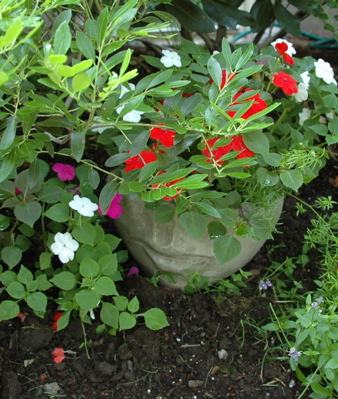
So I went to our local nursery, Allandale Farm. Without much of a strategy, I grabbed several lantana, because I know them. Then I saw some dark purpley flowers whose petals were the same size as the plant’s green leaves, near a table tent that was lettered “Shade Plants,” and I took those. The tag in the pot calls them “torenia.” I nostalgically bought some coleus, remembering how, at age eight, we grew them under the tutelage of our third grade teacher, Mrs. Doyle, who showed us how to pinch back a leaf, so that two would grow in its place.

I nestled them together at the edge of the driveway, near a bare patch in a perennial border and a surplus bag of pine spruce mulch:

Frustration Flowers

This was a few days ago. I haven’t put the annuals in the ground yet. I like looking at the possibility that they represent; I haven’t diminished their lovely cluster by digging them separately into the dirt.

Is this a tale about how a person can take anger and turn it into beauty? No. The point is that anger and frustration are urges that need a place to go and something to do. Another person might take an ax and split wood; I can picture one of my sisters throwing herself into a cleaning fury. A screamer would scream. You might write.

– Beginning with a few details

The details get me started.

At a community garden I see a variety of baptisia, or wild indigo, and have to get one and find a patch for it. In the tub, after a child has sat on the edge and washed her feet, I notice a dirty bar of Dove soap; the words “dirty bar of soap” seem to leap into consciousness and clamor. They seed a poem, currently in progress.

I like compact words and their solid sounds. “Leaf,” “stitch,” and “word” are multi-purpose, with many meanings and applications each, and, because I’m practical, I like that. All function as nouns and verbs, too. These words are enough to capture something about me and launch this project.

Because I spend more time writing, professionally and personally, than I do gardening or sewing, this blog will be more about the composition of words than it will be about gardens and garments. Do you see how all three — leaf, stitch, and word — are components of books? Still, doing one kind of physical and creative labor links to doing another kind. My consternation with the spring garden, for example, reminds me of my uneasiness with a shapeless, thin draft. I’m sure I’ll write in a way that unveils these intersections.

The challenge of what to do with my materials keeps me going. So a blog begins, with the merest of pieces: title, thumbnail, statement, and a first post. Already, the question “what to do next with three five-cent words?” provokes me.