– Secret room dreams

I share an office with a few other writing teachers.  One of my office mates, T., recently told me about her adventures in flower pressing, and she gave me some petals.  Once curled and shaped, they are now paper thin and flat.

The pressed petals remind me of the bright, fallen, and wilted geranium petals on the floor of my room at Wellspring House, where I was in July for a week.  The boards of the floor were painted gray, and when I walked in the room I saw a scatter of droplets — pink, with white edges — under the window.  At first, without really thinking I thought they were painted fingernails.  Then on the wide sill I noticed the clay pot, the green furred and scalloped leaves.

There are geranium pots on our front steps at home, and these too, like T’s petals, remind me of my solitary and spare room at Wellspring.
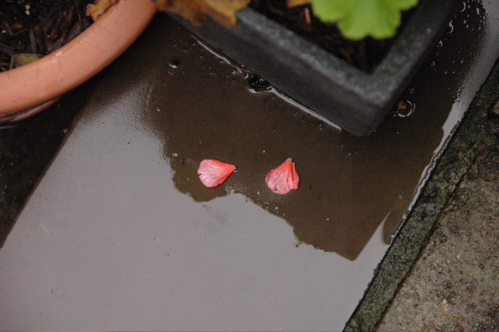
Petals, on steps after rain.

Petals, on steps after rain.

Thoughts of that room prompt memories of other loved rooms, especially two more: a dorm room, an office.  What do they have in common?  Why these three, and not so many others?

I make a diagram.  (Later Lydia sees it and asks, incredulous, “You made a Venn diagram because you were bored?”  I answer, “I made a Venn diagram because I was trying to figure something out.”  She laughs kindly.)

Each room had its own wonderful qualities.  The dorm room: a big closet and a typewriter.  The office: a view into the greenhouse behind the Isabella Stewart Gardner Museum.  The room at Wellspring was named after Emily Dickinson, and then there were the petals decorating the floor and catching my eye.

They shared some features too, and it must be these that cause me to consider them as a trio.  All three had a desk & chair, shelves, and a mirror.  They were intended for solo use, although I recall guests in each one.
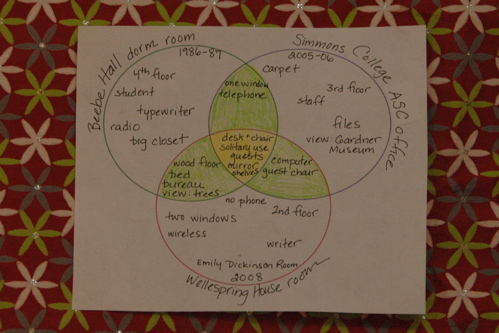
"Three Rooms" by J. Kokernak (Venn diagram)

"Three Rooms," by J. Kokernak, 2008.

I am ruminating over the importance of these concrete details and what they mean now.  Each memory’s connection to my present life (and not my then student, staff, or retreater’s life) is what concerns me.

This exercise on the three rooms reminds me, too, of theme dreams (i.e., ones that recur).  Mine are about secret rooms.  In these dreams, I walk through a house I’ve lived in and find a door that I’ve never noticed before.  I open it, and inside is a room that presents an opportunity to me (space, activity, style), and sometimes to the people I live with.  Sometimes in one of my secret room dreams, I try to get another person’s attention: “Look, look at this!  The room we’ve been wanting!”  Sometimes in one of my secret room dreams, I close the door and keep its existence to myself.

About a dreamed secret room, Gillian Holloway, in The Complete Dream Book, claims that “This room has great possibilities… and represents a neglected potential in the dreamer’s life that the deeper mind is trying to reclaim” (155).

Are the three remembered rooms like secret dream rooms?  There seems to be some bounty there.

– Bodies are weird

These few lines are from a conversation that Jimmy and I had in our upstairs hallway this morning.  It happened to be about menstruation, but it just as easily could have been about sex, psychopharmacology, or even double-jointedness.

Jimmy: Bodies are weird.

Jane: That may be because we think of them weirdly.

Jimmy: And that would be because of our bodies.

Touché.

And speaking of bodies…

“Tethered to the Body,” an essay on my adjustment to wearing an insulin pump and its affect on my sense of (sexual) self, appears in the fall 2008 issue of Bellevue Literary Review. The full version is not online.  You can get the journal at bookstores, or you can e-mail me and I’ll send you a PDF.  In the meantime, here’s the first paragraph:

A $6,000 insulin pump with an on-board computer chip is not alluring.  Neither is the white mesh adhesive patch on my naked abdomen or the length of nylon tubing that connects the patch to the pump.  There is only illness, and there is no way to make that sexy.  After several years as a medical device wearer, I know.

– 100% me

Sunday night dinner. We’re all home. Chicken, salad, corn on the cob.

Jane: Who has homework?

Lydia: I have to write a poem.

Jane: About what?

Eli: It’s not about “anything.” That’s what all the seventh grade poems are about.

Lydia: It’s a one hundred percent me poem.

Jane: You’re a good poet.

Dinner ends; an hour passes. I return to the kitchen, and I see Lydia’s homework stack on the table. On the top, a poem.

100% Me Poem

I pick it up. Lydia’s there and lets me read it: part of her is this, part of her is that, and so on adding up to 100 percent. Under the poem, I see another piece of paper, a form that looks very teacherly, and which Lydia has thoroughly filled out.

100% Me Poem Rubric

Is it possible to score poorly on the 100% Me Poem, and get a… 60% ? Then, would a 12-year-old writer think that her self, and not her poem, was only a portion of what she thought was entire?

I like Lydia’s poem. I don’t love the rubric.

– Considering toast

Toast, from toastalicious.com

Toast, from toastalicious.com

I was thinking of a croissant with my coffee, but then I smelled toast. “Ah, toast.” This was as I got within 20 feet of the snack bar in my building at 9am this morning. I gave in to the toast impulse — I smelled it, I pictured it, I heard the sound of the word in my head — and it seemed foolish to get what I suddenly no longer wanted.

At my desk, I ate the toast. I drank water and sipped coffee but did not look at papers or compute while eating. I stared at the wall; I thought about toast.

Henry James said that “summer afternoon” are two of the most beautiful words in the English language. I cannot disagree. Yet, I’d like to add “toast” to a short list of beautiful, evocative words. Dr. Poppy, in her response to my post on snacks, reminded me of its sensuality and charm: “simple but… sustaining.”

And yet, I was thinking as I ate my toast, do writers always use toast as a detail to convey the same feeling? Is toast a cliché? Would it be possible to ruin toast for a reader, or at least subvert it?

Examples:

At the last minute, she put toast under the pillow. All night, her hand worried it and not the hardened blisters on her wrist.

Their naked bodies pressed together, only Donna’s toast came between them: scratchy, buttery, and smelling of last night’s onions.

Before he tucked the dead squirrel into the shoe box and interred it behind the dog house, Little Guy lay freshly made white toast in the box’s bottom. The toast’s firmness supported the stiff body; a smear of blood seeped into the surface crumbs.

The doctor recommended toast in the sneakers overnight, to deodorize them. “And soak those feet in vinegar, twice a day,” he added. Joe would try anything.

Would the reverse also work? Could you take a noun with negative associations attached to it — like pus or viscera — and make it lovely?

Hmm. It seems easier to try to ruin something than it is to repair or beautify something else.

– Walk into the dark

This excerpt is from a ruminative and sparkling post by writer and teacher Alexander Chee on today’s Koreanish:

Part of what is interesting to me about writing is how writing is a social act—a performance for others, a way to connect that has not one guarantee to it. You write and you don’t know that anyone will ever read it or care. You have to proceed in line after line, like someone descending a stairway towards an unknown space below and past an unknown number of stairs also. It may even be an eternal descent until death. You don’t know how much you’ll have to write before you begin to connect to others—that is the crisis of the student writer, for example, but all writers, I think, recognize that crisis as simply a student writer’s introduction to the idea that they could write for their whole lives and never succeed, and they won’t know, even if they write.

You are basically asking them to walk into the dark and trust that they’ll meet someone there. Someone to whom they’ll entrust all of this work. Most of the time you never say this to them because it is a terrible thing to encounter and everyone makes their own peace with it.

– Future professor

I offered to drop Eli off at school on my way into Cambridge this morning. As we got closer to the high school, right around the time of the first bell, activity intensified: cars, bikes, crossing guards, pedestrians, teens, teachers. As we were stopped at an intersection, a student crossed it diagonally. Tall, slight, curly-haired, and hunched under the weight of his pack, he continuously blinked, grimaced, and adjusted his head on his neck as he made his way across, as though the sun and the concrete world were just too much for him and intruded on his private musings.

“Look at that funny kid,” I said to Eli, and I pointed.

“Yeah, I noticed him,” he replied.

“Someday he’s going to be one of those absent-minded professors,” I said.

Eli paused. He smiled. “And yet, his students won’t not like him.”

I knew what he meant. “He’ll be both. You’re right.”

And on my way to work, alone in the car, I thought about being a student and, along with my friends, loving our funny, weird, and quirky teachers and, as a way to show how much we had studied the objects of our affection, performing for each other our elaborate impersonations of the well-loved teachers’ mannerisms. We would laugh, and the laughter was never mean-spirited. It was gleeful, buoyant, and conveyed recognition. And I dare say the impersonations and laughter knit us together, too.

– Best brief bio

Yes, I do read the “Contributors” section of magazines and journals and study the array of author and artist credentials, which are always publications, prizes, occupations, affiliations, and educations. Here’s one that stands out from all that:

FELIX SOCKWELL is a designer and illustrator living in Maplewood, New Jersey. The illustration on the cover of this magazine, “Truth Seeker,” is a piece that he has been developing, redeveloping, and agonizing over for fourteen years.

From Poetry, September 2008.

– Mending (a life)

Hem pants. Replace buttons. Re-hang shelves and pictures. Fix holes in screens. Weed garden. (Ignore crabgrass.) Deadhead annuals. Scrub enamel sink. Re-plant pachysandra bed. Adjust bike seats. Touch up dinged paint in hall. Oil squeaking hinge. Darn moth holes in favorite sweater, black. Launder curtains, and vacuum louvered blinds. Prune files. Treat stains.  Find missing pieces. Sweep up glass, and — band-aid solution — cover broken pane with a cardboard rectangle. Proofread the syllabus, the assignment, the handout. Adjust temperature. Change sheets. Plane doors. Bring broken chairs to Manny; wait two weeks; pick up chairs from Manny. Glue tiny porcelain arm to tiny porcelain shoulder.

Take old desk and make it new.

Take old desk and make it new.

So much of time seems filled with repairing, maintaining, and renewing what’s already been done.  The moments of decision and creation — when life is composed — are few.

– I am Sarah Palin

When I was in college, at one of the Seven Sisters in the mid-1980s, meals were served in the dormitories by kitchen staff who were longtime employees of the college. This was before the big contractors, like Aramark, took over dining services everywhere. We knew our cook, Charlie his name was, and dinners were like dinner parties. We enjoyed what we ate, and we lingered over the table for hours. Sometimes I sat with a group, and sometimes I sat where there was an empty seat. It was easy to know everyone; there were maybe 150 residents in my dorm, Beebe Hall.

Because the nights were so similar to each other, they generally blur in my memory into one big mealtime. One night, though, when I was a freshman, I was sitting with Andrea, a junior from New Jersey. I don’t recall what I was telling her, but I was talking, and at the same time she was finishing dessert and licking her spoon: licking the bowl, licking the back, dipping it into the melted ice cream again, licking and licking.

She paused in her licking and listening and she interrupted me: “You know what’s a shame?”

“What?” I asked back.

“No matter that you’re here, no matter how smart you are, no matter how much education you get, people are always going to think you’re ignorant.”

What does one say in reply? I burned with sudden shame. “Um… why?” I stammered. Continue reading

– Last beach day

August 31, 2008.  Cold Storage Beach, East Dennis.

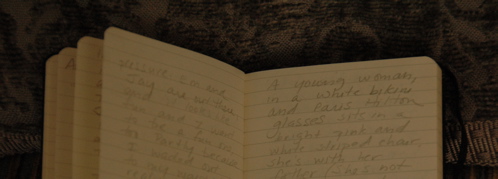
Pages from August 31st notes

Pages from August 31st notes

Verbatim:

“It’s Michael Krantz’s birthday,” Jimmy says when I ask him the date.

The family near us has a boy about Grace’s age with the same insulin pump as mine.  I talk to the mother.  Among many interesting things, she tells me about Cheating Destiny, and parts about history of insulin.  At some point we talk about my parents’ crying when my brother was diagnosed, and the boy says, “I have seen my mother cry four times.”  He grins and adds, “And it was because of me.”

Two families away there’s a guy my age who is fit, who knows it, who wears dark yellow trunks and, over his nape-length curly graying hair, a navy blue bandana tied pirate style.  He’s reading a hard-covered book called God of Sex, I think, although all I can see on the black cover are the big words “God” and “Sex” — I filled in the preposition — and he holds a fluorescent yellow highlighter.  His lady friend (no ring) is blond and wears a yellow bikini.  They are listening to Jack Johnson. It’s loud, which drew my attention to them.  That’s the point.

I am reading Stephen McCauley’s Alternatives to Sex.

In the channel out of the harbor, the lobster roll boat has struggled in the unusually choppy surf and turned around. $20 for a lobster roll and aborted boat ride.  Lazy American recreation.

We all talk about the Lobster Roll Boat.  “Think about boats,” Emily says: “what they mean to fishermen and what they mean to us.”  Yes, I have been on boats and not ever to fish.

I go in the water.  Partly out of guilt: my mother says, “Look at Lydia alone out there, she wants you with her.”  Partly out of peer presssure.  Em and Jay are out there, and it looks like fun and I want to be a fun one, too.  Partly because I waded out to my waist then realized it was not too cold to bear.  Out there, I lick my lips.  They’re salty.  I’m young again.

A young woman, brunette in a white bikini and Paris Hilton glasses sits in a bright pink and white striped chair.  She’s with her father.  (She’s not old enough to have such an older boyfriend.)  Out of their cooler she takes a bag of Dole lettuce mix and a plastic container.  She pours something from the sm. container into the Dole bag, then bunches closed the Dole bag and shakes.  Ah, salad in a bag.  Again and again she puts a fork into the bag, which she holds on her bare legs, and spears some salad.  She eats and eats, the whole thing.  Perhaps because she is so beachy glamorous, she makes this efficient eating, well, charming.  No, cute.

Jason left and came back w/ Nutter Butters and Heineken.  I haven’t had a drink on the beach since I was 15 or 16 and went to Maine w/ Heidi C. and her mother brought a pitcher of gin + tonic along w/ the picnic basket.  I tell my mother this.  She’s alarmed, too late.  “Sandy let you drink?!”  She shakes her head.

At 3:30 it feels like 5:30 did two months ago.

God/Sex pirate and his sexy wife (can’t be girlfriend) have three sexy teenage children.  It’s not only that they’re all good-looking.  They’re supple, and sit in poses. Louche.

Later, Grace walks out to end of jetty and Jimmy follows.  Our caravan gradually leaves.  My father and I still sit in canvas chairs.  He remembers carrying Eli, as a toddler, out to the end of some jetty.  He remembers carrying a little Eli from Boston Public Garden all the way back to Brookline.  He and my mother — always walking.  There are no more babies to carry; the grandchildren are all school age.  I realize that a person only gets, at most, two turns at babies in his/her life: as parent and grandparent.  My parents have had their two.