– Found: two-line dialogue

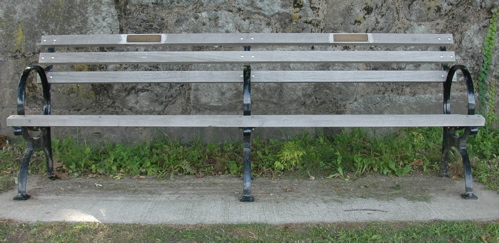
The Brookline Reservoir is ringed by a gravel path. Along the path are benches, on many of which are affixed small brass tribute plates, evidence of some past fundraiser, I guess. Most of the inscriptions are some version of this: In memory of Paul Smith. With love from Elaine, Mike, and Kim.

There are exceptions. One bench inscription says, “Don’t walk by.” That stopped me.

And then there’s the talking bench. Bench dialogueWell, it doesn’t actually burst into speech. However, one plaque has something to say to the other.

Read from the left…

“do you think they’ll sit down?” –Bobbi Davis

… to the right:

“yes, I hope so.” –Stan Davis

These few words, the punctuation, and the names suggest an entire relationship. I picture the ghost of Bobbi, the fun one, easily agitated, leaning forward and speaking emphatically to the ghost of Stan, mild, taking life as it comes, sitting back.

Think about how so many pairs of people you know — whether spouses, sisters, best friends, or characters in a favorite story — can be distilled into the particular lines that they play out over and over again. The cronies who made the gift to memorialize the Davises apparently knew these two well enough to choose and write down a couple of lines that could make strangers known to passers-by.

– Back story: essay on parenting

A few days after I met her, at my friend Pam’s 60th birthday party, I got an e-mail from Amy, who, with her husband, Marc, runs Equally Shared Parenting, a website that offers encouragement to and shares resources with parents who “have made (or wish to make) a conscious decision to share equally in the raising of their children, household chores, breadwinning, and time for recreation.” At the party, Jimmy and I had talked to Amy and Marc about our travails in this sphere.In her e-mail, Amy wrote “We enjoyed talking with you, and remember that you felt you were just about equal in the raising of your children,” and invited us to write an essay for their site.

I accepted.

And then I fretted for a day or two. Could I portray our life with children honestly, showing our ongoing yet imperfect attempts to share the work and the rewards, and still fit into the model that Amy and Marc’s project promotes?

I kept returning to that phrase “just about equal” from the e-mail invitation. That became a kind of mantra as I was writing. Those are three truthful words that describe both the shortcomings and the achievements of Jimmy and me as parents. And, even though I shaped the piece around one particular aspect of parenting, the emotional one, those three words — given to me, really, by the editor — motivated my work on the draft and revisions.

ESP published “Family Dance Party” in July.

– Find your questions

Last week I attended some excellent professional development workshops at the Landmark School. Derek Pierce, the faculty member who taught “Teaching the Analytical Essay,” got us to do some of the writing exercises he uses with his high school students. I found the following one really fruitful, and I promise that it’s as useful for a poet, essayist, scholar, or novelist as it is for the student writer.

1. Take 20 minutes or so and write down 25 personal questions that occur to you. The task is to create or discover ones that are significant, provocative, idiosyncratic. Any question is valid. Try not to second guess yourself; keep writing. [Alternatively, you could take a few days and try to come up with 100 questions; Pierce does this with his students.] Questions generated by participants in our group were unique to each person: One fellow was curious about a dog’s sense of smell; an older woman landed on several concerns circling around loss. Here are a few of mine:

  • How can I find more time to work on my writing when I spend so much time helping others with theirs?
  • Why do I have to ruminate over everything?
  • Why do I prefer writing tutoring over classroom teaching?
  • What is the history of The Miseries, the two islands off the coast of Salem?

2. Go back to your long list of personal questions and underline three or four themes or patterns you notice. Here are mine:

  • my writing — fiction and poetry
  • teaching
  • time & energy — managing

3. Go back again to your long list of personal questions and circle the top five.

4. From the top five, write down the two questions you feel most interested and invested in answering. (You don’t have to know why; just feel it.) Here are mine:

  • What is the history of The Miseries?
  • Why is tutoring considered a lesser art than teaching?

5. Now, choose one question (it could be from the two; it could be from the original long list) that you think stands above all the others in its significance to you. Write it down. This is your Power Question. Here’s mine:

  • What is the history of The Miseries?

6. Take a moment and reflect, in a hundred or so words, why you chose the question. What could you discover about yourself in pursuing an answer to your Power Question?

I wrote this:

I just learned about these islands and their purpose — I was instantly intrigued: by the name, the function, and the possibilities for making something unexpected out of a slight, marginal thing. Islands — so close to the shore but so far — keeping what you want at a distance, but also perhaps keeping what you don’t want at a distance?

About the relevance of this writing exercise and the inquiries that come of it, Derek Pierce said: “Anything is researchable.”
– Right words, right time

Work continues on the revision of an essay that’s really important to me. It’s getting closer to coherence, meaning, and shape, but it’s not exactly… singing.

Sometimes you come across the words of wisdom from another writer, right when you need to read them. The weekly issue of the Grub Street e-mail newsletter hit my inbox, with this remark in the banner:

The story is always better than your ability to write it. My belief about this is that if you ever get to the point that you think you’ve done a story justice, you’re in the wrong business. ~Robin McKinley

Substitute “essay” for “story,” and this comforts me. Perhaps reaching for the essay (the vision of the essay?) is what makes the writing go.

And who is Robin McKinley? I don’t know. But his/her words make me want to know more.