Leaves of insight, before they disappear

6130889443_74c365a02b_b Here are three quotations from my reading over the past few weeks. Each has something to do with writing, even when it is not about writing.

1.
In this profile of Dr. Steven Zeitels (“Giving Voice,” John Calopinto, New Yorker, March 4), who is the surgeon who saved Adele’s voice, another patient, Scott Flaherty, “an operatic tenor… working as a teacher,” describes his motivation for undergoing risky surgery to restore his singing voice:

He explained [to Colapinto] why teaching was no longer satisfying. “I’ve grown tired of just talking about it,” he said. “I mean, when you sing you’re giving voice to your soul.”

Teaching singing to singing parallels the relationship of teaching writing to writing. It’s not enough to talk about or comment on. And yet that seems to be mostly what there is time for. This was my mournful state of mind in the weeks leading up to Spring Break.

2.
The playwright Annie Baker (“Just Saying,” Nathan Heller, New Yorker, February 25) also teaches in the graduate playwriting program at NYU. In his profile of her, Heller follows Baker and her playwriting students into the basement of a Washington Square bar, where they discuss the pressure to outline screenplays. Baker is wearied by them and negotiates her contracts to avoid outlining. She says

“I feel like it’s the most dangerous — I actually feel like Hollywood hurts itself when everybody outlines screenplays. And then it trickles down to grad writing programs. Like, I’m willing to sit around for hours to talk about what the screenplay’s going to be, and talk about ideas, and doodle diagrams on dry-erase boards, but I just won’t…. Because by the time I finish the outline, it’s dead.”

Talking and drawing can be explorative and generative when it comes to creative writing. But outlining: a killer. Too much left brain.

3.
Piano player Jason Moran (“Jazz Hands,” Alec Wilkinson, New Yorker, March 11) lives in New York but teaches once a month at the New Conservatory of Music in Boston. In tutoring Jiri Nedoma, who played his own composition once hesitantly and again with more sureness, Moran directed him to play it again, changing “the whole idea of the song”:

“Make it entirely different. Could you play it in stride piano?” […] Put different factors into the equation. Play it backward. Upside down. Your left hand might use something 1940 and your right hand is 2000, and what you find becomes part of your vocabulary.”

Nedoma played it again: “more delicate,” with richer chords. “He ended with a series of rising notes.”

Moran responded

“What you played at the every end, that’s where you should start… It’s almost like you played all that prelude just to find that little bit.”

Play, play, play. Mess it up. Experiment in unlikely ways. Often, you discover what you’re writing about at the very end — that’s what we tell students. It seems like this is true in other kinds of composition. What is found, at the end, becomes the new start. Not everyone, though, will have the perseverance to revisit one’s own work with the eyes of new discovery.

—–
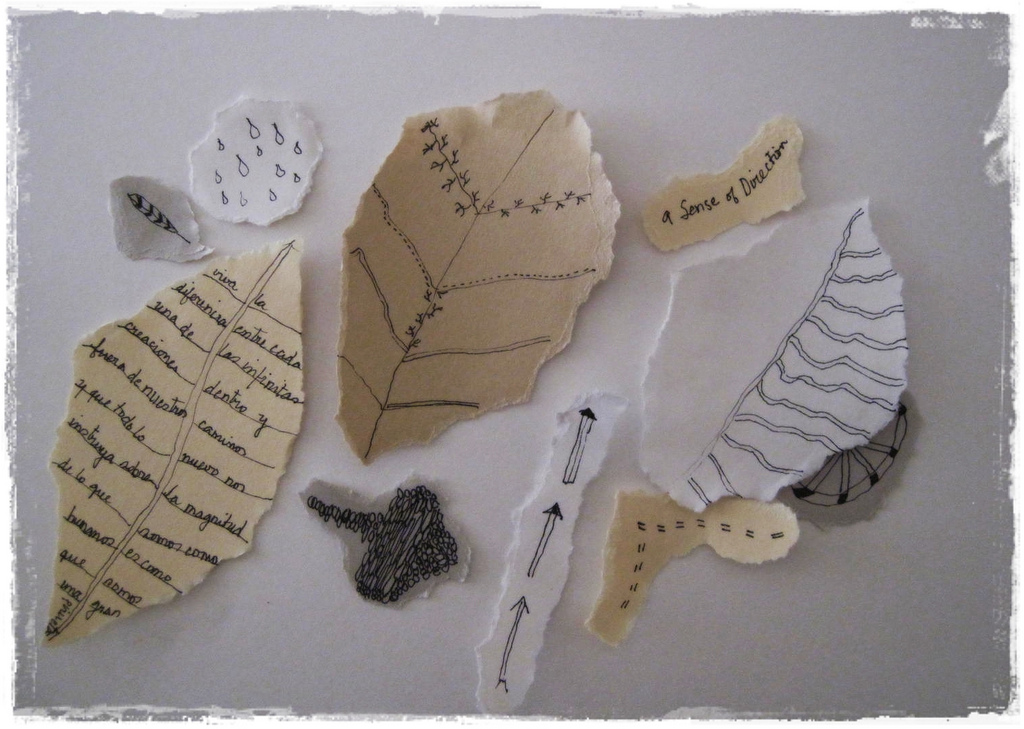
Image, “A Sense of Direction,” by Constanza on Flickr via a Creative Commons license
Precise, and soft at the edges

Red chairOverheard: A young instructor, after lab this week, to a another instructor, “My relationship to perfectionism has changed since I’ve become paralyzed.” She is in a wheelchair.

I hadn’t yet been part of this conversation. My ears perked up, I shuffled over, and I said to her, “You could write about that. I don’t think I’ve ever read anything with any personal insight into that topic from your point of view.”

We talked for a while about laundry folding and kitchen arrangement. Except for me, the group was made up of engineers, people whose work depends on attention to detail. When does attention to detail become perfectionism? I suspect there’s a continuum.

When I have been characterized as perfectionist, it feels like an accusation. The person saying it doesn’t admire the trait or its outcome (e.g., neatly folded sheets in the linen closet, a well-edited memo). Or it’s a way of distinguishing him or herself from me, as in, “You (Jane) are so uptight. I am easy-going.”

I don’t think of myself as desiring perfection, per se. Yet I do desire — and like, feel peaceful with — order, thoroughness, and the well-wrought detail.

Funny, I just had an impulse to make an annotated inventory of what parts of life or the physical world seem more pleasing to me if they are in line with my standards. It might start like this:

  • kitchen cabinets: stuff should be categorized, not stuffed-in randomly
  • closets and bureaus: neat, folded, unstuffed
  • desk: clear surface, things put away
  • yard: neat, trimmed, branches picked up — however, I don’t like a precise, manicured look — there has to be softness around the edges… and yet there are edges…
  • natural world: I like to see fallen branches, puddles, rusted cans among leaves, and yet I usually get to these places via a well-made path, which I like
  • writing: I prefer a fully-explored draft, even over-stuffed with ideas or information and long sentences, yet I want a finished piece to have shape, flow, grammar, and an absence of cliché, which to me is a kind of inexcusable clutter

Toilet outdoorsAs time passes, and therefore there is less time in front of me, I let some perfectionist tendencies go. One does this also as a parent, as soon as you recognize that your infant is a wild thing. Students, too, have minds of their own.

But I hang on to others — performance at work and art and in the primary relationship(s) — and in some ways exacting standards are hampering.

To chew on some more.

—–
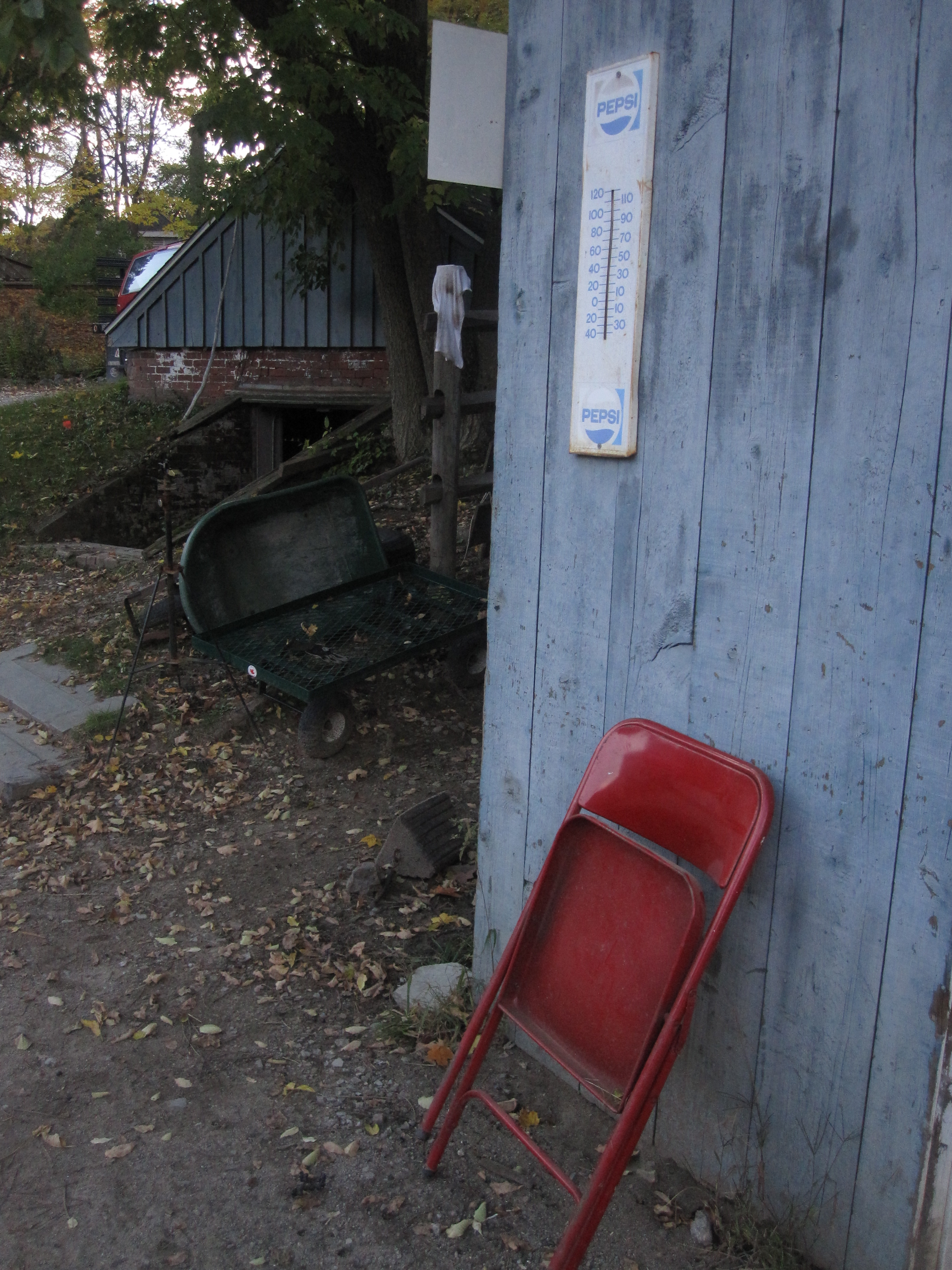
Photos taken October 21, 2012 at Allandale Farm by me.

Held in place by snow

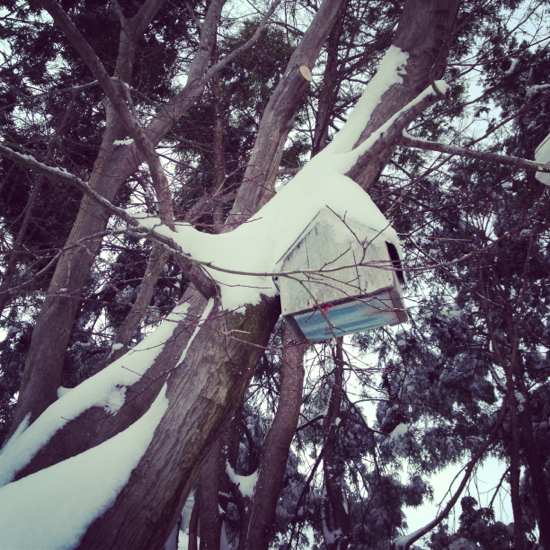
The birdhouse, which came with the big tree on our property when we bought it in 1999, has no function. There has never been a bird in it. Once I saw a squirrel in it and another time a full triangle of pizza! I put the two together and deduced that the squirrel had stolen it from garbage and set it aside for later eating.

Snow_birdhouse

It seems banal to take a picture of a snowy birdhouse among snowy branches, but often the everyday items of our lives gain in resonance and beauty when they stand out, visually emphasized by the snow, which obliterates the background.

So much was blanked out in this Blizzard of ’13. Even my neighbors’ yard, which abuts ours, became softer and more lovely to look at in the snow. The dying cypress hedge punctuates the view, indicates where we end and they begin. Last summer, the dying cypress hedge, dried and brittle looking, was only an eyesore and the topic of repetitive unresolved conversations with the neighbors, who own the hedge and don’t want to cut the shrubs down. Isaac and Olga want to leave the hedge there and plant other things in front. Bamboo, for example. In the meantime, to get privacy from us, they have leaned old wooden pallets against the dying hedge and planted junk vines that they have draped on the dying branches. On our side, I have done no more than keep it clean and trimmed. A fence is called for, but expensive.

I imagine standing in their yard and looking past the dried, thinning cypress into my yard: big Japanese maple, recently painted house, no debris in yard. I feel proud — too proud — and resentful. Why do they get my work as a view and I have to look at their clutter as mine?

At one time, when the children were small and we had a swing set and less time for gardening, no doubt there were days of our clutter that they had to look at. Maybe they are more generous, or more clutter-loving, and could look past what was then our stuff and appreciate the activity.

When we meet them in the summer at the property line, they do comment on the children and reminisce about the times they watched them play. “What a nice family,” they say. We have been spied on kindly, I gather.

It’s not them I don’t like. In fact, on days when they set up all their white tables and borrowed chairs, I know their many friends are coming and that the yard will be filled with people visiting, talking, eating, and that the lovely sound of a chorus of voices in the outdoors dark will comfort me as I go to bed.

It’s like the sound of being a child and going to bed while one’s parents and their friends are in the living room or finished basement, playing cards and drinking cocktails and laughing. The sound of both mystery and safety.

Continue reading

Necessary, and ultimately unnecessary, distractions

About 10 years ago, in the weeks leading up to teaching my first writing class ever, I fretted excessively about what shoes I would wear on my first day in the classroom.

I was almost 38 years old, and really I had not ever before obsessed about shoes. But fretting about shoes, in this case, helped me work through a lot of anticipatory fears about my public role in the classroom. I wanted those shoes to be comfortable but not dowdy, fashionable but not eye-catching. I was getting ready for students to stare at me, but not at my feet.

The shoes I wore that first day — in a classroom at Wheelock College that looked over the Riverway — I have forgotten, and I have never thought again about what shoes I would wear in the classroom. That doesn’t mean the shoe distraction was frivolous; it focused my attention and fears on something concrete and manageable that I had control over. And then I got beyond shoes.

In the past couple of months, I have been preparing for my first ever figure skating skills test. (Read about the story and the outcome here: link.) In the lead-up to the actual date, I tried to learn about and think through everything. The social situation itself would be entirely new to me, even newer than being at the front of a classroom. I had never watched anyone else take a skating test, and surely, as a student, I watched teachers teach hundreds of times.

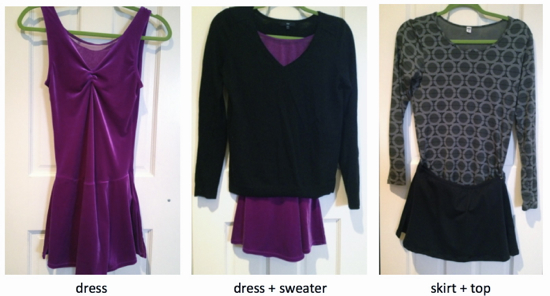
Skating outfits_550_cool

For a while I obsessed about what I would wear. It had to be more than fleece pants and a fleece jacket, which are the skating equivalent of a sweatsuit. But it didn’t have to be as much as a costume, with rhinestones, bright colors, and a theme. I scrolled through the offerings of online retail stores. I looked at skaters’ blogs for advice on what to wear. I ordered three skating dresses (one fit), a skating skirt (nice), and skating tights.

I had options. I didn’t wear any of them.

Two days before the test, my coach reminded me that the test situation would feel new and unfamiliar enough that a new and unfamiliar outfit might not be a confidence builder. He suggested skating pants, a nice sweater, low-key gloves. I went with his advice.

That morning, as I watched the other skaters who tested on the same day, some wearing skirts, I reflected on my outfit purchases that turned out to be unnecessary. But then I thought, maybe they were. Maybe the buying and trying on a skating dress was akin to trying on the identity of “skater.” Maybe the hours of online browsing was a way of wrapping my arms around a really big, overwhelming task. I didn’t know if I could nail the skating, but I do know I can choose and buy clothes online.

I made it through my first skating test ever: link. Next time, I’m wearing the skirt.

Almost one month later, the never-ending holiday ends

We returned the unwanted gifts to the stores in time for the 30-day return limit.

I packed up the ornaments, took down the artificial tree, vacuumed, undecorated the mantle, and got Jimmy to help me put the Christmas things in the attic. Then I went outdoors and stripped the yard of ornaments.

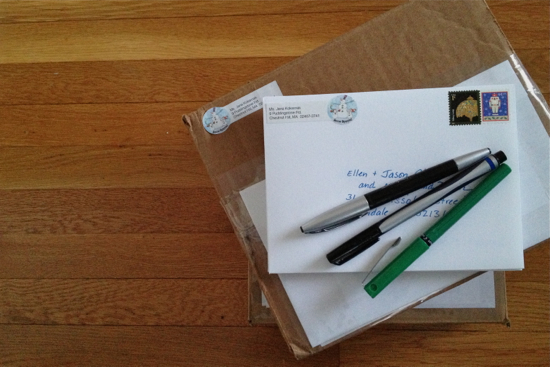
mail

I signed and stamped my second batch of holiday cards. I had ordered some with the New Year’s theme, knowing I’d never make a Christmas deadline. I bought some Taza chocolates and Effie’s oatcakes, local products to send to friends in Germany and son Eli in Burlington, VT.

This morning, I mailed the cards and packages. New postal clerk in Brookline Village: very friendly and efficient.

post office

I declare Christmas officially done. It’s been a long month.

What will I do differently next year? It was fun having dinner at our house; I would cook again, and perhaps the same meal. But the whole presents scheme must change. Next year, it will be quality over quantity. I ended up returning a lot of the gifts bought for the teenaged Gutermans and giving them cash to buy what they want. In the future, I will (a) not shop at TJ Maxx and Marshall’s, which I love and they seem to hate, and (b) buy one special gift, fill the stockings, and give the rest in cash.

I will send holiday cards again. I haven’t done that in years, and I enjoyed the opportunity to reminisce about my cousins and childhood family friends and simply write by (private) hand and not via social (and public) media. At my sister Sally’s suggestion, I made a file with all the addresses in it, so that will be streamlined next year. I even added a few names of people I intend to send cards to next year; this year I ran out.

Here’s the New Year’s card photo, taken August 2012:

Mighty Gutermans

Also, now that the big push of Christmas is behind me and the choke points of the semester still to come, I am going to attempt to blog much more frequently, even if most of the offerings are slight. The accumulation of a lot of small gestures may add up.

It’s a new year and time for new experiments.

When it comes to resolutions, I’m dreaming big and vague

In my New Year’s resolutions, I am taking my cue from MIT friend/colleague Jessie, who frames hers this way:

I try to look at what I have wanted, but allowed myself to be distracted from; what I have enjoyed, but not prioritized; what I need, but haven’t chosen.

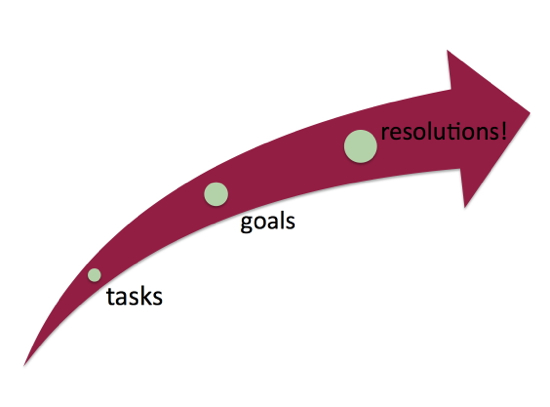
I’m good on tasks and short-term goals, and I get them done. In the next few days I want to finish a full draft of a project I’m collaborating on, and I will do it. In the next three months I am taking a skating test (February 3rd) and going to AWP in Boston (March 6 – 9), and I will be ready for them. I have formulated a plan for getting the tasks done that help meet the goals.

Resolutions_550But thinking and dreaming aspirationally? Perhaps I could dream bigger, and less specifically, for my resolutions. I know I can get stuff done — can I focus, enjoy, and get what I need?

In that spirit, here are my three resolutions for 2013.

Continue reading

Look beyond the self on New Year’s Day

My resolutions are usually about aiming for personal goals or eliminating personal deficits.

What if our resolutions were more focused on our interactions with others, not as a way to get but to give?

The writer David Rakoff (b. 1964) died in 2012 from cancer. In its year-end feature on notable deaths of the year, “The Lives They Lived,” the New York Times Sunday Magazine published a letter that Rakoff’s friend Ariel Kaminer had written, thanking him for important lessons. They are ones to live by:

  1. Don’t trade up.
  2. It’s better in the long run to be kind.
  3. Be grateful and humble and mean it.

Read the full version of the letter, and a fuller description of each axiom, here: link.

P.S. Of course I still have a personal resolution or two and will publish them later.

Over time, we may come to understand what these gifts mean

Angel_smallThere is this great desire to be known. To be recognized for who one is. We need signals from the intimate world, from the people closest to us, that we have been observed and found out. And around Christmas time, we start to hope that the gifts will be those signals — that someone will unearth or make the item that will tell us we are known, and we are prized for who we are.

We know we are loved. But are we known? That we worry about in our heart of hearts.

—–

As I child, I always loved Christmas and looked forward to it each year. My sister Sally and I shared a room for a long time, and every Christmas Eve we would lie in our beds wriggling with delight over what Santa and the morning would bring. It was hard to sleep, and we would kick and bicycle our legs deliberately to get rid of the energy. In later years, after the dream of Santa was behind us, I still endowed Christmas with much hope — a great, great deal of it — even though my rational mind knew that, with knowledge, the magic had dissolved.

When I was about 14 or maybe older, I received from my parents the gift of an antique wicker chair and table that had come from my mother’s Aunt Gert’s house. The set had been dusted off, and my mother had sewn a new cushion set. Intellectually, I could tell this was a special gift. I said thank you, and even now I hope I outwardly seemed grateful and happy. I wasn’t happy, though. I don’t recall if there was something in particular I wanted, but it wasn’t a family hand-me-down. I was a teenager, so perhaps boots or clothes or a record player or hot rollers would have been more worth getting.

I don’t actually remember the nuances of what I felt beyond the shock of seeing the table and chair, around the corner from the living room, too big to be put under the tree. I have a mental snapshot of the moment, and in trying to stand there in the same place again, looking at the table and chair, all I feel is the force of my own self-control: try to be thankful, try to keep your cool, try to appreciate the meaning and effort that mum has put into this.

The effort to accept a gift that one doesn’t want is so great.

—–

I still have that chair and table. Many years ago, I updated the table, marbling the top, when I took a furniture-painting class. The chair has been professionally restored by a wicker man, who told me the chair is a classic, and he may have even named its style, but I don’t remember it. There is a little piece of wicker on the arm rest that has broken off, and I have put it aside, intending to glue it back.

Continue reading

See Jane get ready for Christmas Day

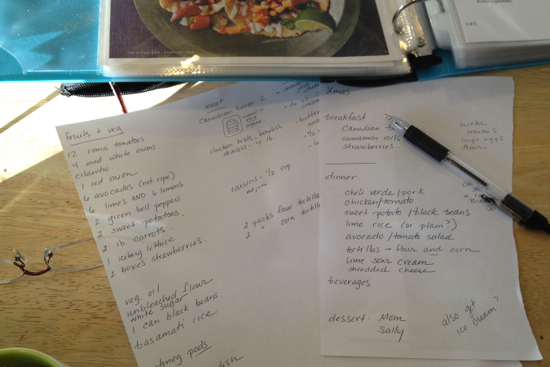
I could write a post every day that featured some hand-written note or scrap I had produced. While I wish I could say that I’m one of those writers who carry around a lined pad and work on their latest thing in longhand, I’m not. But I love lists, notes to self, and notes to others.

A few days ago, I felt a bit panicky about Christmas. There were still gifts to buy and a menu to plan. All the details were in my head, as packed as the city swimming pool on a blistering day and I the lone lifeguard.

I wrote my gift list: items purchased and shopping to be done. This morning: the menu for Christmas Day (15 of us) and a grocery list for the go-getter, Jimmy Guterman. My breathing slowed as I wrote and categorized. All the swimmers started doing laps in lanes.

ListChristmas550I drew a little picture for the Canadian bacon; there’s a certain kind + brand I want, and I can see it in the store and package, but I can’t remember the name beyond the word “organic.” I hope the picture will help Jimmy see it.

Specificity in item, quantity, and place helps with order and therefore the feeling of calm and preparedness.

This is my way to organize the part of the world that has me in it. The impulse comes from and satisfies me, I know, but my drive for order might benefit others.

Well, actually in fact it does. Ho ho ho!