States of matter, a dream

In Colson Whitehead’s “Rules for Writers,” number five is “Keep a dream diary.”

Sometimes, if I am awakened by a dream, I turn on the light near the bed and grab a scrap piece of paper — usually one of those blow-in cards from a magazine I’m reading — and a pencil, and I write it down.

Last night I had a dream that my skating teacher and his wife had a baby, and they wanted me to take care of it. So, I took that newborn swimming, and it swam.

The dream is still vivid, especially the baby and the YMCA-like pool.

Ice, water. (What’s next, an evaporation dream?) What does it mean?

I feel so close to you right now

couples, outside the ICA, Boston, June 2008

Sometimes what you want is far away, a dream.

And sometimes everything you want is right next to you.

On Sunday, two days ago, the five of us traveled in our van to New Jersey to see the relatives there. As the children get older, it is rare that we are all together on a day that is not a holiday. We played a mix CD that Eli made; it might have been the one he called “Hedge Money” or the one called “Sky Mall Mix.” They’re both good.

The three of them are talkative. We eavesdrop and only occasionally interject. I had my notebook on my lap most of the way.

—–

Eli (almost 20) gives travel advice Lydia (age 16), who is headed to Vietnam and Cambodia next year: “There are going to be so many leeches there.”

Lydia disagrees: “Don’t you think I’ve already gone on the web to see what kinds of insects there are?” This does not surprise me. Lydia is thorough and always prepared.

Eli keeps insisting. Lydia says heatedly, “Eli, sometimes you try to act as if you know more about something than I do, when in fact I know more about it!” I wish I had her awareness and the guts to go with it when I was a teenager. Really, it took me until I was about 35 to even think what she said.

—–

Eli looks at a photo of Grace (age 12) on someone’s phone. He says to her, “You’re so hospitable. You’re going to make a great escort someday.”

Grace: “What’s an escort?”

—–

Eli has two more weeks to go at Otto, his summer employer, a new, upscale pizza place in Brookline. By now, with his hands and forearms covered with oven burns and knife nicks, he’s had it. He describes his quitting fantasy (don’t we all have them?): “If I were ever so mad at Otto that I was going to quit on the spot, I would take a bite of everything that was about to be served and be like ‘Fuck you, Otto,’ and walk out the door.” We laugh. Continue reading

Summer chores: pleasure and pain

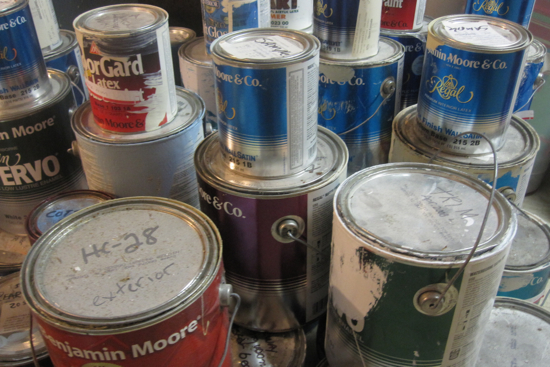
a fraction of my paint can hoard

In his essay, “Good-Bye to Forty-Eighth Street,” E. B. White describes a move from the six-room Manhattan apartment he then shared with his wife. Even in 1957 people accumulated lots of stuff; it’s not just our epoch that is so acquisitive.  Contemplating my own home, which is fairly tidy, I feel about it the same way that White felt about his apartment:

A home is like a reservoir equipped with a check valve: the valve permits influx but prevents outflow. Acquisition goes on night and day — smooth, subtly, imperceptibly. I have no sharp taste for acquiring things, but it is not necessary to desire things in order to acquire them. Goods and chattels seek a man out; they find him even though his guard is up. […] This steady influx is not counterbalanced by any comparable outgo. Under ordinary circumstances, the only stuff that leaves a home is paper trash and garbage; everything else stays on and digs in.

In the passage above where I’ve used a “[…]” as a placeholder for many sentences I’ve omitted, White lists the various things that have made their way into his life without his beckoning or actively acquiring them: books, oddities, gifts, memo books, a chip of wood sent to him by a reader, and “indestructible keepsakes” left behind by someone who has died. Later in the essay he writes about the special problem of trophies. (Note: While my post is not at all about teaching, I think it could be a fruitful assignment in a creative writing class to have students make a long list of items that could fill that “[…]” spot. Perhaps an idea for a poem would emerge.)

White and his wife had only six rooms in this apartment. In our house, we have seven rooms, plus more closets, and an attic and basement. Ah, therein lies the problem. A former grad school professor of mine once said to me, as she and her husband packed up a house to move in with a daughter upon their retirement: “People should not be allowed to know that they have attics and basements.” Continue reading

Writer’s Dozen: William Zinsser and Voice

This is the second in a series of posts, called “A Writer’s Dozen,” on texts that have been important to me as a writer.

In learning to write, there is always some unlearning to do. As writers, we build up our vocabularies and strategies in ways useful to us, but sometimes we get locked into those ways, and our writing becomes disembodied, unnatural, overwrought, show off-y. For writing to be good and worth reading, it has to fit the rhetorical situation and have a voice – a real one that could only come from that writer.

For me, the best definition and treatment of “voice,” as it applies to writing, comes from William Zinsser in his On Writing Well (1976): it is your “commodity as a writer” and conveys your “attitude toward language.” As writer, it is uniquely you.

Last week, some colleagues and I were reading stacks of essays by first-year students, as part of a writing assessment project at another local university. We read in mostly silence, but on our lunch and coffee breaks we would discuss features of student work that we liked or didn’t like. This is the writing teacher’s version of water-cooler gossip.

Uniformly we were irked by students using 50-cent words when plainer ones would do. For example, instead of using “posit” as a verb, which we saw used repeatedly in one essay, we prefer “state” or “argue” when quoting from an article or book or “say” when quoting from an interview.

The fancy word choices enraged one or two of my colleagues. I like a more straightforward style myself, but I understand why students write in what they believe to be a more formal register: to sound smart and to reach the teacher. (For a nice discussion of register, try this: link.)

Entering the academy and the conventions of academic writing is “like learning a new language,” I suggested to my colleagues. “It’s awkward at first, and it takes some mastery of the language before you use it naturally.” Before you get to the point of sounding like a native, there’s a lot of stilted use that doesn’t sound quite right to experienced ears.

I mostly practiced creative writing when I was in high school, and I was considered to be a fluent writer. When I got to college, however, and turned in my first academic paper – over which I had toiled devotedly and seriously – and got an F for a grade, with the comment, “This is not an analytical essay,” I realized I was unprepared for this new country called College and its strange customs. It was a new start and a tough one. Continue reading

Happiness is a moment, not a life

Last Saturday morning, walking to the last sessions of the IWAC Conference in Savannah, I saw this graffiti on a building behind my hotel at the corner of Turner Boulevard and Fahm Street.

The graffiti says, “Happiness is a drug I can’t afford.” (Click and see.) Who spray painted this, I wondered? Is this a shout? And if frustration gave birth to this remark, did the spray painter not feel any thrill in the act of expressing it?

I’ll bet he did have at least a few minutes of absorption that are equated with happiness.

I don’t like that question, “Are you happy?” because happiness is a quality that is on the move constantly. It’s like hunger or the satisfaction of hunger: depending on the moment, I could answer in different ways. If I say NO the person asking may assume a generalized unhappiness on my part when, really, happiness is specific and ephemeral. This is okay.

This month in The Sun, the painter Ran Ortner describes the feeling of being engaged in his work:

In my reading I’ve come across this again and again: that a person is most powerful when in a state of inner peace. The outside world recedes when I’m engaged in my work. I fall under the illusion that what I’m doing is all-important… I’ll take a break, and when I come back and look at the work, I’ll think, Damn, there’s magic there… That’s what makes art great — it’s a souvenir from these frontiers.

To me, a sort of cool-temperatured soul, that inner peace is happiness.

It doesn’t only come with art-making. If it did, I would experience it as infrequently as I make art. So much of my time seems spent in getting work done or giving comfort or making/maintaining a home.

Some of that inner peace comes actually from those activities, even mowing the lawn or sweeping the sidewalk. And I feel satisfied with the souvenir from the frontier of the backyard. Just this morning, Friday at 6:50am, I sat on the steps in the back, watched the birds peck at the damp dirt under the green grass, looked around at my neighbors’ yards, heard the garbage truck on a distant street, and felt happy with the place I’ve made over many moments of absorption. This includes my recent wrestling with two overgrown rhododendron. Happy is a lightness of being — that may be the best way to describe it. (Thanks to Kundera for the phrase.) It comes and it goes and it comes again.

Continue reading

Writer’s Dozen: Natalie Goldberg and Bones

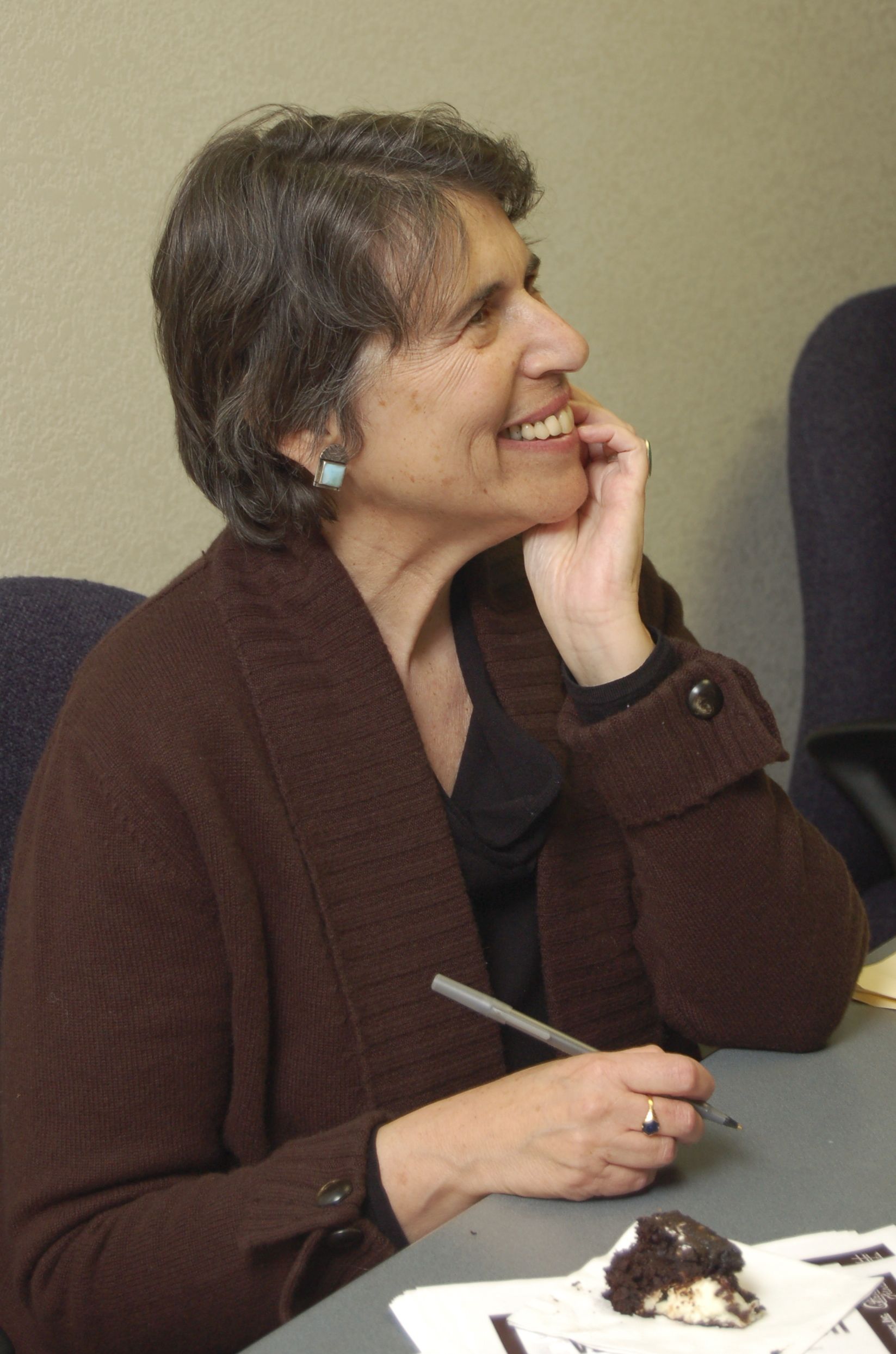
Goldberg, pen, and cake

Permission, sincere belief, and urgency: those are what Natalie Goldberg gives to readers of Writing Down the Bones (Shambhala Publications, Boston: 1986). This post is the first of Writer’s Dozen, a series on 13 texts that have meant a lot to me as a writer.

When I first encountered this book, in the graduate-level Teaching Writing course at Simmons College in the spring of 2003, I wondered why Professor Lowry Pei had assigned it. I cringed reading the first chapter, “Beginner’s Mind, Pen and Paper,” and Goldberg’s hokey advice on choosing a “fast-writing pen because your thoughts are always much faster than your hand” and purchasing “a cheap spiral notebook” over a “fancy” one so that “you feel that you can fill it quickly and afford another.”

Let’s get to the point, I thought. The pen-and-paper suggestion seemed to be a detour and right at the beginning of the book when I was eager to get started. Clearly, this was for adults, and did they really need guidance in finding these most basic tools? If they do, they’re not going to get too far as writers. The snob in me was having her say in my internal dialogue.

Other chapters describe the timed “egoless” freewrite, writing as daily practice, distance of time, and some more fruitful topics. My position on Goldberg’s method started to soften, though, only when I read her command that we shouldn’t “identify too strongly with [our] work.” Words, when writing them, are “a great moment going through” the writer. Not being a Buddhist, as she is, I didn’t quite understand what she was getting at, but I found it a relief to think that I could write deeply and then move on to deeply writing something else, having left the old thing behind, done.

My initial resistance to Writing Down the Bones and the spiritual dimension to Goldberg’s approach had to do with my age (38), agnosticism, and experience writing and getting writing (for work and school) done. I didn’t think I necessarily needed anyone to tell me to write, write lots, write regularly. At first, I wondered if this book was intended purely for the beginner or the unsure, which I believed myself to be not at all.

But I quickly liked and was intrigued by the ideas of this writing professor, Lowry Pei, who has since become mentor, colleague, and friend, and I thought I’d go along with it and see how Goldberg fit into Pei’s approach. I was still keeping my emotional distance from Bones, not sure it applied to me. Continue reading

Writer’s Dozen: a new series

For several months, I’ve been keeping a list of texts that have meant a lot to me as a writer. Some are as long as a book and are explicitly about writing, in particular about practice, process, and style.  A few of my picks are essay length, and a few are about visual art, e.g., photography and ceramics, yet the authors articulate principles that, in my view, apply to writing.

This list of 13 of my fundamental texts will turn into a new series, Writer’s Dozen, starting with my next post. I am inspired in part by an essay I read recently, by Tom Bissell, called “Writing about Writing about Writing,” in which he takes stock of some staples in the how-to-write section of his local bookstore. It’s a balanced analysis; he finds reasons to both mock and praise the books he features. On my list and his only two overlap: ones by Annie Lamott and Natalie Goldberg. Bissell admits to varying personal interest in the other books he critiques, which include Gardner’s On Becoming a Novelist (his one writer’s-life-changing text), Strunk and White’s Elements of Style, King’s On Writing: A Memoir of the Craft, and Snoopy’s Guide to the Writing Life.

I highly recommend Bissell’s essay. He has a tougher sensibility than I, but the heart of his argument is consistent with my motivation for choosing 13 personally influential texts and commenting on them in my upcoming series. About books about writing in general, Bissell asserts:

Most writers have thoughts about writing as an act, as a way of understanding oneself, or as a way of being, and they are often interesting. I have any number of thoughts about writing, all of which I find incomparably fascinating… A how-to-write book saved my life, then, but it did so existentially, not instructively. Many of the best books about writing are only incidentally about writing. Instead, they are about how to live.

Indeed, my favorite books about writing or art are, in their way, about how to live.

First up: Natalie Goldberg’s Writing Down the Bones, a book that initially disturbed me and then later settled down and found its place in my habits.

—–
Image, “Pencil Art,” by Nalini Prasana on Flickr via a creative commons license.

Friends who write letters

In early May, at the end-of-the-year potluck supper of the MIT figure skating club, of which I am a new member, I sat next to Florence. She is a student from Belgium who, in addition to getting a graduate degree in media studies this year, learned to skate and performed a solo in our March show.

Before the potluck supper, we had never talked. Over salad and lasagna and quiche and meatballs, I told her about my goals as a writer and she told me hers as a photojournalist. We were mutually engaged, and the conversation with her made the awkwardness of a social event totally worth it.

Image

mail from Florence and James

At the end of the night, she handed me a tiny pad of notepaper and pen and asked me to write down my mailing address. She had a book for me, something about narrative journalism, that she planned to send me as a form of inspiration. A few days later, the book The Literary Journalists arrived in a package along with The Midnight Disease. In the accompanying note, she referred to our potluck conversation and wished for “all the best in your writing enterprises!”

I felt as though my ambition, which had been feeling to me like an old dress that had fallen off its hanger and crumpled on the floor among the shoes, was freshened, ironed, and made wearable again by her interest and words. A person cannot always plug along alone without such collegial encouragement and enthusiasm. (There were two exclamation points in her note.)

Meanwhile, that same week, I got a hand-written letter also from James, whose presence in my life as a fellow writer and a real friend keeps me company even though we live far apart. Words — by email or the post — keep the embers of friendship glowing.

And over the past year, I’ve also gotten real letters from Ulrike, Susan, Rosemary, and even one of Rosemary’s friends, who passed along a used book she’d finished with. Marcia sent me a vacation postcard. Leslie, even though we share an office at work, sent me by mail an article she thought I’d enjoy; I know for a fact she also enjoyed creating something mail-able that may have grown out of her nostalgia for a pen-pal-rich childhood. My mother sent me a well received Mother’s Day card, which boosted my parenting self-esteem in one sentence, which, by the way, the children agreed with when I read it to them.

Are you wondering how to get someone’s attention — how to really reach them — at a time when email and status messages and even, gulp, blog posts seem to add to more and more clutter?

In your own hand, write some words. Put them in an envelope; add a stamp. Send.

A postcard or letter is personal and private and therefore more treasured. When I receive one, I think: this is for me, only.

The agony of writing comments on student work

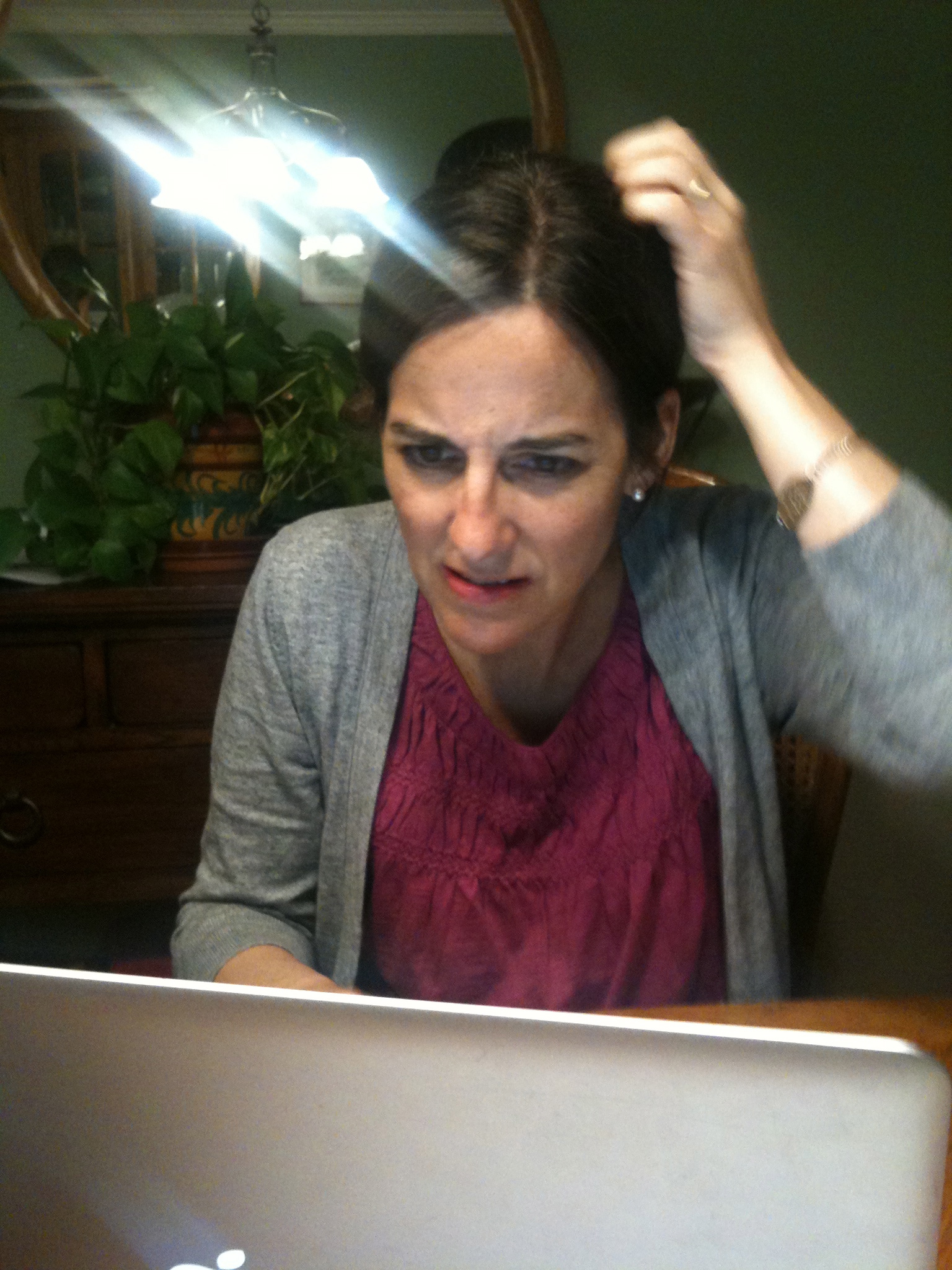
That’s me, sitting at my desk at home, which is really the dining room table, where dining rarely happens. We usually eat in the kitchen unless company comes, and then I put away my laptop, power cord, scratch paper, and pen.

Lydia took this candid photo with her phone when I wasn’t paying attention to her. The draft of a report by a student was diverting me from my own students, aka children, and their homework.  Sometimes Lydia and Grace spread their books and worksheets on the same table, and we homework-it alongside each other. Let’s hope this gives me credit someday for being an involved parent.

The past two weeks have been all about final papers and final presentations, and I have been meeting with students, helping them rehearse talks and improve slides, and reading submissions. Have I worked on my own writing? Not really. I have thought about it.

In a recent column on her writing habits, Anna Quindlen, who writes every day between 9am and 3pm — “an elementary school schedule” — argues that a writer must lead “a humdrum life” and not “write other stuff.” If you have a busy life, and you are writing other stuff (like, I infer, comments on student writing), “you won’t write it.”  Here, the pronoun it stands in for all that glorious self-authored work a writer is destined to do, unless responsibility gets in the way.  Too many lunches, Quindlen adds, also get in the way.

She invokes her Barnard writing professor, B.J. Chute, who told Quindlen and her classmates “not to take jobs that involved writing of any kind because there was no chance we would then go home at night and take up our own material.”  Very good point. I do wonder, though, how fiction writer B.J. Chute managed to get her teaching done without writing on student work. Continue reading

Critical thinking must involve communicating too

A recent post on Tomorrow’s Professor itemizes and describes seven intellectual habits of critical thinkers.

Critical thinking is one of those qualities that are prized in teaching and learning but is often evoked as a good thing without being nailed down. Like “art” or “emotional intelligence,” we believe in it, we know it when we see it, but we haven’t always formulated for ourselves what we understand it to be. The list below, by Edmund J. Hansen, primarily situates the use and cultivation of critical thinking in school, with some references also to its importance in society.

I must admit I read this list with myself more as thinker and not teacher in mind. Do I consistently practice these seven intellectual habits? Do you?

  1. Intellectual Humility: Be aware of one’s biases and prejudices, the limitations of one’s viewpoint, and the extent of one’s ignorance.
  2. Intellectual Courage: Face and fairly address ideas, beliefs, or viewpoints toward which one has strong negative emotions and to which one has not given a serious hearing. Recognize that ideas that society considers dangerous or absurd are sometimes rationally justified.
  3. Intellectual Empathy: Imaginatively (and, I would add, regularly) put oneself in the place of others so as to genuinely understand them.
  4. Intellectual Integrity: Be true to one’s own thinking and hold oneself to the same standards one expects others to meet. Honestly admit discrepancies and inconsistencies in one’s own thought and action.
  5. Intellectual Perseverance: Be disposed to work one’s way through intellectual complexities despite the frustration inherent in the task.
  6. Confidence in Reason: Believe that one’s own higher interests and those of humankind at large will be best served by giving the freest play to reason, by encouraging people to come to their own conclusions by developing their own rational faculties. Also have faith that, with proper encouragement and cultivation, people can learn to think for themselves.
  7. Intellectual Autonomy: Maintain an internal motivation based on the ideal of thinking for oneself; having rational self-authorship of one’s beliefs, values, and way of thinking. Depend not on others for the direction and control of one’s thinking.

I reflected on Hansen’s Habits of Critical Thinkers and noticed that he emphasizes the individual’s responsibility to the self as thinker, reasoner, judger, and perseverer and the benefits one might gain from these habits. Not that he ignores responsibility to others — after all, Hansen is a teacher and promotes these habits in education — but the actions he describes are largely mental, interior, and personal.

This list needs an eighth habit, and it’s one I discern among the ones he has articulated. While the seven above are lifted and paraphrased directly from Hansen, the one below has been crafted, albeit from his principles, by me:

8. Intellectual Advocacy: Be responsible for preparing and communicating — whether in text, speech, graphics, or other publicly available media — reasoned arguments that consider and advance ideas, proposals, and analysis that represent one’s deep thinking, careful study, and sincere concern.

I add this here as much as a reminder for myself as it is for any readers. Often, I pride myself on my skill at weighing information and others’ views. However, I often keep my thoughts to myself, wondering if this battle or that one is worth fighting. I have historically given too much credence to an axiom I learned as a child: “Silence speaks volumes.” Silence, in fact, does not speak at all. Critical thinking gets society nowhere without the thoughtful, well-reasoned, and even impassioned — if passion suits — communication of thinking’s results.

A person must use her critical thinking to question and investigate her own convictions, but she must have the courage to argue for the ones she has examined and can support with evidence (including examples), analysis, and reflection. Do this according to Hansen’s Habits: with honesty, humility, empathy, integrity, persistence, and autonomy.

—–
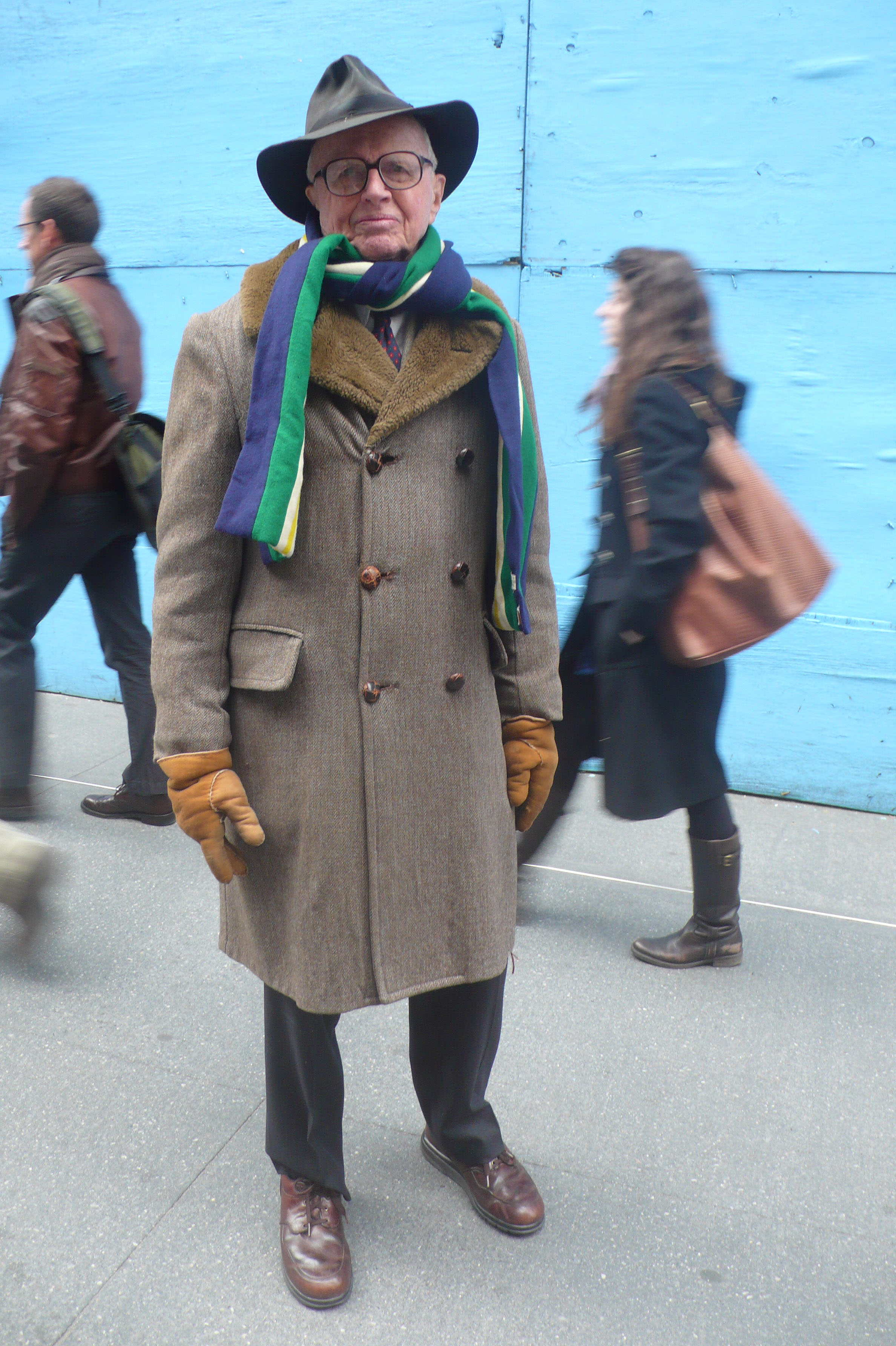
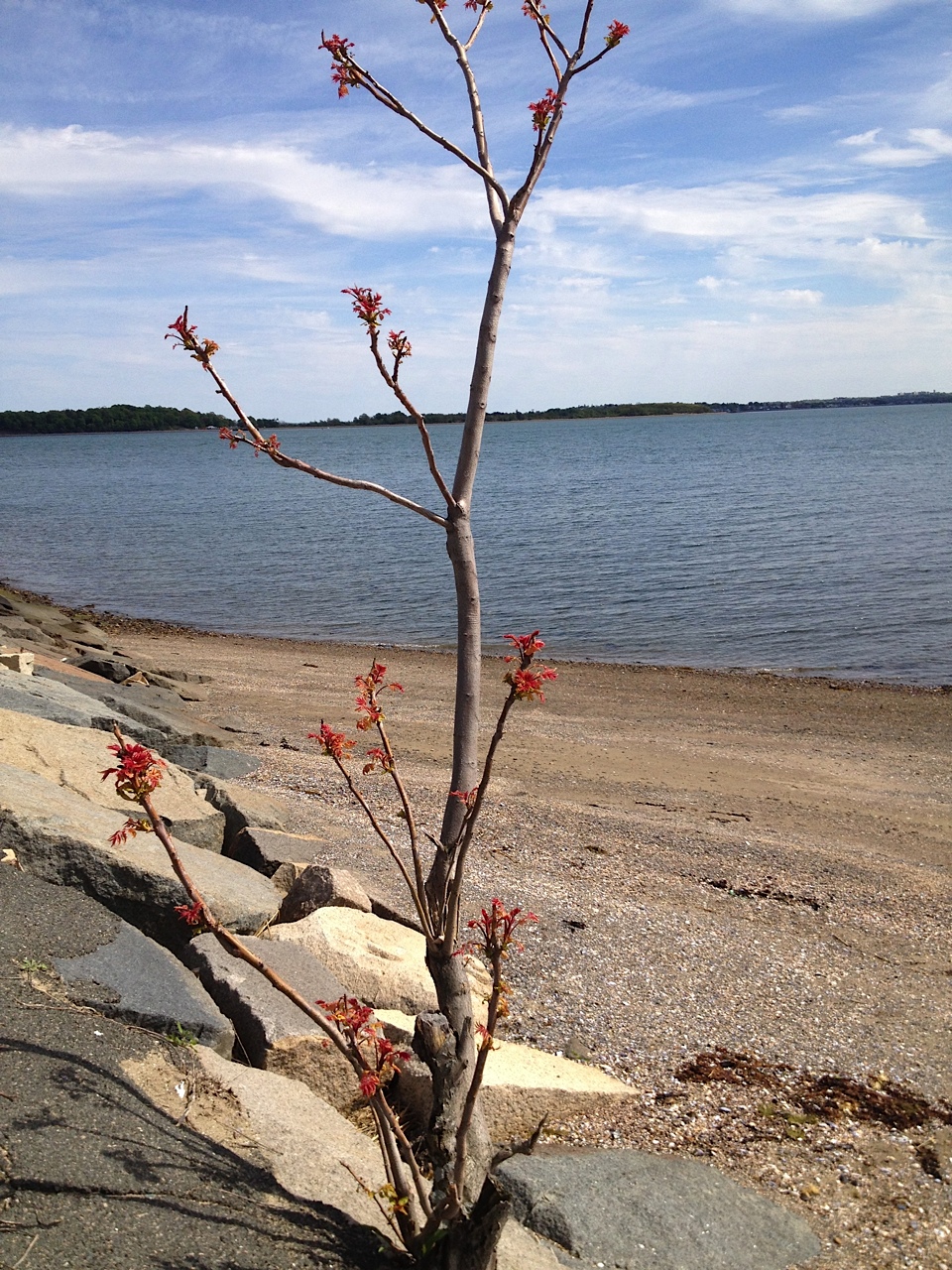
Image by Jimmy Guterman, on the jetty/walking path to Boston’s Castle Island, April 29, 2012.