– Fire starters

Coffee log

When my sister Sally and I were children, we lit the woods behind our house on fire. This is a true story, one I have said out loud many times yet never written down.

I was about 10 years old then, and my friend Doreen and I had been lighting little fires in the woods for days. On top of a flat boulder, we would put a pile of dried leaves and twigs, make sure that the area around the pile was free of other debris, and then strike the match. On our fires we toasted bread. I wonder now if we imagined ourselves to be characters in some of our favorite television shows, like Little House on the Prairie and The Waltons.

Sally and her friend Kenny became privy to our fires, and, of course, they wanted their own. We traded them a book of matches for the Chinese jump rope, and Doreen and I sternly lectured them on safety and secrecy.

It was fall. Later that day, or perhaps it was later that week, I was riding my bike around the curve in the road that brought my house into view, and I saw, behind and to the sides of the house, lots of patches of orange flame, as if there were 50 or 100 campfires on the ground among the tall pine trees.

I felt a clutch in my gut — this had something to do with me — and I kept riding my bike. Mentally I knew I should have stopped, but I kept riding up the street, to another friend’s house. I remember trying to act cool and regular, while inside I was working out my story and imagining what was going on at my house. The woods surrounded the neighborhood and ran behind all of our houses; I must have looked out the window and been relieved that the flames had not traveled up to the house I was laying low in.

Later I heard from my mother what had happened. Neighbors — adults and children — had formed a bucket brigade while they waited for the fire trucks to arrive. Some adults beat at the flames with rakes. No one was burned. The fire incinerated a huge swath of downed branches, dried needles, and underbrush, but the fire fighters arrived in time to extinguish it and save the trees. My mother said it was lucky that my little sister, who had on a fringed poncho that day, had not caught fire.

Sally went with my mother to the house of the people who owned the woods, and she apologized. Was I punished? Perhaps I was grounded. I have always felt that I escaped the greater culpability that I deserved.

The house I live in now has a fireplace. Although we have lived here eight years, in only the last month or so have we tried to get a fire going. Jimmy and I crumple newspaper into the iron stand and loosely lay kindling on top of that. We add a piece or two of split wood. To the paper, we touch a lit match here and there. The paper burns quickly and dramatically, and we stare at it, waiting for the kindling to catch. It does, for a moment, and then fades, like a used-up birthday cake candle. The flames lick promisingly at the bark of the split wood, and then retreat. Within 10 or 15 minutes, the whole thing dies.

We sweep out the meager ashes, pull out the charred pieces, and try again. I go onto the web and read authoritative advice on how to start a fire in a fireplace. The other night, Jimmy whispered in my ear, “Squirt some lighter fluid on it,” and I grin, remembering how we attempted to burn a yew stump in our yard last summer, until Lydia, steadfast at 11, protested emotionally until I poured a couple of pails of water onto the smoldering wood. She was right, and I knew we were wrong. Still, I wanted to keep that fire going, and it was only my love for her that made me stop.

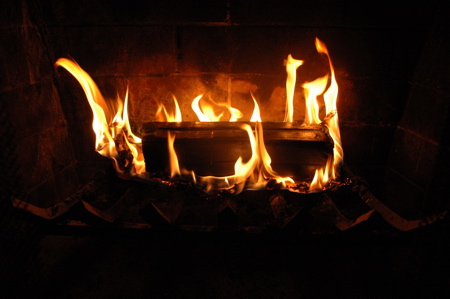
At the local Whole Foods market, you can buy something called a Java Log, which I guess is the organic equivalent of a Duraflame. Jimmy and I are able to get these things burning in our fireplace; we arrange one in the grill and light the paper wrapper where it says “Light here.” As you can see in the picture at the top of this post, as the paper starts burning, it curls away from the log, which is made from compressed coffee grounds. It’s black, and it burns evenly, but it does not make a cheery fire. That dark block is always there.
Lit matchIt strikes me that our shared inability to build a natural fire indoors might be the kind of affliction that a couple in a short story might struggle with. Jimmy and I are not characters, though; we’re just us, and, for now, we’ll stick with the coffee logs. If you know us, and you’re willing to come by and teach two novices how to build a proper fire (Rich?), we welcome you. I would still like, however, to be the one to light the match.

– Row after row

There’s a kind of making that’s really just manufacturing. There are no choices or problems to confront. No risk. No surprise.

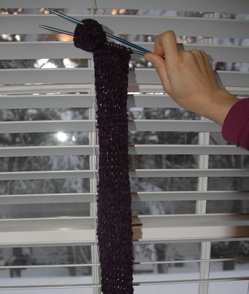
Purple skinny scarfI’m manufacturing a scarf as I sit on the sidelines and wait for Grace to finish her swim practice. Oh, early on I had to make one or two decisions — which of my surplus yarns should I use? how many stitches do I cast on? — but now all I have to do is pick up the needles and start moving my hands to operate the tools in a way I’ve done a thousand times before. As Lydia remarked a few weeks ago about this kind of knitting, it is calming, and it is productive. Row after row after row, the inches add up. I could almost knit this in my sleep. I want the scarf, which is intended for me, yet I feel no urgency about it.

On Monday afternoon, Grace interrupted her swimming of laps, hauled herself out of the pool, and walked over to where I was perched, knitting and waiting for her. Practice was only half done. She looked spent.

“I’m tired. I don’t want to keep swimming today,” she moaned as she leaned against my leg. A conversation determined that her complaint was nothing diagnosable.

“It’s a tough practice,” I replied. “They’re not always fun.” I tried, as I always do when her confidence wavers, to be an external ballast: “You’re halfway there. You look strong.” Inside, I asked myself, Why not just go home? She’s only seven.

“But, Mom!”

With my hand resting lightly on her wet back, I murmured with firmness, “Grace, I know you can do it. Plus, we’re here.” At an education conference in the fall, I learned that children become self-reliant in their interactions with trusted others. It’s our job to coax them, paradoxically, to become more independent. Is this what that speaker meant? I wondered.

Unhappily, she walked back to her lane and slipped into the water. She looked to the coach for direction, and then she bent her knees, pressed her feet against the wall of the pool underwater, and pushed off. Stroke after stroke, Grace swam 25 meters, then 50, 75, and finally 100.

I looked down at the knitting in my lap and tried to compare my rows to hers. What’s different?

When I started teaching, my friend Lisette, a (former) serious college athlete who also became a teacher, asked me, “What are you going to do this semester to get out of your comfort zone?”

“Huh?” I responded.

“What are you going to do that’s hard for you, that you’re not sure you can do?” she elaborated.

I took her question seriously and thought about it for many days as I was planning the semester, and I built into my syllabus challenges not just for the students, but for me. With a silent nod across the miles to Lisette, I do that every semester.

When I do this kind of mindless knitting, however, there’s no risk for me and nothing of value at stake. Like eating ice cream, it’s soothing and filling in a pleasurable way. We all need those kinds of activities in our lives.

Grace’s rows in the pool, however, are different. She’s not always sure she’s up to it or that she can finish what she has signed on to do. There are tears sometimes, cold water, and nakedness in the locker room. There have been no measurable victories so far, although Grace keeps hoping for them, and hence no ribbons on a loop of thread to hang from her neck. And still, she must practice, practice, practice.

Grace swimming

—-

Picture of scarf in hand by Eli. Picture of Grace by Jimmy.

– Fall to pieces

In revising longer works, it’s easy to fall into the trap of endlessly polishing word choices and sentences, because they are small units that can be both held in the writer’s attention and worked on at once, and avoid dealing with the draft in its entirety.

That kind of fine labor, though, could be like running on a hamster wheel — it’s fun, it’s exercise, but you end up not too far from where you started.

For me, and I think for many writers, the hardest parts of revision are figuring out the big picture (“what’s my pressing question? theme? thesis?”); seeing how the pieces contribute to, or don’t contribute to, the whole; and sequencing the pieces in a scheme relevant to the big picture.

On and off, for months, I’ve been working on an unwieldy draft of an essay. It’s too long — 8600 words — for the journal I want to send it to, which has a word limit of 5000. When I read the draft from start to finish, it feels complete to me and every word precious.

So, the only smart thing to do is undo its completeness, which I did.

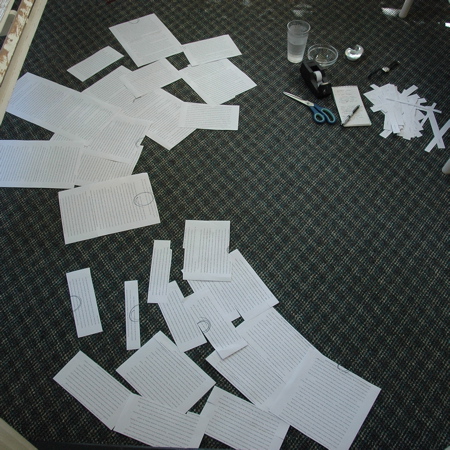
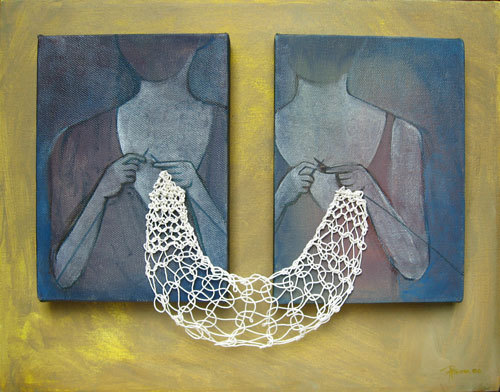
Draft in pieces

I cut it into pieces, based on a similar exercise I’ve done with students and on some remarks that journalist George Packer made to his audience at the Wesleyan University Writers Conference last June. About the structure of his own narratives, he has noticed that the “basic move is between scene and passage of analysis” and “sometimes both occur together.” In the image of my dismantled draft, the pieces in the grouping at the top are scene; the pieces that curve up from the bottom are passages of analysis and, for my purposes, reflection.

Yesterday I looked at each piece and sorted the pieces further: (1) ones relevant to my main idea, and (2) ones not relevant. This work went quickly.

Then I went back into the file for the draft, and I removed (and dumped into another document) all the irrelevant pieces. New word count: 5500.

I’m getting closer. Next step? I’ll lay those patches of paper out on the dining room table, and shuffle them around.

– Convergence

Last week we saw Ratatouille (Pixar 2007) for the first time. Remy is a French rat who loves fine food; his ambition to become a chef is stoked by imaginative visitations from the late Auguste Gusteau, a once-renowned restaurateur who wrote a book titled

Anyone Can Cook.

Yesterday I was sorting through a pile of non-urgent papers that I’ve been hiding, even from myself, in my top desk drawer at home. I came across a document, “NCTE Beliefs about the Teaching of Writing,” that a colleague asked me to read months ago. My eyes fell on the first belief, in bold type:

Everyone has the capacity to write.

These are beliefs. Like the jolly Gusteau, a person can choose to believe that each individual has the capacity to cook (not to become a great chef, but to cook). Like the Writing Study Group of the NCTE, a teacher can choose to believe that each student can write.

What if, however, a chef or a teacher held a similar belief, and yet also maintained an attitude inconsistent with that belief?

How many times have I heard someone grumble about students (especially incoming ones): “They can’t write”? I don’t think that a teacher, whose work is essentially optimistic, believes that college students do not have the capacity to write. What such a teacher is really saying is that her students’ writing does not meet her expectations, or college expectations, and she is daunted by that, and it brings her down. And yet, I wonder, what power does that attitude (“They can’t write”) have on one’s beliefs about one’s own students and, more so, one’s own teaching?

Once in a while I meet a new student in the Writing Center, and, as I read her writing for the first time, I see that it lacks so much in the way of clarity and sense that I do a quick, internal inventory for any teaching skills I might have to offer her as a writer and I come up almost empty. In such an instance, I do feel daunted — it’s like a stone in my chest — and I even set my sights low, not for the student but for the paper at hand. “Jane, just be an attentive audience. Give the student that.” So, I read and I get her to tell me about it. I don’t always understand her reply entirely, but I usually understand enough of it to have a conversation with her about her personal narrative, or reading of a novel, or thoughts about a historical event. I don’t correct or suggest. I listen, ask, nod, smile.

I have been tutoring S., who is such a writing-challenged student, for more than a year. She continues to make sentences that seem more spoken than written, and her grasp of American English idiom is based on what she hears, not what she reads. (For example, in a paper about a high school teacher, she described that person as being “inch arch” of a learning center. She and I figured out that the teacher was “in charge” of a learning center.) Encouragingly, I also see that her sentences are longer and more flowing and that her papers are more fully developed with detail and discussion. She sustains. And that’s a powerful sign of her growth as a writer, but it might be hard to recognize it if I were ticking off her many errors. And there are many; I do see them (and we are just beginning to work on some).

When another teacher, in genuine moments of fatigue or frustration, says to me, “My students can’t write,” I offer, gently, “They’ll get there.” I do not know what my tutee, S., will do in her writing, in school, and in her life beyond my time with her, but I do believe she will get there.

– Cabin fever

Restlessness — a lot of energy packed into a small container (you, your house) — requires an outlet. There are negative ones: complaining, watching reruns of American’s Most Smartest Model, picking at and eating dried-out candy off the gingerbread house. (Yeah, been there.) There are positive outlets, too: cleaning closets, walking around the neighborhood, making something. (Been there, too.)

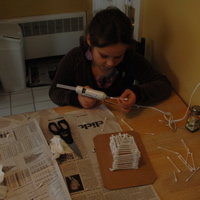
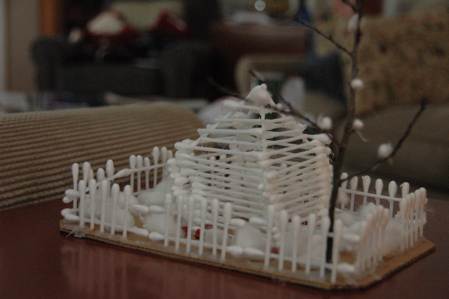
Grace with glue gunGrace channeled her cabin fever into industry today. Inspired by a spilled drum of off-brand cotton swabs, Grace started stacking them into a log-cabin-like structure, and then called for glue. I produced a lower-heat glue gun; I also handed her, unsolicited, a piece of cardboard from a discarded Amazon book box. The impulse evolved into a project, and she worked intently and inventively for a long time, even figuring out how to construct a hip roof by herself (she didn’t know she had made a hip roof until I walked back into the kitchen, saw it, and said, “Hey, a hip roof, just like on our house!”). She stripped a twig of bittersweet, in a bunch in a pitcher on the counter, of its berries and then made a tree in her little cabin’s yard. She used the red, shriveled berries as decorations around the house. I volunteered to help fashion a picket fence after she scalded herself a couple of times with hot glue.

Out of a drawer in the bathroom, Grace pulled a bag of cotton puffs, and she tore these up and put them in the little yard, for snow. “What do you call this?” I asked her. She answered, “Hmmm. Centerpiece of Winter.”

Cotton swab house

I put it on the table where the crumbling gingerbread house had been. A few of us took turns taking pictures of it. Jimmy even took a picture of Grace taking a picture. In her manner, she copied some of Eli’s photography tricks, moving both herself and her subject around, playing with angles and how she held the camera, sometimes close to her eye, sometimes an arm’s length away. I like this one — a bird’s eye view of her house, through the glass top of the living room coffee table.

House from above

And so go the days of our (winter) lives.

—-

Top picture by me; middle picture by Eli; and bottom picture, of her own creation, by Grace.

– Say “yes”

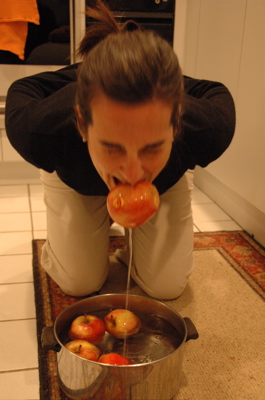
This was not my idea. When Grace set it up yesterday, and then asked, I almost said, “No” or “That’s for Halloween.” Fortunately, that switch clicked off before I fully activated the negative response.

I said, “Yes.”

Jane fishes apple, NY’s Eve ‘07

We all did.

In 2008, let’s all keep protesting the war, interrogating the candidates’ messages, and resisting sloth.

Don’t forget, though, to sometimes flick the “yes” switch. Ride the roller coaster or, at least, the waves. Ski again. Dance in public. Have a tea party. See your friends more. Smile wide enough to show your teeth. Leave the beds unmade. Write, sing, sew, draw, paint messily and off-key.

Repeat a few times.