Old broads in sequins and rouge

I’ve heard it said that if you want to talk to your kids, give them a ride somewhere. I’d like to offer a modification to this advice — if you want to talk to your daughter, take her shopping and haunt the dressing room.

Lydia needed shorts for an upcoming trip with her chorus. Having recently been at Old Navy with Grace and seen mountains of them, we headed there. Lydia filled her arms with what I think of as disposable clothes. (If anyone wants to view the dysfunctional relationship between the U.S. and the developing world, walk into your local ON, head to the clearance section, and see tables piled with t-shirts made in Bangladesh marked down to $3.)

I browsed, too, and met Lydia in the dressing room. “What do you think of this?” I asked her. She may not need my style sanctions, but I need hers.

“Mom, no,” she replied. I love her eyeroll.

“Why not? I love this gray color.”

“Mom. Sequins.”

“But, Lydia,” I implored her, “It’s a peace sign. I’m for peace.”

“Yeah, but you don’t have to wear it on a t-shirt. In sequins. Plus, you’re old.”

“I might buy it.”

“Don’t.”

I didn’t.

And yet I’m still tempted. Something draws me to this t-shirt, and it takes willpower to keep Lydia’s advice in mind.

Not all women resist the call of the sequin, however. This morning Lydia and I stopped in the bagel shop on the way downtown, where I was dropping her off to meet the bus that will take her chorus on the trip that necessitated the purchase of shorts. Most of the people getting bagels at 9:30am in the morning are old-timers. As I waited in line, my eyes were drawn to a woman whose back faced me: curly yellow-blond hair askew, wedgie flip-flops, cropped stretch pants, lumpy purse, and a droopy Pepto-pink sweatshirt decorated with an oversized sequined and plastic-jeweled heart. Continue reading
Be still, my research heart.

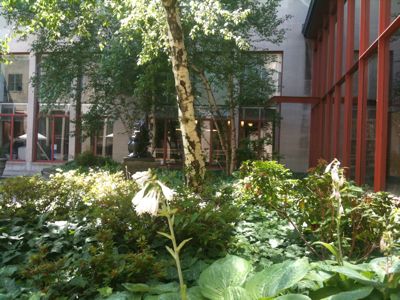
At least twice a week, I walk down the long hallway that is glassed on one side with giant windows that look out on the courtyard outside Hayden Library. I look, and I imagine sitting out at one of the tables and reading in the roofless room, enclosed on four sides and open to the sky. Sheltered/exposed. I look, but I don’t go through the door. And no one else seems to. We’re busy.

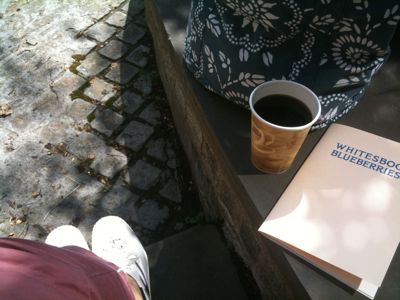
Finally, though, it’s a beautiful day, and I have an errand taking me to Hayden. Through Google Scholar I have found citations to three published articles relevant to my Elizabeth White project. I get coffee at the Clover truck. I head to the library and go through the door. Others have the same idea: there are two young women, with an open laptop, sitting at one table and talking, and there is another young woman at a smaller table, reading. I choose the steps, sit half in sun and half in shade, read a reprint of a pamphlet written by White, and drink the coffee. Already I am happy, like a bee among daisies.

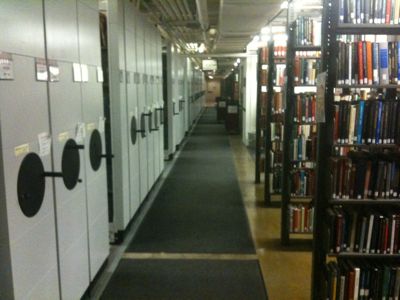
Coffee done, pamphlet read, I head down to the library basement, where the old bound journals cohabitate on those movable shelves. Down there I whiff the minerals of concrete and dust. The air seems to hum, but only because it’s so quiet, and I know that fluorescent lights are supposed to hum. The semester is over; I am alone.

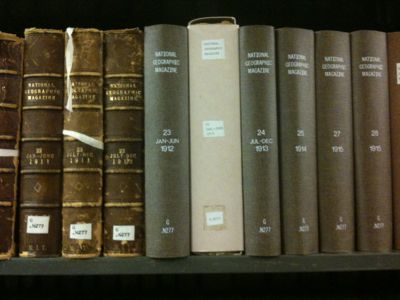
I find the call number for the citations in National Geographic Magazine. Frederick Coville, the USDA botanist to whom Elizabeth White offered her family farm, Whitesbog, as an experimental agricultural station in the 1910s, published three articles in that decade that will help me with my project. Two are on blueberries: one published before White discovered Coville, and one after White and Coville bred a cultivated blueberry that could be farmed. Another article is on the first World War and the U.S. government’s concerns with the food supply in Europe.

Old books have a sour smell, not unlike the tang of expired milk or the acid of bile. When I was a girl and I would open a book with this particular smell in the library and breathe it in, I would consider it mildly vomit-y. I love this smell, and as I open each heavy book I drink it.

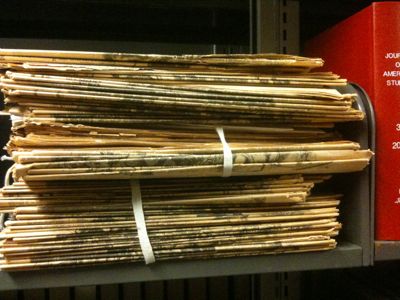
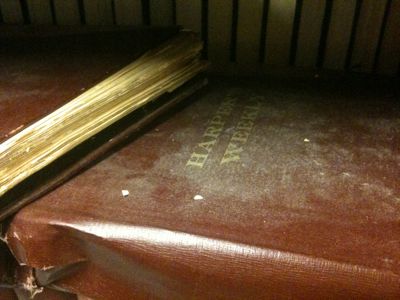
Facing the National Geos are a stack of skinny newspapers. I slide one off the top; it’s Harper’s from 1869. Amazing, I think, that this treasure is out on the shelf and I am trusted to put my human hand on it. It flakes along the fold when I open it wide. Carefully, as though it’s a sheet of glass, I close and arrange it back into place.

My friend Rosemary, doing her own research this summer, offhandedly described her surroundings as “musty old archives,” and reported that our mutual friend, Susan, herself an archivist, first took umbrage at the characterization and then softened: “Perhaps we [archivists] should embrace it.”

Ah, friends, yes. For those of us whose pulse quickens as our steps shuffle down to the library basement, hands open leather-covered and cool pages, eyes delight in the accumulated dust, and noses inhale the sour cloud of old ink while eardrums vibrate with the hum of what is surely our own heart: embrace it all.

You will be mine; you will be mine, all mine.

Those lyrics from this song went through my head as I put this little guy in his place. And then I remembered how much we loved this song in 1980, perhaps because it’s so mimickable. We sang it to each other a lot. I watch the video now, and the song seems to draaaaaaag along. Well, we were 15 that year and had all the time in the world, and we minded not the draggy songs.

I turned on the hose in the back and went to the front yard, where the potatoes are thriving. In only 4 weeks, some of the plants are already 12″ tall, so I hilled them. The UPS guy, in brown shorts that show off the fascinating tattoo running up the meat of his calf, stopped to ask, “What are you growing?” He seemed astonished when I told him, and had been walking toward me but took a step back, and then he said, “Hey, any fruits and vegetables are good, right? Well, except asparagus.” (I happen to agree that asparagus, which I will eat, is over-rated unless garlicked, roasted, and salted.) I confessed my worry that so far the results of my farming experiment are exceeding my hopes: “I might end up with one hundred pounds of potatoes, even more. How will we eat so many potatoes?” He responded by rattling off a list of all the ways potatoes can be prepared, ending with “leftover potatoes, hash browned.”

Even though we Americans normally plant our vegetables in a back garden, the good thing about gardening in the front is that people stop to talk. A woman in a nice black car parked along the curb to go to the temple across the street. I don’t know her, but I recognized her as my friend/neighbor Julie’s friend. She was as interested in my experiment as the UPS guy was, and remarked how satisfying it is when something grows. I said, “It’s amazing,” and then I checked myself: “Well, perhaps it is not amazing.” Lovely and well-groomed, she surprised me when she forcefully replied, “It is amazing. I mean, I’ve grown things myself. Tomatoes, cantaloupes…” In the air and with her hands she held the shape and weight of a cantaloupe, as if she was remembering the growing and picking of it.

While it is wonderful to grow anything ornamental — daisies, hydrangea, impatiens, and sunflowers — there really is something different, and I can’t quite yet put my finger on it, about growing food.

Rejection is impractical.

I recognized the handwriting on the envelope as my own. A SASE, returned to me by the editors of a literary journal. More like the interns of a literary journal.

I opened it and found a flyer for next year’s literary contest. Over and over I flipped this one-page flyer, looking for a handwritten note, saying something like, “Thanks, Jane, but no.” Wordprocessed and photocopied text is all I found.

At last I actually read the photocopy. I studied it even. Ah ha! After the announcement of next year’s contest are listed the winners of this year’s competition, which I had entered. I am not among those listed, and so I deduced that — although no text is actually addressed to me — I did not place in the contest and, furthermore, I will not be published by this journal.

Hmm, thanks a lot for the completely impersonal and oblique reply, oh literary journal. It would have been a step up, you know, to receive a form letter: “Dear Writer, We have read work. It is not right for our publication. Good luck elsewhere. Sincerely, The Editors.” In fact, I would have preferred such a direct form letter. Photocopied notices of next year’s contest are not very good communicators of the “no, thanks.”

“You know what I want?” I said to Jimmy, as we stood in our kitchen, with this blue piece of paper in my hand. “I want to learn something about my writing from the rejection letter.” Here are what might be good responses. I could even imagine a literary journal creating a form letter with check boxes. Even one of these items, checked, would teach me something about my work:

  • No thank you. This still feels like a draft to us.
  • No thank you. This doesn’t fit with our editorial vision or sensibility.
  • No thank you. Honestly, we are overloaded with stuff right now, and your essay did not grab us on the first page, so we didn’t keep reading.
  • No thank you. This is potentially really interesting, but it’s too long for what it is.
  • No thank you. We really prefer to publish the Under 40 and Fabulous Crowd, and this is not that.

While I do see the benefits of preparing one’s work for submission, this kind of rejection is totally impractical. It’s like hitting a tennis ball against the back of the school wall, again, and again, and again. Sure, it’s activity, and it seems relevant to the actual playing of tennis, but it’s not deliberate practice and it won’t get ya nowhere in the game. There’s return, but no feedback.

Jimmy said two things. “You know, you have the platform to publish the essay yourself.” He’s right, and I will.

Then he handed me a 4 x 6″ postcard he got in the mail from Starbucks. “Have this,” he said.

Congratulations

FREE
DRINK

We’ll make you any drink you like.

I’ll take the free coffee. It’ll end up being more personalized than the blue flyer I got from the journal.

Potato farmer’s progress

new potato plant, June 11

I have been wanting to report on the progress of my first attempt at potato growing, and I have been wanting to try Vuvox, a multi-media slide and collage making tool on the web. Two-for-one: I composed a story, with pictures and video, of the first weeks with my potato patch.

Note: My potatoes and Vuvox are still in beta. If you go to the Vuvox potato show, click on the play arrow and let it run through. (If you hold the cursor arrow in the collage field, you can control the speed and direction of the show, but the slide bar is clunky and to be avoided.) When you see the arrow for the video of rototilling, you can click on that, too. It all won’t take very long: 1 minute or so.

Where did I get the instructions for how to grow potatoes? The Maine Potato Lady, of course. Go to her site, and click on “Growing Potatoes Successfully” for a one-page PDF. And because she was out of seed potatoes by the time I was ready to order them, I got them instead from the Gerritsens of Wood Prairie Farm in Maine.

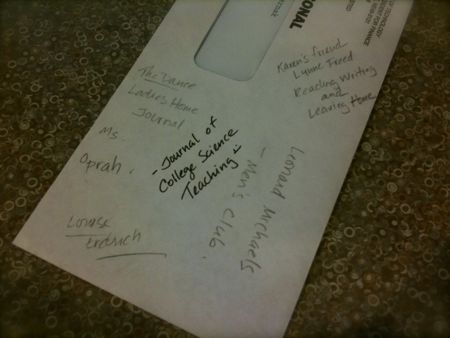
– Front of the envelope

I hadn’t even opened my pay stub — there it was, dropped on my desk — when I called its envelope into service. My office mate, Karen, and I were talking about things to read, journals that might consider our work, and women’s magazines that should not be overlooked.

Sometimes, you just have to write something down, and it cannot wait for the notebook.