Tattered no more

Many readers or watchers of The English Patient (I preferred the novel) were swept away by the romantic story line: the Count and Katharine, their illicit liaisons, the plane crash, desert cave, fire. And I? In both the film and the book, I was drawn to the nurse’s story: Hana, her makeshift hospital, and her care of the burned and disfigured English patient.

Real love, in my view, is seldom epic. It’s steady and practical, and it accumulates in small gestures.

One of the to-do items on a long list of preparations and purchases for Eli’s move to college was mending. Months ago he left three pairs of jeans on the window seat in my room and asked me to make them wearable again. I don’t feel like mending during the school term — I’m too busy mending drafts, I guess — so I put off the task. Last week, a few days before my first child’s departure, I set up the sewing machine, looked at the pants with their three sets of problems, and sat down with scissors and sewing box.

Only one pair was ripped on a seam line, an easy problem to solve, although a rivet through three layers of denim created an obstacle for my non-industrial machine. Solution: remove the rivet, using a hammer and small chisel, and sew along the existing seam lines. Done.

Two pairs weren’t ripped so much as tattered. Eli, through use, had worn the fabric down in the seat and around his wallet pocket. “Couldn’t I just buy you two new pairs of jeans?” I asked him. “I love these,” he said. “Couldn’t you just try to sew them?” Then he flattered me: “Mom, you can do it.”

Anticipating that more fabric would be needed, Eli had given me an unloved pair of denim shorts to cannibalize. I cut patches from these shorts and pinned them to the tattered places. I tacked them in place using a zigzag stitch.

Then I dialed the stitch setting on the machine back to the straight stitch, and I randomly and repeatedly sewed back and forth across the patches. This was true patching, building up a new fabric, in a way.

I kept my foot on the power pedal, periodically pressed the directional switch to reverse (the “back” of the back and forth stitching), and watched the stitches gather and blur into each other. I switched thread color, from gray to light blue for the denim ones and khaki to stone for the corduroys, to increase the blurring effect.

I thought about leaving my signature somehow, writing a word in stitches that would be like a secret message — one so secret only I would know about it — for the mended pants to carry around as Eli wore them. Mom, Jane, love all seemed too corny. (Plus, how twisted would that be, to write your own name in your son’s pants?) I considered hieroglyphs, which would fit invisibly into the random stitching, or tattoos or Japanese characters.

No symbolic language, in the end, made it into the mended pants. After I finished sewing, I snipped all the loose threads and admired my own work. We threw them into the wash, and Eli folded and packed them into his suitcase* for college. The pants and Eli live in Vermont now.

_____

*Wait, there’s more! In trying to lift Eli’s overstuffed suitcase into the back of the car, I hurt my toe. Of course, I had to find a way to write about that. I called it “Toe Story” and posted it on my other blog. Link. There were sequels: “Toe Story 2” and “Toe Story 3.” Link 2 and Link 3.
The girl with silver hands

On Tuesday night, after a gap of five years, our friends the Zimmers came to dinner.

Ulrike and I met 17 years ago, in a manner that is not unlike the beginning of a romance. I was sitting near the window in a coffee shop in Brookline Village, looking out, and she was walking by, looking in. Our eyes met, and, although we were strangers, we smiled a greeting. The next day, or perhaps the day after that, we recognized each other at our children’s nursery school. Instantly, it seems now, Ulrike and I were friends.

We were neighbors during the time she, her husband Claus, and first daughter Pauline lived in Brookline. I look back on that as a golden time, although some of what we discussed during our countless moments together, alone or with Pauline and Eli, was rooted in the struggle to figure out who we were now that we had become mothers.

And, I dare say, if we had had more time together this week, we would have returned deeply to those mutual concerns: Who am I? What work am I most suited for? What do I want for myself?  Where is that line between where others end and I begin? When the Zimmers moved back to Germany in early 1996, I lost a daily connection to a rare and intimate friendship. Yes, letters and email and infrequent visits can keep us in touch, but we are missing out on the incremental and ordinary comforts of being nearby. Shared life.

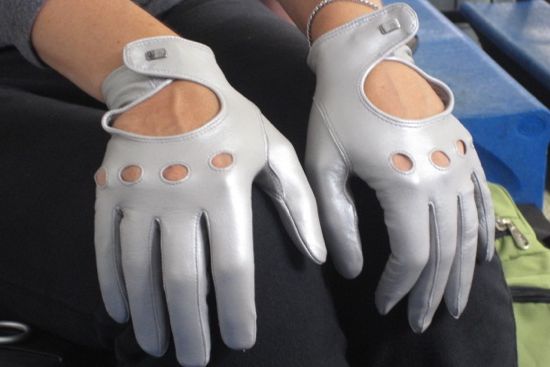
On Tuesday night, Ulrike brought us presents. To me she gave a pair of beautiful, silver leather gloves from a famous German glovemaker. “For the skater,” she said. I felt known by my friend, as though she had recognized the ‘me’ that I am, alone. Not the mother, not the teacher, not even the friend. A true gift.

Today I wore them for the first time. Little by little as I learn how to skate, I have been progressively marking my commitment to it in concrete ways: the purchase of fitted ice skates; the private lessons; the summer practice time; notebook; and gear bag. This is my first piece of costume.

I skated neither better nor worse today. In fact, one of the rink regulars, whom I recognized but don’t know, skated up to me and gave me some unsolicited “skater’s advice,” as he called it, which, he promised, “will give you more power.” (I found this to be extremely irritating, and I wish I had had the perfect comeback. Mad at him, I turned my back, but later tried what he suggested. I vow, though, to never thank him.)

The whole time I skated, I felt my gloves on my hands, and they seemed to be helping me steer into the future, when I will only skate better.

On our last afternoon together, Ulrike was brainstorming ways to get me and my family next to Munich for a visit. (Business trip? Frequent flyer miles? House swapping?)  “We cannot let five years go by again,” she said.

“Yes,” I say. Our words make a promise to the future, when we will see each other again.

—–
The title of this post is an homage to the Brothers Grimm’s tale, “The Girl with Silver Hands” or “The Girl without Hands.” The photographs were taken by Grace Guterman.

A feedback lexicon

Leave it to others to run marathons.

I, instead, participate in another endurance sport: the writing of miles and miles of comments on student writing.

In the past two weeks, in addition to having to submit the final report (with data) on a grant project I collaborated on, I wrote substantial comments on 40 essays and 28 research posters for two summer projects. There was so much to do in a short period of time that last Sunday morning I was sitting at my laptop at my dining room table at 7 a.m. to begin a day’s work.

My comments are typed, so I have a record of them, and for each project I copied and pasted them into one file to look at them for good language for future comments: Did I come up with a tactful yet straightforward way of saying, for example, “This has no evidence”?

Although I continuously referred to the rubric, I had no way of knowing, however, if there was any consistency to my comments as I was doing them. So I turned to Wordle to see if there were any patterns, and I hoped that what Wordle revealed in its illustration of my feedback lexicon would have some relationship to my intentions. Before I created the word map, therefore, I wrote down a list of terms I thought/hoped I used more frequently.

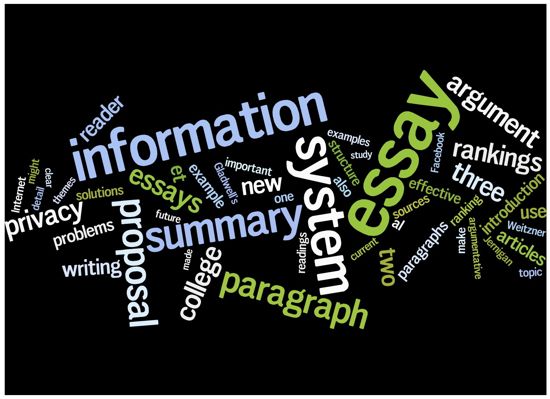
You can see the Wordle of my top 50 words as the illustration at the top.  Most of the words have to do with writing features or issues (e.g., paragraphs), although some of them have to do with the topics students were assigned to write on (one topic was information privacy and the other the college rankings system). I’m relieved to see that there is some relationship between my key words and what I recall of the rubric.

And there is also some relationship between the words I recall using most and the words I used most. Here’s the list of terms I wrote down before doing the Wordle, with some comments on their appearance in the graphic:

  • information (appears first on my list and is prominent in the graphic)
  • readings/sources (“articles,” “readings,” and “sources” appear in the graphic)
  • summary (strong in the graphic, too)
  • propose/proposal (ditto)
  • illustrate (not in the graphic, although “example” is)
  • some/more (not in the graphic)
  • understanding (not in the graphic)
  • synthesis (not in the graphic)
  • detail (in the graphic, quite small)
  • citation (not in the graphic)

So, one disappointment in my comments is that the word “synthesis” does not appear in the graphic of my top 50 words. One of the requirements of the summary prompt was that use of sources be synthesized. Ideally, I would have commented on whether or not a student did that in each essay. Perhaps I used synonyms (e.g., integrate or weave), but I may have missed a chance to emphasize this important terminology, which should become familiar to a college writer early on. Same for the word “citation” — I wish that it, or acknowledge or attribute or cite, appeared on the list of top 50. (It’s possible that source/readings/articles/use in some combination are how I addressed this in the comments, though, and all four of those appear in the graphic.)

And yet I do see some terms on the graphic that are really important in academic writing: argument, paragraph, structure, examples, reader, problems, topic, and even essay.

I did this as a reflective exercise. In future comment writing, I might try this midstream as a kind of quality control: am I hitting all the notes I want to hit? what could be dropped (my use of the tentative “might”)? what could be more emphasized (the word “idea”)?