Writer’s Dozen: Mary Oliver and Sound

This is the third in a series of posts, called “A Writer’s Dozen,” on texts that have been important to me as a writer.
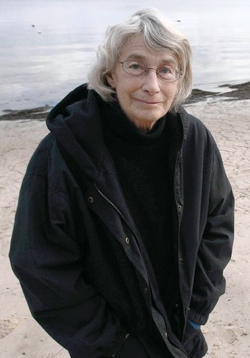
on the Provincetown shore, 2010

Words have more than meaning.

Words have sound, and how words sound affect the quality of something written.

For example, you could use either the word “moist” or “damp” to describe the armpits of a character’s shirt; the meaning — slightly wet — is about the same. And yet the sound of moist, which causes a pressing together of lips to create the mm, a pursing to form the oy, and then a sinister baring of teeth for the soft and hard st, evokes more disgust than the simple, matter-of-fact damp with its softer consonants.

D and p, in fact, are mutes, and m is a liquid. These are terms for types of consonants, grouped into what Mary Oliver calls “families of sounds” in A Poetry Handbook (Harcourt Brace, 1994).

Sounds of words matter — Oliver compares the nouns stone and rock and the commands “Hush!” and “Please be quiet!” — because, as she writes, “there is, or can be, a correlation between the meaning, connotation, and actual sound of the word.”

I love this book for its clarity, simplicity, and helpfulness. At different times in my life, especially my teens and mid-30s, I have had a great impulse to read and write poetry,  with scant formal training in it, and by that I mean no college or grad school poetry workshops. I did, as an adult, take a few classes in poetry through the Brookline Center for Adult Education, where I learned and wrote a lot. (One doesn’t have to get credits to get educated, I say.)

It was around this time I encountered Oliver’s Poetry Handbook for the first time. Over the years, whether I’ve been writing poetry or not, it has been a helpful reference on sound, meter, rhyme, and line breaks. Even if you are more a poetry reader than writer, this book can help you understand how words and combinations of them can do their work.

On rhythm, she writes:

The reader, as he or she begins to read, quickly enters the rhythmic pattern of a poem. It takes no more than two or three lines for a rhythm, and a feeling of pleasure in that rhythm, to be transferred from the poem to the reader. Rhythm is one of the most powerful of pleasures, and when we feel a pleasurable rhythm we hope it will continue. When it does, it grows sweeter. When it becomes reliable, we are in a kind of body-heaven. Continue reading
Looking for signs of meaning where perhaps there are none

When I walk or run around the neighborhood and spot an unkempt yard — knee high grass, fallen branches, no blooms, shapeless bushes, ripped screens, tree branches hanging heavy on the roof — I wonder if either the very old or the very sad live there.

What do the unfamiliar passers-by make of my robust crop of crabgrass in an otherwise tended yard? I hope they think I’m very organic.

Earlier today Grace was puttering around with the camera, taking pictures of things she was on the verge of throwing away. This is my coping strategy, to make it easy to discard things that have sentimental value. The digital camera can help us hold on to them, even after the shoes, artwork, or unmatched dishes are gone to Goodwill or a landfill.

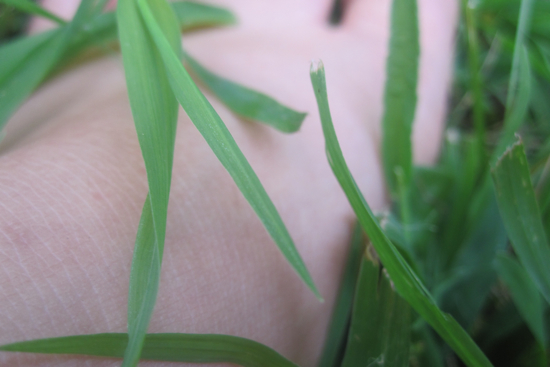
I poked my head out the front door and said to her, “Please take me an artful photograph of crabgrass for my blog.” Here’s one she offered.

What does my crabgrass means to me? I can only do so much; herein lies my limit. If you want trees and flowers, please look past my grass.

Imagine the luck of her future second graders

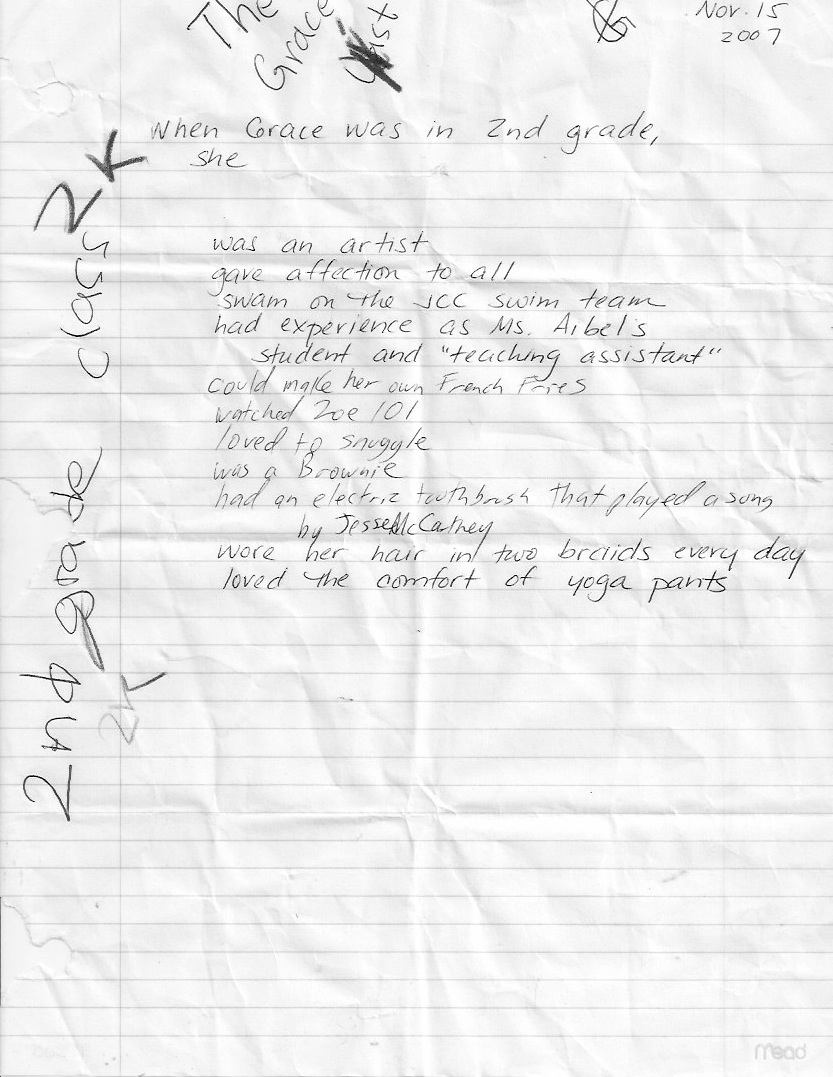
Grace and I have been bitten by the organizing bug, and we are culling our collections. I took four boxes marked “Jane’s Junk” and got them down to one, and Grace has stripped her closet down to the essentials and tackled her desk drawers. Last night she came across a list made five years ago when she was in the second grade. Knowing I like to save the textual artifacts of childhood, Grace handed it to me. You can click on the thumbnail to see the scanned version in full size or read the transcript below.

From the handwriting, it looks like Jimmy and I took turns at dictation. I asked Grace, “What was this list for?”

She replied, “When I was in second grade and thinking about becoming a teacher, I thought it would be neat to be able to tell my second graders some day what I was like when I was their age.”

This is what she was like, as reported on November 15, 2007:

When Grace was in 2nd grade, she

  • was an artist
  • gave affection to all
  • swam on the JCC swim team
  • had experience as Ms. Aibel’s student and “teaching assistant”
  • could make her own French fries
  • watched Zoe 101
  • loved to snuggle
  • was a Brownie
  • had an electric toothbrush that played a song by Jesse McCartney
  • wore her hair in two braids every day
  • loved the comfort of yoga pants

Wouldn’t it be wonderful if Grace, or Eli or Lydia, became a teacher? Then there would be three generations of us: my father, my mother-in-law, I, and one of the kids. Now that would be a family legacy.

States of matter, a dream

In Colson Whitehead’s “Rules for Writers,” number five is “Keep a dream diary.”

Sometimes, if I am awakened by a dream, I turn on the light near the bed and grab a scrap piece of paper — usually one of those blow-in cards from a magazine I’m reading — and a pencil, and I write it down.

Last night I had a dream that my skating teacher and his wife had a baby, and they wanted me to take care of it. So, I took that newborn swimming, and it swam.

The dream is still vivid, especially the baby and the YMCA-like pool.

Ice, water. (What’s next, an evaporation dream?) What does it mean?