Ice skating and September 11, 2001 are bound together in my memory. We didn’t do it that year, and yet I longed for it: link.
And in remembrance: link.
Grace had a gig this afternoon babysitting for two little boys, ages 5 and 1 years, who are children of our friend Ellen, a woman who babysat for Grace when she was a baby. It’s that whole circle of life thing.
We invited the boys here, so that Grace could have backup if needed. Today we’re just puttering around the house anyway; there are still about 10 days left to finish our summer chores before the season officially ends.
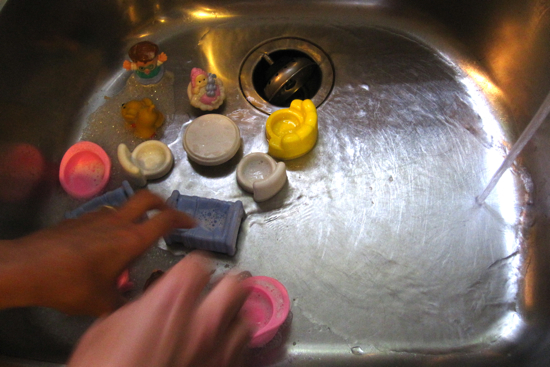
It was time to bring up some age-appropriate toys from the basement. The dollhouse and its residents and furnishings needed washing. Good thing I soaped and rinsed them because most of those pieces ended up in a little mouth.
I did administer one timeout today, when the older boy took his brother’s pacifier and wouldn’t hand it back to me. That parental authority: I still have it. Jimmy let the older boy win at a complex card game with slippery rules, and the two of them bonded.

Young children keep going and going and going. I remember when Eli was little, Jimmy would once in a while hold the tv remote in his direction and mime trying to get him to stop for just one minute.
When the father picked the boys up at 5pm, I told him we got our exercise, two times over, today. “This is how they are until bedtime,” he replied. Honestly, I had forgotten.
Grace is resting. We’re still parents, and we have things to do.
 —–
—–
Suds by Jane; photographs by Jimmy and Grace; and dollhouse by Fisher Price.
The crabgrass is an invader. Not only has it staked its claim on various islands of the lawn, it has mingled with the flowers in the front yard too. What we call “weeds” is socially constructed, you know. Crabgrass is simply one kind of grass, equal to others, but we don’t like it, we can’t control it, so we think of it as a weed: undesirable and to be eradicated.
I’ll live with it on the lawn — and it only grows out front, where there’s sun — but I dislike crabgrass among the flowers I planted intentionally.
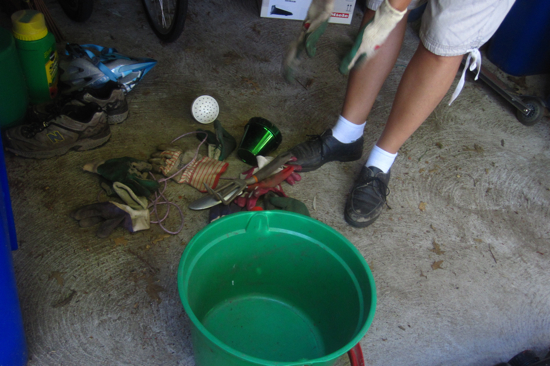
Weeding is good to do early in the day. It focuses the mind and then clears it. Was I procrastinating the semester prep I need to do when I put on my work shoes and gathered the bucket and tools? Yes. If one is putting off something else, though, it is good to at least accomplish another task. Recently I read that the highest-achieving people always do their most difficult work first. Ah, not me. I like a little puttering first, sort of like walking around the block before a run. The warm up, the loosening.
It is satisfying to grab the head of a clump of weeks, pry the dirt a bit from below, and then pull, feeling the roots of the weed pull back and my own gentle force eventually overcome their tenaciousness. Is this similar to the satisfaction dentists, doctors, and even aestheticians feel in their work with the human body? The organism resists; the professional — wilier, and with tools — overcomes. This may also lead to the despair that is sometimes felt in working with the human body, with nature in general: ultimately, its own force or fragility asserts itself and the counter force we apply fails. The river overflows the bank; the freckles proliferate; illness has its way; children grow and become themselves; we age.
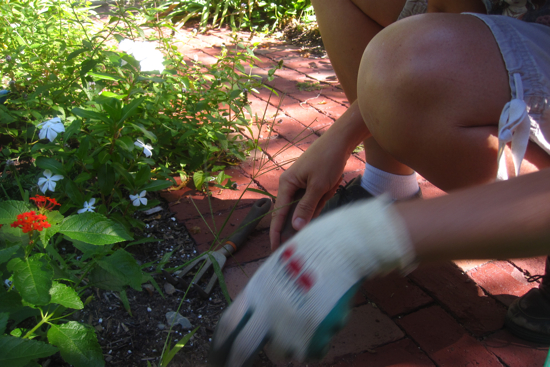
Working with one’s hands — and typing does not feel like work with one’s hands, although hand writing does — focuses the mind on the task. There are a set of small decisions to make as well as continual adjustments. To any passerby, I probably look quite still as I weed, just my hands and fingers busy, but I inch my way down the front walk and my mind, meanwhile, buzzes with thought: about the flowers and which ones to plant again next year, about the fall tasks around the corner, about water and my access to an abundant amount of it, and about the burden and pleasure in owning a piece of the earth.
Eli once said it’s so weird that people can own property, a piece of the planet, and when you stop to think about it, he’s right. Surely, we have to live somewhere, but strange that only Jimmy and I have a claim on these particular 7,000 square feet of dirt in Brookline, Massachusetts. And how far down do our rights go? A foot? Down to the sewer and gas pipes? All the way to the center of the earth? I picture a cutaway view of my house on the earth’s crust and the massive sliver of geological layers on which we rest. And if I do own the sliver all the way to the planet’s core, do I also have responsibility for it?
The parts of life that touch me have this awesome responsibility: if I know about it, or am associated with it, I am implicated in its maintenance or outcome. To not take responsibility (and I don’t, always) is to make an active decision to *not* concern myself, to shut off that part of my brain or body that could act. I won’t help (though I could); I won’t care (though I do); I will leave this to someone else.
I’m not borrowing the rhetoric of the self-help movement to assert my need for “me time” (I hate that expression). Occasionally I have this dialog with myself because I am lazy or tired or even because I lose faith in myself.
This is the third in a series of posts, called “A Writer’s Dozen,” on texts that have been important to me as a writer.
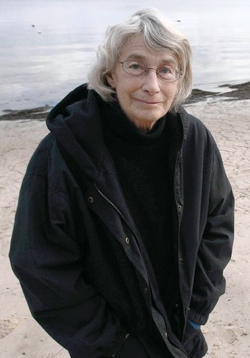
on the Provincetown shore, 2010
Words have more than meaning.
Words have sound, and how words sound affect the quality of something written.
For example, you could use either the word “moist” or “damp” to describe the armpits of a character’s shirt; the meaning — slightly wet — is about the same. And yet the sound of moist, which causes a pressing together of lips to create the mm, a pursing to form the oy, and then a sinister baring of teeth for the soft and hard st, evokes more disgust than the simple, matter-of-fact damp with its softer consonants.
D and p, in fact, are mutes, and m is a liquid. These are terms for types of consonants, grouped into what Mary Oliver calls “families of sounds” in A Poetry Handbook (Harcourt Brace, 1994).
Sounds of words matter — Oliver compares the nouns stone and rock and the commands “Hush!” and “Please be quiet!” — because, as she writes, “there is, or can be, a correlation between the meaning, connotation, and actual sound of the word.”
I love this book for its clarity, simplicity, and helpfulness. At different times in my life, especially my teens and mid-30s, I have had a great impulse to read and write poetry, with scant formal training in it, and by that I mean no college or grad school poetry workshops. I did, as an adult, take a few classes in poetry through the Brookline Center for Adult Education, where I learned and wrote a lot. (One doesn’t have to get credits to get educated, I say.)
It was around this time I encountered Oliver’s Poetry Handbook for the first time. Over the years, whether I’ve been writing poetry or not, it has been a helpful reference on sound, meter, rhyme, and line breaks. Even if you are more a poetry reader than writer, this book can help you understand how words and combinations of them can do their work.
On rhythm, she writes:
The reader, as he or she begins to read, quickly enters the rhythmic pattern of a poem. It takes no more than two or three lines for a rhythm, and a feeling of pleasure in that rhythm, to be transferred from the poem to the reader. Rhythm is one of the most powerful of pleasures, and when we feel a pleasurable rhythm we hope it will continue. When it does, it grows sweeter. When it becomes reliable, we are in a kind of body-heaven. Continue reading
One less man to pick up after,
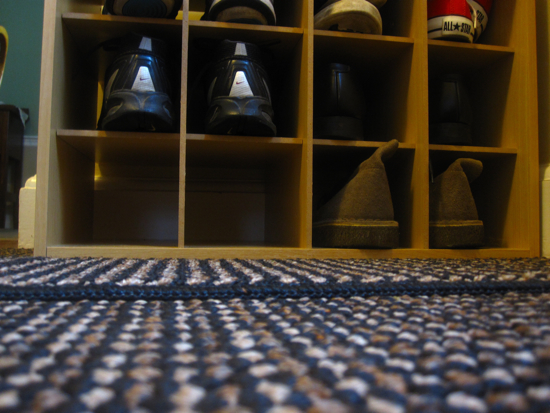
slots for Eli’s shoes
All I do is cry.
door to Eli’s room
Why, why, why did he leave?
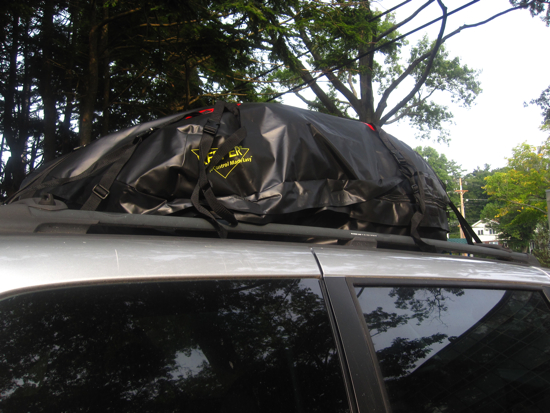
bag for Eli’s stuff
Because he is headed back to college today. Will miss.
When I walk or run around the neighborhood and spot an unkempt yard — knee high grass, fallen branches, no blooms, shapeless bushes, ripped screens, tree branches hanging heavy on the roof — I wonder if either the very old or the very sad live there.
What do the unfamiliar passers-by make of my robust crop of crabgrass in an otherwise tended yard? I hope they think I’m very organic.
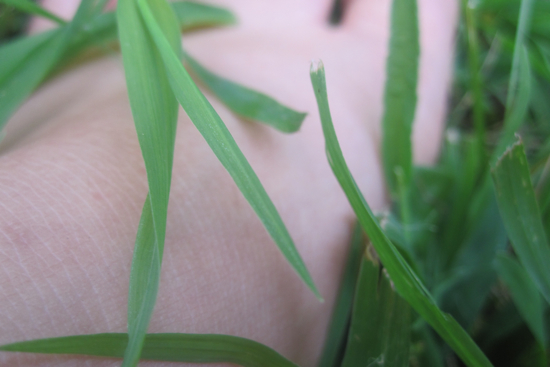
Earlier today Grace was puttering around with the camera, taking pictures of things she was on the verge of throwing away. This is my coping strategy, to make it easy to discard things that have sentimental value. The digital camera can help us hold on to them, even after the shoes, artwork, or unmatched dishes are gone to Goodwill or a landfill.
I poked my head out the front door and said to her, “Please take me an artful photograph of crabgrass for my blog.” Here’s one she offered.
What does my crabgrass means to me? I can only do so much; herein lies my limit. If you want trees and flowers, please look past my grass.
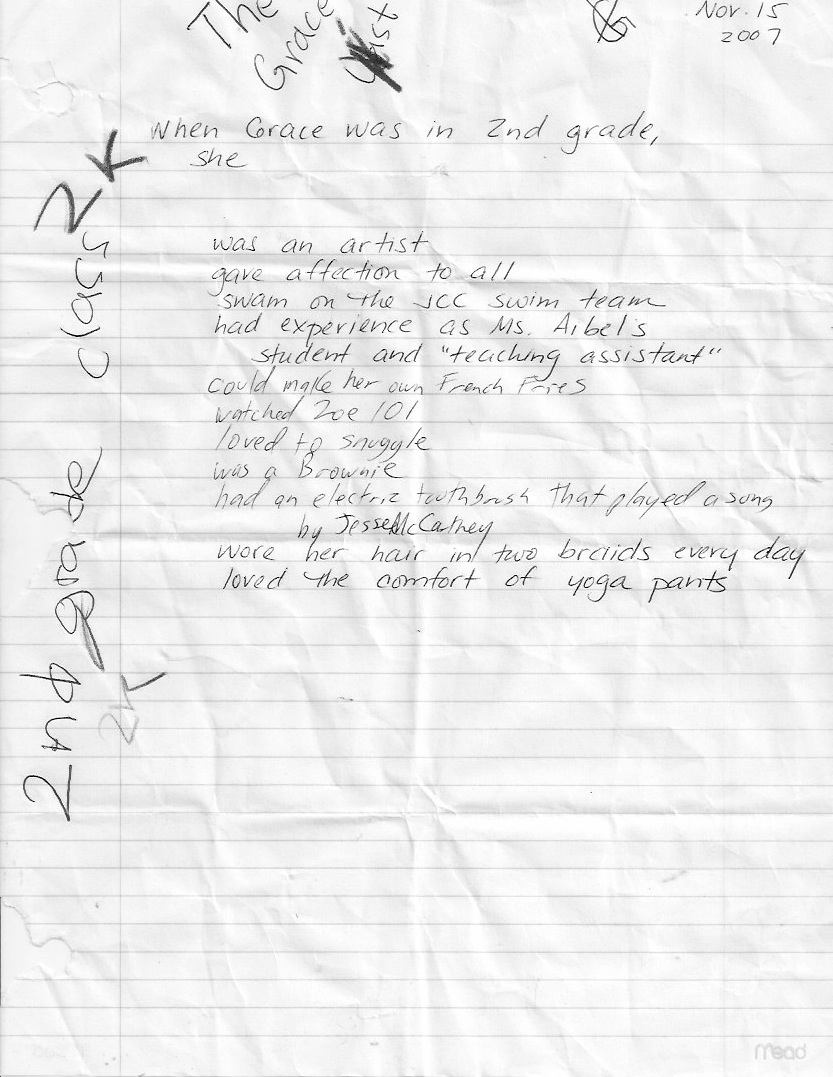 Grace and I have been bitten by the organizing bug, and we are culling our collections. I took four boxes marked “Jane’s Junk” and got them down to one, and Grace has stripped her closet down to the essentials and tackled her desk drawers. Last night she came across a list made five years ago when she was in the second grade. Knowing I like to save the textual artifacts of childhood, Grace handed it to me. You can click on the thumbnail to see the scanned version in full size or read the transcript below.
From the handwriting, it looks like Jimmy and I took turns at dictation. I asked Grace, “What was this list for?”
She replied, “When I was in second grade and thinking about becoming a teacher, I thought it would be neat to be able to tell my second graders some day what I was like when I was their age.”
This is what she was like, as reported on November 15, 2007:
Wouldn’t it be wonderful if Grace, or Eli or Lydia, became a teacher? Then there would be three generations of us: my father, my mother-in-law, I, and one of the kids. Now that would be a family legacy.
In Colson Whitehead’s “Rules for Writers,” number five is “Keep a dream diary.”
Sometimes, if I am awakened by a dream, I turn on the light near the bed and grab a scrap piece of paper — usually one of those blow-in cards from a magazine I’m reading — and a pencil, and I write it down.
Last night I had a dream that my skating teacher and his wife had a baby, and they wanted me to take care of it. So, I took that newborn swimming, and it swam.
The dream is still vivid, especially the baby and the YMCA-like pool.
Ice, water. (What’s next, an evaporation dream?) What does it mean?

couples, outside the ICA, Boston, June 2008
Sometimes what you want is far away, a dream.
And sometimes everything you want is right next to you.
On Sunday, two days ago, the five of us traveled in our van to New Jersey to see the relatives there. As the children get older, it is rare that we are all together on a day that is not a holiday. We played a mix CD that Eli made; it might have been the one he called “Hedge Money” or the one called “Sky Mall Mix.” They’re both good.
The three of them are talkative. We eavesdrop and only occasionally interject. I had my notebook on my lap most of the way.
—–
Eli (almost 20) gives travel advice Lydia (age 16), who is headed to Vietnam and Cambodia next year: “There are going to be so many leeches there.”
Lydia disagrees: “Don’t you think I’ve already gone on the web to see what kinds of insects there are?” This does not surprise me. Lydia is thorough and always prepared.
Eli keeps insisting. Lydia says heatedly, “Eli, sometimes you try to act as if you know more about something than I do, when in fact I know more about it!” I wish I had her awareness and the guts to go with it when I was a teenager. Really, it took me until I was about 35 to even think what she said.
—–
Eli looks at a photo of Grace (age 12) on someone’s phone. He says to her, “You’re so hospitable. You’re going to make a great escort someday.”
Grace: “What’s an escort?”
—–
Eli has two more weeks to go at Otto, his summer employer, a new, upscale pizza place in Brookline. By now, with his hands and forearms covered with oven burns and knife nicks, he’s had it. He describes his quitting fantasy (don’t we all have them?): “If I were ever so mad at Otto that I was going to quit on the spot, I would take a bite of everything that was about to be served and be like ‘Fuck you, Otto,’ and walk out the door.” We laugh. Continue reading
It was late afternoon and time to attach the sprinkler to the hose. I searched the darkening sky, and I asked Sara (age 10) and Grace (age 12), “Do you think it will rain?” They laughed. Within 10 minutes, the sky had opened, and I crossed another item off the Saturday list.
 leaf stitch word