Banana tattoo

Eli was home from college for a week. Even when he was quiet he made his presence felt by the traces he left here and there: a skateboard in the mudroom, canvas shoes near the door, and water glasses near the couch and his bed.

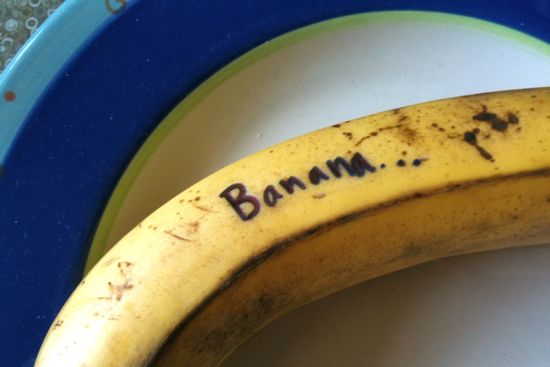
This morning I grabbed the last banana to caramelize for the waffles, and I saw that Eli may have picked up my tendency (and taken it to the next level) to see writeable surfaces in every scrap.

How do I know he wrote “Banana…” on the banana? That’s his handwriting and his sense of humor.

I am instantly in love with this project

This notice from The New Yorker caught my eye and rang the wonder bell.

Patrick Shea, an elementary-school teacher and musician who lives in Brooklyn, has spent the past three years setting “Moby-Dick” to music, writing one song per chapter. He’s performing them with his band, Call Me Ishmael, during a weekly residence at Pianos, a club on the Lower East Side.

I found Patrick Shea’s blog and song list. I found the song for possibly my favorite chapter, 89: Fast-Fish and Loose-Fish. My one-word review: peppy.

Not sure these songs will climb any charts, but no doubt Melville would have related to this display of obsessiveness.

It’s always good to leave a note

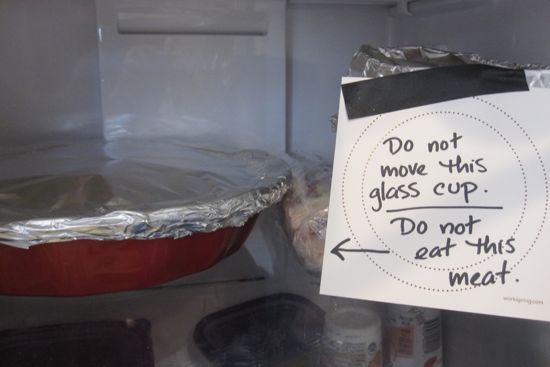
We’re having friends over for dinner tonight. Because I’m working until 5pm today, I cooked the main dish (the filling for Korean beef tacos) overnight in the crockpot. This morning I shredded the meat, strained the broth, and packed the meat and liquid into the refrigerator. Eli is home from school for a week, and I can imagine him rummaging through the fridge in my absence, finding cooked shredded beef, and sampling. And there would go dinner.

He’s still asleep. Soon I’m off for the day, so I’m left him a communiqué, taped to the Pyrex measure containing the broth to be boiled down later.

About me Lydia once said to Jimmy, “It’s so cute how mom leaves these little scrap notes everywhere.”  Any paper bag, junk mail envelope, promotional note pad, newspaper or magazine page margin, notice from school, a stray and linty post-it note, or an old greeting or business card: these are writable surfaces and a good place for me to leave a list, note to self, or note to you.

On teaching: some lessons via David Byrne

In February 2009, we went to see David Byrne and his band at Radio City Music Hall. The tour marked the occasion of Byrne’s new album, Everything That Happens Happens Today, with Brian Eno.

When the curtain opened, the audience saw the full band and dancers dressed in white and poised to play and Byrne himself also dressed in white but with his back to the audience. We could see his guitar strapped to him, although it was partly blocked from our view by his back.

We don’t expect this as audience: our first encounter with the performer ignoring us. He’s there for us, right?


In my seventh row seat, however, the teacher in me — immediately and without much reflection — got it. Facing an audience takes so much out of a person, even if he is accustomed to that encounter, that Byrne was delaying that moment. He was on stage and yet easing his way into it.

This memory and its interpretation is clearly my projection of an inner state on Byrne’s; I actually have no idea for this back-to-the-audience stance. (Indeed, when I mentioned this to Jimmy, who has a different memory of the show, he said, “Maybe Byrne was talking to the drummer and the curtain suddenly went up, and he was caught there.”) This interpretation is about me and my relationship to my audience, i.e. students, much in the way my dream about Beck was about me.

Unless you are a raging extrovert and love the limelight, it takes some psychic sturdiness and a little push to get one’s self, as a teacher, to stand up in front of those students every day and really be the teacher.

Today, writing in the New York Times about his experiences as high school teacher of students with learning disabilities (please read his great essay!), William Johnson describes one dimension of the job that requires special fortitude:

Like most teachers I know, I’m a bit of a perfectionist. I have to be. Dozens and dozens of teenagers scrutinize my language, clothing and posture all day long, all week long. If I’m off my game, the students tell me. They comment on my taste in neckties, my facial hair, the quality of my lessons. All of us teachers are evaluated all day long, already. It’s one of the most exhausting aspects of our job.

[…] If our students are not learning, the let us know. They put their heads down or they pass notes. They raise their hands and ask for clarification. Sometimes, they just stare at us like zombies.

And if they are college students, sometimes they just fall asleep. Continue reading

Give me your tired, your poor, your huddled masses

This is the line that goes through my head every time I enter a Registry of Motor Vehicles, as I did yesterday with Lydia to get her learner’s permit.

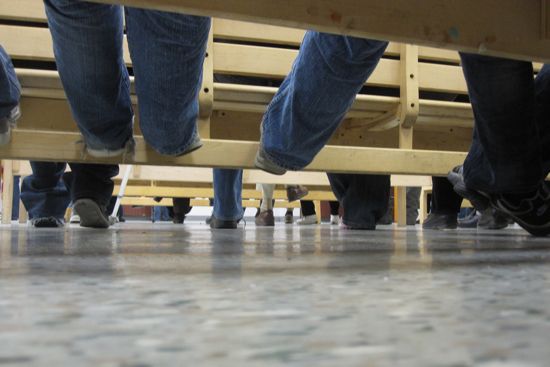
view from the floor, Watertown RMV waiting room, Feb 27 @ 4:23pm

While I don’t think my parents ever embarrassed me*, I do cross that line occasionally with my children. Usually they let me know and stop me from whatever I’m doing.

At the Registry, Lydia wasn’t too happy with me taking pictures of people in the waiting room. (Who knows when I’ll need a portrait of human abjection?) So I moved the camera to the floor.

Missions accomplished: learner’s permit gotten and pictures taken.

*Well, Mom, once there was a weird hairdo.

The pitfalls of self-selection

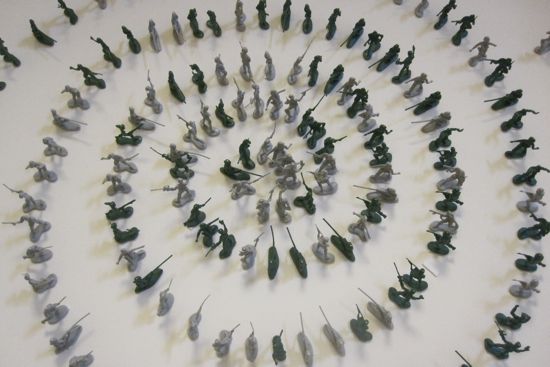
soldiers affixed to wall, MIT's Infinite Corridor, 12.14.2011

This morning I went to the free lessons provided to members of the MIT Figure Skating Club, which I joined this year. The teaching is professional and attentive, and groups are small. Weekly attendance varies, though, and there is sub-par continuity.

Today Esther, the club founder, announced the start of lessons at 9:30am, and she directed absolute beginners to one teacher, beginners to another, the “somewhere between beginners and intermediate” to two teachers working together, and the intermediate to the fifth teacher. I swizzled over to the group with a lot of room for in between, where I consider myself.

The two teachers for that group, Susan and Alex, suggest we divide into two sub-groups: “If you can do the backwards crossovers well, skate with Susan. If you’re still working on them, skate with Alex.” I skated over to Alex’s circle. We warmed up by practicing forward moves around our circle.

At Alex’s signal, we switched to backwards crossovers. I practiced haltingly, stopped to watch the others, practiced some more, and watched some more. I looked over occasionally to Susan’s circle, too, to watch their attempts. (Often I can learn as much from my slightly better peers as I do from the instructor.)

Here’s one thing I noticed: every single skater, but for two in Alex’s group, was struggling with the crossovers in some way. The self-selection into groups, therefore, was according to a criterion that could be too loosely interpreted (if you can do moves “well” versus “still working on them”). Except for the two skaters who had (wrongly) sorted themselves into Alex’s group and who could do the backwards crossovers very well, we were all still learning, practicing, working.

Nothing bad came of this. We all got excellent instruction, including 1:1 coaching, and plenty of practice time. Still, perhaps the self-sorting could have gone better if Susan had said, “Skate with me if you can do the backwards crossovers in a fluid motion and are now working on the second push; skate with Alex if you haven’t gotten to the second push yet.”

This is recreational skating, so there is little at stake. However, think about how this happens in other educational contexts or at work. People are asked to volunteer if they are (self) perceived as “good” at something. “If you can draw, sign up for the graphic design committee,” or “If you have leadership experience, we need some committee heads,” or “If you’ve finished the homework, come work with your classmates who haven’t.” In every case, it’s possible that some not-very-qualified people who overestimate their own ability will end up in a high stakes position in which they’ll flounder. It’s also true that some very-qualified-yet-humble people will not volunteer for a role in which they could make a huge contribution to the group.

Last semester, for example, in one of the classes I teach in with students organized into project teams, I said to a student whose work I had seen, “We need you for the presentation slides. You have a sharp eye and a real sense of visual design.”

“Me?” she balked. “Oh, I just learned this stuff in a class last year.”

“Yeah, but it’s good.”

“Oh, I don’t know,” she continued to protest.

Another student chimed in: “I’m good at graphic design. I’ll do it.”

The team elected the second student, who chimed in with great self-assurance, to design their presentation. It turned out fine; it was workmanlike. But did it pop? No.

This is an age-old problem: the egotistical will typically overestimate their abilities and the modest will underestimate (or under represent) them. As teachers or administrators, though, we must come up with more precise language and criteria to improve self-selection. We could also ask for examples and demonstrated skills.

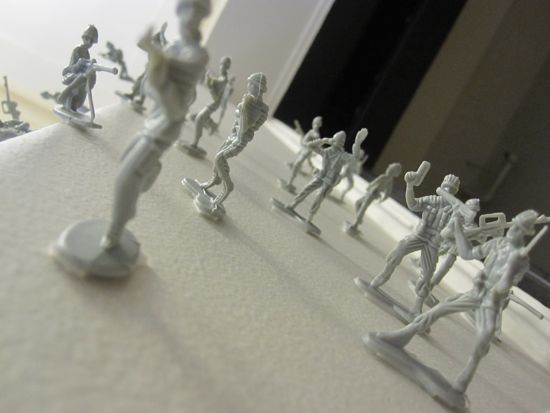
more toy soldiers on wall, MIT's Infinite Corridor, 12.14.2011
Turtle dreams and other boxed things

Recently I’ve been thinking about boxes. I turned on the timer (30 minutes), opened OmmWriter (still love it), and I followed my thoughts from one to the next. Here’s the result, without edits, although I did add one link.

boxes by Grace and photo by me

When I was a child, I loved miniatures things: figuerines, the shoes that came with Barbie, safety pins. Once, at a town fair, I entered a raffle for a green-and-clear blown glass turtle. I paid 50 cents for my ticket and dropped it into a coffee can with a slot cut out from the smoky white plastic, and I hoped and hoped.  It’s possible I bargained with God, in whom I then believed.

I didn’t win that raffle, although I did win a “wash and set” (remember those?) at the town beauty parlor. I tried to trade this prize with the grown woman who won the turtle; she had gray, curled hair, and it seemed likely she’d want my prize even more. She said no. I still picture that glass turtle as it was displayed that day on a circle of mirror placed on the prize table.

I don’t remember if I liked jewelry or not, but I did like the boxes that jewelry came in: small, well made, sturdy, the lid close fitting. The box itself seemed as special as what came in it.

For a while I went through a period of collecting boxes: wood, ceramic, paper. They had to be small. Big boxes seem to not be collectible.

And yet, among the Kokernaks, who all share a love of putting, throwing, or giving surplus things away, there is an appreciation for what we would call a good box, as in, “Keep that. It’s a good box.” Jimmy too says this.

In the spring of 2003, when I was in graduate school and taking a course on teaching writing and visiting classrooms to observe teachers at work, I sat in on my friend Lisa R.’s English course at Wellesley College. That day the students were studying and discussing a Shakespearean sonnet. In her remarks, Lisa revealed how much she herself loved sonnets, “a whole argument packed into fourteen lines.”  Shakespeare loved them for this too, she added.  Some other scholar, she told the students, referred to the sonnet as “a tight box.”  I loved that image, and it gave me a new way to think of sonnets and all formal poetry.

What can one do — how much liberty can one take, what can a writer or person — within the constraints? The thought gives me shivers. Continue reading

It’s the Jane Show

I’ve often thought of this blog as my own school newspaper or ‘zine, with the editor and writer in one. And now it’s about to become my own local access cable television show in a way.

Even though I know some video and audio editing software — thanks to excellent training by friend/colleague Lisa Dush — and even though I’ve had a Mac forever, I hadn’t yet learned iMovie. That changed today. I took some video I’ve been shooting over the last couple of weeks on my adventures (read: follies) in mouse proofing, and I used the iMovie platform to make a little home improvement show, starring me.

In this 12-minute movie, I

  • laugh at myself,
  • praise plumbers,
  • use one French word and two expletives,
  • mention whipped cream with delight,
  • deploy “so” and “okay” as pause fillers,
  • have weird intermittent eye contact with the camera (which disqualifies me from any real work as a tv announcer or host),
  • lie on the floor for a few seconds to think,
  • express love for my new LED head lamp,
  • show what a basin wrench can do, and
  • thank my parents for one cool thing.

I’m not sure if, in the video, I succeed at teaching or explaining much about mouse proofing that an amateur wouldn’t already know. The Jane Show below, therefore, might be of most interest to friends I don’t see often. Video is the next best thing, or perhaps even better because edited.

—–
Thanks to Jimmy Guterman for shooting the outdoor video and Eli Guterman for having a really nice tripod.

Guess who’s back, back again?

Shady’s back, tell a friend.

Shady is what I’m calling my mouse. He’s back. I actually haven’t seen him, but I do see the droppings under the sink again, and, as I study them, a line from an Eminem song goes through my mind: “Guess who’s back, guess who’s back, guess who’s back, guess who’s back.” Answer: Shady the Mouse. There are enough droppings that I think Shady might be bringing along his trailer park girl in a search of some crumbs.

This afternoon I vacuumed the tell-tale turds. Jimmy walked into the kitchen, and I showed him the evidence. “I have a Plan B, and this week I’m going to implement it,” I promised.

“This means war!” he said rather vigorously.

“Oh, no,” I said. “This means counter-intelligence.”

“We’re going to outsmart mice?” He seemed willing to humor me.

I am going to outsmart mice.” The last word was mine.

I do have a Plan B, and I have two new tools (nonviolent) provided by my parents. I also have been scouting the perimeter of my house, and I have an idea as to how Shady and his girl might be getting in.

I’ll report back.