What goes into grading

By this time of the semester — classes ended, presentations watched, final paper drafts discussed — I feel as though my teaching is done.

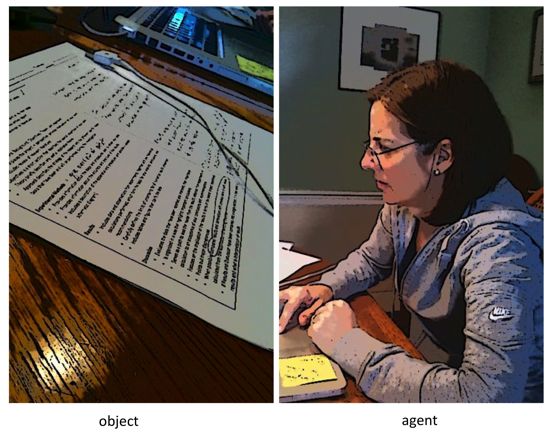
And yet, I’m not done with the semester because I’m still grading.

There’s a lot of it to do, and it’s hard to get motivated because I feel as though the students’ attention and energy has moved on. Yeah, they are still taking exams, but they are already looking forward to the summer and perhaps to next fall. So, what is the purpose of my careful reading of and comments on their final papers? Why all this time spent on the minute calculations of the final grade? Seriously, it can take me 15 hours for each class (I have four) to read the final papers and put the whole thing to rest. Is there any relationship between that time spent and student learning? Continue reading

Student success, my reward

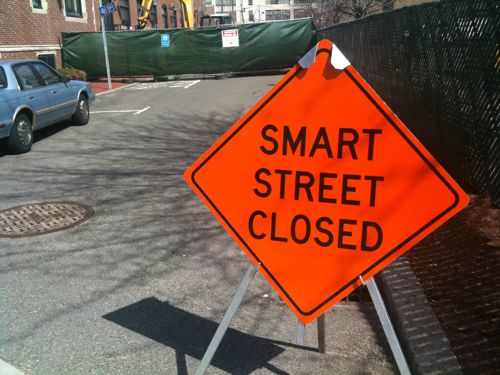
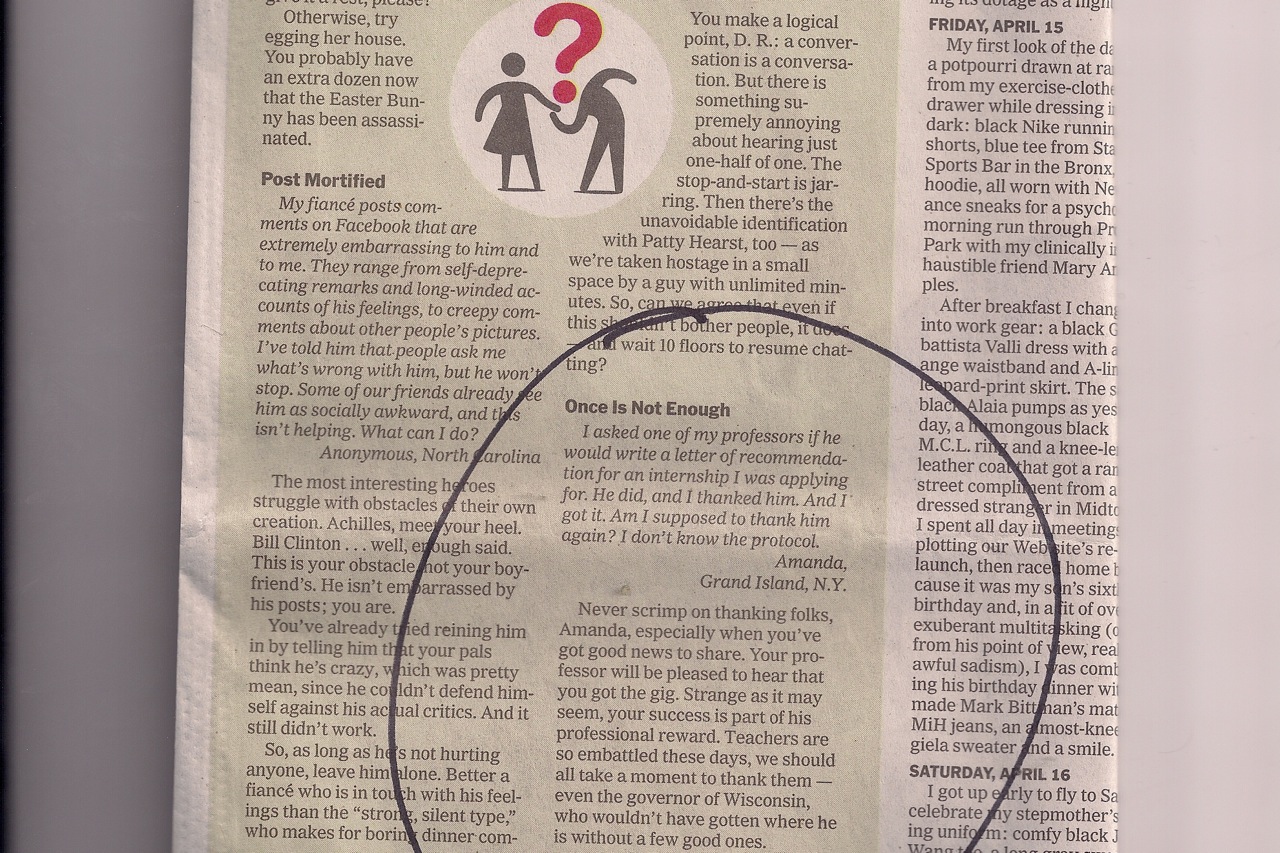
Social Q's column, NYT, 4.24.2011

This weekend Eli and I will finally do some baking and thank-you-note writing for the high school teachers who wrote him the recommendation letters that helped him apply and get accepted to colleges. The baking (chocolate beet cupcakes?) is a way to recognize their labor with ours. In his notes, Eli can let them know he has decided to attend UVM out of the various schools he was accepted to.

Perhaps it’s that time of year, but I’ve been wondering about the outcome of some recommendation letters I wrote for students over the winter for internships, etc. or the personal statements I helped them revise last summer and fall for grad school applications.

On Sunday, the Social Q’s column in the New York Times published a query by a college student confused about the protocol of thanking her professor for a letter he wrote. (See photo of clipping above.) Must she thank him a second time, after learning that she got the internship? Philip Galanes, the etiquette expert, replied, “Your professor will be pleased to hear that you got the gig… [because] your success is part of his professional reward.”

Dear Students, it’s true. We teachers are invested in your futures, just as physicians are invested in their patients’ health, and parents in their children’s well being and independence. It’s not that we are so self-effacing that we have no lives of our own — of course we have lives — but you’re like our garden. And because the processes of growth, despite all our knowledge of them, still seem so magical and the signs often imperceptible (children, like plants, seem to grow and develop overnight in the dark), it really is thrilling to see evidence that you are flourishing.

Yesterday, after a delay of almost a year, I got an email from a student who told me the outcome of his MD/PhD program applications. Together we had worked on his personal statement, he writing and I responding. He told me he has been accepted to a desirable program. Having worked with him on that personal statement, I know what this means to him.

What it means to me? I have an ego, too: In the collective work of educating young people, my individual contribution matters.

Snarky little bits

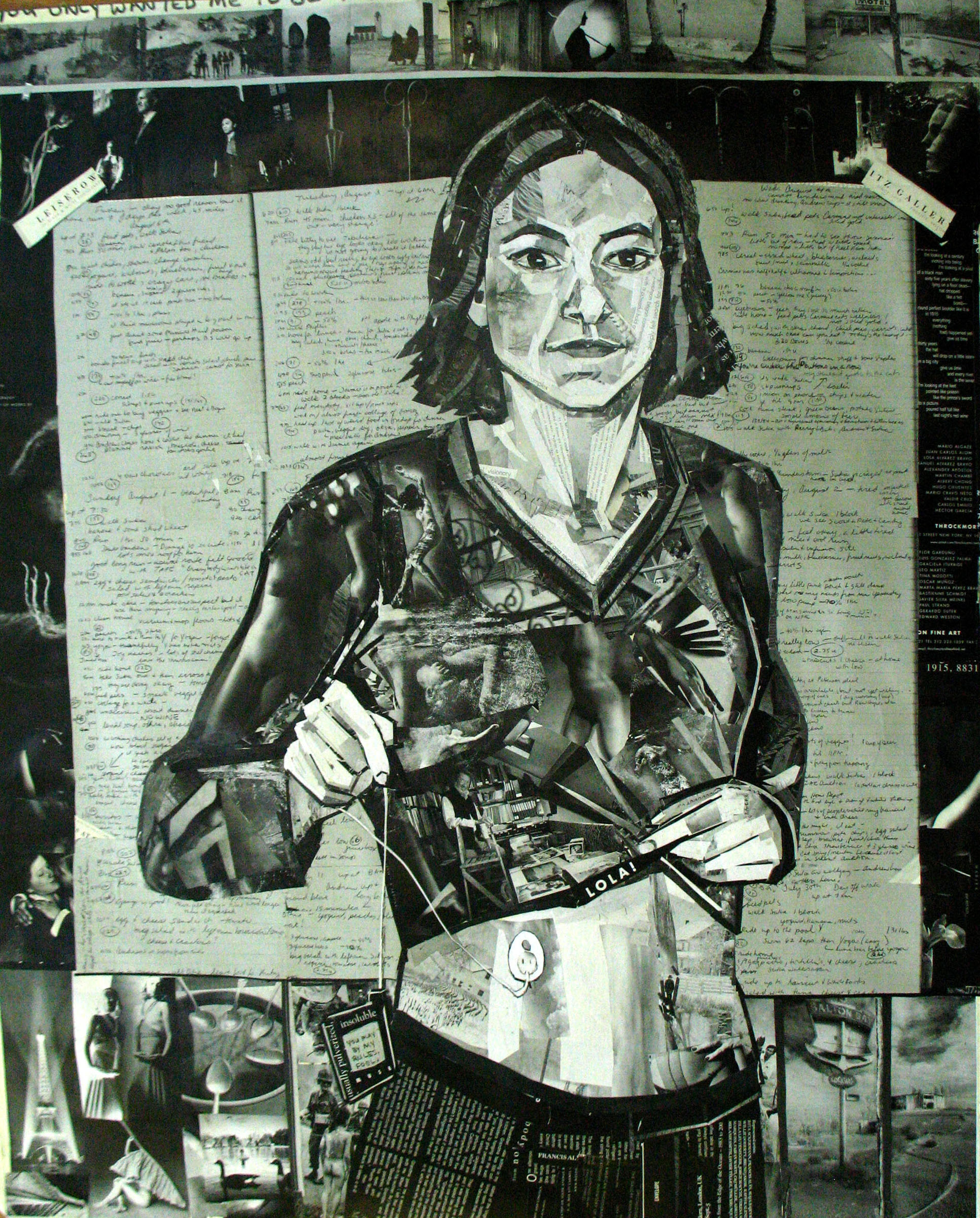
The Boss of Me, by Kathryn DeMarco

I do not know of many representations of diabetes in art or culture, at least ones that interest me. There is the movie, Steel Magnolias (1989). The Julia Roberts character Shelby, who has diabetes, is possessed by a hypoglycemic episode (really, it’s freakishly portrayed) while in a beauty parlor chair, as you probably have seen, and she later dies young.

Ann, the protagonist of the Kathryn Harrison’s novel, Exposure (1993), has diabetes, too, but does not die young. A New Yorker, videographer, crystal meth addict, and shoplifter — doesn’t she sound busy? — Ann doesn’t take insulin when she is supposed to and yet she does take that meth. Clearly, she has (out of) control issues. It’s a strange story, even stranger than I’ve described, and yet at least Exposure is literary.

Art is not required to be representative. I know that. But still, I can’t help but look for myself out there. As a woman, for example, I do like to read novels with women characters. It follows that, as a person with diabetes, I might like to read a few good novels with diabetic characters or see diabetes refracted through film, music, or visual art.

I’ve stayed on the trail, and several weeks ago I came across the work of collage artist Kathryn DeMarco, who makes self-portraits, some featuring explicit or oblique references of her body with diabetes. Online, I found her portrait above, The Boss of Me, and stared at it a long time in recognition. I’ve held the same pose, looking in my bathroom mirror, holding up my shirt to look at the white adhesive patch on my midriff, the pump held in my hand like a heavy fish still attached to the line. And the look on the face — not smiling, not frowning — is sober and forthright. Like mine, when I look at myself. Continue reading

A hunt for illustrations

"love & fear," by David Pham on Flickr

Usually, I use my own photographs as illustrations for posts. Sometimes, I hunt for them on Flickr, which involves the dual challenge of finding images that communicate, although not too tritely, and that are licensed by Creative Commons.

The search for the image does not come before I write the post or even after I’m done. I search sometime in the middle, when I know what the post is about yet I am still developing the idea or story. The right image is not only for the reader’s experience, it’s for my writer’s one. A photograph is inspiration and a kind of information.

Yesterday, I wrote a short piece for A Sweet Life on loving and fearing my doctor. Link. It started out as loving him and hating the visits, but when I searched Flickr for love/hate images, I mostly found pairs of hands with “love” inked on one set of digits and “hate” inked on the other set. Trite. The frustrating search helped me, though, realize that “hate” was too extreme a characterization of what I feel about quarterly visits to my diabetes doc. Fear is a more apt complement to love.

And so I browsed through Flickr images for love twinned with fear, and, in addition to many mentions of 1 John 4:18,  I found the above image by shapeshift (David Pham). Taken in 2005, the photograph is of a mural on the wall of a construction site in the Mission, San Francisco. I like the intimacy of the pair, with the human heart and skull dwarfing them in size. She is showing him something; he looks down at it, literally. They smile, even though the fragility (and glory) of the heart and the unavoidability of death hover over them. These observations and others, whether I dealt with them explicitly or not in “Why I Love and Fear My Doctor,” fed me while finishing the post. The reflection, prompted by the image and my hunt for it, took me to a different ending than the one I had planned.

Of course I hope the illustration does some work for the reader, too.

It’s bigger than you.

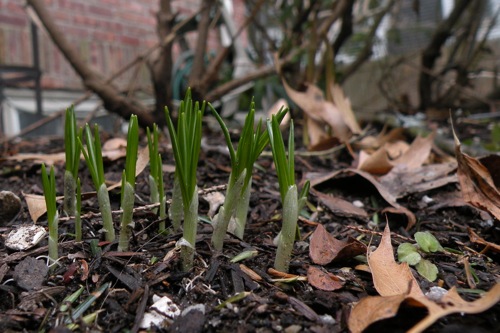
I’ve noticed that, in my yard anyway, shortly after the buds of the crocuses start to swim up through the crocus leaves, the rabbits come out and nibble the leaves and those almost-flowers down to a stub. Two days ago I walked around the yard and counted the crocuses on the verge. Today I walked around the yard again. Crocuses: most nibbled and now inert for another year. Only one flower, hidden under leaves, left.

I sigh. The phrase “Oh, life,” goes through my head, and next, “It’s bigger than you,” and then the whole song. This is how the mind works, and I can’t help the association. Unlike Stipe’s persona in the song, I am not bitter over aborted buds, but I do think so many of the tasks of adult life involve a reconciliation between the dream and the real. Yes, it’s easy to be sanguine about the damage done by a rabbit; perhaps these kinds of things are practice (like kindergarten) for encountering bigger forces.

I love this song and video. This goes out to friend and fellow fan, James.

Twenty nickels

20 nickels on the kitchen table

The weight of my insulin pump, 100 grams, is equivalent to a dollar’s worth of nickels. Lately, though, it has been feeling a lot heavier, which may say more about the state of my diabetes mind than it does the specifications of the pump. Read more here: link.

Restored riches

We were sitting in the living room. Upstairs Eli whooped, and a few seconds later he burst out, “Hey, I found my wallet!”

“Hooray!” we answered, having all been waiting for this moment. A few days earlier, Eli had lost his wallet, and the search for it had been a running narrative in our house: the calls to the places he had visited, the rummaging under the seats of the cars, and the repeated question: “Could you have left it in [x place]?”

He thumped down the stairs, pants on and shirt off. Apparently the wallet was in his t-shirt drawer, which he rarely looks in because his laundered clothes seem to stay in the same basket they travel to his room in.

“I’m so relieved. I knew it was at home somewhere!”

His energy and lightness reminded me of a Kay Ryan poem I coincidentally had read the night before, called “Relief,” and I told him about it and what it made me recognize.

Relief

by Kay Ryan

We know it is close
to something lofty.
Simply getting over being sick
or finding lost property
has in it the leap,
the purge, the quick humility
of witnessing a birth–
how love seeps up
and retakes the earth.
There is a dreamy wading feeling to your walk
inside the current
of restored riches,
clocks set back,
disasters averted.

Still dreamy over his found wallet, Eli said, “Yes. Just last week my friends and I were talking about relief, and how it is the best feeling.” He smiled, and his voice emphasized best. I thought about how relief and happiness, like anger and sadness, might be twin emotions.

A few days later, Jimmy and I went outdoors to pick up all the branches and trash that the disappearing snow has revealed one layer at a time. In our yard we found Dunkin Donuts cups, an ice cream container, scraps of vinyl from the new crosswalk that was scraped up by the plow, a pack of breath mints (empty), snack bar wrappers, and a small-size pizza box. None of these items seemed to originate from our trash. Perhaps our Starbucks cups, strawberry boxes, water bottles, Diet Coke caps, and gum wrappers were found in other yards.

I raked away the leaves from the daisies and euphorbia, which, I observed, are getting their start, and chopped at the islands of snow still holding down branches of the weigela, ilex, and euonymous. Branches freed, the bushes immediately straightened up, not trained by this winter into hunched back-ness, as I had feared.

As I continued to rake around the yard, here and there I saw shoots of crocuses needling their way up. The worry inside me — that winter has been too cold, the snow too deep for the November-planted bulbs to survive and do what they do — flipped instantly, as easy as a coin toss but with the same held breath. They made it!
School love

Today I walked over to one of the undergraduate teaching labs to drop off my comments on drafts for students who are learning, section by section, to write an IMRaD paper on the research they are doing on a polymerase.

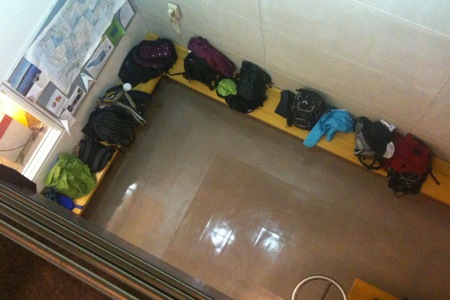
The lab is in the basement, and one walks down an open staircase to get to it. As I descended, I looked over the railing at the students’ belongings — backpacks, water bottles, jackets, bike helmets — strewn on the benches outside the lab. Around and down I went, and on all sides of the stairwell outside the lab were these signs of school.

My heart felt full. I imagined this same bounty of backpacks and jackets outside other schoolrooms with students of other ages. Kindergarten cubbies, the hallway outside the Grace’s 5th grade class or Eli and Lydia’s high school homerooms, the undergraduate microbiology lab. What those backpacks mean is this: We are a community of learners, this is our gear, and we need this stuff to do what we do.  And then I thought about how great it is to be a teacher, to have a responsibility to these students.

This feeling is inchoate; I cannot quite nail it down in words. The descent down the staircase, the view of backpack after backpack after backpack, and, finally, a glimpse through the windows into the lab of all the white-coated young people at the benches, working and talking, made me buoyant. School is more than a place; it’s an idea, one that students and teachers carve out of otherwise pressured and complex lives.

For a few minutes, I was so happy to be reminded by the backpacks of my good fortune — my luck! — to be working at this place and participating in an idea I believe may be the very best one we’ve got: we are human, and therefore we learn.