The way I do the things I do

On drafts, I prefer to handwrite my margin comments and type my summary comments. Writing by hand is (a) faster for me and (b) friendlier for the author, leaving traces of a reader. I have neat handwriting, and I don’t savage a page with my own scribbles, so this works well.

a glossary of sorts

Many of my comments are particular to the content: “These are your objectives, but what problem with this protein — a research one — is at the heart of what you plan to do?” Then there are the moves I make over and over in everyone’s draft, pointing out some aspects of style that could be improved, and I want to leave the responsibility for alteration or correction to the author. They are, quite simply, the ones shown here, and I define them on some spare scrap at the beginning of the hard copy of a draft.

Sure, I have a good vocabulary, feel for style (not just my own), and knowledge of grammar, and I could go the extra step and make all these changes. My hope, though, is that these marks will bring choices or errors to the attention of the author and that s/he will puzzle them out, alone or in a conversation with me.

Winter’s softer edges

Winter hardens us. Not only the icicles are brittle.

A few hours of warm sun in late February, therefore, can loosen up the spirit as well as shrink the snow piles. One of my favorite concepts from middle school science class is sublimation, or the transition of a solid to a gas without passing through the intermediate phase, liquid. That’s what the snow does on warmer days: sublimates. (Some readers may prefer Freud’s use of the term to describe a particular kind of defense mechanism. It would be interesting to see if we could get those two definitions in alignment.)

As the snow disappears without leaving many wet patches, signs of life reappear. The world is not dead under snow, as I noticed in a walk around the neighborhood yesterday afternoon.

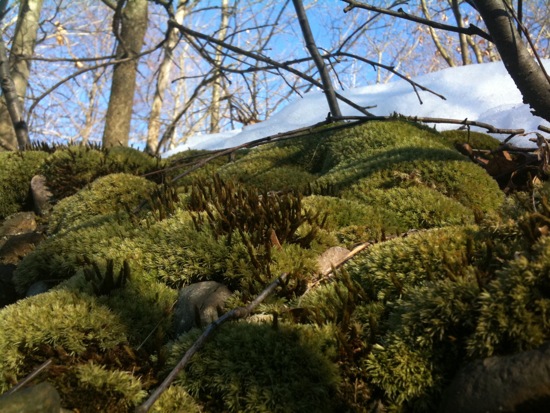
The moss is profuse and verdant and, when I put my hand on it, springy.

moss on a big puddingstone boulder

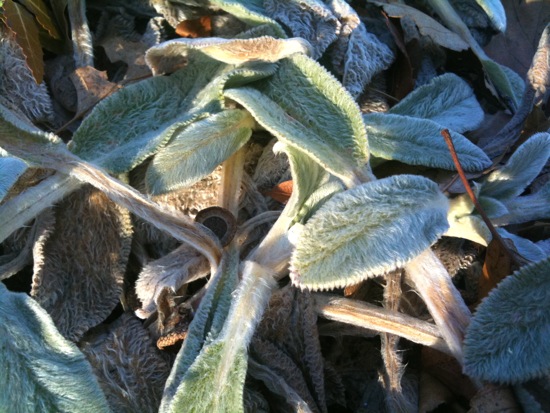
The lamb’s ears, though I have never grown this perennial myself, are vital and very soft.

lamb's ears on neighbor's stone wall

And this little creature — a mole that I did not touch although I did speak to her — looks silky. Slit-eyed, she poked around the edges of the snow for a while, nibbling at acorn caps and looking for a way back into the ground.

Why do I call her a she? To me, the underside of her belly looked swollen and dotted with teats. Yet perhaps my imagination put them there, looking for even more signs of a coming spring.

Technological distractions

For a couple of years, I’ve been sampling wireless presenter tools (“clickers”) without buying. Colleagues have loaned me theirs. The writing program officer also keeps a couple on hand, and I’ve been a heavy borrower.

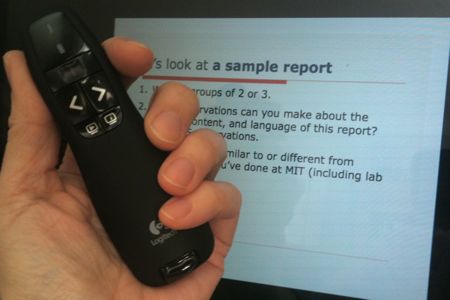
a tool, not a toy: the Logitech R400

Recently, after trying and loving the Logitech R400, I made a commitment and bought one. And on its inaugural day, I felt so prepared, so completely supplied with technological accessories — laptop, power cord, VGA adapter, USB drive, wireless presenter — that I forgot to pack my bag with something I need even more than I do the digital: a juice box.

Read about my want of a quick carbohydrate, and how it almost brought down my lecture, here.

Too much hand holding

The first time my new skating teacher grabbed my hand and held it, I liked it.

We were attempting backward crossovers, and his holding of my leading hand made me feel secure, as though, if I fell, he would prevent me from landing hard on my tailbone.

“And, to be honest,” as I told Jimmy about it later, “It just felt good. It doesn’t happen often in adult life that a stronger adult offers a real hand at a moment of risk.”

Plus, have I mentioned he’s cute? That made the initial hand holding nice, too.

This morning in lessons we were attempting to put moves together: crossovers and turns. For a while we’ve been isolating and practicing various moves. Literally, each week we’ve been skating in circles and doing the same things over and over.

As Fred demonstrated what he wanted us to do — skate forward crossovers, glide, turn, and skate backward crossovers — I thought to myself, This is when I fall. Interestingly, that little voice inside me was pretty matter-of-fact. I knew it would be difficult and that I would stumble.

I skated into the turn, turned, and fell. I got up. The next time I tried, Fred grabbed my leading hand and completely interrupted my concentration. Never mind whether I fell or not, I simply couldn’t skate with any basic competence as his gloved fingers gripped mine. Later he said, “Swinging your arms too far was making you spin, not just turn.” Well, his holding my hand stopped my inadvertent spinning, but it also made me forget the coordination of my four limbs! It was as if my concentration had digressed to what to do with that one hand. I couldn’t keep the big picture in mind.

Near the end of the lesson, we practiced slaloms for a while and then Fred showed us the 3-turn. I feel pretty comfortable with the slaloms, and I did them over and over as he worked 1:1 with another student. He skated over to me, watched, said “good” a few times, and grabbed my hand as a way of directing the shape of my arm. I completely lost my internal rhythm and felt, suddenly, remedial.

Is it okay to say to your teacher, whom you generally like, “Stop taking over my moves”?

Different students need different levels of hand holding, I know. It may be better — this is what I believe — to offer less of it. And if we see a student who is struggling, and we have the urge to step in, perhaps we should first ask: “May I help you with that?” And then, and only then, offer a hand.
—-

Photograph of Grace (in blue jeans) and me (in tan cords) taken with ToonCamera for the iPhone.

There is nothing to write.

On the contrary, there is always something to write.

Occasionally a child or teenager will stand in front of the opened refrigerator door and, uh, meditate. With the right hand on the handle and feet planted on the floor, s/he will stand there, silent and contemplative. And finally, if I am sitting there at the table, s/he will say, “There is nothing to eat.” (Full disclosure: I too, as a child, was guilty of perpetrating this on my mother.)

cartoon fridge, this morning. lots of dairy, I just noticed.

“Have an apple,” I say.

No.

“Fry an egg.”

I don’t want an egg.

“Leftover soup. Cheese and crackers. Celery and peanut butter. A sandwich.”

No, no, no, and no.

“Well, you must not be that hungry,” I conclude.

S/he will say, before stomping out of the room: There is never anything to eat in this house!

It seems to me that people who write, either because they want to or because they have to, will occasionally stand in front of the open-doored refrigerators that are their minds and be disappointed that a delectable cake, already sliced and plated, is not sitting there on the middle shelf waiting for them to grab and eat it. Instead, they have to choose a few ingredients and assemble them into something they might want to eat. Often, they turn away.

To that, I say, “Don’t just stand there with the door open!” Instead, do this. Continue reading

Origins of my $8 table

I like order. While I am no perfectionist, and I recognize that we live in a chaotic universe, I feel more at peace when t-shirts are folded and put away neatly and tasks are on lists.

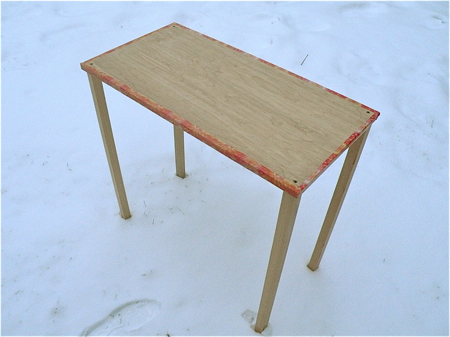
my January laundry table

Where there is no order, I enjoy imposing it. I see a mess, and my imagination starts selecting, categorizing, and straightening. When I am in a colleague’s unruly office, I must resist the temptation to say, “I could help you with this.” (What a time suck that would be.)

I like the revision part of writing as much as I like the generation part. The mental activity is not unlike cleaning out a closet. Creativity is not all right brain. Could anything ever get made without the desire to bring coherence to a wash of ideas, experience, sensations, stuff? The left brain brings shape to raw material and finds what my friend Jan calls the spine of a piece.

I often think about one creative activity when doing another: writing when gardening, for example.  Recently, I organized the laundry corner of the basement, quickly made a rudimentary table, and thought about teaching while doing both. And I didn’t just think about teaching while my hands were busy; I thought about my wonderful junior high shop teacher, Richard Bayrouty, who died in December, and the benefits of real hands-on learning.

In 1977, when I entered 7th grade, there was a policy shift in my hometown’s school system that girls could take industrial arts, or “shop,” as an elective. If I remember correctly, before 1977 all girls took home economics (cooking, sewing, laundry) and all boys took shop. That year, the policy loosened, and suddenly there was cross-registration. Boys who wanted to make and eat cookies took “home ec” with Ms. T. Girls who knew how to sew, cook, wash, and iron, as I did, took shop. My friend Lynn-Marie, who recently wrote to me that she never “caught on to home ec” and “never really liked to cook,” and I were the only two girls that year in Mr. Bayrouty’s class.

He had the best classroom. Continue reading

The world is strange again.

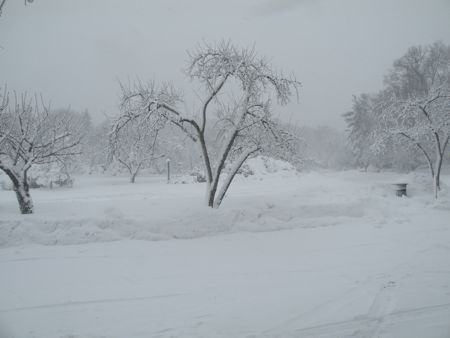
On the morning of the snowstorm, I am awake at the usual time. There’s no rush to get going. Still, I turn on the coffee and check “what happened overnight on the Internets,” as Jimmy would joke.

From my father, I read a gang email to all five of his children, exhorting us to clean off our cars before the temperature drops below freezing. His message may affect each of my siblings differently, but me, I feel watched over in a good way.

I put on my gear and go outside. Jimmy shovels; I clear the cars properly, even their roofs, and then I shovel around them.

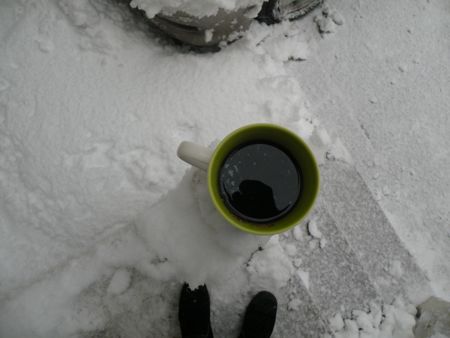
Any mug can be a travel mug, depending on where you're going.

Snow removal from the cars, driveway, and sidewalk takes about 90 minutes. We jam the shovels in a snowbank — it’s great snow for igloo-making, why don’t we make one? — and walk over to the shops at Putterham Circle. Only two are open: the convenience store and Starbucks. While there are no cars in the rotary that feeds the shopping center, inside Starbucks it is steamy with people.

For once, no cars in Putterham Circle.

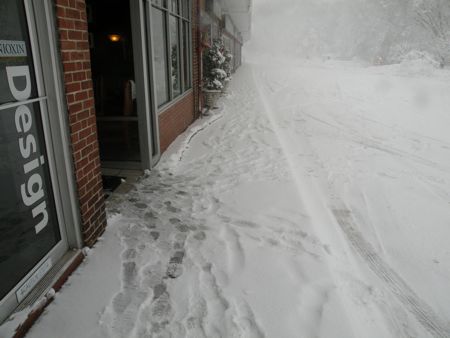
All footprints lead to the coffee source.

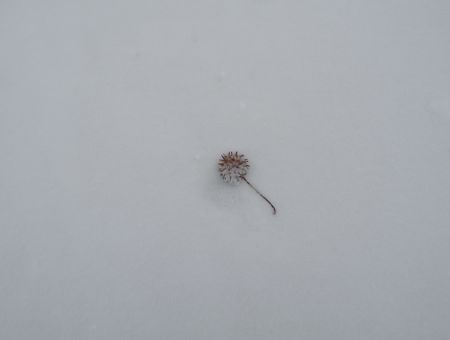
Then we walk, lattes in hand. It’s easy to shuffle across the intersection and down South Street. We walk and walk and pass only a few neighbors, here and there, out shoveling or snow-blowing. Ogden Street has not yet been plowed, and on the snow’s surface are chestnuts, still in their pods, that have just fallen.

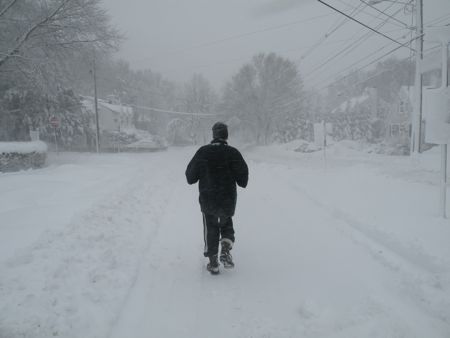
Jimmy walks blithely down the middle of South.

Now, this is still life.

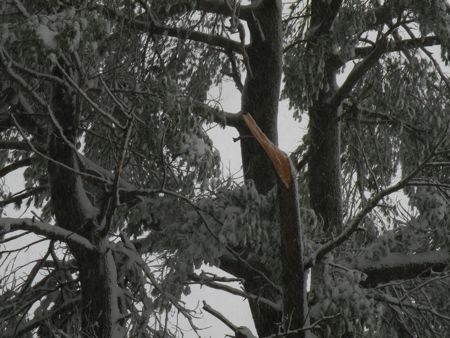
We see these fresh wounds everywhere.

Near Bournewood, we throw our empty cups into a dumpster in a driveway.

As we walk through the hospital grounds, I say, “I think Anne Sexton stayed here. And perhaps Robert Lowell.” Jimmy asks, “And Sylvia Plath?” McLean, in Belmont. Continue reading