– My very own teacher

I met with a graduate student today, whom I interviewed for a study I’m conducting on the poster session. At one point in the interview he paused in answering a question about himself and interjected, “I’ve got to give a shout out to my Dad.” And then he told me something he had learned from his father, a professor.

with first teachers, on the beach, 1966

Today is my father’s birthday. My father is a teacher, too. Although I am not aware of following exactly in his footsteps (he taught math), I’m sure I often tiptoe in them.

In honor of him, I share with you an excerpt of a reflection I wrote in 2003 for a grad school course on teaching writing. If you stick with it for a few paragraphs, you’ll find out how powerful it is to grow up with a teacher in your very own home.

* * *

Rewards

First, a few words about my beloved third grade teacher, Mrs. Eva Doyle.  I remember three things I learned from her: the multiplication tables up to a factor of eight, all the state birds, and crocheting.  The state bird project sticks in my mind because of the pure pleasure for me in colored pencils, detailed work sheets, characteristics of each bird (a yellow throat, for example), and beautiful bird names.  Multiplication memorization and crocheting are also vivid, because of how Mrs. Doyle used the promise of a needlework lesson to reward math mastery.  When every student in the class had made his or her way through the tables, she told us, the class would learn to crochet, as a group.  Eventually, after some duration of time I do not remember, Mrs. Doyle brought in a bag of yarn balls and a crochet hook for everyone to keep.  We pulled our 20 or so chairs into a circle, and our teacher walked around our perimeter, leaning over our shoulders to give help. In this manner, Mrs. Doyle taught us girls and boys how to make a chain, then a daisy chain, and finally, a granny square.  The ambitious kids went on to make five granny squares, with a grab bag of colors provided by Mrs. Doyle (from her own money probably), and stitch them together to make a hat. I made one of those hats. Continue reading

– Potato lover

Whenever I have been asked the question, “If there was only one food you could eat for the rest of your life, what would it be?”, I have answered: “Potatoes.” And since the waning days of last summer’s sunflower folly, I have been daydreaming about filling my only sunny patch with the tubers. Today I did a little more than dream, and I went over to Wood Prairie Farm and ordered 6 pounds of organic seed potatoes (Caribe, Reddale, and Yukon Gold) and packets of carrot and beet seeds, too. There will also be a few sunflowers, to please the neighbors (and bunny) who enjoyed them last year. My plan is to plant 4 12-foot rows of potatoes, 1 12-foot row of carrots and beets, and another 12-foot row of sunflowers. That might seem modest, but come August, I hope to have an abundance.

Now, if only I had a root cellar.

—-

Image of Caribe potatoes by rovingsprout on Flickr.

– I’ll take reality.

I have always preferred reality.

I was the child who read the Little House series, Nancy Drew, Tree Grows in Brooklyn, Jane Eyre, Secret Garden, Pig Man, and Anne of Green Gables.

And like my daughter Lydia, I have always liked facts. One spring, when I was about 16 years old, I took a stack of books out of the library’s nonfiction section on farming, gardening, and vegetables. (That summer I also attempted a 10 x 15′ garden on a clayey waste plot in my family’s back yard. What I recall is that lettuce grows quickly, and slugs like to make a home among lettuce leaves, which a person finds out when she holds that salad lettuce up to her mouth and sees a baby crawler on a leaf.) Another time I took out a less goal-oriented selection of books on the human body — a bunch of owner’s manuals. (I remember a set of photographs from a dermatology book on effects of aging, and how an older person could pinch skin on the back of her hand and it would stay in a little teepee shape for a second or two. I tried this on my own hand then and could not imagine a little skin teepee as a possibility.)

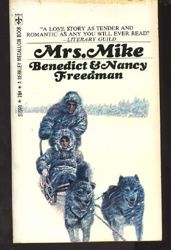
In my fiction reading, as much as I followed plot I liked learning how people did things with their hands: laundry in big tubs, food over an open fire, sleeping 3 or 4 to a bed, toys from sticks and rags, and treatments from poultices (ah, Kaiser Pease’s onion bath in Where the Lilies Bloom). When I picked up Mrs. Mike again, at least 30 years after I first read it, it was to find the description of an emergency amputation that has stayed with me:

I filled a kettle. I lifted it to the stove. The cries drew me back. His nails dug long furrows in the wood of the table. His dark eyes rolled back under his lids, leaving white, unseeing holes. The smooth muscles moved in Sarah’s arms. Back and forth, back and forth. The trap bumped and clanged against the table. Sarah’s strong man’s hand pressed the saw’s teeth deeper into the wound. It quivered, it quivered like jelly. A strange laughter stirred me. Mother and child, I thought. Mother and child. Then Sarah begin hacking. The bone chipped and splintered. I looked at her face, at the clamped lips! I looked at her hands. I thought, how can she do it! I looked again at her face, relentless and calm… His body lay under her hands, twisting, screaming, while she hacked at him calmly with a saw. I stared at a flap of hanging flesh.

Continue reading

– Stories, built

My MIT friend and colleague, Lisa Dush, also runs Storybuilders, which helps organizations and individuals make digital stories. In January, I went with her to Washington, DC to work with the staff of College Summit, a really cool nonprofit organization that works with high schools to raise their college-ready culture and get more kids into college. For two full days, we worked with the six staff members on developing and revising their stories, recording the audio tracks, uploading photo files into the video software, and constructing the mix of words, sound, images, and effects. Later, Lisa worked with the College Summit folks on production.

She recently sent me a link to the finished stories! Here is Darin’s on College Summit alumni leaders. Even though I heard Darin read his story aloud many times during workshop, and also looked over his shoulder as he sorted through images, I was surprised and moved by several moments. This is a powerful testament to peer mentors (and superhero underpants).

More of the College Summit stories can be found at the Storybuilders’ site on Vimeo.

– Distressing ratio

I just walked back from giving a short lecture across campus. It was a 20 minute performance, complete with (a) slides that articulated and illustrated common issues that students struggle with in writing a technical report and (b) enthusiasm.

As I walked back, I added up the time spent looking again at the batch of reports and my summary comments; making 14 slides, with examples from student writing; and mentally rehearsing. Time? Seven hours.

Sometimes I’ve heard professors tell students it takes an hour of preparation for every one minute of presentation. I did not spend 20 hours on my talk today, although perhaps all the time spent reading & commenting on the papers that led to this talk counts for preparation.

This makes me realize, though, that some professions (all?) are like icebergs: most of what one does (as a teacher, writer, dancer, bass player) is hidden from the people we work for (students, readers, fans, audience).

——

Post script: Later Jimmy asked, “How many people were in that lecture?” I answered, “Fifteen students and one professor.” And he reminded me to include those numbers in my ratio, which in turn reminded me that it’s not all about me and my experience!

– Be good to it.

It’s important to gratify the body.

Those are the words of a yoga teacher. She said them before our brief rest period. I thought of them again when, at the end of the hour on Wednesday, we massaged our own faces and scalps.

A person can interpret this value any way s/he likes. I do not think, however, that Portia meant we should press our faces into a bag of Doritos or have yet another cup of coffee, which is what I am doing right now, at my desk.

There are many things she might have meant. This is worth thinking about.

– Park Street busker

“Excuse me.” That’s what I said to the couple blocking my passage from the turnstiles to the station at Park Street. They were just standing there, looking up at signs, their backs to me. “Oh, sorry,” he replied, in a British accent. I moved quickly past them, no eye contact, up and around the low barrier near the track, and I felt a few seconds of regret for not being nicer to them.

Down the middle stairs tiled red, into that basement that’s like a big grungy shower room — all those worn white tiles — to wait for the train to Kendall Square. It was 4:50pm, and I was leaving GLAD and heading back to MIT to get my car to pick up Grace at BSED. Three points of my life, in acronyms.

I felt neither haste nor leisure. People brushed by and pressed into each other. There was another middle-aged pair, a man and woman, chaperoning a bunch of teenage girls, some wearing Red Sox “merch,” as my kids call it. Was there a game today? Sometimes I eavesdrop on people, but this afternoon my spying tendencies were worn out.

Against the red tiles of one of those square pillars that hold the Green Line and all its trains up over the Red Line’s sublevel, a small man sat. His black guitar case was open in front of him. A music stand, adjusted low. An acoustic guitar, a high buttery voice, a Spanish song. “Noche …  noche…  noche,” was the only word of what he sang that I recognized. Another verse, full of the sound of longing but no words I knew, and then again, “Noche… noche… noche.”

I thought of taking out my phone and taking a picture, a video even, so that I would have a document to share with someone. And then I realized that what held me to the moment was that it would come and quickly go. Anticipating that its life was only minutes long, I soaked in all of it — his singing, the sound of words I didn’t know, the crush of tourists and fellow commuters, his smile when I put $2 in the guitar case, his gold-rimmed dark glasses removed when I got close up to him.

The moment would be gone, I knew, as soon as the train came. Which it did.

– Big pond, many fish

I missed the 4C’s convention in Louisville this year (sponsored by the Conference on College Composition and Communication), which is a biggie in the teaching writing world.  I went last year and even gave a presentation, one among hundreds of presenters. This year, Alex Reid went, and he did some basic arithmetic that describes how dilute the audience gets at one of these huge conferences where everyone is vying for a little sip of the attention water. He estimates that, on average, most of the 3,000 attendees make it to 6 out of about 600 panels and that most panels attract between 10 and 30 audience members. That’s the thing about big ponds.

I was swimming in another school of fish last weekend, attending the 2010 ACPA annual convention in Boston (sponsored by the American College Personnel Association, the leading organization for student affairs professionals). It was a good chance to hang out with James and also reconnect with that world, in which I felt more a part when I worked in academic support and writing centers. Even though I no longer have official student development responsibilities, I do believe that I will again, someday, and that in the meantime I continue to be a deeply interested observer in how undergraduates mature and how the academy can support their development in thoughtful and humane ways.

I went to five or six panels; I took notes. Rather than writing a summary, I’ll try to capture what floated to the top and what ideas have stayed with me enough that I’m still thinking about them a week later. Continue reading

– What death tastes like

I’m upstairs, in the bathroom, about to hop in the shower (as my mother would say. One can’t actually step into the shower, or take a shower. Hop, we must.).

Suddenly, from downstairs I hear running feet, the slam of a door, adult gagging sounds, and child screeching ones. I go to the top of the stairs. Through my mind runs all the first aid procedures I’ve learned related to choking and heart attacks.

“What’s happening?!”

I hear Grace, off stage, yell: “Dad’s gagging.”

I yell back: “What’s wrong?”

Jimmy walks, coughing, to the bottom of the steps. “Oh, my god, it’s the DayQuil. It’s horrible.” He drinks water from a cup.

Lydia joins me on the upstairs landing. Like Jimmy, she’s suffering from a sore throat, and she was the first one today to sample the orange liquid cold medicine.

“It can’t be that bad,” I say to both of them.

Lydia rolls her eyes at me. “Mom, it literally tastes like drinking death.” (Note: emphasis Lydia’s.)

And now I know.

Meditation on adult fears

In graduate school, at the first meeting of an American poetry seminar that turned out to be wonderfully heavy on Emily Dickinson, the professor asked us to introduce ourselves by going around the table and disclosing our worst fears. As soon as she said it, the professor withdrew the prompt. “No, don’t say your worst fears, say your second worst fears. It’s too terrible, as an adult, to claim your worst fear. ” She paused. “What if it came true?”

My second worst fear is a wood chipper, those little green or orange monsters with big metal teeth that get lugged around by tree jockeys and that eat branches and trunks. Last fall, on my way to work, I saw one on Amory Street in Brookline and sticking out of it was not a mouthful of hemlock but the blue-jeaned legs and ass of a man. I was riveted and terrified. As I drove closer I could tell that he was intentionally face first inside the jaw, fixing it, I gathered. A couple of other tree guys stood around, unperturbed and waiting.

A healthy respect for the destructive power of machines may be rational (as may be the fear of waxing, which was the pick of another female grad student in my class). However, sometimes a fear grows until its size in one’s imagination becomes irrational.

A friend of mine, an artist, has an ex who has diabetes, as I do. Things are not going well for him, and I encouraged her to encourage him to make his way to the Joslin Diabetes Center, where he would get help with his medications, diet, exercise routine, and even his feelings of discouragement. “They will take care of all of him,” I assured her. The thought of this buoyed her. Recently she wrote to me: “Would you be willing to talk to him? He wants to go and he seems reluctant to go.” Ah, of course. Continue reading