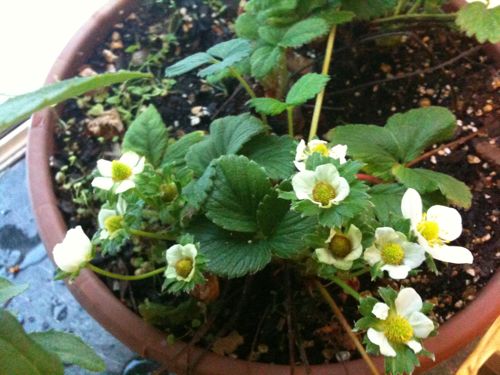
My officemates and I are turning our huge window and its sill into a greenhouse. In addition to some cactii, which are meant only as houseplants in New England, we brought in some of the spent container plants from our home porches back in October: fuchsia, geranium, sweet potato vine, and strawberries. All are thriving, and there are strawberry buds. Will we soon have red berries in Room 12-111? Stay tuned.
Author: jelizabeth
– Writing in the snow
Brian is the first to tell me about Ommwriter. Telling, in this instance, involved posting a link to my Facebook page. I happen to like, in our Internet age, how much we can learn about each other, even our siblings, via blogs, e-mail, and social networking sites. He guessed right that I would be curious about this.
Ommwriter is a new text-processor (dowloadable, not web-based) that creates a distraction-free space for writing and concentrating. The image of the space — a range of grays: snowed-over field, storm sky, tiny tree silhouettes, and six buttons — is what made me want to try it. To be bodily in the space was the dream; to type in it, the reality.
I tried it on Thursday, when I wrote my Beck post. Instead of opening up a new post field in wordpress and typing, formatting, uploading, googling, and linking as I wrote, I just… wrote. Did I like the experience? Eventually. Did it work? Yes.
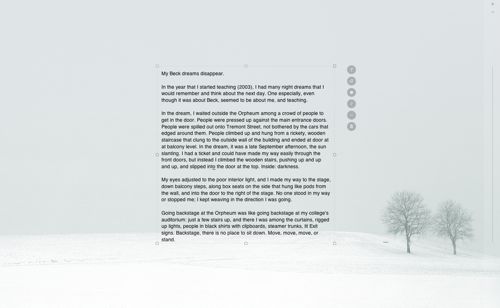
With Ommwriter, what you see and hear is what you get. Everything is available in the space: the text box, sound control, and save button. It’s supposed to be an immersive experience, so immersive that, when you open a file, there’s a vivid and gentle reminder to use headphones to get the full experience. (I didn’t, because my house was empty and quiet.) The music is like what you get with The Buddha Machine: tonal, steady, and low. I’ve never studied Zen Buddhism, so I have no idea if this adjective actually applies, but I could imagine some person saying, “How zen,” and getting started with Ommwriter. You open it; the music starts; and all there is to do is write. Continue reading
My Beck dream disappears
In the year that I started teaching (2003), I had many night dreams that I would remember and think about the next day. One especially, even though it was about Beck, seemed to be about me, and teaching.

In the dream, I waited outside the Orpheum among a crowd. People pressed up against the main entrance doors. People spilled out of the alley onto Tremont Street, not bothered by the cars that edged around them. People climbed up and hung from a rickety, wooden staircase that clung to the outside wall of the building and ended at a door at balcony level. In the dream, it was a late September afternoon, the sun slanting. I had a ticket for the Beck show and could have made my way easily through the front doors, but instead I climbed the wooden stairs, pushing up and up and up, and slipped into the door at the top. Inside: darkness.
My eyes adjusted to the poor interior light, and, from the top, I made my way down balcony steps, along box seats on the side that hung from the wall, and into the door to the right of the stage. No one stood in my way or stopped me; I kept weaving in the direction I was going.
Going backstage at the Orpheum was like going backstage at my college’s auditorium: just a few stairs up, and there I was among the curtains, rigged-up lights, people in black shirts with clipboards, steamer trunks, lit Exit signs. Backstage, there is no place to sit down. Move, move, move, or stand.
I edged around a curtain, feeling it touch my back like hair, or a hand, and stood out of view of the audience yet close enough to center stage that I could see the house, performance area, and backstage at once. There was Beck, alone in front of the audience, with just his amped guitar, big hat, and a vest. He sang “Mixed Bizness.” He played hard, danced his plastic moves, and jerked his shoulders and guitar when he hit a line like “Freaks flock together.” He seemed to be possessed by the music, deep into it, as mesmerized by his performance as the audience was. Continue reading
– Heart breaker, list maker

GROUND BF 4, RIBS 2
Leanne told me that she and her spouse have become one of those families with an extra freezer in the basement.
Then she told me the part that made my heart beat faster and gave me goosebumps: Mark keeps a notebook on top of the freezer, with a running list of the items and quantities inside. Leanne, what a catch! I love that about him.
I have often joked that, when looking for a romantic partner, it would be helpful to identify someone who can both dance and cook. These qualities might sustain your life with both joy and food.
I’d like to add a third quality to that list, and suggest that someone — like Mark Mason — who can make and keep a good list is a rare and wonderful find: a sustainer of order. Ah.
—–
P.S. Thanks to Leanne for the photo, and the introduction to MM.
– Vain, vain world
The VFW Parkway: that’s my strip. Home Depot. Jo-Ann Fabrics. Starbucks. The connector to 95S to get to the Cape. I drive it often, practically hypnotized by the same-old-sameness. Not mindful, not in the moment. Lost in my own reverie.
Many times I’ve passed this group of signs without really seeing them. Every time around this point, I’ve thought long and hard about vanity. (Interestingly, I haven’t dwelled on Jennifer, who is my cousin.)
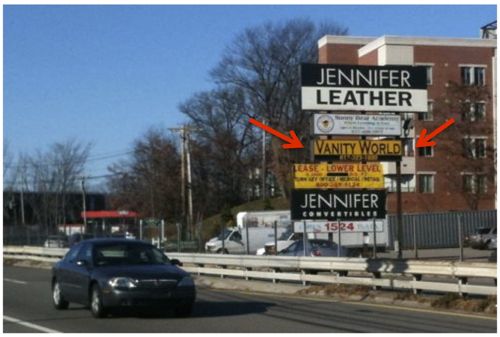
Vanity, all around us. The guys at the gym who look sideways at themselves in the mirror while gently running their palms over pecs (the self feel-up?). My dentist, the competitive weightlifter in the 50-and-over division who introduced me to “cut” as an adjective. The lushly pregnant celebrities on the cover of People. The botoxed and lip-injected woman on the T with eerily old hands. Old feet, beautifully pedicured. The accumulation of friends on Facebook. Black and white photos of authors on book jackets: eyeglasses, bemused grin, hands placed just so. Shaved heads. Waxed crotches. The tanning salons clustered around Boston University. Clarice’s good bag. Modesty, an eschewing of vanity, and therefore vanity supreme. Pynchon, Dickinson. White teeth. Sunglasses. Bonfire. The memoir. The blog. Tweet. I’m guilty, too.
Vain, vain world.
My rumination was interrupted, finally, by an ah-ha! moment one day as I drove past the stacked signs, and concrete meaning derailed my train of thought: “Oh, bathroom sinks!” I laughed over the repeated misreading and my elevation of the prosaic to the profound. Ha, that, too, a kind of vanity.
– States of mind
Every time I hear on the radio the new Alicia Keyes/Jay-Z song, “Empire State of Mind,” I (mis)hear Keyes’s lines as her voice enters the song. To me, it sounds like:
In New York…
I’ve become a wintry tomato
There’s nothing you can’t do…
Play the video, and listen for the line starting at 0:56. Do you hear what I hear?
In the car today I asked Lydia, “What is she actually singing there?”
Lydia replied, “Something about dreams.”
“Dreams?” I queried. “Dreams?! Where do you hear that?” I sang to Lydia my tomato line.
Lydia smiled. “I think I prefer yours, Mom.”
For the record, this is what Keyes sings. Lydia is right.
In New York…
Concrete jungle where dreams are made of
There’s nothing you can’t do…
You pick what you like: wintry tomatoes, or concrete jungle dreams. I’ll stick with what grows on the vine.
– Explicit lessons
Eli, at the dinner table, asked us if there were any “explicit lessons” we had taught him. He couldn’t think of any.
“Uh, what do you mean?” I asked.
He gave an example: “My friend’s parents taught him you should always walk a girl to the door.”
Hmm. Well, that is not anything I or Jimmy had ever thought to make explicit. I do recall, from my own youth, that my parents thought this was a good thing: boys should make sure girls get home safely — and that means to the front door, and into it. (And who makes sure that boys get home safely?) Yet, I have failed to pass this along.
“What about a message like ‘Be kind’?” I suggested.
Apparently, that doesn’t count.
“Turn off the lights when you leave a room?”
Nope.
“Brush your teeth? Get a good night’s sleep?”
No and no.
Eli did not seem to mind that we couldn’t come up with anything. “Basically, I think I know a lot of stuff and you didn’t have to teach it to me.” He said something like this, in so many words, and added that he was able to think through, on his own, a lot of situations and dilemmas he encountered.
Wonderful, his mind is at ease. However, mine has not been. I’ve been mentally backtracking through Eli’s 17 years on the planet (and Lydia’s 13 and Grace’s 9), looking for moments when I have communicated an explicit lesson or made a parental speech.
I have thought of only four items for what must be a rather skimpy guide to life. Here they are. Continue reading
– Big needles
This video of an extreme knitting installation reminds me how getting ready to do something is as much pleasure as doing it.
Extreme Knitting, by Rachel John. October 2006.
– Bulbs and boxes
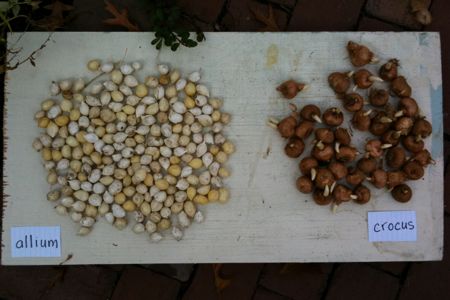 What I like about bulbs, which I planted on Sunday, is their utter forgetability. I dig a hole, drop them in, leave their spot unmarked, and forget. The cold and short days of winter will pass — some sparkling days swiftly, most days grindingly — and then one day I’ll be walking up to the house, with my head down and hands in my bag searching for keys, and I’ll see them. The cocked, belled heads of the crocii will be first.
We moved into this house in the summer of 1999, not sure what was planted but for the big, gumdrop shaped old shrubs. Much of the planted parts of the yard seemed taken over by leaf mold or invasive ground vines. That first summer, the most we did was cut back the overgrown parts and mow the neglected grass. In late February 2000, though, stomping through the yard with Eli and Lydia who were still small and close to the ground themselves, we spotted tell-tale little blue heads poking up just inches from patches of cold, bare ground still circled by snow. Planted by someone else before us, they were like a gift from the past to the future. And there we were.
I had a feeling like that recently when I went up into the attic to rummage through my boxes of books and papers I had packed up in June 2006, when my job at Simmons College ended due to budget cuts. (That was a sad, sad time.) I’m currently getting ready to teach a course next semester on expository writing at the Harvard Extension School, and I’m basing it on the first year writing course I taught at Simmons, in which we read and wrote about biographical texts of my choosing. (At MIT, I don’t choose the texts for the WAC courses I’m involved in; the lead professor does.) I opened box after box and found treasure after treasure: books, DVDs, notes, and handouts I had forgotten. If I were in a movie, I would have had to toss those papers into the air to communicate my glee. Instead, I leafed intently through them, my interest in my dearest interests rekindling; I made a pile of keepers. While I did not speak aloud to the empty attic, I felt like whooping, “Yippee!”
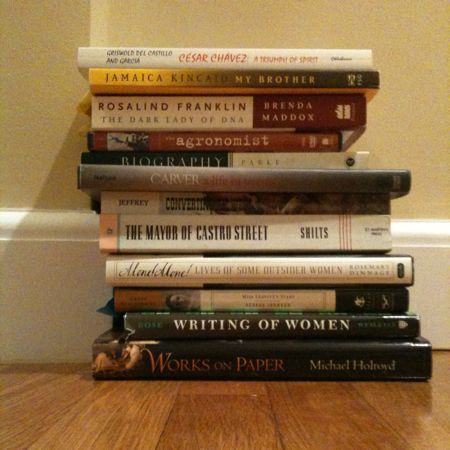 Sometimes pieces of ourselves get shut up and put away, underground or in attic boxes. The putting away can seem as though an interment: Oh, that part of myself, or my talents? It is dead to me. Never again. And then, months or years later, the boxes get reopened, the green leaves and colorful heads push up from the ground, and we realize that the book, the bulbs, those little packets of life, have only been waiting for us, keeping themselves alive, shut away in darkness.
– Peeling bark

It’s the Acer griseum (a maple) in our front yard, a nice small tree. Yes, it’s supposed to do that.
 leaf stitch word