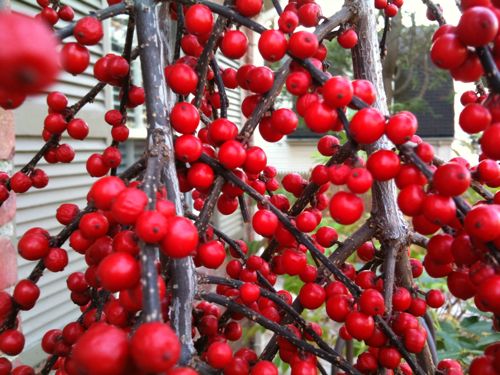
P.S. Although not bittersweet vine, these red berries are for you, Mom!
P.S. Although not bittersweet vine, these red berries are for you, Mom!
At long last — weeks after I had given up the hope that I would see them this year — they returned.
As I stood at the kitchen sink, drank from a cup, and stared absent-mindedly into the backyard, I faintly heard a chorus of chattering. I heard it before I recognized it.
My attention tracked the origin of the noise. I went to the door, opened it quietly, and peered up at the old trees. Ah, they were dotted and filled with the purplish, black birds. Hundreds of them chucked like pigeons and squeaked like rusted gates. Hundreds. From the trees in the front of the house to the trees in the back, a crowd of them swooped, and the swooping felt like a huge quiet breath inhaled by the sky over my shoulder: a pause, a contraction, a gathering of force.
Usually, their arrival coincides with Columbus Day. This year, I waited and waited and waited, yet they seemed to have passed by without stopping for me, or perhaps they had not passed by at all, which made me wonder: what is going on in our climate?
The grackles are very late this year. Still, they have arrived and will probably stay for a day or two. While their gang sound is chilling and seems to bring a portent, I am relieved by their visit.
—-
P.S. This video was taken by me, on the morning of November 16, 2009, as I stood on our back steps and looked up at the trees in our yard and beyond to my neighbor’s red roof. As you watch, turn up the volume on your machine to appreciate the effect of a sky filled with grackle sound.
In high school, I had a clerk’s job at the Leicester Pharmacy in the center of our town. It was about three miles away from our house. To get there, often I drove or got driven. Once in a while, I walked and took the lovely meandering way: up our street, down the dirt road that connected our circle to the newer Cricklewood development, out onto Pine Street, a detour through the old cemetery, and then back up Pine Street to where it met Main. If it was autumn, I’d kick the fallen leaves as I walked, in no hurry at all. As I strolled, I thought my thoughts. I hummed to myself, bothering no one.
Last Thursday night, one of my office mates Karen and I were talking about our teenager children as we tidied up the piles on our desks. Their lives, to us, seem to be like full-time jobs, plus moonlighting. Busy, rushing from task to task, sleepless. No time to think their thoughts. Like the present-day us.
About 12 years ago, when my oldest child (now 17), was a little boy, my friend Martha Mulligan and I were feeling the pressure from our culture to get stuff done, gracefully and in multiples. (This was before the GTD system was even a gleam in David Allen’s eye.) We felt ourselves to be failing more than meeting expectations. Mirthful over our own daily inefficiencies, together (and probably with Eric and Jimmy, too) we came up with an idea for a humor book, with illustrations, called Maximize Your Inefficiencies. Martha billed it as “the Dilbert for your home life.”
I still have the file. I dug it out.

Martha and I planned for 101 inefficient items, perhaps one per page. It would be like a coupon or flip book, the kind you can purchase on impulse at the counter of a book or gift store. Continue reading

Usually, we keep the cars unlocked when they’re sitting in our driveway. What would anyone want to steal, but a handful of change in the cup holder, empty water bottles on the floor, or a soccer ball in the back? An opportunistic thief, it seems, might also be attracted to a red bag full of first aid supplies for Grace’s scouting troop, of which I am the volunteer first aider. Bandaids, gauze pads, Benadryl, instant cold packs, surgical scissors, a CPR face mask: stolen. Today we replenished the kit. It costs $104 for supplies that fit this description, plus $20 for a discount backpack to hold it all.
On the MBTA Green Line, a man in nice pants, black scuffed vinyl shoes, and a puffy down Patriots jacket sat across from me, with his head bent over a notebook. Left-handed, he wrote a numbered list of principles in big block letters on the lined paper. The list, which was easy to read upside-down and across the aisle, had to do with campaigning, I gathered. “1. Door-to-door. Get the message out. 2. Phone bank. Waste of time. 3. Direct mail. Expensive, uncertain.” And so on. I feared, for some inchoate reason, he was launching the beginning of a political career.
Above ground at the Park Street Station, the street was blocked off with that yellow police tape. The whole intersection, blocked. People standing around. No cars. I looked and looked at my fellow bystanders, trying to make eye contact before asking someone to explain. No eye contact. I walked over to the hotdog stand guy. “Yes, miss?” he said to me as his glance landed on mine. I asked him what had happened. He answered, “A quite older woman was hit by a truck in the intersection. She passed away.” Oh, no. Still, I found it so strange that the gentle phrase “passed away” could be used for a victim who had been rammed by a truck.
In the rundown jewelry store on the corner of Tremont and Winter Streets, I finally got the battery in my watch replaced. Only $8.49 — what was I waiting for? For at least two months, I had been covertly using the digital display on my insulin pump as a time keeper. The jeweler’s assistant told me she sees everything out her store window, everything. The old woman who was hit by the truck had her “head cracked open. Open.” The assistant, who had heat-straightened brown hair and a very kind smile, cupped her two hands around her forehead as she described what she saw. I pictured her head like an egg, the shell opening. Continue reading
And this is rest and spirituality enough for me.
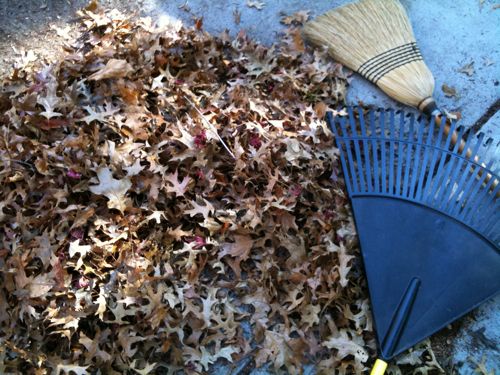
Task and tools
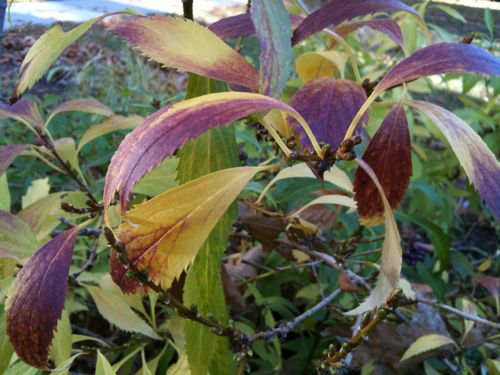
An unexpected fall show from the forsythia
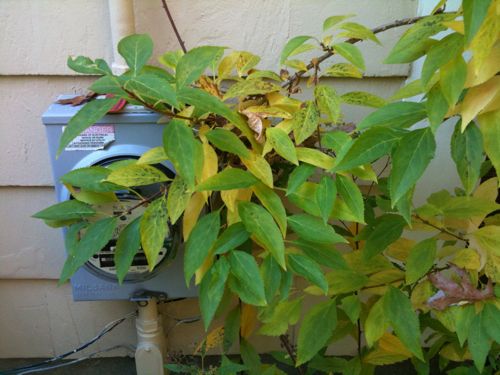
Modest meter
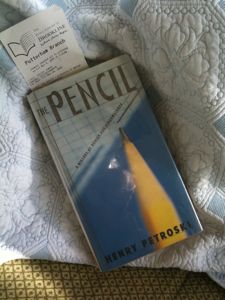 For some reason, Grace, Jimmy, and I were talking about single-noun-subject books. What concrete thing interests you enough that you would read or write an entire book about it? Salt, for example.
Grace raised potatoes as a possibility.
“Pencils,” I said. “I love pencils. I would read an entire book about pencils.”
Yesterday, my library helpers found and brought this home for me. I saw the title, and my heart started to beat a little faster in anticipation. I opened to chapter one. First words: “Henry David Thoreau seemed to think of everything…” Ah, book heaven.
 It’s Halloween; I’m alone.
It’s a good time to watch Jesus Camp, a documentary loaned to me weeks ago by my friend David, a fellow volunteer at GLAD.
“I heard it’s disturbing,” said Eli, when I showed it to him.
Perfect for tonight.
—–
P.S. The photo has nothing to do with the film. It’s simply a snap of the spooky moon in the sky over my house on this balmy, windy Halloween.
If you want to go far in friendship, you shouldn’t laugh at someone when they fall.
–said by Grace Guterman, age 9
 When it’s midterms for students, it’s midterms for teachers. (There’s something rather binge-and-purge about school, isn’t there?) In the past two weeks, since Columbus Day, I’ve been reading, commenting on, and grading the drafts of technical reports and scientific analysis papers, about 35 altogether. They’re long (average: 20 pages), but after the first few in a batch, I get into a rhythm. And while I don’t copy and paste comments from one report into another, I do notice similar issues and may make similar comments among reports.
I don’t claim any of the following lines as poetry. Here are some of the kinds of things I write or type in the margins. Continue reading
Over at digital digs, Alex Reid (someone I don’t know but whose thoughts I enjoy reading), writes about how he learned to write. While his post raises illuminating questions about a well-accepted pedagogy — that teachers’ experiences of learning to write and developing a writing practice are central to their teaching of first year composition — his post also gives me an idea for a meme.
He captures his development of a writer by describing three contradictory practices. I’m going to do the same, and then I’m going to tag four friends.
My practices?
1. The first grade I got in college was an F. The class was English 150: Critical Interpretation. The professor was Robert Polito. The assignment was to do a close reading of a Shakespeare sonnet. Continue reading
 leaf stitch word