– In the pines, in the pines

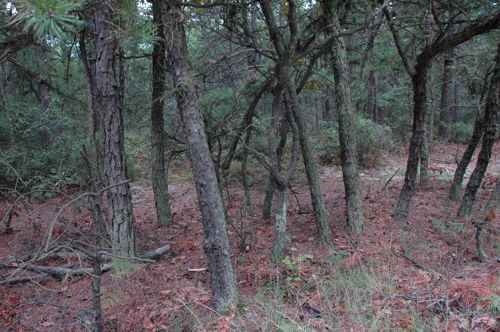
Pines2“What did you find out?” That was the question I was asked when Jimmy and I returned from our one-day field trip to the Pine Barrens of New Jersey, to find Elizabeth White’s house, Suningive, and explore Historic Whitesbog Village, a state trust which preserves a turn-of-the-century company town built around cranberry and blueberry farming.

The question, innocent enough, made me bristle. It seemed to beg for information, and the purpose of the trip had really been about sense. Having spent a good part of the summer reading about agriculture, fruits, the Pine Barrens, and Elizabeth White and her family, I wanted to test my sincerity. Am I really interested in this subject? Is my curiosity powerful enough to bring me back here, to keep taking the next steps?

There’s something about the beginning of an idea that’s so fragile: just a few cells, stuck together, with a heart barely beating. One must hold onto it, without exposing it. That’s how I feel. The beginning should be conducted in the darkened room of privacy.

So the question — wow! That felt like an intrusion. Inside, I felt my will kind of clamp down around what I could say or reveal, wanting to keep it for myself.

Still, the question-asker is a kind of audience, and I had said enough about my impulse to write a biography of Elizabeth White that the audience deserved a response, an early communication. Continue reading

– If only we could go back, if only!

"Eyes the shady night has shut," by Iseult

"Eyes the shady night has shut," by Iseult

In a conversation about Ted Kennedy’s death and the Massachusetts response, James asked me about what he called my “JFK Jr. project,” a piece on the summer of 1999, when I became scarily obsessed — unusual for me — with the story of the crash of the plane piloted by John F. Kennedy, Jr. and carrying his wife Carolyn Bessette and her sister Lauren.

Earlier this summer, I drafted an essay and then shortened it into a script for a digital story. I recorded it, with help from Anthony Sweeney, in a workshop conducted by my MIT friend and colleague, Lisa Dush, who runs Storybuilders. Later, I edited it in Audacity.

It’s about 4 minutes long, and you can listen to it by clicking the SoundCloud arrow. If you prefer reading, you’ll find the text of the story after the jump.

Continue reading

– Cupcakes and life

CupcakesAt 9:40pm, Jimmy is folding laundry and playing dj. It’s Prince: “I Would Die 4 U,” “Raspberry Beret,” and “When Doves Cry.” Eli is out. I am putting away my sorted clothes, and Lydia and Grace are hanging out with us. As usual, the children introduce conversational threads out of nowhere.

Lydia:  When we go to New York, can we go to Magnolia Bakery?

Jane:  Why?

Lydia: Because they mention it in “Lazy Sunday,” and Andy Samberg loves their cupcakes.

Jane: Lydia, it’s only a cupcake.

Lydia: Mom, life is short —

Grace: — in a long way.

*

—–

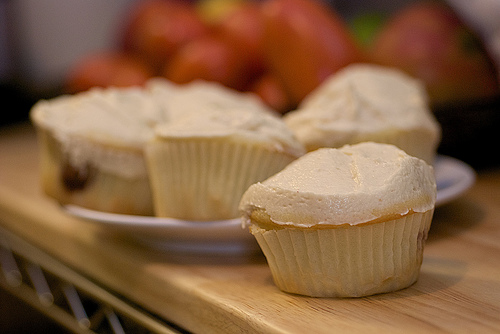
Cupcakes image is from B Tal’s photostream on Flickr. I worked with B Tal, that is, Brian Talbot, at Simmons College, and I once had the opportunity to have one of his peanut butter and jelly cupcakes. They were so great I had to get the recipe, and I have made them for the kids, who have dubbed these THE BEST CUPCAKES EVER. (Who cares about Magnolia?) You can make them, too, by following the recipe that appears under the photo on his Flickr page. Two tips from me — use only 1/3 or so cup of milk in the frosting recipe, and either make a double batch of the cupcakes or a half batch of the frosting, because the frosting recipe, as is, makes too much for the 12 cupcakes indicated. And refrigerate them: like a lot of cake and frosting combos, they are delicious cold.

– Words that cannot be said

PagesWhen I was a child, there were words forbidden in our household.

The following were the big three. Really, these are the words I recall my mother itemizing, after she announced: “There are three words I don’t want to hear.”

I am about to write them, which is a kind of saying.

Stupid

Hate

Kill

My parents had five children. While that made for a lot of fun, it made for friction, too. The forbidden words were ones that are most often useful in situations involving conflict. Say my sister Sally and I were playing the card game Spit. I’m older, but she was faster. In the heat of the game, when I suspected she was on the verge of winning, it would have been normal for me to growl at her and bark, “You’re so stupid and I hate you. I’m gonna kill you!”

But, I didn’t, because the words were forbidden. And just now, typing them? I felt very uncomfortable and even queasy. Those are not my words.

In the house I grew up in, we sat down together every night and ate a meal that my mother, usually, prepared. (Once in a while my father cooked.) It must have been hard to create a menu that all seven of us would find pleasing, day after day. I remember liking almost everything, or at least being willing to eat almost everything put in front of me. Still, my brothers and sisters and I each had our own personal limit. Me? Creamed corn. My brother Michael? Deviled ham sandwiches. (Sally, Emily, Brian: What were your dislikes?) Nevertheless, we could not say, “I hate creamed corn.” Instead, my mother recommended we phrase our distaste this way: “I don’t care for creamed corn.” Wordy, indeed, yet tactful.

My parents also preferred real words for objects, and not slang, especially when it came to the body and its processes. Continue reading

– Dream of kahare

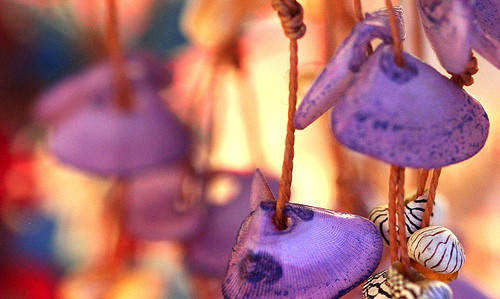
Purple shellsI sit in a restaurant with two colleagues, a female one from my current job and a male one from a job I had 14 years ago. In my immediate view is what looks like an artichoke heart, but paler green. I hold it up to my mouth; I eat. I register “sweet, like fruit,” but my dream mouth doesn’t taste. Still, I sense that this is a discovery: a new fruit. It’s called a kahare, and I know this because I see the word on the menu in my dream. Kahare. Exotic — not from here — and delicious.

Waiting on my plate is something else, the color of black raspberry ice cream and the shape of a long, round-edged bar of soap and as smooth. It is intact; there are no bite marks. Continue reading

– Habitat

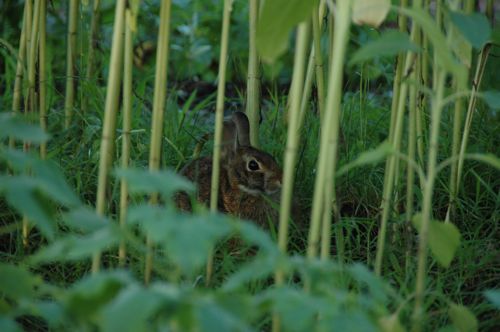
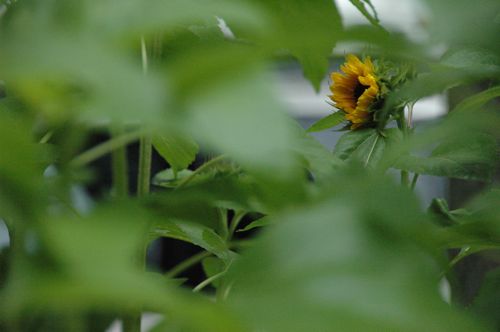
I planted the sunflowers for me, and also for passers-by, but it seems that the creature most enjoying them is a wild rabbit. It’s there in the morning for a couple of hours and then later in the afternoon, resting in the shade.

Rabbit

It seems to have its own spot: a bare patch of dirt among the stalks and leftover lawn. I’ve seen the rabbit stretch its length and roll a bit on its bed, so I guess it has created that bare patch, worn it down in the same way we humans wear down a path: thoughtlessly.

The rabbit no longer seems paralyzed and wary when it sees us watching it. Sometimes, the rabbit turns and looks at us. Other times, it stretches and rolls on the dirt. The children stand quietly and look. Jimmy waits to run the mower until mid-afternoon, when the rabbit is out. I showed the rabbit to an older couple who go often to services at the temple across the street; she always wears green as her signature, and he always drives their car. They stood with me on the sidewalk and looked in, delighted. We spoke in low voices, as though a new baby was sleeping there under the sunflowers.

I had hoped my sunflowers would attract hummingbirds and butterflies. So far, there have been many bees and one butterfly. The rabbit is the most frequent visitor.

Scratch that. The rabbit may be its resident, splitting its time between the sunflower patch and a nest or burrow somewhere else in the yard or neighborhood. Continue reading

– Mudroom thoughts

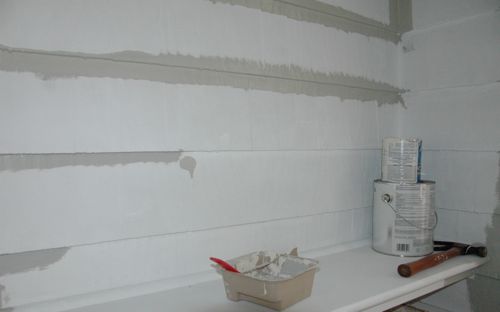
I am painting the mudroom in our house. It has seemed to me, as I’ve been sanding and priming and painting, that this is about as prudent as detailing the family minivan or polishing a car’s hubcaps. (Not very.)

Mudroom process

Still, I will finish it, and it will be good.

The experience — while longer than I budgeted — has yielded many long moments of my kind of meditation: an unhurried and unworried turning and turning over of thoughts. Here are a handful.

1. To be a professional ANYTHING takes more than talent, desire, and hard work. It takes a stomach for boredom. Don’t a lot of people think they can paint? I mean, hey, how hard can it be to lift the brush, stroke it back and forth, swipe at spills with an old rag? Not very. What’s hard, though, is to keep going through the boring times. This is true for every job and vocation and art: There are long patches of boredom. What makes someone a professional painter (or writer, teacher, accountant, mechanic, gardener, athlete, chef, whatever) is stick-to-it-iveness, not just in the face of challenge, but in that gaping yawn of same old, same old, end not in sight, still must go on. Continue reading

– Convalescence

Dark sunLydia came into the bedroom at 7pm last night and said, “Mom, I can tell you kept yourself busy this morning.”

“You can?” It was so sweet of her to know how I operate.

“Yeah,” she replied. “You never fold my clothes.”

She was right. Yesterday morning I busily and methodically went through the house, making beds, folding dropped clean clothes and putting them away, hanging up jackets and shirts, sponging the kitchen table, and straightening books and papers on the coffee table. That’s my modus operandi: to deal with percolating fear, I keep busy.

By the time Jimmy and I left, yesterday morning, for the hospital at 11am, the house was as neat as if we were expecting company. My hair looked great and perfectly straight, because I had blown it bone dry, which I rarely do in the summer. My finger and toe nails were trim and clean — don’t anesthesiologists examine the nail beds for oxygen flow? I think I learned that on Quincy, M.E., years ago, when the clue that pointed to murder was the dead woman’s painted fingernails. She had died during surgery, and her nails were still beautifully manicured. Quincy had overlooked that detail at first: Don’t women often have painted nails? Ah ha!, though, not if they’re having surgery; the surgical team needs those nails bare. Quincy removed the polish and found the cause of death: a lethal injection to the nail bed.

Not only do my hands tend to unnecessary tasks when nervous, my mind does, too. Continue reading

– First sunflower

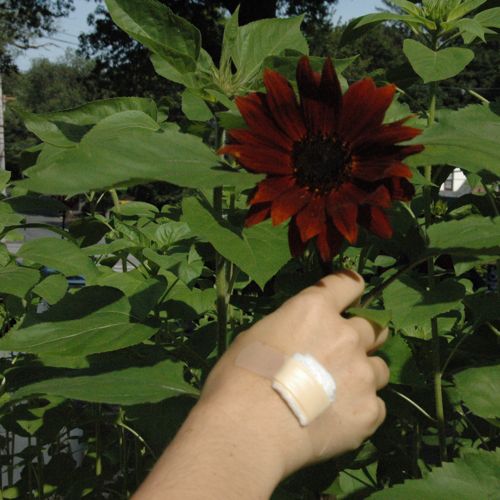
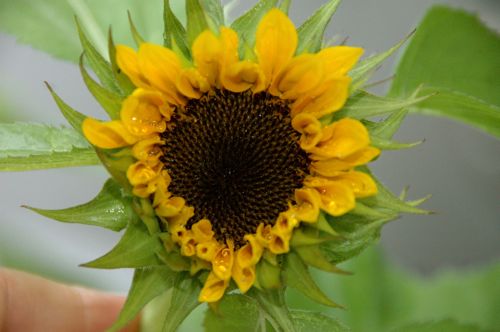
Seventy-two days after I planted the seeds, the first sunflower in my folly has shown its face.

First sunflower 2

Like someone who has been waiting and waiting for a long expected guest, I want to run into the house and yell: “She’s here! She’s here! Everyone come outside — she’s here!”

Sunflower face

—-

Photographs by Eli Guterman.

– Summer’s punch list

tool wall 500

"Tool wall," by Valerie Everett

Often, I think seriously about changing this blog’s tag line to this: “What goes into planting, fixing, and writing.” I rarely use my skills in handwork to do much else than repair or fix stuff up. This month, for example, I’m painting the mudroom, tinkering with the garage door, and changing the latch set on a storm door.

Last week I bent myself over the sewing machine to hem a few pairs of pants for Grace, and yes she did appreciate my labor. It is good to know how to do things: When you do it yourself, you save money, and you’re on your own schedule. I hemmed those pants the same day I bought them, and I draped them over the end of Grace’s bed as she slept, so she could see them when she awoke.

(My mother did that occasionally for us when we were children. She’d sew late into the night to finish pants or a little jacket, and arrange them on a clothes hanger and then our bedroom doorknob so that, when we awoke, there would be a new outfit in a place where before there was nothing, just a door. Perhaps that is why I love — and I really mean love, and never tire of — that scene in Disney’s Cinderella where all the birds and mice work together to fashion a dress for their poor but beautiful friend. You can see that scene and the animals’ industry in this YouTube short between the 3 and 5 minute marks. If you let it play another 30 seconds, you’ll see the stepsisters tear that dress to tatters, and that, for me, is more upsetting than the missed connection with the prince.)

But!, this isn’t about making dresses, it’s about mending them and lots of other stuff. Continue reading