– Evidence

Last summer I started and made substantial progress on a draft of a memoir/essay about having a crush on one of my Wellesley College professors, *not* having an affair with him, and reading many years later of his death from prostate cancer. A first excerpt is here, and another one is here. (There’s also a reflection on writing the essay here.)

Then, I put the essay aside for the winter and did other things and wrote other pieces as well as lots of comments on student work.
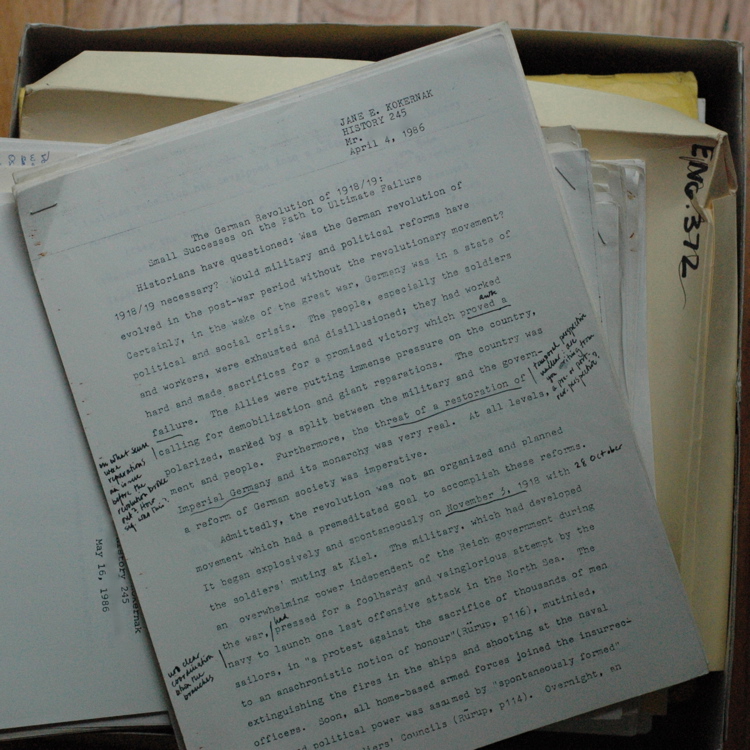
Archives750RetouchedResolved to finish the draft, I picked it up again a couple of weeks ago. I hit a snag when I felt I had exhausted my memory of that time in college. Searching for something concrete, I opened up my college archives (a green cardboard box) and found three papers I wrote for that professor.

Ah, evidence. It helps. In writing about those papers and his comments, I found my way back into the essay and finished the draft. It’s funny how artifacts function, however. While they are more lasting and stable than memory, our interpretation of them is often — usually — slippery.

Excerpt #3, “Dead and Gone (draft)”:

All that I have left from Mr. K’s class (History 245) are three papers I wrote, typed, handed in, and got back with his handwritten feedback and grade. These are my only concrete artifacts of my time in that course. Who knows, though? Maybe in the College Archives, or in his own papers, there are records of that course from that semester: a syllabus, a grade book, his own notes if he kept them. (All teachers must keep some sort of notes.) But this is all I have and all I’m willing to put my hands on. Continue reading
– Overheard and overbought

I heard this today, as I stood in the check-out line at my local grocery store. It’s a revision of a well-known saying, and another customer was sharing it with another clerk.

When you complain, you complain alone.
When you laugh, everyone laughs with you.

That seems good to remember.

And what was I buying at the grocery store? I’ll tell you, and I’ll also tell you that I noticed, as my 14 or so items were picked up one by one and scanned, that none were essentials.

  • 3 liters of Polar seltzer (for Grace’s 3rd grade party)
  • 2 half-gallons of Minutemaid lemonade (ditto)
  • 1 box of Cheez-It Party Mix (afternoon snack)
  • 1 jar of roasted sunflower seeds (the protein to go with the Cheez-Its)
  • 1 sandwich roll (okay, I need that for my lunch — I’m home today)
  • 1 single-serving sized bag of potato chips (ditto)
  • 1 hosta (to fill in a blank spot in a shady patch)
  • 2 six packs of those mini soda cans: Diet Pepsi and Diet A & W (because)
  • 1 bag of ice cubes (for Grace’s 3rd grade party)

Not only do we live in an age of complaint, we (still) live in an age of excess. I mean, none of those things are items I need. And yet I bought them, and will again.

– Contraries

My friend Lisette once said something like this: People’s contraries make them interesting. She was taking about a feminist she knew who was obsessed with (her own) personal beauty, and I found this alarming. Lisette found a way to be more tolerant.

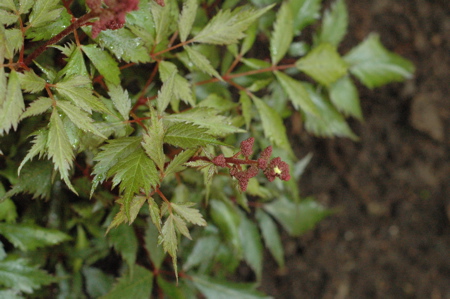
It’s gloomy and wet today, and I was thinking about contraries as I was planting some astilbe in the dry strip of shaded dirt that runs alongside our garage and next to Bob and Mary’s fence. Over my head, the neighbors’ scraggly hemlocks protected me for a while from the rain. Then, the branches got soaked, and the rain started dripping on my head and bent back.

Mite on astilbe plume, 5.29.2009

Mite on astilbe plume, 5.29.2009

I kept going, even though I felt as gloomy as the weather (and maybe it was the weather). I was determined to get the five astilbe in the ground because the tight-fisted buds on their plumes seem about to burst and I’d like to see that effect in the garden and not in the plastic nursery pot.

As I was digging, I contemplated the poor soil and noted an absence of worms and I wondered, for about the 50th time, if I should buy some worms and try to get them established here and thereby really perfect the soil. Or, maybe, I should relocate worms from other parts of the yard, where I have seen them, to here. Continue reading

– It’s not the climb; it’s the cliche.

I can’t help it — that Miley Cyrus song, “The Climb,” has been giving me goosebumps, which goes to show that the intellect has very little control over raw feeling.

I know, I know: The song is laden with cliché and bombast. It’s oversung.

However, my inner teenager has been responding in a big way: Yes <sniff>, it is the climb. That’s what… <snuffle>… matters … <sigh>.

So, what prompts this confession of uncoolness? This morning I’m digging through a box from my personal archives — it’s a big green square gift box labeled “Papers High School + College” in my printing — and I find my high school graduation speech, Leicester High School, Class of 1983. (I wasn’t valedictorian; I was either salutatorian or oratorian, which are either second or third rank.) Even with my reading glasses on, I have to squint to read it: This was the early days of photocopier technology, and the ink hasn’t held up. The full text, however, is legible enough: I see that the speech is laden with cliché and bombast. And while this first speech of mine may not be about the climb, it is about the path, which is a kind of journey. (Maybe only teenaged pop singers get to travel uphill?)

If I’ve piqued your curiosity, I’d also like to satisfy it, so I’ve transcribed the full text below. I don’t promise great or even mediocre rhetoric; it’s just a chance to read what an 18-year-old girl, only a few months away from college and some teacher’s first year composition course, thought was an example of her best writing.

Be kind! Continue reading

– Sprouts

Saturday, May 23, 2009 (Brookline, MA): A sunflower folly, planted by local resident Jane Kokernak on May 10, was unveiled today. Early reports suggest that seeds sprouted consistently across the bed. Kokernak, who paused in her sweeping and bagging of tree pollen, remarked, “I’m pretty happy with the results so far.” She forecasts dramatic growth in the seedlings over the next three months.

Sprouts

Sprouts and Jane

Photographs by Eli Guterman.

– Sunflower folly

This is what hope looks like.

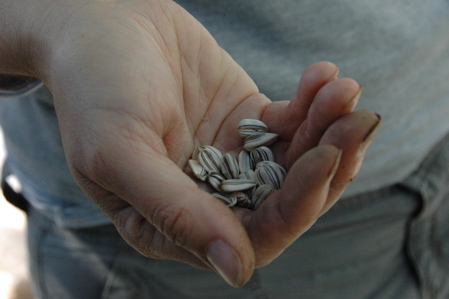
Seeds in hand
During a spring semester clouded by the recession and my own economic downturn, I forced myself to take on tasks that were both optimistic and doable. I tended to my students and their work; I cultivated ties to colleagues and friends; I hoed the already neat rows of my resume; and I scattered queries for teaching jobs.

And I planted sunflowers, a huge patch of them. A “folly,” it’s called. In the midst of the sober and the sensible, I had to do something dramatic, quirky, and above all possible. I mean, sunflowers I can grow. (So can you.)

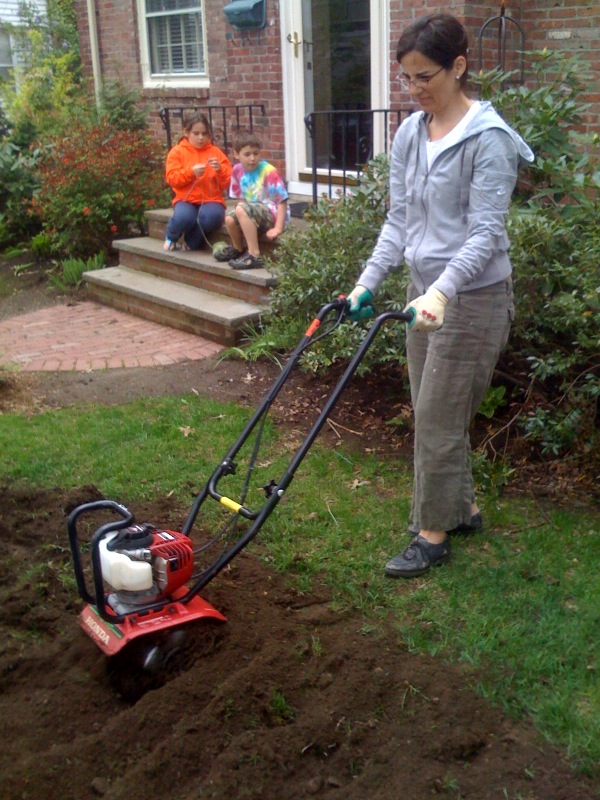
Along with my helpers Grace, Jimmy, and George, I stuck those seeds in the dirt only 10 days ago, on May 10th. It’s too soon to tell whether the folly will be a success. Amazingly, however, there has been an unexpected bounty on the teaching front: I’ve been rehired, as funding to the MIT writing program has been restored for the coming year.

And I am so… HAPPY! I feel the way I expect those sunflowers to make me feel when they bloom in August.

There’s still time for you to plant your own sunflower folly, according to the tutorial that starts below. The original concept can be found in Katherine Whiteside’s The Way We Garden Now (an excellent, unfussy, and imaginative garden project book, by the way). Variations are by me. Continue reading

– Accentuate the positive

This week at MIT could be called “Presentations Galore.” In many classrooms, lecture halls, and meeting spaces, day and night, students are making formal presentations to their peers, profs, and even parents, if they want to invite them. My colleagues and I who are communications lecturers have been overseeing a lot of the behind-the-scenes rehearsals and being first audiences for draft presentations. We reserve practice rooms, lug laptops and projectors, cue students, ask questions, offer feedback, articulate our puzzlement, troubleshoot PowerPoint, watch the clock, talk through nerves, and inspire confidence.

And on the big day, the best thing we can do, besides be attentive members of the audience, is root for them, like devoted sports fans. Students do better when they sense our belief in them. They can borrow our positive energy.

So, I sent my presenters an e-mail yesterday morning, just a few hours before showtime. I wanted the message to be practical, positive, and sincere:

Dear [student names]:

I really enjoyed working with you on your draft presentations. I have
learned soooo much from your teams this semester, and I look forward to today’s showcase of your work.

Here is some preparation advice that is most relevant on the day of:

–Drink water. (If your mouth and voice are comfortable, you will feel more comfortable *and* confident.) Bring some with you, so you can keep sipping up until your showtime.

–Breathe. (Some deliberate breathing, in the five minutes before you go on, really helps with gaining your poise.)

–Pick a personally relevant, positive message. (Like, “I will reach my
audience,” or “I will enjoy this,” or, like an athlete, “I’m winning this
thing.” Once, before a good presentation, I said this to myself: “I own this stage.” This seems corny, but, honestly, it WORKS.)

And remember… your audience is interested in your project, and your friends and peers are rooting for you!

All good thoughts,

Jane

Thanks to my friend, Jan, who sometimes signs her notes, “All good thoughts,” which makes me, the recipient, feel as though she’s sending some good vibes my way. And if you want to hear Bing Crosby and the Andrews Sisters sing “Accentuate the Positive” (1944), you could watch this scene from The Singing Detective on YouTube.

– What they teach us

On Wednesday afternoon, I went to capstone presentations by students graduating from Mount Ida College, where I used to teach and run the writing center. Events like these seem more a measure of educational outcomes than any standardized test or GPA could ever be. The students were poised, engaged, knowledgeable, professional, and comfortable discussing both theory and its application to experience. Wow.

I really, really went to see Sarah Elliott, who worked with me in the writing center. In her capstone poster and remarks, Sarah described her year-long practicum at the Italian Home for Children in Jamaica Plain, working 1:1 with traumatized children, one in particular.

At some point, someone in the audience asked Sarah and her peers, “What did you learn about yourself through your work with your clients?”

I loved Sarah’s answer, and I wrote it down on the spot:

What they teach you is so much more important than what you already know.

In the auditorium, I was sitting in the dark next to Alan Whitcomb, a math professor and first year program director there who’s on my A-list of good teachers. I leaned over and said to him, “That’s what I think makes a good teacher.” He agreed, and added, “And it’s harder to teach that way.”

Interesting, that. To be a learning kind of teacher may be harder than being an expert kind of teacher.

Yet, it’s such a useful and optimistic stance as a teacher and tutor, or social worker, doctor, advocate, therapist. Open to students, open to keeping one’s own work alive.

(Go, Sarah!)