– Right, right, right…

I’m of this guilty, too.

There’s this warped conversation filler that people — busy people — use to signal their attention to another speaker and urge that conversation along. I say it’s warped, because listeners are not supposed to supply conversation fillers; normally, the speaker gets to “like,” “um,” and “I mean,” and “ahhhh” her listener to death. A speaker uses a filler to give herself time to think and still hold the floor while she’s formulating the words for the rest of a thought.

However, there’s a new conversation filler in town: “Right, right, right, right…” Sometimes when I’m speaking — and quite clearly and steadily — my interlocutor, who’s supposed to be listening, will interject or, really, voice over my sentence with the rapidly repeated word “right.”

It goes like this:

Jane: I’m wondering if my tendency to wear a shoulder bag rather than a back pack —

Chiropractor: Right, right, right, right…

Jane: — is in part the cause of my impaired neck.

Many people do this, start talking over another person’s sentence. It’s possible that “Right, right, right” is supposed to convey that the “listener” is in sympatico with the speaker.

However, this is how it sounds to me.

Jane: I’m wondering if my tendency to wear a shoulder bag rather than a back pack —

Chiropractor: Hurry, hurry. I know this already! It’s my turn to talk.

Jane: — is in part the cause of my impaired neck.

Dear listeners, it’s okay to make eye contact occasionally, say “hmmm,” nod, and even wrinkle your brow at the person who is talking.  But the right, right, right, is — forgive me, I can’t help myself — wrong, wrong, wrong.

I’ve done it, too, and now I’ll be very careful and stop.
– Dear Ms. Morin

Jan Morin
Leicester High School (1979-1983)
Winslow Ave.
Leicester, MA 01524

Dear Ms. Morin,

My friend Rosemary, writing about her relationship to exercise over her lifetime, looks back on high school gym classes, where “being active meant being an athlete.” It made me think of high school gym class, and that made me think of you.

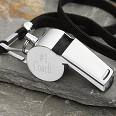
Ms. Morin, I was never a hardcore athlete and I liked gym class, and I liked it whistle1because you were a great gym teacher. I don’t know if I was aware of your greatness when I was in high school, or if this is only a realization I’ve had since becoming a writing teacher five years ago, but I always had fun in class and enjoyed talking to you. Teachers bring energy to their students, whether positive or negative, and yours was buoyant, humorous, and tough. I can still see your off-kilter smile; I remember your laugh, a whooping cackle.

Gym was one of those classes, as it is today, that was a requirement. We couldn’t get out of high school until we had taken so many P.E. hours.  That means that, unlike on sports teams, where everyone has volunteered to participate, all the students in gym were there to some degree against their own choosing.  Continue reading

– Rejection is exasperating.

After my “On Lice” essay received notification of rejection from the journal I sent it to back in August, yeah, I was disappointed for about a day. Let down.

Not personally hurt, though, or even stung. By the next day, my feelings had turned into exasperation, like Grace’s here.

grace-on-lawn

Grace, collapsed on the lawn in front of some public monument in Ottawa. August 2008.

Who has time for being rejected? Not me.

Being rejected is totally impractical. It means that one has to try again, at an activity — seeking prospects, and preparing the manuscript for submission — that adds on time to the time it took to write the thing.  And, therefore, it takes time away from other things I might do. Continue reading

– Two hours and five minutes

That’s how long it took me to make an MLA style list of works cited for an essay I am submitting to journals.

There are only nine sources on this list.

Why did it take so long? After all, I kept detailed research notes.  And, I tried EasyBib, which automates citation creation.

It took so long because, like the dashboard design that is unique to every car model, how each publication, whether print or electronic, catalogs its content is idiosyncratic.  Sometimes the author’s name and date are right there, at the top of the page.  Sometimes the name of the newspaper is the same as the owner (New York Times, for example). Sometimes URLs remain stable over time. And sometimes — most of the time — not.

Teachers, don’t we wonder why our students fail, almost every time, to adequately document their research in their papers? What’s wrong with those damn students? (Yes, I am shouting in my stage voice. You know I love them, and I suspect that you do, too.) Let me tell you something:

Continue reading

– Good use of time?

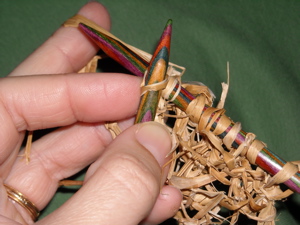
Without the energy to start a new knitting or sewing project, much less decide on one, I experimented on knitting the same thing — a small leaf — in different materials: yarn, wire, plastic bag shreds, and dried grass.  The straight-up yarn leaf in marled red came out pretty nice, and it’s in the banner photo above.

With me, Grace sat and clicked her needles, too.  She has a few projects going on, all in yarn.  (She loves beginnings. Me? I like finishing.) She admired my yarn leaf and even the one done up in green plastic, from loops I had cut from a grocery bag.

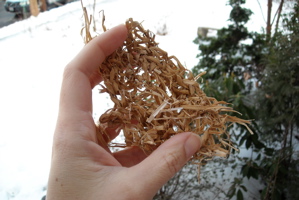
About my attempt to harvest, tie together, and knit the dried ornamental grass that grows alongside our driveway, she said, “Now that’s a waste of time.”

“I don’t think so,” I replied.

knitting-grass

“Why are you doing it? It doesn’t even look good!” Grace smiled; I know she loves me.

“It’s an experiment. Somethin’ to do. And I’ll learn something.”

Grace shrugged.

I learned that grass is difficult to tie together securely, although not difficult to knit, albeit with care. Furthermore, odd textiles do not always make for odd beauty — sometimes the result is just a wicked mess.

leafy-leaf

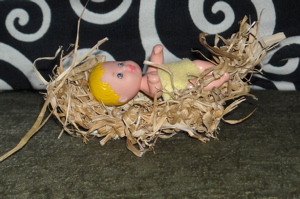
I also was reminded that the mind makes interesting associative leaps while the hands are busy. The needles and my fingers seems like a convergence of beaks; I was a bird among birds, building a nest. For eggs. For baby birds.

Or for baby Moses, in his rush basket on the Nile River, with his sister Miriam watching him.

Or baby Barbie, in his knitted leaf nest on the green chair, with Jane photographing him.

moses

– Hidden badness

Yesterday I made a turkey tortilla soup for lunch. It was to be the vehicle for a delicious, surprising chili accessory that I ate recently at my friend Brandi’s home: a dollop of sour cream, into which was mixed lime zest and juice. It was just the thing that turned her good chili into one of those meals that makes you feel loved and delighted.

The limed sour cream was just as delicious at my house.  I did wonder out loud to my fellow diners, however, if the combination constituted what my brother Brian recently called a hidden badness: a food that contains ingredients that you can’t see or identify. (An example of hidden badness, apparently, is fruited yogurt. And American chop suey.)

Lydia, at the lunch table, said, “Yeah, that’s a hidden badness.” She avoided the sour cream with lime.

Eli, the food adventurer, disagreed.  “I would call this, and other things like this, the hidden goodness.” He dropped more sour cream into his soup and ate the whole bowl.

And so did Jimmy.  And so did I.

Grace, at a friend’s house, escaped the moment.

– On the first day, magic

Last night, on the first calendar day of the new year, we saw Aurélia’s Oratorio at the A.R.T. Without dialogue and obvious plot, it’s filled with dance, music, visual tricks, acrobatics, puppets, black, white, red, gold, and weird beauty.

What is the show about?  Hmm.  During one scene, Grace whispered to me, “Ah, the dance is about the coat.”  And that’s just the kind of experience it is: the dance is about the coat; the body is about time; love is about absence; and color is about movement. And shoes are for hands.

See some here.  Don’t worry if you can’t decipher the voiceover; spoken words don’t matter to this show.

– Freaks, inside or out

In The Family Stone, a movie that Jimmy and I saw together and (dis)liked differently, the Luke Wilson character exhorts the straight-laced Sarah Jessica Parker character to fly her “freak flag.” Yeah, I loved that. I also cried when the Diane Keaton character died.

In praise of freaks of all kinds (and aren’t you, whether secretly or openly, one too?), I offer a brief list of some 2008 favorites.

Book: No One Belongs Here More than You, Miranda July.

Musical artist: Ida Maria.

Essay: “Mine Is Longer than Yours,” Michael Kinsley, New Yorker, April 7, 2008.

Sitcom: The Office. (I almost picked 30 Rock, but there have been fewer surprises there this season.)

Blog written by someone I don’t know: David Byrne Journal.

Tears of joy and relief: Reading this transcript, while watching a video of the speech, on the morning after.

Clothing: Anthropologie.

Siblings: my four.  All strange, in their own ways.

That’ll have to do.

—-

p.s. Thanks to my always surprising friend James, who got me to do this.  And to Lydia, who heeded the call first and thereby inspired me.

– Body’s report card

It’s on the kitchen counter, having arrived in the mail a day or two ago: a letter from the Joslin Diabetes Center with a full, quantitative report on what’s going on in my blood cells and, by extension, me.  I’m not ready to open it.

report2

Last week I saw my diabetes specialist. At one time, when I was new to diabetes and full of zeal, my performance — at monitoring, eating, record-keeping, sweets-avoiding, exercising, and controlling — was excellent. Sometimes, when Dr. A. introduced me to a med student on rotation, he would say, “This is my best patient.” Or even, “Here’s my A student.” In my late 20s at the time, that always struck me as paternalistic, if not affectionate, but still flattering. In the last couple of years, however, my body’s quarterly report card shows a more erratic performance. Occasionally, those numbers look great. More often than not, they look… merely adequate. Last week, as we looked over the records that I keep daily on my blood sugar, Dr. A. raised his eyes over the top of the paper and  asked me, in so many words, why I couldn’t do better. When I shrugged and smiled weakly, he caught my glance and then tapped the side of his head (home of the brain) as if to say, “You can do it. And because you’re not doing it, it must be your attitude.” Continue reading