– Accidental sunflower

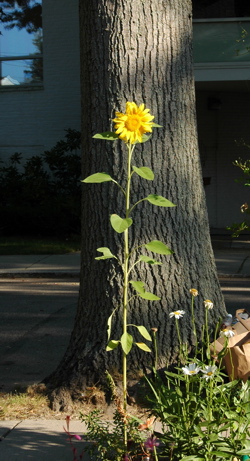
Lone sunflower

*

Grace planted this.

She planted many more sunflower seeds in the spring, and this is the one — out of all the seeds, and then out of all the seedlings — that grew.  The skimpy crop is mainly my fault; I could have helped her tend to them better as they were getting their start, but in the spring I was distracted and overwhelmed.

I can sit on my front steps, which may possibly be my favorite perch, as Julie pointed out the other day, and focus on it, instead of the service driveway to the building across the street.

This reminds me that, while many are good, many are bountiful, many en masse are stunning, one of something can be enough.

– On head lice

Over the summer, I finished writing a personal essay on my experiences with head lice. As part of that process, I researched and read way too much about Pediculus humanus capitis, a parasite that feasts on human blood and causes incessant itching. I also wrote about times, which I thought were past, when lice descended on our house.

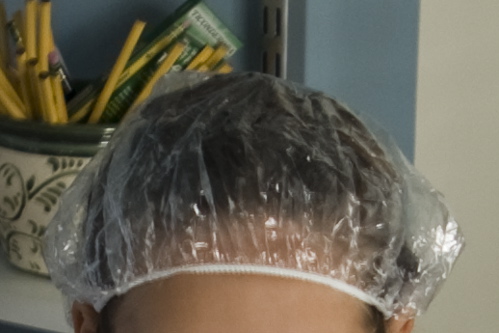
Grace undergoes a Licefreee! treatment

Grace undergoes a Licefreee! treatment

Well, the past has become present, and I’ve had to confront some fresh cases of infestation. This time, though, I feel no panic, because I see lice and I know what it takes to get rid of them. I’d like to share what I’ve learned with readers who may be confronting head lice on their children’s heads for the first time. Continue reading

– No hummingbirds yet

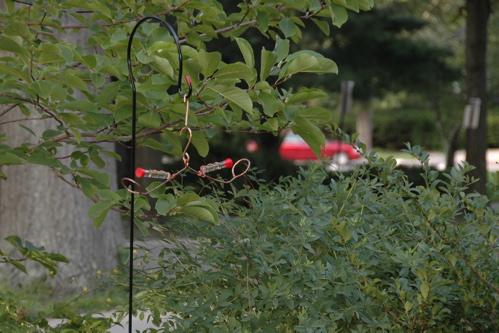
This is my new garden ornament. It’s called “The Tweeter Totter,” and it’s made to attract hummingbirds. I bought one, at the Bird Watcher’s General Store in Orleans, after watching bird after bird feed at the one in my parents’ yard. Hummingbirds in flight look like giant bees, and a person can’t help but stare at them, as she would at a baby, or fire.

There is, however, no action at my feeder.

Plenty of vacancy at the Hummingbird Inn

Plenty of vacancy at the Hummingbird Inn

Did I miss the height of the hummingbird season? Have they all headed south?

I built it. Why won’t they come?

– Personal essay checklist

Here’s a great criteria checklist for the personal essay genre, whether you’re writing them or teaching students how to write them. I discovered it yesterday while browsing the pages of What the Writing Tutor Needs to Know by Margot Iris Soven (Thomson Wadsworth: 2006).

  1. Does the essay enlighten the reader through an interpretation of self, the self in relation to others, or the self in relation to the world?
  2. Is there sufficient description of events and people?
  3. Does the essay convey the author’s mood or feelings?
  4. Has the author responded to all of the questions in the assignment?
  5. Is the style personal? (Usually includes the personal pronoun “I,” descriptive adjectives, and conversational language.)
  6. Are mechanics correct? (Soven 131)

There are so many aspects of this that I like. Most attractively, it’s simple, yet manages not to be vague. Furthermore, the list leads with the hardest tasks — enlightenment and interpretation — which nod at the key feature of an essay; it’s idea-driven. The essay’s relationship to the reader is emphasized. “Sufficient” detail is enough; description does not have to be exhaustive.

Mentally, I measured some of my essays-in-progress against this list, and some of them passed and a few did not. About the few that seem still to be lacking, I realized that I am still struggling with the first item. What are the essays about, at the level of the idea? They might tell a story, or present anecdotes and observations, but they do not (yet) present to a reader an original interpretation of the story or anecdotes.

I’m not teaching the essay this year — all my classes are science writing ones — but, if I were, I’d use this checklist with students, to help them make observations about essays written by other authors as a way to get them thinking critically and creatively about their own. In the meantime, I’ll apply this checklist to my work.

– Snacks = love

On Sunday, we were lounging in the front yard, where it was bright. Grace and her friend Julia were sculpting animals from long sheets of aluminum foil. Lydia was reading Harry Potter for the first time. Jimmy was sitting in the shade, and I was sitting in the sun. (Eli is still at photo school in Maine.)

I went in the house for a glass of water; I came out with an old quilt, a pitcher of lemonade, strawberries, cheese and crackers, and peanut butter and crackers. How much nicer than snacks from a bag.

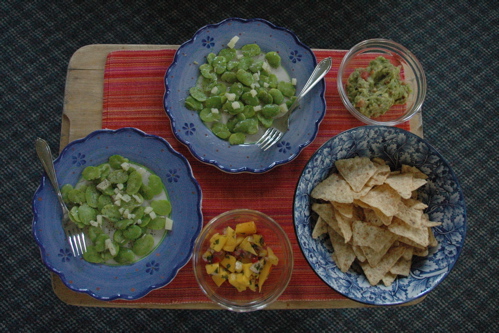
On Monday afternoon, we were hungry, and I hadn’t yet gathered the will to make dinner. To eat only a piece of cheese or an apple seemed paltry. An early-day trip to Russo’s with Julie meant that I had on hand the ingredients for some simple surprises. I prepared Marcia’s fava beans for Jimmy and me, and I put out chips, guacamole, and mango salsa for the girls. If we had beer, I would have drunk one, but we didn’t, so we had water and lime. We sat on the screened porch.

Monday afternoon snack

Monday afternoon snack

Since August 1, people have been saying, “Summer’s over.” They still say it. These leisurely snack periods are my way to put the breaks on, I think. Let’s not be in a hurry to eat lunch, to eat dinner. Let’s not wish away our time. It’s nice to sit for a while, talking and eating, and watch one part of the day segue into the next.

Also, snacks do not exhaust the cook. I love making them — they are like little gifts — and eating them. They should be quick to make and slow to eat.

Today? Popcorn (with butter) and lemonade, in the backyard. Someday soon, a snack picnic.

– Good question

In an essay on memoirs in the September 2008 Harper’s Magazine, Francine Prose writes:

On nearly every occasion when I’ve been invited to speak about both fiction and nonfiction writing, someone has asked my opinion of the scandalous disclosure that James Frey had fabricated sections of his memoir, A Million Little Pieces. I reply that I’m puzzled that people seem more upset by a lie about how long a writer spent in rehab than a lie about whether Saddam Hussein had access to weapons of mass destruction. Inevitably, nervous laughter ripples through the room.

In fact, I couldn’t be more serious. Each time, I find myself wondering: Why isn’t the audience talking to one another, and to me, about how, for the past eight years, our government has deceived us about matters of huge consequence–the war in Iraq, the economy, the environment, Abu Ghraib and Guantánamo, real estate foreclosures, poverty, unemployment, the handling of the Hurricane Katrina tragedy?

(Incidentally, her essay is not at all a defense of Frey or Seltzer’s contraptions, which she finds “B-list” at best.)

– Postcard to me

On the evening ferry from Oak Bluffs back to Hyannis, I finished reading the last few pages of the book I had brought along, and then I completed a chronological list of the little events that had comprised my day.

Next to me sat a couple with their two young children. The little girl — I’ll call her Rachel — was about six years old and full of energy and sweet sass. She complained about her parents’ lack of a pen, so I loaned her one. Then she enlisted her mother as a scribe. Rachel said out loud the words she wanted on postcards to various friends, and her mother wrote them down. The girl would say, “Dear Maya. Um, today we went to the beach. I had a hamburger for lunch. Then I had chocolately crunchy ice cream -.” Her mother interrupted, “That’s boring.” Her father, who seemed to have educational intentions, gently added, “Rachel, people don’t only want to know what you did; they want to know what you thought.”

Rachel tried again, “Hmm. Today we went to the beach. It was fun. Then I had a hamburger…” She seemed to be thinking. Her mother, who really did seem to be kind and loving, said softly, “Still boring.” Her father said, “Rachel, give your thoughts.”

I sat there, wondering what he meant. Rachel seemed perplexed, too. She kept listing her day. To the mother’s credit, she continued to transcribe although a few times she said, “Boring.” They managed to write about five or six postcards this way until the mother decided to take a break. The girl did not protest. Five or six postcards is a lot of writing for any six-year-old, even one with Rachel’s spark and persistence.

I love getting postcards. They could say anything: “Beach. Kite. Hamburgers. Ice cream. Bicycle. Thinking of you.” It makes me picture my friend’s travel day a bit, and I feel remembered, even in the midst of vacation distractions. Plus, who doesn’t like to get real mail?

I wondered what the family would think of my postcard to me, or what I wrote in the last four pages of my notebook on the ferry ride home. Here it is, with only a few lines about a private conversation omitted. Continue reading

– Terra firma

That really is the phrase that goes through one’s mind, joyously, after one has spent a few hours on a small boat, commandeered by an arrogant captain, with 90 other passengers who are gripping their stomachs, wincing, weeping, and eventually puking into garbage bags as the boat made its way out of Provincetown Harbor and into a post-storm ocean with 15-foot swells to seek whales, which it eventually found, although not many — myself, two daughters, and one niece included — were well enough to view them, and then rolled and heaved back around the tip of the Cape and into the harbor.

– Say that, then

I was just looking at my earlier post, to see if I missed any errors when I proofread it this morning.  Lydia read the first paragraph or two over my shoulder.

Lydia: “You don’t love writing?!”

Jane: “Well.  I love it, but it’s not an easy love.”

Lydia: “What do you mean?”

Jane: “I mean, it’s difficult, like… ”

Lydia: “… a relationship?”

Jane: “Yes! Like that.”

Lydia: “Well, say that, then.”