– Can’t not write

I thought that would be a more precise title than “I hate writing,” which is not true. I cannot say, either, that “I love writing!,” in the same way another person might say, “I love ice cream!”

On vacation, I brought my iBook, to work some more on my “On Lice” essay and attempt to finish it for a journal’s August 1st deadline. In the hotel room and at poolside, I wrote the connecting pieces and conclusion, and submitted it with a few hours to spare.

Hotel bed, Jane, and iBook in Ottawa

Hotel bed, Jane, and iBook in Ottawa

Yesterday I brought Grace and her friends to a birthday party in Wellesley, Massachusetts. I brought my iBook along, thinking that I’d sit somewhere and drink coffee and read the newspaper online while I waited for them.

There was no WiFi in Peet’s.

I tried to insert myself in someone else’s network. On the AirPort pull-down menu, I chose “VillageChurch” as a possibility, and then attempted obvious passwords like Jesus, G0d, M4ry, Chr1st, and Church. (My password is not hard to crack — why should theirs be?) Nothing.

I looked around a bit desperately at the other patrons. Could I catch someone’s eye and wordlessly signal to him that I wanted to piggyback onto his account? No one looked at me. I did, however, notice the same excessively thin and tattooed middle-aged woman whom I had seen only two days before at the Newton Farmers’ Market, and I considered getting another tattoo, and then I stopped. “Jane, don’t go there.”

I wished I could e-mail friend James Black or talk to him. I’ve been reading his posts on writing and not writing and having imaginary conversations with him. Suddenly, it seemed urgent to have a real one, and we were disconnected. I had no book or magazine to read. I could have walked down the avenue and shopped, but I don’t like to shop.

“Damn,” I thought. “I have to write.”

Sighing, I opened the file for an essay, called “Dead and Gone,” that I hadn’t worked on since my retreat in July. I read the last two paragraphs, noticed how unpromising they seemed, and wrote a next sentence.

Then I stopped and tried to break in again to the VillageChurch network.

“I really don’t want to write this,” I thought. “It’s probably going to suck.” My internal voice is normally rather matter-of-fact, and it was in this instance, too.

So, I wrote two paragraphs, and then realized there seemed to be a huge gap in the story, so I inserted the cursor between the two and wrote a long passage in which I tried to elaborate the romantic fantasies I was having about my (now dead) college professor, when I had a crush on him. Honestly, only one of them do I vividly remember; some of it I had to make up. (Is it dishonest to fictionalize the memory of a fantasy? This is a real question.)

Here’s something I wrote yesterday, that I don’t actually recall dreaming about then. Continue reading

– Travelers’ advisory: Canada

Although I have often said that travel with children is more a change of scenery than an actual vacation, we managed to see new sights and experience rest and recreation during our recent trip to Montreal and Ottawa with four children: our own, plus John Tyler, Eli’s 17 year old best friend. It turns out we had much of our fun off the beaten path, which is often how things go.

Montreal

Vieux-Montreal (or the old city) spreads out along the seaway. It’s great for walkers, bikers, tram riders, and Segways, which Jimmy and the three older kids tried on our last day in town. The food there was not great on the low end, as my sister Em had warned; I can vouch for that. French fries and ice cream abound.

We did *not* go to La Ronde, the massive amusement park that is across the seaway and impressively visible from the boardwalk. No one in our clan likes roller coasters and other rides (which also explains why we, as a family, have never been to Disney World).

Of the touristy things we did in the “new” city — Biodôme, Insectarium, Jardin botanique, and Parc olympique — what we enjoyed the most was the Olympic swimming pool, which seems to attract more Québécois than visitors. For $3, a person can swim all day. We did that one day, and we liked it so much we went back again the next. As I sat on the side and watched the kids swim, an athlete (heading to the Beijing Olympics?) was practicing her dives off the highest platform and a team of synchronized swimmers, all wearing white caps emblazoned with the red maple leaf, practiced their routine on deck.
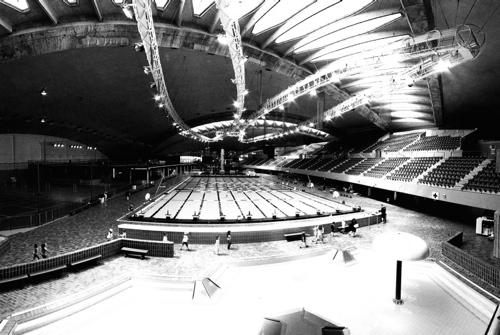
Pool, Parc olympique in Montreal

Pool, Parc olympique, Montreal

Because we were with kids, two of whom are vegetarians, we ate in a lot of pasta restaurants in Centre-Ville, where our hotel was. Groan. The food was forgettable at best. On our last night we drove north on Avenue du Parc on a hunt for Fairmount Bagel, billed as a Montreal institution. I pictured a sit-down deli, sandwiches, Dr. Brown’s cream soda. It was a storefront that sold good bagels indeed, but was not a deli. It was almost 8 o’clock and we had to eat somewhere. We parked. We walked around. Finally we found Le Petite Ardoise on Laurier Ouest. It was a delight. We sat on the terrace out back; the waiter spoke mostly French but was very kind and willing to try some English to translate the menu; the crêpes were just right for an outdoor nighttime meal. Later I apologized to everyone for dragging us out for bagels. Lydia said, “That’s okay. If we hadn’t come here, we wouldn’t have found the little French café.”
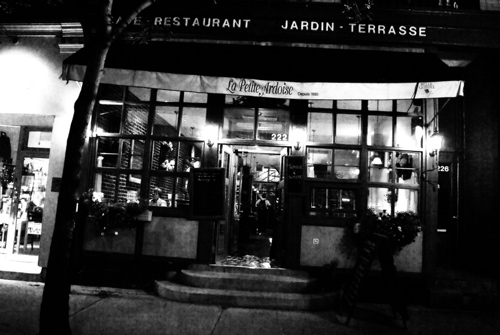
Le Petite Ardoise, Montreal

Le Petite Ardoise, Montreal

We had one why-are-we-doing-this? moment, at Oratoire Saint-Joseph, which is a pilgrimage site and the largest dome in the world after Saint-Peter’s in Rome. It was really late, and we had already been to a lookout at the top of Le mont Royal. At the cathedral John, Eli, and Lydia bounded up the granite steps, and Jimmy and I goaded Grace to keep going, up and up, 100 steps or more. She fell and banged her knee cap, hard, on a granite step, and then she fell apart, crying. Gently I tried to soothe her, and then get her start climbing again. (What was I thinking?) She sniffled, stopped, climbed, sniffled, stopped, climbed, and so on. I tried to distract her by telling her about this healer — Father Ralph DiOrio — who for a long time had an office in my hometown when I was growing up, and the stories of how he healed the sick and injured were dramatic and fascinating. Grace kept crying; I kept talking. Meanwhile, other visitors are walking up the stairs or down the stairs, passing us. We finally made it to the deck, to look out as the boys took their pictures, and then had to persuade the still weeping Grace to walk down. Really, it was an act of persuasion, not force, but still: What was I thinking?! The next day, Jimmy told me that another visitor, a woman, happened by us on the steps, just as I was telling the story about Father Ralph. She looked at Grace and then us, as if to say, “What are you thinking?!” Good question.
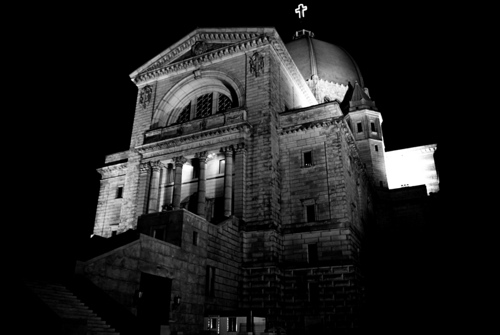
Oratoire Saint-Joseph, at night

Oratoire Saint-Joseph, at night

The next morning I told my roommates — Jimmy, Lydia, and Grace — about a dream I had in the night, in which I went to a religious retreat at a huge campground. Many of the people there were members of families that we used to socialize with as children (the Newcomers, the Fisets), and many were strangers. We were all waiting for the healer, who was taking his time coming. People were crying as they waited. I tried to comfort them. I kept saying the same phrase to them, over and over, and embraced each one. Grace wrote it down in her notebook, and today I came across the page, which she must have ripped out of hers and tucked into mine. This was that dream phrase:

You’re a stranger to me, but I love you, and I want you to know everything will be fine.

And so went my only vacation-time dream.

In Montreal I was not only a monster to Grace. On the last day, just hours before we were set to head to Ottawa, she and I went skating for a few hours on the indoor ice rink at Atrium Le 1000, a huge office tower at 1000 de la Gauchetiere Ouest, which was only one door away from our hotel, a Marriott. Why it took us until the last day to discover this, well, that’s the nature of vacation. As we whirled around the ice, with a assortment of skaters, I had that feeling of perfect rightness: This is where I want to be, now. Grace did, too. Usually a timid skater, she ordered me a couple of times to stand still at the side while she skated solo once or twice around the ice. Then, she ordered me to take a solo turn while she waited and watched.

Ottawa

I have less to say about Ottawa, and yet we enjoyed it more. It was our first visit. My mother recommended it as a destination, and yet when I told this friend or that about our plans to travel there, eyes would either narrow or open wide with skepticism. “Oh…. really? How… nice. Are you sure?”

It rocked. Canada’s capital, it’s lovely, walkable, outdoorsy, English, artsy, interesting. You can walk right up to government buildings — Parliament, for example — and not have a machine-gunned guard try to inspect your bags or keep you out. Hmm, how unlike another country I know well.

Parliament, Ottawa

Parliament, Ottawa

We had the same bad luck with food that we did in Montreal, but that’s not because there were no good restaurants; there are plenty. It’s just that our kids don’t want to eat in any of them. We did walk 18 blocks one night to Pancho Villa, at 361 Elgin, and we all loved the freshly-made Mexican food and the cheery waitress.

Our hotel was on the corner of Sparks Street, home to the city’s pedestrian mall, and the annual Buskerfest was going on while we were there. We saw more fire-eating acrobats in three days than any of us had in our lifetimes. And still, we kept going back for more…

Every night in the summer around 10 o’clock there’s a weird, yet affecting sound and light show at Parliament. Actually, it’s projected *on* Parliament. Lydia and I went. It’s very patriotic, and I tried to imagine myself as a Canadian. I felt proud.

During the day, we walked through Byward Market and passed by restaurants, food stalls, souvenir vendors, flower and vegetable farmers, and coffee and ice cream shops. Kind of like Fanueil Hall in Boston, times 10.

Jimmy and my favorite spot was also the place we had the least time in: the National Gallery. This may be the most beautiful museum I’ve ever been in. The way it uses its site and honors the art inside enlarges a person’s experience of a building. I can’t describe it. I wondered, as I walked through, if what I felt was akin to what people walking through those ancient, massive Greek temples felt, in their times. The art, especially 20th century Canadian, was something, too.

We hoped to visit, but did not, the War Museum, which we drove past on our bus tour. The guide told us that its building is the only one in Canada that is not visible from the air, because of how it is designed, like a bunker, with sloped sides and planted on its roof with grass.

Now that I’m home, I keep meaning to check this on Google Satellite.

—–

Pictures by Eli Guterman.

– After vacation: chores

It’s good to have a helper.

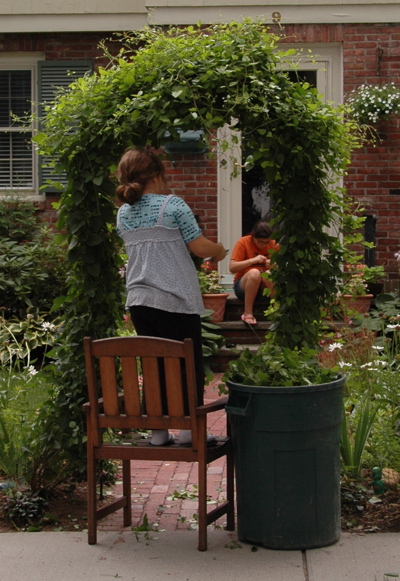
Grace, the little gardener, prunes the clematis arbor.

Grace, the little gardener, prunes the clematis arbor.

My other helper sits in the background, where only moments ago she checked my hair for lice, which has descended again on our house. To the back of my head Lydia said, “Dammit. White hair and white nits. I can’t find anything.”

Upstairs, staff photographer Eli is hard at work at the desk, editing and archiving photos, a few of which I hope to publish.

Someone has to wash the kitchen floor, and I think it will be me.

– During idle minutes

Like Jimmy, Lydia likes to be extra on time, or early. So, at her urging, we took our seats 15 minutes before departure time on La Balade, a open tram that scoots its passengers along the waterfront in Vieux-Montréal.

We were sitting in the back row, Lydia’s choice, for the best view. I agreed, “Yeah, we have the future in front of us, and the past behind us.” I spread my hands as if introducing a prize on a game show.

Lydia: “Not really. It’s more like the present is in front of us. We can see it.”

Jane: “Okay, yes. I guess it wouldn’t be the future…”

Lydia: “… if we can see it.”

We sit there quietly for a while and watch people who are not in the tram go by us in bikes and on foot. It’s breezy and sunny.

Lydia: “Well, actually, the present only lasts this long.” She holds her thumb and index finger together so that there’s space between them for only a raisin, maybe. “I mean, once I even say the word present…”

Jane: “… it’s gone?”

Lydia: “Yeah.”

The tour starts and we are wheeled up to the locks (west). The narration is on a tape that alternates between French and English. I like tours, but I lose track of the voice on tape.

The driver turns the tram around, and we head east. He stops at the clock tower and gives us 10 minutes to explore. Jimmy and I stand near the river and remark on how swiftly it flows, how huge it is. We go back to our seats in the tram, where the girls still sit.

Grace has turned around, and has rested her arms on back of the seat and perched her chin on them. The girls, therefore, are facing in opposite directions: Lydia, forward, Grace, back. We wait again for other passengers to return.

Grace: “I love the past. I like looking at it.”

Jane: “Maybe you’ll be a biographer.”

Lydia (sighing and rolling her eyes): “I hate the past.”

The tram eventually starts again. This was Sunday.

– Out of nowhere

Lying on the couch in that early morning daze, Grace just asked me,

Mama, can people marry objects?

I had to stop and think.

I don’t think so.

Grace asked a child’s inevitable follow up question,

Why not?

Of course, not being a legal scholar, I had no answer. Her logic for the impulse that sparked the question, however, is irrefutable:

People should be able to marry something, if they love it.

I thought about describing marriage as a socially-constructed institution that preserves a status quo and testing her notion against that theory, but then thought, She’s only eight, so I’ll wait.

– Arts camp

Today is Festival Day at Creative Arts at Park. Parents walk around, watch performances, meet teachers, and see their children’s pictures, objects, and sculpture.

I’m in the air conditioned room where the juvenile writers work. I can’t resist checking my e-mail and pretending that I’m a young writer at camp; I put words in a file because it’s my turn. It’s fast and freeing. It’s my 20-minute, unrevised blurt:

*

13 Ways of Looking at a Guterman

*

1. You see the hair: head, brow, lash. Circulation, blood: that interior river sprung.
*
2. Each finds their own place. Friends are places to hide. Friends set you free.
*
3. Sound frees, freaks, frets. Guitar has frets. Lydia frets. Grace freaks. Eli, “Free us.”
*
4. Strings attach you. Blood ties and sometimes it leaks. They bleed they cry.
*
5. In bed, dreaming. Limbs stir and breath is slow. They submerge themselves in worlds not known.
*
6. Rhyme, they don’t. Different, they insist and take and beg and bargain. No five-year-old Jesus comforts them. No sparrows.
*
7. Food in cupboards, stashed. Cooked, they don’t eat. Hidden, they gorge themselves. We starve them; there will never be enough.
*
8. For us, too much sometimes. Three pairs of legs, arms, nostrils, those eyes. Three times ten toes. Digit after digit after digit.
*
9. Pixelated beauties, freeze. Stop time. Blow smoke in their faces. Breathe in.
*
10. Ions and electrons, slow down. No slouching towards Bethlehem, you rush.
*
11. Heads together, they share ideas and parasites and propagate both widely. I pick and pick and those damn notions and lice return.
*
12. Return they won’t. Gone, gone, gone – every new day, an old one gone.
*
13. Old clothes and battered shoes. Papers and artifacts. What they sound like. These we hold fast to. What they smell like? Atoms dispersed. Join the air.
*
*

Eli looks over my shoulder and says, “Mom, let me read it.”

He reads it. “Uh, I don’t really get it.”

Jane: “It’s not literal.”

Eli: “Okay.”

*

At 12:15pm we have three children in three separate performances in three different spaces. There are only two of us. Fractions.

*

– Midnight costumer

An eight-year-old child comes home from her arts camp on the second-to-last day and says to her mother, “Peggy says I need to wear jeans tomorrow.”

The mother, who knows that (a) the girl has no jeans and (b) the girl doesn’t like jeans, asks, “Why?”

The girl says, “Because I need them for my costume.”

Ah, yes, the last day of camp is filled with the performances and art shows the children have been preparing in the intense five-week session.

The mother offers to alter her own jeans skirt.

The girl refuses it. “Mama, my character is a man. So I can’t wear a skirt.”

The jeans make sense; now the mother remembers that the girl plays Frank, whoever he is, in Annie Get Your Gun.

So, mother and daughter head to the fabric store and buy stretchy, denim-like fabric (that’s not denim!), a “quick sew” pattern, and notions. We come home, eat dinner, and get through the evening activities, including girl’s bedtime.

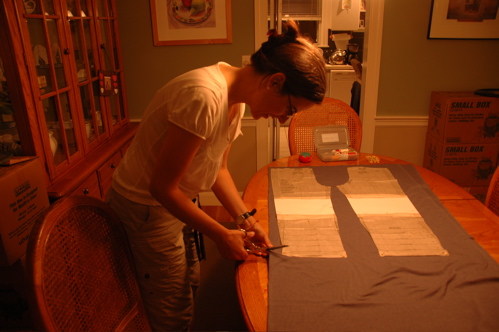
And here’s a picture of the mother, at 10:30pm, about 12 hours before the curtain goes up.

Jane cutting fabric for Grace's faux jeans

Costume Department

Photograph is by girl’s father.

– Money

On Sunday, my friend Betsy and I did some consumer research, by sitting through the 4:50pm showing of Mamma Mia!, the movie version of the Broadway musical based on the ABBA repertoire.

We did this so you don’t have to. It is possibly the worst movie I have ever seen, or it may be tied for worst with Baby Geniuses.

MM is not even interestingly bad, and it’s not even worth the price of the summer afternoon treat of sitting in ice-cold air conditioning. Betsy and I frequently cringed in sympathetic embarrassment as the normally talented Meryl Streep or Pierce Brosnan belted out a song and emoted in their close-ups. (Worst: when the close-up occurred as one was singing! Pierce, how could you?)

This is a movie made by capitalist cynics (Tom Hanks and Rita Wilson, who knew?), who have pegged their audience: middle-aged, conventional, probably married people who feel that “life” (i.e., Greek island, beautiful child of uncertain paternity, slutty and artistic sidekicks) has passed them by while they were earning a living and raising their children.

As Betsy and I, both in our early 40s, grabbed each other’s elbow and winced at clunky scenes, two women in their 30s stumbled over us on their way out, halfway through the show. In the row in front of us, women over 50 sniffled and wept as Donna, the Meryl Streep character, sang “The Winner Takes It All” with her blonde hair extensions and red silky cinematic scarf swirling around her face and professionally-slim figure.

It’s a Baby Boomer fantasy, and a hetero one, too, as James reminded me, when I warned him and Doug, who know their theatre, not to see it. Indeed, my intelligence was insulted by the coy, easy-to-miss glance used by Harry, the Colin Firth character, to signal his sexuality late in the movie during a chaotic dance number in a stone church on the top of a craggy, picturesque hill. (Colin, how could you?) When the two youngsters — Sofia, Donna’s 19-year-old love child, and Skye, her fiance — decide at the altar not to get married so they can “see the world instead,” Donna and Sam, the Pierce Brosnan character, decide even more spontaneously not to “waste a good wedding,” and they link up instead.

Disappointingly, there aren’t even any good movie kisses here, between the kids or between the so obviously young at heart.

Someone — Jimmy’s mother? — asked me earlier this summer if I had noticed the rise in food prices. I hadn’t, but then I started paying attention. Wow. Between Betsy and I, we spent $16 for two tickets to a film made only to take our money.

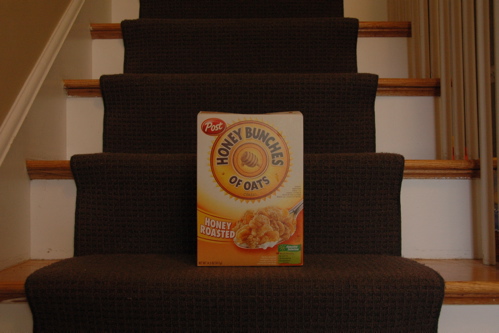
As I sat eating my breakfast today, I realized that I could buy four boxes of this cereal for the same amount, with a few pennies to spare.

Cereal box on stairs

Cereal box on stairs

At $3.99 per box and only 6g of sugar per serving, it’s less expensive and cloying than sitting through Christine Boranski, Meryl Streep, and Julie Walters singing “Waterloo,” in Elvis-like (or is it Elton-like?) get-up over the credits.

– Advice

From Sara, Grace’s reading teacher who is tutoring her over the summer:

Read one book at a time.

From Hal Blythe and Charlie Sweet, who published a fascinating and enjoyable article, “The Writing Community: A New Model for the Creative Writing Classroom,” in the Spring 2008 issue of Pedagogy:

… To write like a professional, the writer will craft two works simultaneously (319).

These practices are an inversion of what I normally do: read two or three books at a time, and write one piece at a time.

Interestingly, I am having an easier time sticking to Blythe and Sweet’s advice than I am to Sara’s. I agree with Grace: it’s hard to finish one book when you’re dying to read another.

– Arbor

Plants grow, tended or untended. I return home from a week away and find that vines, which I usually keep trimmed back to the arbor at the end of the sidewalk, have a way of their own, preferring lush life over neatness.

Arbor, clematis

Photograph by Eli Guterman