– Retreat, return

This morning I was in Ashfield; this afternoon I was in Northampton; and tonight I’m back in Brookline. Going from retreat mode to home mode requires a decompression chamber. For me, it was an audio version of Sedaris’s Me Talk Pretty One Day and the long drive.

Being at a retreat is like being a resident of the Biosphere, I decided, which is a place that Jimmy and I visited with Eli and Lydia many moons ago, so many that there was no Grace. The retreat was a sealed experience; everything that was important and riveting seemed to happen inside it. I don’t mean that it all happened inside Wellspring House — there were jaunts to more than one coffee house — I mean that it was self-sustaining and total. “Real life” was outside the sphere.

Early in the week, I started working on an essay that doesn’t have a title, but that does have a key verb: recedes. It’s about the cognitive necessity of letting go — of disappointments and joys, possessions and experiences — and the emotional desire to hold on and make it last. A few days before I left for Ashfield, I had a two-act dream. The first act was sheer experience. In the the second act, my dream self tried to get back into the first act:

This part evaporates, and I, in the dream, want it back. My dreaming self tries to imagine its way back into the scene and cannot. Dream self decides, therefore, to investigate the scene of the party, and the two meeting, and the location of the car as a way of staying close to what I just experienced. It’s still night and the party has just ended. The indoor and outdoor lights are on. I walk through the empty house, see where they stood, and walk into the back. There is a high stone wall, taller than me, and over it from the next yard other lights glow. They more than glow; they are in fact almost blinding. On this side of the stone wall, it’s hard to see. There’s darkness and shadows; only the top of the wall and the space above it is lit. I feel my way among shrubs and try to find where the car might have been parked. I start to doubt that there would be any way to find out if what I had witnessed had ever happened. I hold on to it against logic, yearning to relive what I have just lived. As I stand there, weightless in the dark, I realize that it has disappeared and it would be wise to let it go.

Dream self tells dream self this, and then I wake up, and then I lie in bed and keep thinking about the dream.

So much of what I’d been thinking about experience, how it recedes, and how we try to keep it alive or even resurrect it coalesced in the dream. I’ve written more about it than the passage above, which suddenly seems to me a fitting commentary of coming to the end of the retreat week.

You are welcome to analyze my dream in your own way. What I take from this, however, is that experiences of all kinds — art, travel, love, and other big stuff — have a powerful hold on us, when we’re in them and after we, in time, move on. And yet, although we know “the world spins only forward,” and we must keep living our lives forward, we can get caught in loops of memory, too. I tell myself, “let it go,” and yet I keep thinking about the dream.
– Retreat day five

Overheard in Shelburne Falls coffee shop on Tuesday:

I wouldn’t just be campus security, I’d be campus police.

I turned and saw a just-out-of-college-aged guy boasting to his guy and girl friends. I thought about my brief stint working for campus police as a college freshman. I chuckled. And that was it.

And then today I was working on “Dead and Gone,” the piece on my college professor, writing back into that time in college, and my campus police experience returned to me, relevantly.

When I was a freshman (at a women’s college), I worked at Campus Police. I’d show up at 10pm and sit in the station until 1am, waiting for calls into the dispatcher for the escort service we called simply “Campus Van.” Occasionally I would go out on a call and ferry a late-night studier from the library or science center back to her dorm. Mostly I would sit around the station with the night officers and one or two other financial aid students like me. There was one, a tall, wiry, stooped-over girl named Kelly, whose bleached hair showed dark roots and whose spectacles were oversized and green-rimmed, who clucked over the guys (they were all men) and flirted with them, too. One instant she’d be telling one that he looked tired and needed a nap and in the next instant she’d be slapping another playfully on the arm and pleading, “Oh, stop.” Obviously, she wanted him not to stop.

Kelly was transparent in her flirtations, and the officers were the same in their preening. Did they want to attract us, or just show off? As I sat there on the leatherette divan and stared at the television mounted to the wall near the ceiling and tried not to fall asleep, a couple of the dark-shirted officers might be punching and teasing each other while a third one would be on his back on the weight bench, raising and lowering a horizontal bar and puffing his cheeks out and in, out and in. When the bar clanked back into the bracket, I sensed that an audience was supposed to look. I glanced over. He stared at the ceiling, as if contemplating the feat he had just accomplished. Too bad you can’t save people from their efforts, because I could have told him in a sentence that I wasn’t aiming for a cop boyfriend. From the same social class, probably, as Kelly and the cops, too, I had my sights set higher: not on a monied life, but an intellectual one.

I was choosy without having a lot to pick and choose from. I had no boyfriend, having just broken up with my high school one. With my roommate, I went to a few MIT fraternity parties, didn’t get drunk, and didn’t have a good time. I wasn’t shy, but I wasn’t good at the kind of flirting that Kelly was. The only way I’d ever met boys before was in a classroom, and where I found myself, there were none.

I didn’t plan to go down this path, but my hands started typing the words, so I went.

– Retreat day four

Less writing today on a day that was still literary. Friend James and I went to the Emily Dickinson house in Amherst. The volunteer guide told me nothing I didn’t already know from reading her poems, scholarship on ED’s work, and Alfred Habegger’s excellent biography. Still, it was something to see a facsimile of the dress she wore daily (so petite) and a giant oak tree in the yard, planted as a sapling when Emily was born in 1830.

The idea that shaped the docent’s talk was that “how Emily Dickinson,” the girl who stayed at home, “ever became a poet is a mystery.” Huh? Has anyone ever heard of… imagination? James suggested that the docent’s take on the poet’s life had to do with the docent being a historian, a seeker and interpreter of clues and artifacts.

Perhaps that the docent was a historian is what prompted me to take out an abandoned, unfinished memoir piece, called “Dead and Gone,” and do some work on it. This is its (drafty) beginning, some of which I wrote today:

The photograph, candid, shows him on his bicycle. He’s smiling, and his wavy hair blows back from his high forehead. These are the days before helmets and specialized bike gear became ubiquitous. Riding up the hill to Green Hall, he’s relaxed on the seat and makes it look easy. His look is collegiate: corduroy jacket and pants, sweater, low hiking boots.

That the photo is black and white makes it look older, and paradoxically, makes him look younger. Aren’t black and white photos usually from personal archives of our younger selves, before color? I suddenly realize that, when I knew him, around the time the photo was taken, he was younger than I thought he was.

I was a college student, and he was my history professor. He seemed, at that time, in the realm of “grown-up.” I vaguely knew that he was married, had children. Perhaps he or his wife had even responded to the ad I posted in the Campus Employment Office under “Babysitter Available,” and I couldn’t help them because I was busy babysitting another family’s child.

Because he was grown-up – a man, professor, scholar – this was also a large part of his attraction for me. I was infatuated with him. I loved him as much as you can love someone you admire from ten feet away, three times a week, for the 70-minute class period.

I had not, however, thought of him or my crush for more than 10 years when I came across this picture and a long, glowing obituary of him in my alumnae magazine. This was 1999 and I had been out of school since 1987. I hadn’t seen him or taken a class with him for two years longer than that. Suddenly, though, I was overcome with shame. The obituary described his devotion to his children, scholarship, and students. The colleague who wrote the tribute, who obviously knew my former professor more deeply and steadily than I had, praised his service to the college and generosity to his students.

“I am such an asshole,” I muttered. My heart stabbed at itself contritely. I thought back to a meeting with him in his office when I, it seemed as I looked back, misjudged him. He was a nice man, and I thought he was hitting on me, and I am such a jerk. Such a jerk. An obituary might cast a life in certain light, illuminating and enlarging it. The grandeur of this one made my memory of that meeting seem overplayed, pathetically. At the time, it had all seemed so clear to me, so black and white. And it turns out I knew him not at all.

After our visit to the Emily Dickinson house, James and I found her gravestone, as well as her sister’s and parents’, in a nearby cemetery. Strange to think of her bones under there, that scruffy patch of grass.

P.S. Check out James’s more sustained description of the same field trip on his new blog, Quota.

– Retreat day three

At 11 o’clock at night, there was still one more bit of writing to do. But I was tired and didn’t feel like it: no energy, physical or creative. Not much stamina. The fan in the window was the sound of sleeping, which is what I wanted to do. I said to self, at least write a sentence. So I wrote a few, and then I kept going, not even looking at the keyboard (I can touch type). This is that piece entirely, proofread only for spelling:

At first, it is repulsive. The knowledge that the heads of one’s children are teeming with bugs is something to stomach. After their showers and before a treatment, we together sit in their messy rooms, with dirty and discarded clothing on the floor around us. It’s easy to feel poor and afflicted. We bicker.

Lice make you pay attention. Inspect. Scrutinize. And you might not like what you see: wax in children’s ears, moles and bites on their heads, hairs in their noses, teeth tartar, chapped lips, and rings of summer’s grime around their necks. And you may tell yourself This is not my beautiful house! And you may tell yourself This is not my beautiful life!

Lice disrupt your routine and get you to miss work. Children stay home from school. After you soak and smear her head for what seems like the tenth time, you plunk little girl in front of the television and let her eat her lunch there, too. You sit, exhausted in mind though not really in body (you’re upper middle class, after all), so you flop in a chair and read an issue of People that you’ve already read. Brittney and Kevin are on the cover.

Now, if their children had lice, you know they’d hire someone to handle it. A former nurse or mother of grown children who prides herself on lice detection and eradication. The business has a cute name, like Lice Busters, and promises confidentiality. It costs $400 a head to delouse it, and you know they’re glad to pay it.

Why don’t you hire a professional nit-picker? They exist. You read about one in the New Yorker’s “Talk of the Town” section. Into Google you type “lice picker professional Boston,” because that’s where you live. That search avenue fails.

So you call the pediatrician, and you hope she’ll give you a prescription for something strong the kids can take to kill the lice from the inside out. The doctor’s nurse calls back, and she advises you to treat the child with an over-the-counter preparation today, and then try the same preparation again in one week. “That should work,” she chirps.

“I’ve already done that! I want the drug fix!” you want to say, but you don’t. Sighing, you hang up. You’re pretty sure that you already know more about this health topic than the doc does. You’ve lived it. And, like a terminal cancer patient, you’ve turned over every stone for information on new treatments, alternative treatments, and risky ones too. You’re ready to offer your children to medical science: “Study them.” Do anything it takes. The smell of the insecticide in the drugstore lice lotion is driving you mad. You’ve stopped liking it.

The two other children arrive home from school. They join the little one in front of the television, and you ignore all three of them. In a couple of hours, it’ll be dinner time, and then, after that, inspection time. You know how that’ll end and you’re tired in advance. Shampooing, smearing, and then pinch after pinch after pinch after pinch. They’ll go to bed late. You’ll got to bed after you clean out the sink and throw the towels in a hot water wash. Your feet will ache.

In bed, you’ll forgive yourself. You don’t have to love taking care of them every minute of every day. You just have to do it.

Interesting how I switched from first person to second person and then kept going with it. During the day I had been thinking about how a lot of my lice essay deals with the meditative aspects of nit-picking and not much about the frustration. I read, too, a long mostly uninteresting newspaper feature about the local lice scourge and one of its moments stood out for me: the mother, going into her bedroom to cry, when she learns that her daughter is infested, again. I thought, condescendingly, well, surely it’s nothing to cry about. While I never cried when our children had lice (six, seven, eight times?), it made me weary to the bone. And maybe, as this almost freewrite suggests, pissed off, too.

(Third day’s word count? Way more than day two’s, plus another essay started. Momentum is a good thing.)

– Retreat day two

The draft of “The Work Hands Do” grew by 1,716 words today. I feel like I’m coming to the end of it, like maybe tomorrow I could verify some facts and finish this version, of which this section is part:

There’s a stigma to lice, and I’m not sure what’s at the root of it. After all, the head lice epidemic largely affects school age children, six to twelve million a year, according to a recent report by the Centers for Disease Control. We’re not, as a culture, afraid to discuss other school age illnesses, like asthma and food allergies, so why head lice? Head lice are not sexually transmitted, although pubic lice are, and perhaps the two conflate in the public’s imagination. Body lice are prevalent among the homeless, so head lice, too, may be associated with poverty and poor hygiene.

Maybe that’s it: lice are dirty, whether you’re talking about grime or sleaziness. If contagions are preventable – haven’t we all increased our attention to hand-washing in the last several years? – then a head full of lice is an outward sign of poor fastidiousness and moral failure.

I had lice at least once, during one of the several times my children seemed to be farming them on their heads. At first, the itching seemed sympathetic. I’d comb squirming lice from hair for hours, absorbed in my task and mesmerized by scurrying creatures, and later as I lay in bed and tried to go to sleep, my head felt as though its surface was crawling with microscopic feet.

One day, though, after I finished spitting out toothpaste water into the bathroom sink, I raised my head, glanced at myself in the mirror, and caught a glimpse of a louse skating along one of the hair strands that brush across my forehead. I leaned closer and saw it dip down into the hair, out of sight. Visual confirmation of what I had suspected made me relieved and squeamish at once.

It was late, so I went to work, where I did not tell my officemate about the louse sighting. I decided, simply and inconsiderately, that I did not want to deal with unanticipated consequences. Are omissions lies? Not always, but, in this case, yes.

During a break, I went into Metaphor Yarns in nearby Shelburne Falls, because I had to. I met the proprietor, Meta (pronounced Meetah) Nisbet, who told me about a wonderful series of books by Sally Melville and then realized she was out of the very one I wanted. I mentioned that I had stumbled across Shelburne Falls years ago, when we were driving back from MASS MoCA with the kids and simply had to stop somewhere, and we discovered her town and the magical Bridge of Flowers. She asked if we had caught The Knitting Machine when it was at the museum, and I said no, so she told me about cranes, giant knitting needles, and a giant flag.

What could I do, but go to YouTube and look for it? “The Knitting Machine,” by artist David Cole, is straightforward yet weirdly phallic, and I think it’s meant to be. See what you think:

– Retreat day one

For the week, I’m at Wellspring House in Ashfield, Massachusetts. Today was the first day of five or six days of writing and not much else. There are no planned activities, no television. In town, there’s a library, hardware store, pizza shop, and general store/cafe that makes good coffee and is open for breakfast and lunch. And that’s about it.

I’m trying to finish the draft on an essay on lice-picking, which is really (I think) about love. I might call it, “The Work Hands Do.” So far, I’ve added more than 1200 words to the document. I know that writing is not about quantity, but I do have to generate enough material to have something to work with. Here’s an excerpt:

The poison, permethrin, promises to “kill lice and their unhatched eggs with usually only one application.” The permethrin kills no lice; it slows them down for an hour or so. Immune, adapted, they cling, restively, at the bases of hair shafts and do not scurry. They’re drunk on permethrin. I have time to sight, catch, and comb them before they sober up and escape back into the jungle of hair. I dip the fine-toothed louse comb into a container of burning hot water and swirl. Captured ones float for a few moments before sinking. I don’t know, but I imagine that the sinking is a sign of death.

The lice are dark enough in the container of water that I count them. Occasionally the count seems not to add up so I hold the comb up to look for bodies trapped like seeds in teeth and find them there, suspended sideways in the comb, delicate legs scurrying in air, yet not desperately so. They seem to scurry always in a workmanlike way, regardless of footing, unable to take me in as a threat, unable to even see me, not afraid of me as a predator in the way that mice are afraid.

I make my thumb and forefinger into pliers and close over the head and tail of each trapped one and drag it down the long space between teeth it is caught in. I feel its substance, like nut meat, and I imagine eating them. I do this enough times so I think always of eating them when they are pinched in my fingers like this. It would be so easy to eat them, like completing a gesture I already know, that I feel drawn to doing in the way I feel drawn to letting my body go over the barrier at the edge of the falls or on the third or fourth level of an open air parking garage. It’s so close.

I do not eat them. It would not be something that I would do.

– Nuggets

We overcame family inertia and went to Halibut Point State Park for the holiday. Even though it’s not open for swimming, we thought that the kids would find the quarry fascinating.

In the van on the ride up to Cape Ann, one of them introduced the topic of wills. “Hey, what happens to us if you guys die?” was the opening question. We all discussed this at length, and Jimmy and I outlined our so-called “estate plan” (who gets them and our life insurance money). The three of them called for a revision, and they had some good ideas. Eli offered to become guardian of the girls if he’s 18 when we die: “I would take good care of them.”

Grace eventually called for an end to the conversation. She also doubted the likelihood of such a catastrophic family event, saying, “Mama can’t die.” Eli answered, “That’s right. She’s a machine.”

I asked them all about words they disliked. (This is a game my sister Sally came up with years ago.) We had fun with this. Lydia answered so quickly, it was almost as if she were waiting for a chance to say them.

Lydia: I hate the word girdle. And jiggle. Oh, and jelly. But I like the word jam. And I don’t like the word gravy. Or regurgitate.

Eli: When I was younger, I didn’t like the word vat. And now I don’t like when people swear in a way that doesn’t sound good. Like when they’re trying too hard. It sounds good in a movie, in dialogue, but not when people talk.

Grace: I hate the word empathy! It sounds like one of those pencils that don’t have an eraser and scrape my ears! (She mimed putting her hands over her ears.)

Jane: Here’s a word I dislike that students use all the time, once they discover it: plethora. I also dislike moist. Yet I like wet. And I hate the word vinaigrette.

Jimmy: veggie.

Words they liked? Simultaneous (Eli). Pathetic (Grace). Linoleum (Lydia).

Someone’s iPod and speakers made the rounds among the backseats, and the three of them took turns playing DJ. Eli played “Upside Down” by Jack Johnson and said that his camp’s folk band is doing a version of it. (That should be an improvement.) Grace picked “Soulja Boy” by Soulja Boy (good thing she can’t decipher the lyrics). Lydia, who has an ear for singers and loves a song that’s a real song, treated us to “Mercy” by Duffy. Watch this (there’s fire), and listen:

Before we headed to the quarry, we went into town to get some lunch. Lydia, who has been to Rockport the most recently of all of us, with a friend and her mother, blurted, “I know a good place to eat! It’s like a fish house, but it has grilled cheese.” We looked for such a place; we found one.

At the quarry, finally, the kids, who are all excellent swimmers, wondered why there was no swimming allowed. “Someone could drown,” I speculated. They wondered how deep it is. I guessed 100 feet and then discovered later that it’s 60. We found some gravel and threw it in. They pried up egg-sized stones, stood at the top of 40-foot ledges, and tossed them in. Plop. Grace and Eli found a few rocks the size of, oh, lunch boxes. Only Eli was strong enough to heave them in, which he did. Humongous splash. By that time, he had an audience of two elderly people and their grown daughter, who misread a caution sign and kept calling the park “Danger Quarry.”

None of us fell in, but Jimmy experienced many times that parent gut-clutch, when kids get too close to the side, which they did, many times, because they’re kids.

Of course, everything fell apart on the ride home. I drove. There was teasing, “monkey bites” (a kind of pinching), and parental irritation. Many times Jimmy told Eli (future guardian of the girls?) to keep his hands to himself. Grace cried. Lydia giggled. I said to Jimmy that I wished there were a way to call ahead and have a pot of coffee waiting when I walked in the door.

We made it.

– Slivers

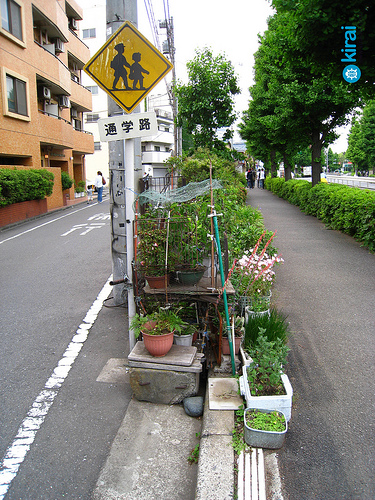
If a person gets the urge to grow something, she can do it anywhere there’s some light. A pot or a patch and time to tend it is enough. Last week boingboing linked to a post on Kirainet about gardens on little public corners in Tokyo. Here’s one:

Sliver Garden in Tokyo

The anonymous gardener appropriated some unused public space — just a sliver — and made something both useful and beautiful in it. I probably should say that the gardener is making something there; gardens change every day and are never finished.

The sliver garden made me think about a story an old boss once told me about a friend of hers, who had a fantasy (if I remember this right) of buying and restoring a big, old waterfront home in Maine. This friend lived in some other, non-Maine non-old place, in a suburban development, not too far from her job, which she liked and which financially sustained her and her family. Yet, this fantasy kept pressing on her: an out-of-reach, vivid Someday Dream. So many aspects of it made it unattainable in the present: her like and need for the job, lack of money for a second home, lack of time and skills to do the fixing-up, a spouse’s lack of interest in the same project. The Someday Dream floated farther and farther from her reach.

Finally, someone asked this woman who was filled with longing, “What is the feeling under the fantasy?” The woman, at first, did not seem to understand the question, and she answered with a more specific description of the house she dreamed of and the place she pictured it in.

Her interlocutor explained that she wanted the woman to examine the more pure feeling underneath the specific details. This was (and is) a harder question. After a long pause, the woman finally said that she wanted to take something old, with a history, and make it livable. In answering the question, the woman herself realized that she didn’t have to live in an 11-room, white, black-shuttered Victorian in Kennebunkport to get close to that feeling.

It’s funny: I don’t remember the exact outcome of this story, but I do remember that, by figuring out the feeling underneath (and I love that the feeling is under the fantasy, supportive like a foundation, or hidden like a cellar), the woman made some change in her life that gave her access to the fantasy. Maybe she moved to an old house in her town. Maybe she bought old furniture — stuff with the history she was after — and restored it. What’s important is that she figured out a way to give shape and actuality to a dream of something longed for.

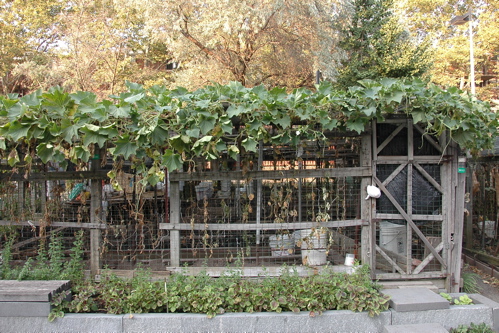
Last fall, on the afternoons that I dropped Lydia off at her chorus rehearsal, I regularly walked through the community gardens on East Berkeley Street in Boston. On a sliver of land between the street and a public alley behind townhouses, there’s a double row of fenced and gated outdoor rooms, each about 10 feet by 10 feet. There are a few double lots.

Many of the gardeners maximize their spaces, growing greens and vegetables in the ground, flowers in hanging pots, and squash vines on the fencing. Such parcels seemed like farms to me, and I’ll bet they are to the people who cultivate them.

East Berkeley Street farm

Other gardeners trace paths inside the fencing and fill them with stone or broken pottery. I noticed ornaments and signage. Some gardeners post photographs, protected in acetate sleeves, featuring the same garden in another season, creating a weirdly fascinating, double view of the same location. A few gardeners have turned their allotments into sanctuaries with grasses, torches, wind chimes, and seating.

Whether farm- or patio-like, do such places give all their proprietors a feeling under what started as a more specific fantasy? I imagine the person or pair that arranged this tableau:

Red chairs on East Berkeley Street

This is what having some of what you want looks like. As I stood there, I felt it, too.

– Clouds

This is a cool way to kill, I mean spend, some time. Copy and paste the text of your c.v./resume into Wordle. The Wordle tag cloud might teach you something about yourself, or remind you of stuff you already know. Every word in my December ’07 resume makes the cloud below. (Collaborators, you’re in there, too!) Most repeated words are biggest.

And, what the heck, here’s Robin Behn’s “Gray Poem,” well loved by me:

From memory, I would have said that “whale” or “dive” would be among the prominent words in Behn’s poem. But, look at this: “turn” and “fathoms” and a few others are most recurring.

P.S. Thanks to Jimmy for the heads up.

– Images

I love the images in these two lines, from two different pieces:

All over the room, like boats softly tooting their horns in a harbor on a foggy night, men were weeping. (Nicholas Dawidoff, “The Man Who Wasn’t There,” New York Times, Sunday, June 15, 2008)

and

At times I was lonely, but it was a bearable loneliness, the way I imagined that a star, brilliant in a Milky Way of other stars, would be lonely. (Walter Dean Myers, “Poets and Plumbers,” What They Found, Wendy Lamb Books, 2007)

I tried to find more lovely sentences from my reading of the past week or so, enough to make a handful or a dozen, but these two kept pushing contenders aside.

The first is from a personal essay on his lost father, and other men without fathers, by a male author; he hears the weeping as he sits in a darkened movie theatre watching the last scene in Field of Dreams. The second represents a moment of self-reflection by Noee, the 17-year-old female protagonist in a short story, who feels distant from the boys and young men who try to attract her attention. Her father is dead, too.

The loneliness of the first-person narrators is made even more piercing, I think, by the beauty with which it is rendered by each writer. There’s something strangely comforting, too, in the idea of sadness shared, distantly, among other boats and other stars.

Is that ethical, to make sadness be beautiful? That’s a seduction. Should sadness be starker, plainer? It has one quality in art, and another in life.

Either, it is a feeling of force:

Sadness drives us to restore attachment and is from an evolutionary point of view an important adaptive emotion. The sadness caused by bereavement is the cost of having been attached, and it may also act as a social signal that is a plea for sympathy.

In these lines, who makes the plea: narrator, or author?  Does it matter? As a reader, I do feel as though someone in these words is reaching out to me.