– Conservation

If you ever accidentally dump a bottle of water into your purse or bag, as I’ve absentmindedly done a few times and Grace unwittingly did yesterday, and a notebook gets drenched, take heart: It is possible to save your writing, if not the paper itself.

Grace, notes

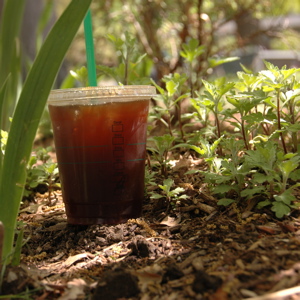
Gently tear the wet pages away from the binding, and lay them on top of drinking straws on top of a textureless cloth or mat. Let them dry for a day. Transcribe the stories — Grace, anticipating the end of the school year, has one on “No Homework!” and another on “Weather this Summer!” — into another notebook or file.

– Opposable thumbs

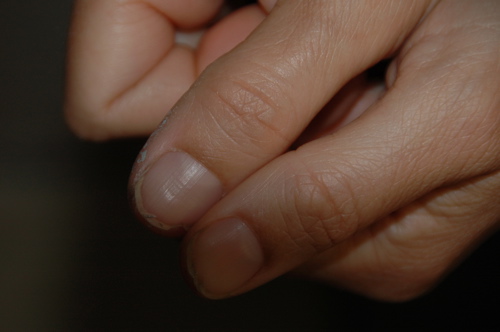
The tips of the nails on my thumbs are always notched, never rounded. The padding around the nails is usually cracked and, in the winter when it’s dry, split and bleeding. Every day these useful digits are under pressure.

My thumbs

With them, I peel stickers off apples; hold tiny bits, like garlic cloves and jalapeños, as I mince them; scrape dried paint drops off the floor; pry open the tightly sealed container of a glucose test strips bottle, six times a day; dislodge nits from children’s scalps and hair and pinch them off; peel up the ends of tape from the roll; snip withered leaves and blooms off plants as I walk by them; puncture plastic bags of mulch or frozen french fries; press a rubber eraser down on the page; pick snarls out of thread; unknot shoelaces; unbutton and button my pants; buckle belts and Mary Jane shoe straps; unscrew the empty reservoir from my insulin pump; fish coins out of my wallet; adjust a slipped bra or camisole strap; floss; and more.

When I, occasionally, use my teeth as tools — to open something stuck, or to bite open a knot — I hear my mother’s voice in my head: “You’re going to crack a tooth!” No one, however, objects when I maltreat my thumbs. They’re designed for many tasks, for any task.

Emily, my sister, broke both her thumbs when she landed and keeled backwards after completing a running long jump during Field Day activities in 8th grade. I was in college at the time, and I remember that sinking feeling of sympathy when my mother called me and told me about Em’s accident, and that her hands would be casted for six weeks.

Imagine six weeks without the use of your thumbs.

Photograph by Jimmy.

– Aliens

1. Eli is sorting through years of accumulated stuff. In his desk drawers and closet, he has found artifacts that he wants to toss, and we want to keep. This little fellow, painted years ago at Plaster Fun Time, when Brian worked there, makes a nice garden ornament.

2. On the morning (Wednesday) after a soaking rain, this creepy colony appeared. It was sudden.

Mushrooms under the hosta, in shade

3. I wondered how, and how quickly, fungi grow. I went to YouTube and searched “mushrooms time lapse,” hoping for one or two hits. There are more than two. Apparently there are lots of YouTubers fascinated by the growth (and use) of mushrooms. Weird.

Thanks, Jimmy, for getting down on the ground and sidewalk to get the alien and mushroom images. And thanks, www.fungifun.org, for the time lapse short of mushrooms, er, growing.

– Devil inside

Every teacher has their “duh” moments, and probably at least one per semester. You say something to your class, and it’s immediately apparent by the looks on their faces that you’re so wrong, or uncouth, or just not with it. By being wrong or simply inexperienced, however, you sometimes learn the coolest things.

Like this semester, in my section of the writing component of an introductory genetics course (which was hard for me to teach, as a newcomer to MIT, and hard for the students to get), I had this brilliant idea to make, with the class, a glossary of sorts for the scientific report that each student was writing on a very similar set of experiments. I had noticed, as I was reading their drafts of the report’s introduction, that the student writers varied dramatically in their use of a technical vocabulary. So I stood near the white board, marker in hand, and asked them, “What are the terms and concepts you think you should cover in this report?”

It was a way of them teaching each other — and me, too — the material, and it worked. As I wrote on the board each term they offered, I asked the speaker to say something about the term, “polymerase,” for example. That student might say, “It’s an enzyme in DNA.” And then another student might add, “It’s what causes amplification.” And then I might ask, “What’s amplification?” And so on. Everyone took notes!, without prompting.

I had a question, too, about this one term that cropped up in almost every one of their drafts: “wild type.” Hmm, what’s this? I immediately associated it with other terms I know, like wild card, wild thing, and wild horses. Crazy, out of control, the outlier. I said, “Someone explain to me this term: wild type.”

There was silence. Smiles. Looks around the room. A few giggles.

“Uh, wild type is just basically the version of a gene as it occurs in nature,” explained one student. She was hesitant, not in her knowledge, but as a way to show tact. Another student added, “It’s a gene that’s not mutated.” This is, I gathered, common knowledge (although not, then, to me).

I laughed out loud at myself. Then they laughed. It was a “duh” moment, but it turned out to be a good one, too.

I remembered this today as I was driving home along a winding back road and occasionally checking my speedometer to make sure I was adhering to the limit. And then I was thinking of (a few) people I know who try to respect posted speed limits. And I broadened that category to people I know who honor common courtesies, follow procedures, recognize the importance of Scrabble rules, and so on. Sometimes it can feel like a burden to always remain within bounds. It’s a weird comfort, though, to realize that even though you may not be a wild thing, you’re always the wild type, through and through.

—–

P.S. Does anyone remember “Devil Inside” by INXS? I was a fan of that band in the 1980s, and Jimmy and I went to Great Woods to see them when I was in my mid-20s. Even then, I somehow felt too old to be in that crowd.

– What you remember

Sunday. The water was 52° F. today; the air was 68°. Grace, Elena, and Sarah went into the water the moment we got to Cold Storage Beach; my father stood there, knee-deep, for a few minutes and then dove in. Later, I went in all the way, as promised. I lasted about 10 seconds. Lydia and Karalyn had a swim after they came back from the jetty.

Last year’s Memorial Day weekend was also sunny and warm, “75-80 degrees,” according to my mother’s 2007 datebook. The 2006 holiday weekend was glorious, too, and we went swimming to get a jump on summer. Three times: I’d call that a tradition.

This morning before the beach, and then later at dinner, I surveyed my siblings, their spouses and friends, and my parents, “What do you remember about Memorial Day from when you were a child?” Flags. A commemoration at school. Cemetery visits. Going to the parade. Being a Girl Scout and walking in the parade. An annual get-together with family friends.

Those memories of Memorial Day are like mine. I also remember the first few lines of one of the few poems I ever had to memorize in school, and I recall reciting it, with my classmates, in the paved playground of Leicester Center School, when I was in 4th or 5th grade, during a ceremony in which the flag was unfolded from its formal triangle, then raised to the top of the flag pole, then lowered half-way.

In Flanders Fields (1915)

In Flanders fields the poppies blow
Between the crosses, row on row,
That mark our place; and in the sky
The larks, still bravely singing, fly
Scarce heard amid the guns below.

We are the Dead. Short days ago
We lived, felt dawn, saw sunset glow,
Loved, and were loved, and now we lie
In Flanders fields.

Take up our quarrel with the foe:
To you from failing hands we throw
The torch; be yours to hold it high.
If ye break faith with us who die
We shall not sleep, though poppies grow
In Flanders fields.

John McCrae

I do not remember learning about World War I in school around this time, but we did learn about poppy fields, and veterans’ cemeteries, and flags. We must have recited the poem in sing-songy, childish voices, caught up in the rhythm. I doubt we stopped in the middle of the first line of the second stanza, as a reader should. I read that line now, as an adult, for the first time in more than 30 years, and I wonder, how can you not stop after such a line, “We are the Dead.” That stanza is something, isn’t it?, with all the thudding “d” sounds, starting with that doubled one: dead.

It seemed beautiful to me then, as a child, that image of an endless field of orange poppy heads waving in the sun, a makeshift burial ground transformed. Somber and bright at once. I don’t think I thought of sleepless soldiers under the poppies, or who the speaker of the poem might be or, rather, had been.

– Supermarket beauties

Gayla Trail at You Grow Girl and Elizabeth Licata at Gardening While Intoxicated both have recently reported their finds at botanical society plant sales. Why am I paying full price? Why haven’t I bumped into any of these botanical society sales? Do you have to live in Toronto or Buffalo to get perennials for a few dollars each?

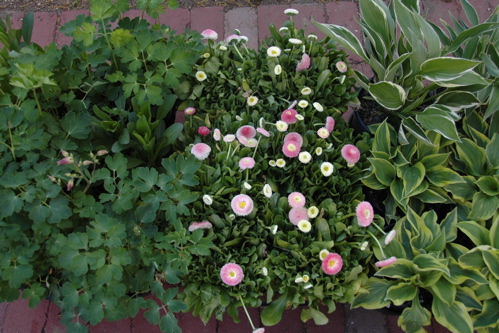
Maybe not. At my local grocery store, in addition to the cemetery planters and buckets of geraniums, there were — surprise! — really nice full size perennials on sale, two for $10. (At the local nursery, the same plants are $14 each; even at Home Depot they’re $9 or $10 each.) I inspected them and found these:

Supermarket Beauties

  • Leucanthemum ‘Becky’ (2) — daisies? I should get more.
  • Aquilegia ‘Biedermeier’ (4) — I love columbine.
  • Bellis ‘Strawberries & Cream’ (6) — This was an impulse grab. I’m not normally looking for pink, but these are sweet.
  • Hosta ‘Wide Brim’ (4) — Our back yard is a mix of part and deep shade. These thrive.
  • Hosta ‘Francee’ (2) — Ditto.

Eighteen plants, $90. Not bad. Now if I could only find some cheap annuals. Hardware store, here I come.

– Verified

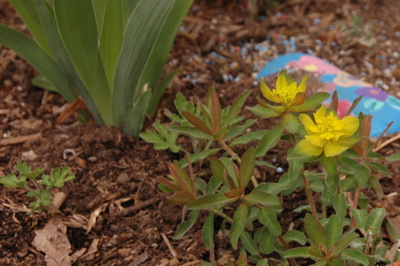
Last fall’s mystery plant, which I identified as a Euphorbia, has risen again. Its leaves are limier and its bracts are yellow. (Hmm, I guess this one is not Euphorbia ‘Rubra‘ or ‘Excalibur’, as I speculated previously. )

Euphorbia Arises

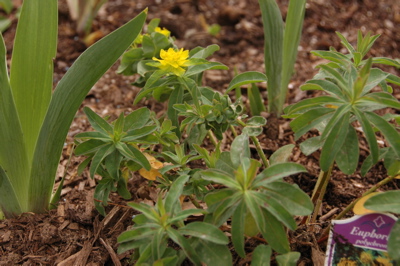
Sunday I strolled the section of yellow-flowered perennials at Allandale until I spotted a twin to my mystery Euphorbia; it’s a ‘Polychroma’. Lovely — yellow in the spring and reddish in the fall. (If only all plants could pull off that color change.) I brought home the twin and planted it.

Euphorbia twin verifies

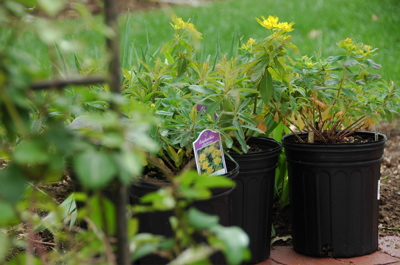
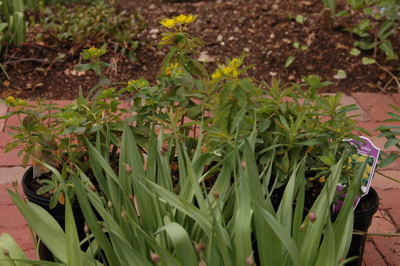
Two Euphorbia polychroma, one on each side of the sidewalk, shading the roots of the clematis that climb the arbor, seemed… stuck out there and lonely. So I went back and bought four more. (They’ll make two sets of triplets when planted.)

Euphorbia four wait

And that pretty well captures how my gardening “design” process works. Not much advance planning, it evolves one tiny decision at a time.