– Transition time

Years ago I learned the phrase “transition time” from one of the kids’ preschool teachers. A bridge from one kind of activity to another, it’s something that all children need and something that some have trouble with. For example, if a child is engrossed in building with Legos, he might be unable or unwilling to follow directions to put away the toy and put on his coat if he has not first been given a warning as well as some time to transition from his play into the practical.

Transitions help us cope with change by easing us forward. Routines help, too.

Two days before Thanksgiving, on November 20th, it snowed lightly. There were still plenty of leaves on the ground, and the Japanese maple in our backyard, which bursts every fall from green to crimson and then drops its leaves within a few days, still wore half its foliage. I stood in the backyard, trying to gauge when the leaf guys would come to finish their work for the year and, after that, when I would have an hour or two to break open the bales of hay and mulch around new shrubs and divided plants.

I stood in my neighbor Gail’s yard and looked into my own. There was a soccer ball left behind from some game that did not involve me; there were the patient hay bales against Bob & Mary’s fence, the carpet of crimson leaves, and a toddler picnic table under the maple.
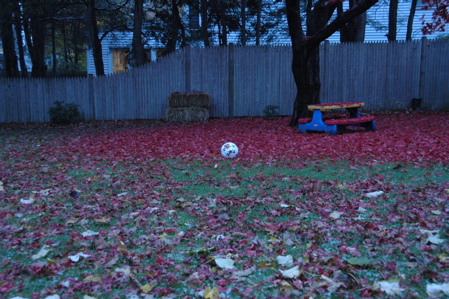
Backyard November 20

I have no toddlers in my house, and won’t again. The sight of that leaf-covered picnic table, too small for any of our children, reminds me of its redundancy. At best, it’s an artifact. I stood there for a long time and looked at it.

What happens to knowledge when it is not applied to daily use? I have this expertise in caring for the newborn and very young: feeding, washing, handling, soothing, delighting, lugging. I no longer need to mash up anyone’s food, wash a boy’s hair while protecting his eyes, or grab a girl up and out of a sandbox. Now that there are better music makers in this house than me, I haven’t sung anyone an invented lullaby in ages. (One of my lulling hits: “You’re A Baby.”)

Does such knowledge disappear? Is it transformed and applied to other uses? Does it go underground, and hibernate?
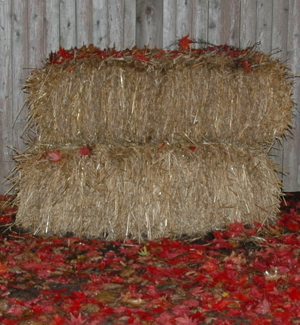
Hay balesThe leaf guys came on a clear day and vacuumed up the red leaves. Soon after, it got cold – bitterly – and we got busy here. It has since snowed again; the stray leaves that fell after the final cleanup are clumps under snow. The brilliance of the fall is a memory. I wonder if I missed my chance to lay down the hay. Like a child sometimes, I don’t like to be rushed, and I waited too long. It’s December 9th and gardening is over for the year.

I’m not a person to spend the winter months dreaming of what I’ll plant in the spring. I put those thoughts aside until signs of thaw, and then I feel, too, as if I’m thawing out. My interest in the yard reawakens. In the meantime, I keep my hands busy in other ways. Knitting is one of them.
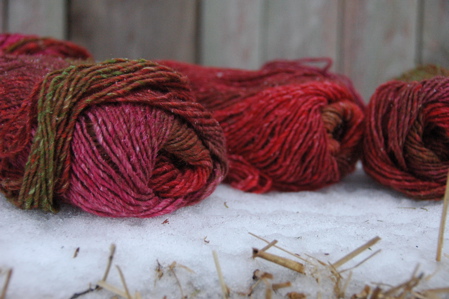
Yarn on hay December 7

– Future man of letters?

Scene: outside kindergarten wing today, 2 p.m.  Woman walking with a child who is not her own.

George: Jane, are you going to my brother’s Bar Mitzvah tomorrow? 

Jane: Yes.

George: Would you take notes for me?

Jane: Mmm, okay.  (pause)  Why?

George:  Because I want to tell my teacher all about it on Monday, and my mother is going to be too busy to remember everything.(pause)  So write down everything. And then give it to me. 

Oh, these articulate five-year-olds!  And, at the same time, how wonderful it is to be given an assignment. 

– Longer

Scene: Writing Center. Student and tutor looking together at a paper.

Student: Why did you circle this… and this?

Jane: In a few places you use long phrases, and I’ll bet you could find a way to say it more directly.

Student: Oh, I know. But I sometimes add more words on purpose, so it will make it longer. You know, so it seems like a paper.

Jane: Academic?

Student: Yeah. Teachers seem to like that.

Jane: Hmm.

– Garden for our times

Do you remember the walled, overgrown garden brought back to life by a boy and a girl in F. H. Burnett’s Secret Garden (1911)? The book was a favorite of my childhood, and perhaps the long, restorative story about gardening has something to do with my own attraction to shabby, abandoned patches, as if glory and possibility, like this, await in each one:

The seeds Dickon and Mary had planted grew as if fairies had tended them. Satiny poppies of all tints danced in the breeze by the score, gaily defying flowers which had lived in the garden for years and which it might be confessed seemed rather to wonder how such new people had got there. And the roses–the roses! Rising out of the grass, tangled round the sun-dial, wreathing the tree trunks and hanging from their branches, climbing up the walls and spreading over them with long garlands falling in cascades–they came alive day by day, hour by hour. Fair fresh leaves, and buds–and buds–tiny at first but swelling and working Magic until they burst and uncurled into cups of scent delicately spilling themselves over their brims and filling the garden air. (247)

Lovely, isn’t it? Fresh, new, full of playful life — not unlike an uncomplicated view of the child.

And here’s the garden for our times. It is tended by the 21-year-old Edmond who has been traumatized by witnessing the slaughter of a contemporary war started in England by “The Enemy,” and it appears at the end of Meg Rosoff’s How I live now (2004):

On the warm stone walls, climbing roses were just coming into bloom and great twisted branches of honeysuckle and clematis wrestled each other as they tumbled up and over the top of the wall. Against another wall were white apple blossoms on branches cut into sharp crucifixes and forced to lie flat against the stone. Below, the huge frilled lips of giant tulips in shades of white and cream nodded in their beds. They were almost finished now, spread open too far, splayed, exposing obscene black centers…

The air was suffocating, charged, the hungry plants sucking at the earth with their ferocious appetites. You could almost watch them grow, pressing fat green tongues up through the black earth. (181)

The passage is narrated by Daisy, Edmond’s American first cousin and former lover, also 21, who returns to him after a six-year absence because of the war, which spread beyond the British island to six continents. Like the Secret Garden, this novel, which Meg Rosoff reportedly began writing in the run-up to the war in Iraq, is aimed at a young audience. Rosoff doesn’t shy away from blood, terror, or torture: a man has his face blown off, some civilians are slaughtered and most are displaced from their homes, and children roam the woods and abandoned farms, hiding and fending for themselves. Parent figures are either absent or die off quickly.

How I live now, coverThere’s nothing pastoral about the England in How I live now. Yet this dystopic novel is not without hope. In the end, Daisy joins Edmond in tending his rage-filled garden, and the reader senses that somehow subverting anger into hungry, persistent life offers a way back to what has been in short supply: peace.

– Extremities

Although the frequency of my visits to the daphne that Jimmy and I transplanted in September have waned from daily to weekly, I keep monitoring her and doing the little I can to cultivate her return to vigor. Mostly, I have watered the ground inside the dripline, keeping it damp yet not flooded.

In October, her leaves stopped drooping: some fell off, and some sprung back. Her branches no longer looked like slumped shoulders; they regained their uprightness. Last Thursday, on our warm and breezy Thanksgiving Day, a few hours before heading downtown to my brother Michael’s new apartment, I poked around the yard. I pulled out and trashed the spent lantanas and then carefully assessed the daphne.

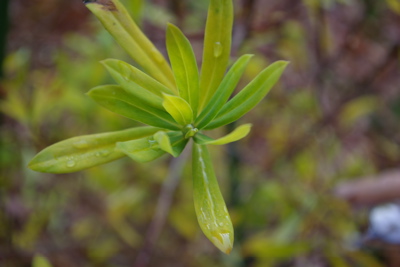
At the center of some remaining leaf clusters, there are tiny buds.

Bud inside leaf cluster

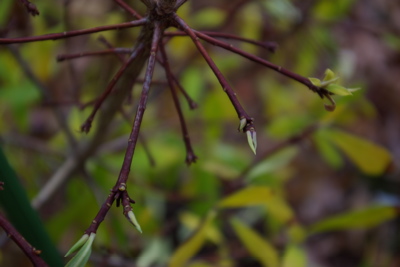
At the tips of leafless branches, more buds are starkly visible.
 

Buds at branch ends

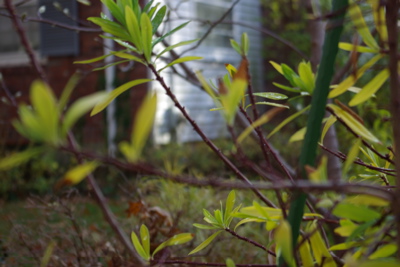
Overall, her aspect is alert.

Alert branches

When I visit my endocrinologist for quarterly check-ups on my diabetes, he always checks for two pulses in each of my bare feet: one on the top of the foot, and one on the side, around the ankle. He also pricks the bottom of each foot with a microfilament and asks me if I notice the light touch. The health of the extremities — circulation and feeling in the hands and the feet — coincides with the health of my overall system. And so far, so good. There’s plenty of blood pumping unobstructed to the farthest reaches of me.

I’ll take the buds at the tips of the daphne’s branches as signs that she’s taking up water and nutrients from the roots and compensating for the ones we severed when we transplanted her. Something good that I can’t see is happening underground and inside the vascular tissues.

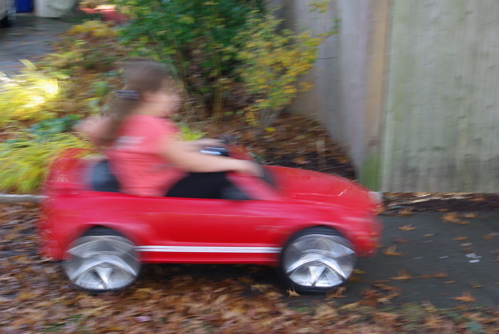
What I’m worried about now is this: two underage drivers (Grace and George) in a powerful, undersized electric car.

Underage drivers in red convertible

Their roadway, the sidewalk, skirts the daphne’s location. The branches tremble as the two whiz by.

——

Pictures by Eli Guterman, who recently said to me, “I’ve looked at your blog, Mom, and you make some awkward cropping decisions with the photos I take for you.” I present these, therefore, uncropped.

– Hanging drop

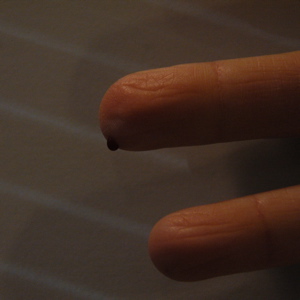
Until I looked at Laura Splan’s watercolors in blood, I hadn’t thought of my own blood as paint or ink. Yet, it is. Many times a day I prick my finger, squeeze a drop of blood from it, and touch the drop to a test strip inserted into a glucose meter. After I’m done with the procedure, my fingertip often keeps bleeding, even though I’ve stopped being aware of it. So, as I put my hand on the mail, or a page of my glucose record log, or the Times, my blood smears and makes it mark. On paper, blood is permanent.

Hanging drop of my blood

Before I drive or teach — two activities during which I don’t want my glucose level to drop precipitously — I check my blood sugar. Once without my noticing it I left a smudged arc across the front page of a student’s paper. As I handed it back to her in class, she noticed it, and she visibly recoiled. “Ach, what’s this?!” Oh, shit, I thought. “I’m sorry, that’s my blood. From my finger. I’m so sorry.” I knew her as a fragile person, intensely worried about her own symptoms. Damn, why couldn’t I have smudged my blood across the paper of one of the nursing students?

Clearly, the traces of my blood on paper are not intentional or artful. Still, Laura Splan’s work put me in mind of them, and I started wondering about what I could do with all those smears. At the same time, I’ve been reading this sparkling, ruminative book, I Am a Strange Loop by Douglas Hofstadter (Brian, you would like this), which has a long section on math theorums and proofs, and I’ve been thinking about how much I loved geometry and calculus in high school and college. But, I didn’t go down the math path when I could have, and that knowledge is rusty and faded.

I’m in a predicament. I can’t draw, but I want to use my blood as ink. And I can’t, really, do math, but I want to use math in some way.

Ah ha! (When I was on staff at Simmons College, I was in a cross-disciplinary workshop on teaching writing in which the participants shared a lot of cool assignments they give to students. Donna Beers, a math professor, would sometimes get her mathematics education students to write what she called a numerical autobiography. At the time, I tried writing mine, but it quickly bored me: age, weight, street addresses, telephone numbers, age of first period, age of first kiss, number of children, favorite number, et cetera. No focus, no shape.) New, better idea — I could attempt to compose a numerical memoir piece, based on my life with diabetes, and I might get Eli, one of our in-house artists, to collaborate and contribute photographs that illustrate measurable moments! (He agreed.)

I even have the draft of a beginning, which is something I cut from another piece I wrote. Its working title, which came to me as I was driving around thinking about this, refers to the many times in a day or week I have to puncture myself. I’d like it to catch the reader’s eye.

—-

Number of Pricks

For several days in the fourth week of February, 1992, I was in the hospital. I was 26 years old and eight weeks pregnant with my first child. I had learned, the morning of the day I was admitted to Brigham & Women’s, that my blood glucose was high, around 300, and that I had diabetes.

By the end of day one I started injecting myself. The nurse offered to do it, but I said, “I might as well start.” She demonstrated on an orange; I jabbed the syringe filled with insulin into the flesh at the back of my arm and plunged. Mechanically, it is not difficult.

That night, lying awake in my hospital bed, I estimated my life expectancy – I chose 76 because it was 50 years beyond my then age and 50 is an easy integer to work with — and I multiplied four injections per day by 365 days by 50 years.

Here’s the equation. Solve for X.

4 x 365 x 50 = X

My thoughts were so scattered that I couldn’t do the simple math in my head. The next day I called my father, the math teacher, who advised against calculations: Do one thing, he said, and then do the next. Don’t count beyond today, or backwards, just take the next injection. Sometimes that trite “one day at a time” advice works; what he said helped.

More than 15 years and 20,000 injections have passed since that first day. And although I have come to take the long view when it comes to diabetes and follow a regimen that I hope will get me to old age with my feet, eyes, gums, and kidneys intact, it is what I do and don’t do during any one day — the increments of insulin dosing, carbohydrate counting, blood glucose checking, aerobic exercising, and portion measuring — that adds up to a life with Type 1 diabetes.

[end of excerpt, beginning of experiment]

—–

Picture of my November 14th fingertips by Eli Guterman

– Dead skin dress

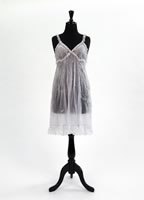
Artist’s “peeled” dressHow floating this is, yet how shaped and shapely. The fabric appears to be gauze or some sort of soft netting. So fine, it’s translucent; any woman wearing it would find her skin visible through it. It appears so lightweight it may even lack weight. On, I imagine it might feel like someone’s breath or a second skin.

In fact, it is a second skin: This dress, made from huge pieces of “hide” created by lavishing her body with a skin-peel facial mask and then gently stripping it off, is embedded with artist Laura Splan’s dead skin cells. The fabric is herself, in a way, which she then trims, sews, and embellishes as she would any delicate cloth.

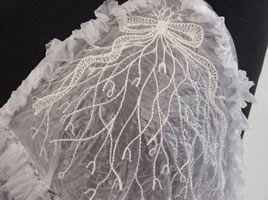
Splan must have a light hand and lots of patience. Embroidered bodice cupLook at the machine-sewn detail on the bodice. She calls this sexy, ghostly work Trousseau (Negligee #1). Inspired equally by the body and artifacts of medicine, Splan also paints in her own blood on watercolor paper, tracing the patterns of neuroanatomical forms. She sews lace doilies based on the structures of viruses. She has knit a blood-filled scarf from vinyl i.v. tubing and photographed it. See for yourself — more of Laura Splan’s fascinating work is here.

– Tutor as tailor

My writing center colleague, Jane Hirschhorn, published her article, ESL and LD Students: Diverse Populations, Common Concerns,” in the fall issue of Praxis. Grounding her discussion in research and personal experience, Jane describes writing challenges shared by diverse students, and she offers tutoring strategies, with examples, that effectively serve them.

Her key metaphor, incidentally, is tutor as tailor, which reminds the reader that tutoring involves the art of seeing and serving each person uniquely.

– Potion

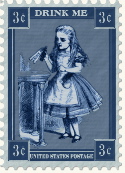
“Drink me” smallIf I owned a café (an idea I’ve flirted with), I’d put this on the fall menu.

Peel and slice a one-inch knob of fresh ginger, and pour over it a quart of boiling water. Steep for 10 minutes, then strain. Combine this ginger tea, which has a bite to it, with an equal amount of apple cider. Serve hot or cold.

That’s it, folks, one of my favorite kinds of recipes: common ingredients + no work = alchemy. It was told to me in the waiting room of the Boston Children’s Chorus by Cynthia, the mother of one of Lydia’s fellow singers. Drink up. The mixed flavour might give you, too, a curious feeling.

—-

Fictional Alice stamp created by web designer and writer Amber Simmons.

– Little house moment

Rain on stepsSaturday: rain, finally.

There was one quiet period when Lydia was at Mandarin Gourmet, having lunch with her friends; Eli was at John’s house, doing some mysterious thing that teenage boys do, fueled by Vitamin Water and cheddar cheese potato chips; and Jimmy was at Roche Brothers, getting provisions.

Grace and I were home, quietly puttering around. I sorted the junk mail on the dining room table while she worked at a rainy-day gardening task I gave her: creating plant markers for all the “new” perennials I made over the summer by dividing the overgrown ones. They’re about to fade into the ground for the winter, and I want to mark their places while they’re still recognizable. Look at this — 45 plants from the original seven.

Plants markers by Grace

Finished with lettering, Grace wanted another chore. “Do you want to organize the spice jars?” I asked. We have too many, including lots of half-containers of duplicates and triplicates (four little shakers of thyme leaves!). I put them all on the counter for her, and then she arranged them according to her own scheme, which had something to do with size. Any scheme is better than no scheme.

Spice collection undergoes renovation

I left her arrangement out for a while, admiring it and inviting the comers-home to admire it, too. Hours later, after Grace was asleep, I filed them away into the cabinet.

During the industrious and peaceful hour or two, I suddenly thought of Laura Ingalls Wilder’s Little House books, and how much I loved them as a child, and how the drama of the family’s survival is punctuated Little House coverby these moments of unadorned pleasure of a kind we don’t usually get to experience in our lives, in a time when the birch plant markers have to be ordered online and delivered by UPS, and when we can walk across one intersection and get Starbucks coffee or egg drop soup any time we want. I like that, and I even wish sometimes that there were still more restaurants within walking distance of my house, but I also like when, as I felt on Saturday, what you have to do is not be anywhere else but where you are.

—-

Read the first several paragraphs of Little House in the Big Woods here.  Ah, trees.