– A “Jane thing”

Normally, I am content to leave the food enthusiams and food blogging to my friend, Marcia, who introduced me to the essays and novels of Laurie Colwin and gave me, more than 15 years ago, a flank steak marinade recipe that has never failed to get oohs and ahhs from my guests.

Once in a while, though, I come across a revolutionary way to do something in the kitchen and I have to step up and spread the word. Years ago, for example, lying on the couch and watching cooking shows on PBS with preschooler Eli, who found them relaxing, I saw Nathalie Dupree cut an onion in such an elegant, straightforward, SENSIBLE way that, not only did I adopt her technique, I converted others, too.

This week, in the kitchen assembling cheese enchiladas from a recipe, I let out an “oh, my god” when I got to the step for heating the corn tortillas.

Jimmy: What?

Jane: Oh, my god. Here’s the most brilliant way to heat tortillas.

Jimmy: How?

Jane: Get this — you heat the first one in the fry pan for a few seconds. Then, you lift up that tortilla with the spatula, and put the next one underneath, and heat it for a few seconds. And then you lift the two tortillas, slide another one underneath with the spatula, and cook for a few seconds. You keep doing that, until you have a stack of 12.

Jimmy: That seems like a Jane thing.

Jane: Yeah, it does.

Not only did it seem like a good idea on paper, it was a good idea upon execution. It worked, beautifully. My old habit (heating them one at a time and then trying to keep the bunch warm in foil or a low oven) now seems clunky.

Life with tortillas? Changed.

—-

Thanks to stranger Elise Bauer, at Simply Recipes, for the tortilla tip included in her pretty delicious “Enchiladas” recipe.
– Games teachers play

Items to keep in your school bag:

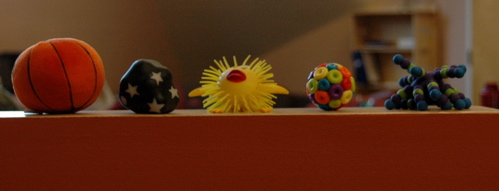
Five toys on ledge

Not by nature a maker of fun, I do like to have fun, and I believe that others need it, too. Do you notice, for example, in a classroom, if the teacher is not providing any chuckles, a student in class will start performing that function? Intuitively, we all know, even if we resist the knowledge, that the Class Clown is essential. Just as every group could use a leader or two, every group could use a fun-maker.

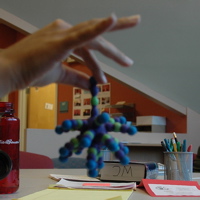
Even a serious teacher like me can design some fun. Props help. A few weeks ago, seeing that my September and October calendars were filled with appointments for visiting classrooms on campus and giving students my brisk “Come to the Writing Center” speech, I bought five toys. Diversely, they squish, boing, and bounce.

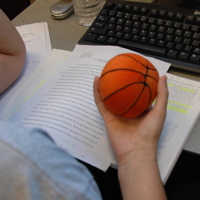
I bring them into the room and put them on the desk. Boing!I introduce myself in 15 words or less, and then I ask the students to think for 30 seconds on this question: “What makes writing so hard?” I add: “Every answer is the right answer.” I wait. And then I hold up the first ball and I give my brief instructions: “I’ll throw this to one of you. When you catch it, say your first name, and then tell us what you find so hard about writing.” I toss, a student catches, and the ball makes a surprising, mechanical “boing” sound. He laughs. The group laughs. The catcher answers: “I’m Paul. And getting my ideas down is hard for me.” Yes, I say, that’s challenging, for all writers in fact.

I give another stage direction: “Paul, throw that ball to one of your classmates. It’s someone else’s turn to tell us her first name and what’s hard about writing.” The next person answers. Squish spiderAfter that I introduce a new toy, and then another — they’re getting the hang of it now — and learn a few more things about what makes writing hard for students: “grammar,” “finding the right word,” “thesis” (over and over), “getting the length right,” and “starting.” Within a few minutes, all five toys are in play, and the students seem to have figured out the drill, and they’re looking at each other, waiting for a turn, aiming if they’re throwing, and talking to me and each other. The game, furthermore, is giving me material; I’m not a lecturer, and I get most of my energy from the questions and thoughts that students bring to or make in class. In this case, their responses give me an entrée to a conversation about how 1:1 tutorials in a writing center support students at all stages of the writing process and for any writing challenge.

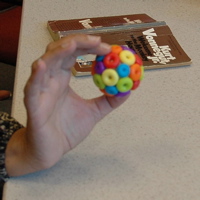
Fruit loop superballIt’s fun with a purpose, I know. In order to teach, a teacher must build some sort of bridge — or, at least, toss a fruit loop superball — between herself and students.

—-

Thanks to Joanne Manos and Kristen Daisy, in the Writing Center that afternoon, for their willingness to “lend a hand” to these pictures of the toys.

– Mystery plant: solved.

Last night, Lydia assembled with friends at M.’s until 10; the girls, it was reported, ate Poptarts and watched SNL shorts on DVD. Eli left our house around 5 o’clock, in a small car filled with teenagers and one big dog and driven by a mother, to go to an all-ages show at a converted church in Allston; he got home at 10:10 and said, when asked if he enjoyed the show, that instead he “hung out” at C.’s house with her and another girl. Hmm. In those hours when the 11-year-old and 15-year-old were absent, Jimmy caught up on some e-mail, seven-year-old Grace watched Nickolodeon, and I spent an hour researching plant images on the computer that’s in the tv room.

My mystery plant, I feel certain, is a spurge. Curious how I figured it out? Please read on. Continue reading

– Sitting still

This drought is hard on living things with shallow root systems. For weeks I’ve been moving the sprinkler around the yard, trying to hit each spot every few days. Around 8 o’clock the other night, I was standing in my driveway, watching the oscillating streams that were illuminated by the street light. On the other side of Puddingstone Road, Steff emerged with her children from the lit foyer, saw me in the mostly dark, and asked in a friendly way if I was watching my grass grow. “Yes… yes, I am.” A simple answer, yet not quite right.

Plant & brick detail, wet

Often in the summer I sit on the front steps, looking at the current state of affairs in the yard: subtle undulation of brick, mix of blooms and leaves, shadow and light on the lawn. Sometimes I look across to the temple, and I check out the greenness of the grass or the alertness of the annuals or the bend in the trunk of the tall white birch, which Dick tends while Rufus, his bulldog, keeps him company. In an hour, creatures might shift a bit, puddles may appear, but nothing much changes — nothing more than this, anyway:

A haiku by Shiki (Japanese. 1867-1902):

The sparrow hops
Along the verandah,
With wet feet.

Our front door, unless we’re asleep, is always open to the storm door, so we can look out. This morning, Grace perched herself on the front steps: Grace, sitting still for a changenot feeling well, sitting quietly. That’s my summer spot. Today I sat inside, on the stairs that go up, and looked out at her looking out. I thought of how a moment freezes when we watch our children, still, like this. Eli told me once that he’s noticed me stand in a doorway and watch the girls, who go to bed earlier than he does, as they lie there. “You like to watch us sleep, right, Mom?” All parents do: It’s the only time, kids, that you stop moving, and that Time stops, going neither forward into your future or looking back over its shoulder at your earlier selves. It stops. I study you, in the absolute present. This is not time expanding, as it does when a person becomes absorbed in the activity of writing or gardening or making music or love. That kind of flow has movement in it, even if the movement makes the experiencer lose consciousness of self and time. What I’m talking about here is Time… pausing. Time bare of verbs.

One by Issa (Japanese. 1763-1827):

How lovely,
Through the torn paper window
The Milky Way.

I was not, then, watching the grass grow two nights ago. More like me, grass, water, dark, warm air, streetlights, and still.

Grace and Jane on front steps—–

Photographs of Grace alone and Grace & Jane by Eli.
Haiku from
Haiku (Everyman’s Library, 2003).

– Summer fades

For season-watchers, thoughtful gardeners, and poetry readers, here is an excerpt from Louise Glück’s poem “October,” from her collection Averno (FSG 2006).

4.

The light has changed;
middle C is tuned darker now.
And the songs of morning sound over-rehearsed.

This is the light of autumn, not the light of spring.
The light of autumn: you will not be spared.

The songs have changed; the unspeakable
has entered them.

This is the light of autumn, not the light that says
I am reborn.

Glück’s precision and steady hand remind me that there may be allure in what is plain. Even if it unsettles you. Especially if.

– Mystery plant: are you ready?

First, watch this brief (one minute) commercial from the 1960s. If you’re at least my age (42), you might recognize the jingle.

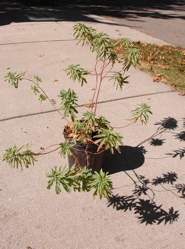
A couple of weeks ago, at Allandale Farm, where I go to feed what Jimmy calls my addiction, Mystery plant, unadornedI bought this plant. It was one of a kind, nestled among other pots of other sun perennials, and unmarked. I asked the guy out back, “What’s this?” He didn’t know. I asked the guy out front, “What’s this?” He didn’t know. I bought it anyway. I felt drawn to it, especially its red branches, and knew I had to have it. It’s not lush or an obvious showstopper, and it sort of reminds me of Charlie Brown’s Christmas tree: twiggy, droopy, and left behind. I’ve been trying to figure out what it is, and, as I’ve been fruitlessly researching plant images, the jingle from the commercial from the board game I played over and over and over again as a young girl keeps looping through my head. I’ve substituted one word. It goes like this, and I sing it to myself: “Mystery plant… Are you ready for your mystery plant? Mystery plant… Are you ready for your mystery plant?”

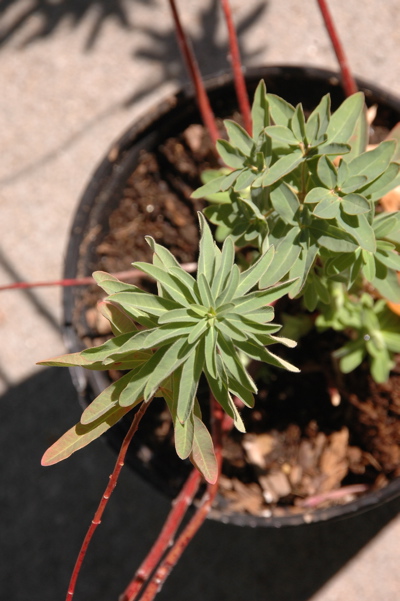
Mystery plant, leaf patternNot sure, I’m starting to suspect it might be a daphne cultivar. The leaf pattern — click on thumbnail at left for a close-up — is similar to others I’ve seen, including the ailing daphne in my own yard, but it doesn’t have the necessary full foliage. If you have a clue or an answer, let me know.

Photographs by Eli. Video via YouTube.

– Potatoes, and other prompts

I like the concreteness of things. Focusing on them while writing also frees me from my vague and persistent thoughts. Put an old key, a knife, an unfamiliar picture, or brooch in front of me, and I feel interest in at least describing the item. That inevitably leads to a connection with my own experience and, sometimes, a new question.

In her handbook, Writing Alone and with Others, which is filled with attractive writing New potatoesexercises, Pat Schneider offers many examples of using objects as “triggers” in her workshops for writers. Sometimes, she places a covered basket of 30 or 40 items on a table, removes the cover, and asks group members to take one or two objects, hold them, and freewrite for 10 minutes or so. Other times, she has multiples of the same item, and hands one to each member, getting them to all start writing from a similar place, as a way of seeing how individual writers will all mull differently over a shell, for example. Some items she suggests, like cinnamon sticks, even have scent.

  • Here are Schneider’s suggestions for a diverse basketful: shaving brush, rusty horseshoe, a ball and jacks, baseball, crocheted doily, piece of frayed rope, bottle of pills (with label scratched so pills become unidentifiable), rosary beads, crumpled cigarette pack, page of scripture written in Hebrew, small teddy bear, broken dish, mirrored compact, man’s pipe, baby bottle, old piece of jewelry, spool of thread with a needle stuck in it, dog whistle, artificial flower, plastic Jesus figuerine, and empty whisky bottle.
  • Suggestions for multiples of same object: mothball (in plastic snack bags to protect hands), piece of penny candy, a nail or screw, a vitamin pill, acorn, torn piece of a map, slice of raw carrot, rock, a small piece of sandpaper along with a bit of cotton, or a long stem of wheat or grass.

Collect some acorns. Buy a bag of wooden clothespins or new potatoes. Make your own object-filled basket. Offer surprise to your students. Or, assemble a collection, put it aside for a few weeks, and then take it out again to prompt your own writing. Surprise yourself.

—–

Picture credit goes to BBC Food.

– Before and after

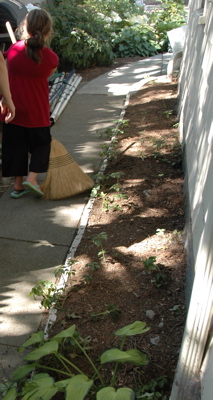
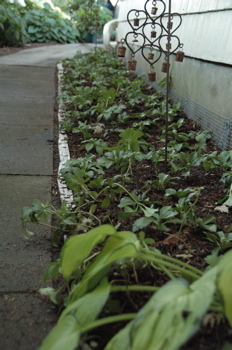
For anyone who is interested in the results of my propagating 100 pachysandra cuttings from my parents’ yard into mine, this post gives an update on the health of the transplants and, at the end, shows how I did it.

The “before” patchThis is also a before-and-after story and an occasion for me to remark on my uneasiness with sudden and dramatic transformations, which this is not. I recognize that, as a culture, we want big and positive change: the new fabulous job that will turn those daily doldrums and interpersonal irritations into personal zest and suitable comrades; the surgery or exercise that will turn my everyday outer self into a “10” (oh, yes, I’ve had those fantasies of ten-ness); the design and construction project that will help a house be all it can be (bigger, better, beautiful). This is prevalent — just type “before and after” into the Google search box and see what you come up with.

A couple of summers ago, driving to Crane’s Beach with my friend Betsy, she asked me what I would do if I won a million dollars. I asked her permission to reframe the question, setting $50,ooo as the limit, because I couldn’t wrap my mind around so much possibility — such an immensity seemed a pressure, an obligation, a weight. She laughed; she agreed; and we played the game. On my list, I put a beautiful coat, well-made shoes, a charitable gift, and a personal chef for a year. Later, I played the game with the kids, and they put items on their lists like “couch for my room,” “video game console,” and “elevator in our house.”

As Jimmy pointed out, as the kids and I were itemizing, any one or two or three ofThe “after” patch, with bells those wishes are ones we could actually afford now. He was right, and I realized — from Betsy’s laughter, from his comment — that the kind of changes that are either most interesting or tolerable to me are incremental ones. Indeed, I’ve become happier with my living room after getting a chair reupholstered from a busy, whimsical print to a green, textured chenille. Work is better on the day I tidy up my office and have a conversation with an eager student. My old clothes look snappier when I’m wearing a new sweater. This kind of change, which is probably most common in most of our lives, isn’t the stuff of dreams or the stuff that sells. Who would pay the initiation and monthly fees to a gym that promised only that working out would help you feel moderately better? Does anyone lie in bed at night fantasizing about updating the sleeve lengths on all their jackets and sweaters? More significantly, are any of such changes representable?

I confess: even though I am capable of ho-hum-to-fabulous fantasies, it’s the small changes in my life, wardrobe, house, hairstyle, garden, career, cafeteria that sustain me.

If you would like to follow how I made this incremental change in my side yard, as illustrated in the above Before and After images, please… Continue reading

– Sign in stone

Do you know how an image, from a book or movie or even your own dreams, can enter and then stick in your mind? For days, since reading this passage in If on a winter’s night a traveler by Italo Calvino, I’ve been seeing this hand in stone — my version of it — everywhere:

Monday. Today I saw a hand thrust out of a window of the prison, toward the sea. I was walking on the seawall of the port, as is my habit, until I was just below the old fortress. The fortress is entirely enclosed by its oblique walls; the windows, protected by double or triple grilles, seem blind. Even knowing that prisoners are confined in there, I have always looked on the fortress as an element of inert nature, of the mineral kingdom. Therefore the appearance of the hand amazed me, as if it had emerged from the cliff. The hand was in an unnatural position; I suppose the windows are set high in the cells and cut out of the wall; the prisoner must have performed an acrobat’s feat – or, rather, a contortionist’s – to get his arm through grille after grille, to wave his hand in the free air. It was not a prisoner’s signal to me, or to anyone else; at any rate I did not take it as such; indeed, then and there I did not think of the prisoners at all; I must say that the hand seemed white and slender to me, a hand not unlike my own, in which nothing suggested the roughness one would expect in a convict. For me it was like a sign coming from the stone: the stone wanted to inform me that our substance was common, and therefore something of what constitutes my person would remain, would not be lost with the end of the world; a communication will still be possible in the desert bereft of life, bereft of my life and all memory of me. I am telling the first impressions I noted, which are the ones that count.

It’s not just the image. I love the simple surprises in “mineral kingdom,” “free air,” and “white and slender,” the slant repetition of “desert bereft of life, bereft of my life,” and the narrator’s measured acceptance of the remarkable “thrust out” hand he has seen and what it means to him.

– Necessary flaws

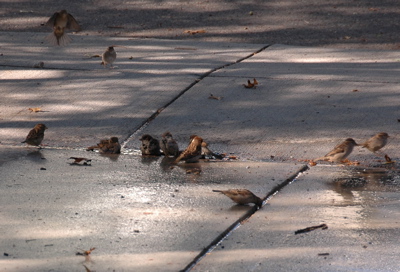
Bird party on September 19th

This afternoon I set up the sprinkler, turned it on, and forgot about it. An hour later, Grace pulled me to the window, pointed to the end of the driveway, and said, “I think the birds think it’s a birdbath.” Indeed, there were several little ones, touching down and splashing in the inch or two of water that had accumulated in the seam where our driveway meets the sidewalk.

A few years ago we replaced the cracked and heaving driveway that seemed original to the house (1930s). The paving contractor jackhammered, cleared, and carefully graded a new footprint before pouring a truckload of cement onto a bed of compressed sand and gravel. Jack, the owner, who was on the job constantly, promised a pristine surface, free of the mud- and ice-collecting potholes and cracks that characterized our old driveway. And when it dried, it looked good. And then it rained, and we noticed that “perfection” came with a few flaws, noticeably some shallow dishes in the driveway that collected a skim of water when it rained. We debated calling the contractor back and demanding a touch-up.

I don’t remember why, but we let it go. Today I was reminded of how cosmetic flaws can turn into features, ones that capture run-off from the lawn, bathe birds, delight a child, and, in turn, give me something to think about.

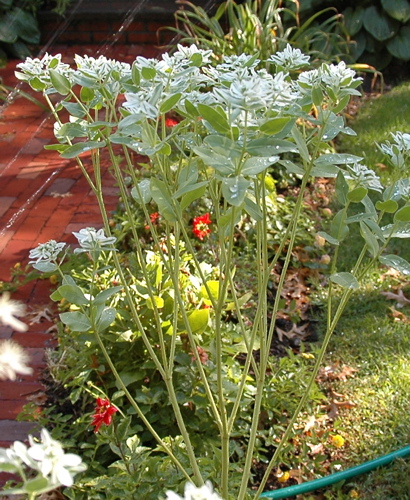
KilimanjaroAnd furthermore, the birds have done a lot of work in our yard, scattering seeds and berries all over the place, causing some annuals — like Euphorbia marginata Kilimanjaro — to come back, unexpectedly and in surprising places, year after year. The birds deserve their afternoon refreshment.