– Simple machine

When I threw away my old pruners — which had an irregular cutting edge and a safety catch that always stuck — I promised myself, when it was spring, I’d look for and buy the Mercedes of pruners: beautifully engineered, balanced, responsive. The price would be no issue. I use the tool all the time between April and November, and I even keep it within reach, on a nail I’ve banged into the wall near the garage door. Going out into the yard? Grab the pruners.

Spring weather and a free afternoon beckoned me out to the yard today. I put on my sturdy dirt shoes and raked up a carpet of wet leaves. I needed more! I wanted to cut something. Alas, I had no pruners and no desire to head to a specialty store to comparison shop for high-end ones.

I headed instead to the nearest hardware store, about two miles away in West Roxbury. First I grabbed some leaf bags. Then I asked the guy at the desk, as I made an odd, pincer-like gesture with my right hand, “Got any, uh, you know, clippers?” (Why the gesture? Why the vocabulary loss?) He pointed; I found the gardening aisle. My eyes scanned the price stickers first, looking for the most expensive pruners. They were ugly, and the handles were coated with that spongy foam I find so annoying. I looked again, searching for design features.

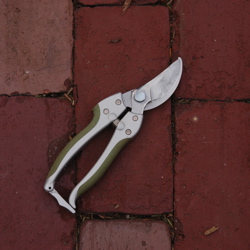
PrunersMy eyes landed on these, and lingered. I instantly liked them: clean, streamlined, unadorned. And yet… they were so cheap, only $7 or so in a long line of higher-priced choices. Would low price turn out to mean low quality?

Well, I took them home anyway, simply because I liked them so much. It turns out they are sharp, easy to handle, and effective. My favorite detail is the safety catch, which is the metal hinged piece at the bottom that opens and closes like a gate and latches ingeniously.

The manufacturer is True Value (item #680043): no snob appeal, just a well-made simple machine.

– Stitched seaweed

Our house, which is currently undergoing dramatic structural changes, was built in 1938, according to our town’s property records. Nine years ago we bought and moved into it. We have learned much about it and previous owners since then.

At the closing, the lawyer for the bank remarked, as he studied the paperwork probably for the first time, “Oh, I know this house. It’s the bad luck house.” And he told us about financial reversals, domestics woes, and crimes committed in the house.

We learned more about the crimes, especially, a few months after we moved in, at a party that our new neighbors (and now friends), Rich and Julie Ross, threw. A woman was there who had, in high school, dated a boy in the family; she got caught up in an investigation as the local police and the FBI prepared to nab various family members for drug trafficking. They nabbed them.

When I dig in the yard and the shovel hits metal or unearths a buried strip of plastic, my first, impulsive thought is that I’ve come across a stash of money or a bundle of bones.

I haven’t, yet.

The garage walls are punctuated with covered cavities, and I wonder if little bags of cocaine were stored there.

I have found no supporting evidence.

Interior walls of the house were mirrored — beautifully and expensively, like a hotel lobby — when we moved in, and I wondered what was behind the mirrors.

It turns out (we’ve had them all removed, over time), nothing.

Once, as workers took out the old dishwasher and installed the new, we found a lost snapshot of a little girl and a fatherly man, standing together by a little swimming pool in the backyard. They looked happy. Carved into the paneled walls of the finished part of the basement are traces of people who have moved away: “Steve + Joan 70-71.”

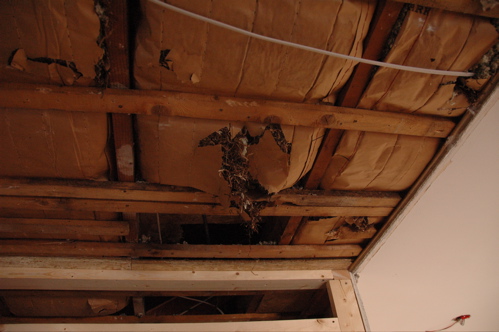
Over the years of our ownership, there have been lots of repairs and cosmetic projects in our house on Puddingstone Road, but nothing major until now. Builders are ripping down walls and reframing them into other room configurations. A bathroom floor and tub have made their way into the dumpster; I see grayed, creaky boards where they once sat. Old ceiling plaster has been pried and brushed loose. Shreds of insulation drift down, like ghosts released.

Here’s a picture of the insulation in the ceiling over what used to be Jimmy and my closet:

Cabot’s Quilt

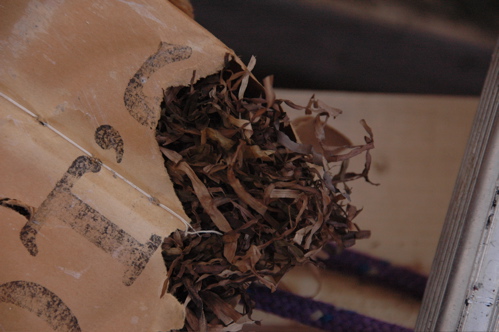
The stuffing, it turns out, is eelgrass, that profuse plant that washes up on ocean beaches all over the world. In 1893, Samuel Cabot, a chemist who graduated from MIT and Switzerland’s Zurich Polytechnicum, having learned that “early settlers had used eelgrass as a crude home insulation,” invented Cabot’s Quilt, clumps of the dried ocean plant stitched between brown paper. A six-inch layer of it is as effective as fiberglass, according to one source. There is a one-inch layer of it in our walls. Brrrr.

On the brown paper is stamped words: Samuel Cabot. Boston. One yard. Cabot’s. Those were the clues that helped me find the story (thank you, Google!) of this curious insulation, which went out of production in the 1940’s, although Samuel Cabot Inc. still exists.

When the foolish, unfiltered banker told us in 1999, at the signing of documents that made this house ours, that “bad luck” was associated with it, I retorted (politely), that it was up to us to “make it the good luck house.”

Although I think it is unfortunate that much of our house remains poorly and archaicly insulated, I am also pleased to discover that the walls around us are stuffed with a kind of leaf, stitched between paper that’s faintly printed with words.

Eelgrass from Cabot\'s Quilt

Is that karma or what?

– Signs of progress

Tending pachysandra, September 2007In September, I wrote (pridefully) of how I propagated and planted 100 pachysandra cuttings from my parents’ yard into mine. Within a couple of weeks, the cuttings had taken root and appeared sturdy. Over the winter, I checked on them from time to time, when they weren’t blanketed by snow. They drooped, yet remained green and leafy. I anticipated their spring return to robustness.

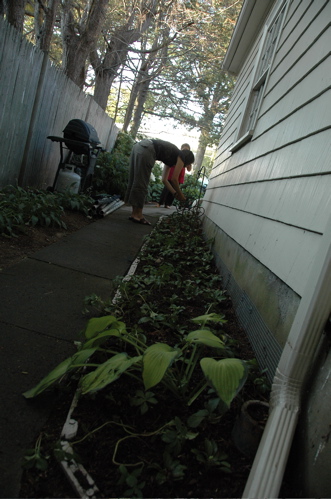
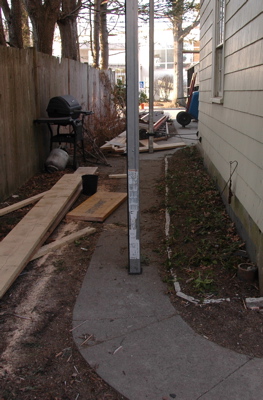
Flash forward to today: Now they’re trampled, knocked over, torn, dug up, and gone missing in places. Our house is undergoing what, for us, is a dramatic transformation — we’re adding a bedroom over the garage and redoing the rest of the second floor — and the builders and their staging are taking over the pachysandra’s territory.

Pachysandra, March

There’s also a pile of lumber on top of a more established hydrangea given to me by Leah B., a favorite former student and one I tutored frequently when I worked at Simmons. There are ruts in the lawn and broken branches on a holly. Around the foundation, where hostas and plumbago are soon to emerge, are scattered old nails and splinters of wood.

Do I feel sad? No, not that. Do I feel hopeful, that the return of a growing season will restore the trampled green things? Uh, no, because it’s also possible that the fragile pachysandra were too tender to survive boots, tools, and ladders. Yet I don’t exactly feel unhopeful.

I feel… like an accomplice. I set something into motion that’s directly competing with and possibly destroying some other process I set into motion. And all I can do is see it through, and do what I can to repair what’s been broken asunder.

The hydrangea will bounce back.  The broken holly will fill out again in a season or two.  Hostas are unstoppable and will find a way.  It’s the viability of the pachysandra I’m not sure about.

– Desperate measures

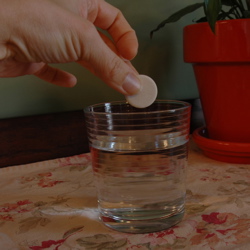
Hand, tablet, waterThis week Eli was sick with a cold. On Thursday, one of my tutors apologized for bringing her sickness to work. On Friday, one of my colleagues brought along her obviously sick child to a staff meeting.

Such occurrences don’t bother me. I figure that my persistent exposure to germs are an occupational hazard of both parenting and teaching. I don’t use hand sanitizer. I abide by the five-second rule and sometimes eat things that have fallen on the floor. I do not fear touching doorknobs. I’ll drink out of another person’s water glass, if offered. You can drink out of mine, if you like.

This morning I woke with a cough, a deep chest one. Right now I have two part-time jobs that together add up to more than one, and fatigue is my new tag-along. My guard is down. The palace has been invaded.

It might be too late, but I’ll try anything. Eli and my mother are recommending AirBorne, a packet of so-called immunity boosters in a fizzing tablet. Normally I eschew such remedies, preferring chemicals and a nap.

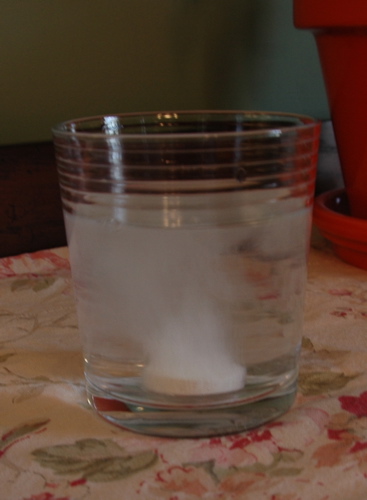
FizzzzzzzThis item has a homey list of ingredients, however, which sound as though they were grown in someone’s yard: lonicera, forsythia, ginger, schizonepeta (what’s this?), echinacea, and other herbal names. It looks and tastes like Alka-Seltzer. L’chaim, everybody.

– Consider the sink

You spend a lot of time in front of it, so you think sometimes that the television or pc is the most important object in the house. And you wish it wasn’t.

Take comfort: You spend a lot of time, too, at the kitchen sink. It is more essential than the screen, and perhaps you even enjoy, like I do, your time in front of it.

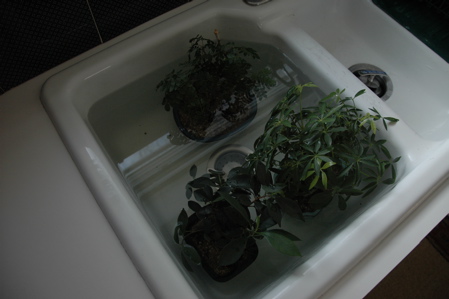
Beyond its usefulness as a trough in which to wash potatoes and dishes, the sink is a player in parts of your life that have nothing to do with food. If, for example, you are an indoor gardener like Jimmy, you give your bonsai their weekly soak in a sink.

Bonsai in sink on snowy day

Paintbrushes get clean there. Women bend themselves over the sink and wash their hair under the kitchen faucet; it’s something we start doing as teenagers and then keep returning to. During the morning rush, teeth get brushed and the last going-out-the-door glass of water gets drunk there.

Because you’re standing there so often, sometimes you kiss at the sink.

Babies have their first baths in stainless steel or white enamel tubs set into the waist-high countertop. Perhaps puppies do, too. When children are toddlers, and after they play in the backyard dirt with the hose, they get carried shoeless into the kitchen, plunked down at the sink, and have their feet and calves and shins washed of mud with the sprayer and by their mother’s soapy, slippery hands.

When children are older still and bring home head lice, they lay their long, sturdy bodies down on the counter and hang their head into the sink for what I call “the treatment.” Here’s an excerpt from an essay I wrote about the experience of nit-picking:

A prehistoric creature with a tough carapace and immense evolutionary stamina, the lice resist the drugstore poison that I massage through my son’s hair, and the next day through my daughters’ hair. Working in the kitchen, I bend their necks over the edge of the sink and rinse the white cream that smells like deodorant – both fresh and chemical – from their hair and their heads, holding the sprayer in one hand and supporting their skulls in the other. Trying to see, I lean over them and into them. My arm or breast through my t-shirt frequently brushes a shoulder, cheek, or, in the case of my son who is standing and not lying on the counter like the girls, a back. The gentle pressure makes us close and I wonder if they are aware of my body and the part that is touching them, as I am aware all the time when I am with them of their bodies and what their parts feel and smell like, how they have grown and lengthened. Their hair straightens and darkens in the stream from the faucet. The children are hypnotized. I wish the running water alone could rid them of parasites.

The window over the sink has, in many houses, the best view. If you’re tall enough to look out, you stand there often, for long periods of time, and stare at the steady trees and grass. You spot the neighbor’s gray cat, which is the exact color of a shadow but for its white feet and snout, and sometimes you see a rabbit shading itself under hosta leaves. And the squirrels, always the damn squirrels. In the winter, you watch a snowman’s creation, a snowball fight, the snow angel parade. There is no “world” out the kitchen window, and so the trance you find yourself in, standing in front of the sink, is local. At night, you try to look out and see only yourself reflected.

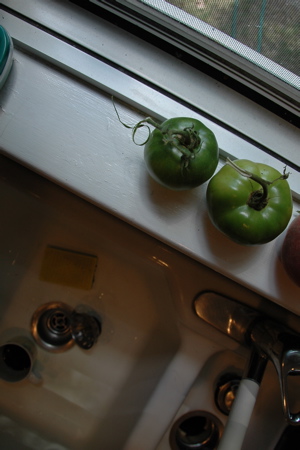
Tomatoes on window sillOn the sill, you keep the shampoo at hand. Someone emptied her pocket of a few rocks and pebbles, and now they belong. In late summer, the green tomatoes soak up the slant of sun. A wedding ring or watch visits occasionally. When the power goes out, you light a candle and place it on the ledge in front of the window and above the sink, for safety and a bit of illumination.

—-

Bonsai picture by me. Tomatoes on sill by Eli.

– Prompted by snow

The view of snow out of a second floor window into our backyard reminds me of other times, in other winters, I’ve stood at the same window and looked out on the same view. These linked memories seem to collapse time and heighten the present moment.

Snow out window, December 14

Yesterday I was the first adult home, and I dug out the driveway. This morning, I dug out a 600-word essay I wrote in mid-winter 2003 and tried to publish, in a local newspaper, in winter 2004. It seems fitting to publish it here today. Yes, it’s about snow, and something more.

—–

Snow Hunger

February 2003

This morning, snow again. The branches of the bare and mature Japanese maple outside the girls’ window is furred with snow, as if the snow had grown there. The lower-growing junipers in the back, planted like fence posts in a line by the neighbors on the border of their yard and ours, are top-heavy with snow, their heads bowed in awe of the maple.

I say out loud to Grace, “Oh, look at the beautiful snow!” Almost three and unstoppable, Grace jumps off the low bed she is dancing on, steps onto the blue stool at the window, and blurts, “Oh, I hungry for it.” Her instant desire, I know, may have more to do with getting the snow into her mouth than appreciating its beauty, but I am instantly touched by her word choice, so more deeply true than “I want to eat it.”

I love the snow and the cold. Especially the snow. Last winter there was none that accumulated, and in this house we wished daily for it, watching the sky out our kitchen window as if we could discern the signs of weather. We wished for freezing temperatures, too, a long string of sub-freezing days and nights.

In December last I bought a backyard skating rink kit, and Eli, Lydia, and I assembled it in the backyard on an afternoon cold enough for coats and gloves but not too cold that it would have been unwise to run the hose for several hours. The water started running into the 17 x 21 foot form in mid-afternoon, and even at 9 p.m. Jimmy and I were still checking the progress of the fill. Moon glow and a backyard light shimmered on the water, yet we could not see well and so had to put a finger in to check how far to the top edge of the frame the water had reached. By our bedtime it was full. We turned off the hose, disconnected and drained it, and coiled it away in the garage for the winter, its last watering task done.

A day here and a day there, temperatures dropped below freezing. Through January, February, and March 2002, however, there was no trio of days cold enough to freeze such a large quantity of water. Nevertheless I loved looking out at that still, shallow pool every morning as I filled the pot to make coffee. I noticed the stray leaf or two that had fluttered down and settled to the bottom, a dark rotting brown against the slippery vinyl white. Some mornings there was a crust of ice; leaves and broken twigs rested lightly on it. Those days gave us hope for even colder weather, for a giant puddle to blossom into a skating surface, for a frosted patch to fill with bright, whirling parkas and a flash of skate blade and the shrieks of the neighborhood children convening in our yard.

The hope for cold and ice — for extreme weather — was the only hope last winter. I also remember sitting on the wooden steps leading from our porch into the backyard a few months earlier, on September 11, 2001. It was a stunning and clear afternoon, and I remember peering at the blue sky, the Japanese maple leaves not yet ready to turn from dark green into their autumn flame, and these words bursting into my thoughts: “I will never be happy again.”

One season later my daily wish for a certain kind of atmospheric condition, and the ice it could bring, lifted me. Better it was, I think now, that a sustained freeze never arrived. There was so much potential in that silent, inexpertly made pool of water.
—–

Picture above, of the view from the window at 8 a.m. today, is by me. Picture below, of the tangle of tree branches seen through the same window, is by Lydia.

Snow on branches, December 14

– Transition time

Years ago I learned the phrase “transition time” from one of the kids’ preschool teachers. A bridge from one kind of activity to another, it’s something that all children need and something that some have trouble with. For example, if a child is engrossed in building with Legos, he might be unable or unwilling to follow directions to put away the toy and put on his coat if he has not first been given a warning as well as some time to transition from his play into the practical.

Transitions help us cope with change by easing us forward. Routines help, too.

Two days before Thanksgiving, on November 20th, it snowed lightly. There were still plenty of leaves on the ground, and the Japanese maple in our backyard, which bursts every fall from green to crimson and then drops its leaves within a few days, still wore half its foliage. I stood in the backyard, trying to gauge when the leaf guys would come to finish their work for the year and, after that, when I would have an hour or two to break open the bales of hay and mulch around new shrubs and divided plants.

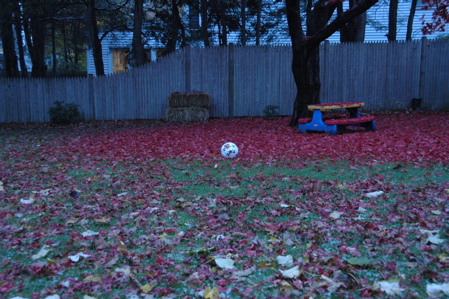
I stood in my neighbor Gail’s yard and looked into my own. There was a soccer ball left behind from some game that did not involve me; there were the patient hay bales against Bob & Mary’s fence, the carpet of crimson leaves, and a toddler picnic table under the maple.

Backyard November 20

I have no toddlers in my house, and won’t again. The sight of that leaf-covered picnic table, too small for any of our children, reminds me of its redundancy. At best, it’s an artifact. I stood there for a long time and looked at it.

What happens to knowledge when it is not applied to daily use? I have this expertise in caring for the newborn and very young: feeding, washing, handling, soothing, delighting, lugging. I no longer need to mash up anyone’s food, wash a boy’s hair while protecting his eyes, or grab a girl up and out of a sandbox. Now that there are better music makers in this house than me, I haven’t sung anyone an invented lullaby in ages. (One of my lulling hits: “You’re A Baby.”)

Does such knowledge disappear? Is it transformed and applied to other uses? Does it go underground, and hibernate?

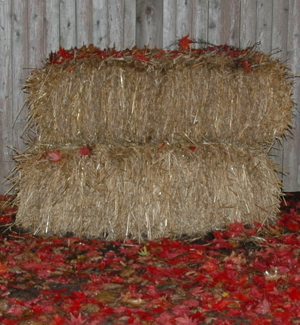
Hay balesThe leaf guys came on a clear day and vacuumed up the red leaves. Soon after, it got cold – bitterly – and we got busy here. It has since snowed again; the stray leaves that fell after the final cleanup are clumps under snow. The brilliance of the fall is a memory. I wonder if I missed my chance to lay down the hay. Like a child sometimes, I don’t like to be rushed, and I waited too long. It’s December 9th and gardening is over for the year.

I’m not a person to spend the winter months dreaming of what I’ll plant in the spring. I put those thoughts aside until signs of thaw, and then I feel, too, as if I’m thawing out. My interest in the yard reawakens. In the meantime, I keep my hands busy in other ways. Knitting is one of them.

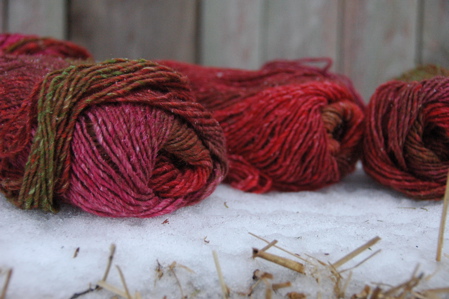
Yarn on hay December 7

– Garden for our times

Do you remember the walled, overgrown garden brought back to life by a boy and a girl in F. H. Burnett’s Secret Garden (1911)? The book was a favorite of my childhood, and perhaps the long, restorative story about gardening has something to do with my own attraction to shabby, abandoned patches, as if glory and possibility, like this, await in each one:

The seeds Dickon and Mary had planted grew as if fairies had tended them. Satiny poppies of all tints danced in the breeze by the score, gaily defying flowers which had lived in the garden for years and which it might be confessed seemed rather to wonder how such new people had got there. And the roses–the roses! Rising out of the grass, tangled round the sun-dial, wreathing the tree trunks and hanging from their branches, climbing up the walls and spreading over them with long garlands falling in cascades–they came alive day by day, hour by hour. Fair fresh leaves, and buds–and buds–tiny at first but swelling and working Magic until they burst and uncurled into cups of scent delicately spilling themselves over their brims and filling the garden air. (247)

Lovely, isn’t it? Fresh, new, full of playful life — not unlike an uncomplicated view of the child.

And here’s the garden for our times. It is tended by the 21-year-old Edmond who has been traumatized by witnessing the slaughter of a contemporary war started in England by “The Enemy,” and it appears at the end of Meg Rosoff’s How I live now (2004):

On the warm stone walls, climbing roses were just coming into bloom and great twisted branches of honeysuckle and clematis wrestled each other as they tumbled up and over the top of the wall. Against another wall were white apple blossoms on branches cut into sharp crucifixes and forced to lie flat against the stone. Below, the huge frilled lips of giant tulips in shades of white and cream nodded in their beds. They were almost finished now, spread open too far, splayed, exposing obscene black centers…

The air was suffocating, charged, the hungry plants sucking at the earth with their ferocious appetites. You could almost watch them grow, pressing fat green tongues up through the black earth. (181)

The passage is narrated by Daisy, Edmond’s American first cousin and former lover, also 21, who returns to him after a six-year absence because of the war, which spread beyond the British island to six continents. Like the Secret Garden, this novel, which Meg Rosoff reportedly began writing in the run-up to the war in Iraq, is aimed at a young audience. Rosoff doesn’t shy away from blood, terror, or torture: a man has his face blown off, some civilians are slaughtered and most are displaced from their homes, and children roam the woods and abandoned farms, hiding and fending for themselves. Parent figures are either absent or die off quickly.

How I live now, coverThere’s nothing pastoral about the England in How I live now. Yet this dystopic novel is not without hope. In the end, Daisy joins Edmond in tending his rage-filled garden, and the reader senses that somehow subverting anger into hungry, persistent life offers a way back to what has been in short supply: peace.

– Extremities

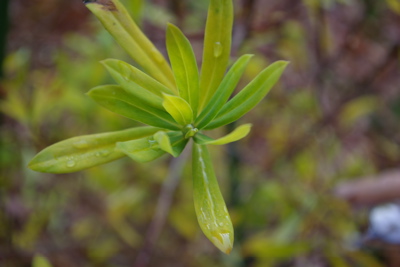
Although the frequency of my visits to the daphne that Jimmy and I transplanted in September have waned from daily to weekly, I keep monitoring her and doing the little I can to cultivate her return to vigor. Mostly, I have watered the ground inside the dripline, keeping it damp yet not flooded.

In October, her leaves stopped drooping: some fell off, and some sprung back. Her branches no longer looked like slumped shoulders; they regained their uprightness. Last Thursday, on our warm and breezy Thanksgiving Day, a few hours before heading downtown to my brother Michael’s new apartment, I poked around the yard. I pulled out and trashed the spent lantanas and then carefully assessed the daphne.

At the center of some remaining leaf clusters, there are tiny buds.

Bud inside leaf cluster

At the tips of leafless branches, more buds are starkly visible.
 

Buds at branch ends

Overall, her aspect is alert.

Alert branches

When I visit my endocrinologist for quarterly check-ups on my diabetes, he always checks for two pulses in each of my bare feet: one on the top of the foot, and one on the side, around the ankle. He also pricks the bottom of each foot with a microfilament and asks me if I notice the light touch. The health of the extremities — circulation and feeling in the hands and the feet — coincides with the health of my overall system. And so far, so good. There’s plenty of blood pumping unobstructed to the farthest reaches of me.

I’ll take the buds at the tips of the daphne’s branches as signs that she’s taking up water and nutrients from the roots and compensating for the ones we severed when we transplanted her. Something good that I can’t see is happening underground and inside the vascular tissues.

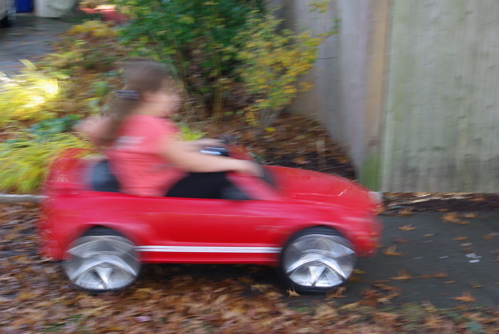
What I’m worried about now is this: two underage drivers (Grace and George) in a powerful, undersized electric car.

Underage drivers in red convertible

Their roadway, the sidewalk, skirts the daphne’s location. The branches tremble as the two whiz by.

——

Pictures by Eli Guterman, who recently said to me, “I’ve looked at your blog, Mom, and you make some awkward cropping decisions with the photos I take for you.” I present these, therefore, uncropped.

– Little house moment

Rain on stepsSaturday: rain, finally.

There was one quiet period when Lydia was at Mandarin Gourmet, having lunch with her friends; Eli was at John’s house, doing some mysterious thing that teenage boys do, fueled by Vitamin Water and cheddar cheese potato chips; and Jimmy was at Roche Brothers, getting provisions.

Grace and I were home, quietly puttering around. I sorted the junk mail on the dining room table while she worked at a rainy-day gardening task I gave her: creating plant markers for all the “new” perennials I made over the summer by dividing the overgrown ones. They’re about to fade into the ground for the winter, and I want to mark their places while they’re still recognizable. Look at this — 45 plants from the original seven.

Plants markers by Grace

Finished with lettering, Grace wanted another chore. “Do you want to organize the spice jars?” I asked. We have too many, including lots of half-containers of duplicates and triplicates (four little shakers of thyme leaves!). I put them all on the counter for her, and then she arranged them according to her own scheme, which had something to do with size. Any scheme is better than no scheme.

Spice collection undergoes renovation

I left her arrangement out for a while, admiring it and inviting the comers-home to admire it, too. Hours later, after Grace was asleep, I filed them away into the cabinet.

During the industrious and peaceful hour or two, I suddenly thought of Laura Ingalls Wilder’s Little House books, and how much I loved them as a child, and how the drama of the family’s survival is punctuated Little House coverby these moments of unadorned pleasure of a kind we don’t usually get to experience in our lives, in a time when the birch plant markers have to be ordered online and delivered by UPS, and when we can walk across one intersection and get Starbucks coffee or egg drop soup any time we want. I like that, and I even wish sometimes that there were still more restaurants within walking distance of my house, but I also like when, as I felt on Saturday, what you have to do is not be anywhere else but where you are.

—-

Read the first several paragraphs of Little House in the Big Woods here.  Ah, trees.