– Slow down, you move too fast…

It is customary for Tom Cavanagh, the principal of the K-8 school in Brookline that Grace and Lydia attend and Eli graduated from, to begin his frequent e-letters to the school community with a quotation and a short thoughtful essay. This one hit my Inbox on a day in which I, and everyone who works with me in the writing center, had spent careening from tutorial to tutorial, task to task. The principal’s words spoke both to my conviction that everything we do in education is necessary and therefore hard to say “no” to, and to a hunch that we must allow ourselves a moment now and then to pause and take a breath. Please keep reading, courtesy of the man his students call, respectfully, “Mister Cavanagh.”

Chestnuts, a handful

—-

Season of mist and mellow fruitfulness!
Close bosom-friend of the maturing sun.

–John Keats, “To Autumn”

Several years ago, during a particularly hectic autumn, I was running from project to project and classroom to classroom. One afternoon I was racing up the stairs and as I came into the office, I told Mrs. Helen Hunt, my former secretary, that I wanted to quickly dictate a letter to her. As I waited impatiently in my office for her to come in, I made a quick phone call and shuffled some paper on my desk. When Mrs. Hunt came into my office and sat down, I immediately started dictating the letter. However, when I looked over at her, I realized that she was not taking the dictation. Instead she was staring serenely out the window seemingly in another world. Following her gaze, I looked out the window and saw that she was staring at the magisterial oak trees that canopy over my office.

“Aren’t the trees beautiful at this time of year?” she sighed.

“Yeah,” I said grudgingly and carried on with my dictation.

However, Mrs. Hunt was not quite ready to let go of the moment. She stood up and walked across to the window and said, “Come here, Tom.” Knowing it was useless to proceed with my agenda, I got up and stood next to her at the window. She pointed toward a small outgrowing maple tree on the knoll and pointed to the flame bushes that are outside Ms. Cherkerzian’s and Ms. Roses’s rooms, and she explained to me what each of them were. And then she walked over to the side window that points towards the Hoar Sanctuary and made me look at all the elms and oaks and maples blending in a colorful autumnal weave.

It was a lovely sight and I momentarily gave up my urge to get back to dictation. Finally sensing that she had my total attention, Mrs. Hunt said softly, “You know, Tom, it’s important to stop to see the beauty that’s around us and to really enjoy nature.” This incident was to me what is called a ‘teachable’ moment. And from that moment on I have tried — sometimes in vain — to remember to enjoy the extraordinary beauty that New England offers.

I share these thoughts with you because we are in the waning days of the most beautiful autumn of recent years. And, perhaps, many of you are like me: forced marching from one obligation to another and missing what is directly in front of our eyes. Below [in the principal’s letter] you will see a rapid-fire listing of various school events and programs. Many of them may make it on your calendar and you will find yourselves with more to do than time allows. Might I respectfully play the role of Mrs. Hunt and remind you not to let the seemingly interminable burdens of each day cause you to miss what’s in front of your very eyes. — Tom Cavanagh

—-

Today Eli and Lydia, at Arnold Arboretum, took turns with the camera, snapping shots to illustrate their principal’s essay, and occasionally posing for each other. The handful of horse chestnuts image, above, and the tree trunk & leaves picture, below, are by Eli.

Leaves, tree, shadows

– Oh, to draw!

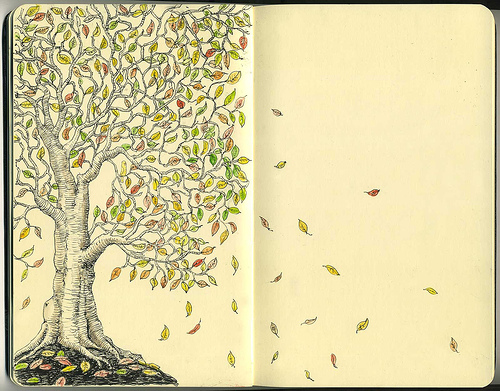
Today I’m wishing that my black notebooks — full of penciled words, notes to self, lists, names of books, phone numbers for contractors, half-baked ideas, found language, beginnings, and occasionally the pressed leaf of a plant I come across and want to remember — contained one thing as lovely as this:

“Autumn” by Mattias Adolfsson

“Autumn” by Mattias Adolfsson, http://mattiasa.blogspot.com

See more entrancing notebook images from various artists at the Moleskine Project. You might find yourself wishing my wish: to draw, and to do it well.

– Plants do what plants do.

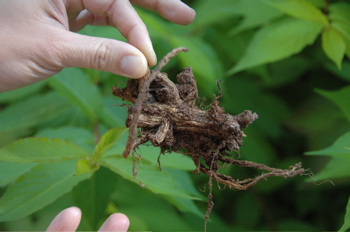
These are rhizome and root bundles of the Christmas fern, and, having sat in the package for a few months, they are as dry as straw.

Fern rhizomes

This is the parched rhizome of a bleeding heart.

Bleeding heart root

I have a few of each, packed in peat moss in plastic bags and waiting, on deck, in the garage. All the season-end gardening work, but for the laying down of some hay around the newly divided day lilies and hostas and the transplanted daphne, is done, and I feel restless to do some more. But not restless to buy some more. Why I didn’t plant these, when I bought them in early July, I’m not sure. The rhythms of summer gardening are different from the fall ones: There’s so much labor at the beginning that a person tires by late June and slows down. It was easy to buy these — that takes no energy — but I must have lost my momentum by the time I got home.

Summer gardening seems to fan out expansively in front of the gardener, and some leisure naturally occurs. I don’t fight that. Fall gardening has a deadline built in, and the cooler weather and shorter days motivate me — this happens naturally, too — to tidy things up and shepherd the plants into hibernation. I pause, once in a while, to look and enjoy, yet the pleasure is sharpened by my knowing that the display days are numbered.

At the moment I feel a little burst of energy to plant something, but not foolishly. There’s not much time for green foliage with moist roots to establish themselves out of the pot and in a new habitat. So, I’ll try these shriveled, woody packs of DNA, and I’ll see if some insulating dirt and a long, winter sleep will revive them, come spring.

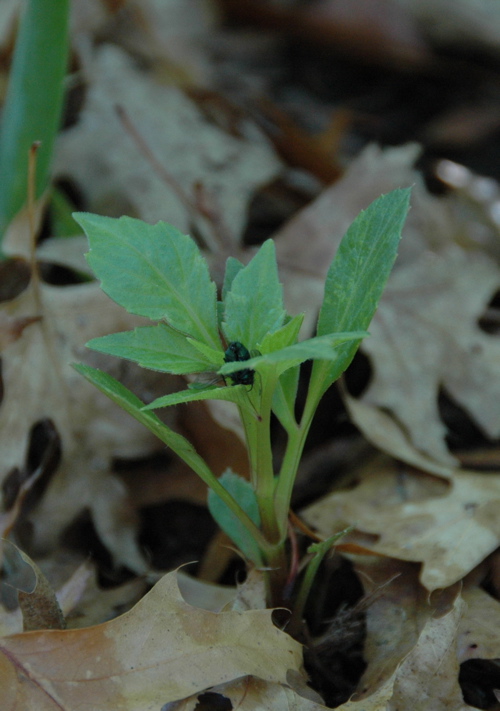
Dahlia surpriseIt could happen. Yearly, I am surprised when what are supposed to be annuals in zone 6 (greater Boston), like chrysanthemums, come back, after I’ve left them to decay and mulch. Once in a while, a stray dahlia, springing up from the leftover bit of tuber I must have left behind when I dug some out, pokes through. In fact, just today I noticed one emerging among fallen leaves. Doesn’t it know it’s October 14?

Guest photographer: Jimmy Guterman. Customarily our specialist in candid shots, today he agreed to photograph the standing still.

– Mystery plant: solved.

Last night, Lydia assembled with friends at M.’s until 10; the girls, it was reported, ate Poptarts and watched SNL shorts on DVD. Eli left our house around 5 o’clock, in a small car filled with teenagers and one big dog and driven by a mother, to go to an all-ages show at a converted church in Allston; he got home at 10:10 and said, when asked if he enjoyed the show, that instead he “hung out” at C.’s house with her and another girl. Hmm. In those hours when the 11-year-old and 15-year-old were absent, Jimmy caught up on some e-mail, seven-year-old Grace watched Nickolodeon, and I spent an hour researching plant images on the computer that’s in the tv room.

My mystery plant, I feel certain, is a spurge. Curious how I figured it out? Please read on. Continue reading

– Sitting still

This drought is hard on living things with shallow root systems. For weeks I’ve been moving the sprinkler around the yard, trying to hit each spot every few days. Around 8 o’clock the other night, I was standing in my driveway, watching the oscillating streams that were illuminated by the street light. On the other side of Puddingstone Road, Steff emerged with her children from the lit foyer, saw me in the mostly dark, and asked in a friendly way if I was watching my grass grow. “Yes… yes, I am.” A simple answer, yet not quite right.

Plant & brick detail, wet

Often in the summer I sit on the front steps, looking at the current state of affairs in the yard: subtle undulation of brick, mix of blooms and leaves, shadow and light on the lawn. Sometimes I look across to the temple, and I check out the greenness of the grass or the alertness of the annuals or the bend in the trunk of the tall white birch, which Dick tends while Rufus, his bulldog, keeps him company. In an hour, creatures might shift a bit, puddles may appear, but nothing much changes — nothing more than this, anyway:

A haiku by Shiki (Japanese. 1867-1902):

The sparrow hops
Along the verandah,
With wet feet.

Our front door, unless we’re asleep, is always open to the storm door, so we can look out. This morning, Grace perched herself on the front steps: Grace, sitting still for a changenot feeling well, sitting quietly. That’s my summer spot. Today I sat inside, on the stairs that go up, and looked out at her looking out. I thought of how a moment freezes when we watch our children, still, like this. Eli told me once that he’s noticed me stand in a doorway and watch the girls, who go to bed earlier than he does, as they lie there. “You like to watch us sleep, right, Mom?” All parents do: It’s the only time, kids, that you stop moving, and that Time stops, going neither forward into your future or looking back over its shoulder at your earlier selves. It stops. I study you, in the absolute present. This is not time expanding, as it does when a person becomes absorbed in the activity of writing or gardening or making music or love. That kind of flow has movement in it, even if the movement makes the experiencer lose consciousness of self and time. What I’m talking about here is Time… pausing. Time bare of verbs.

One by Issa (Japanese. 1763-1827):

How lovely,
Through the torn paper window
The Milky Way.

I was not, then, watching the grass grow two nights ago. More like me, grass, water, dark, warm air, streetlights, and still.

Grace and Jane on front steps—–

Photographs of Grace alone and Grace & Jane by Eli.
Haiku from
Haiku (Everyman’s Library, 2003).

– Mystery plant: are you ready?

First, watch this brief (one minute) commercial from the 1960s. If you’re at least my age (42), you might recognize the jingle.

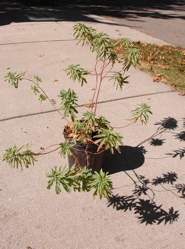
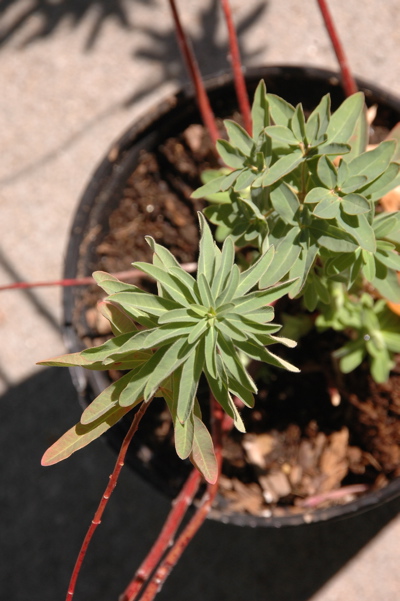
A couple of weeks ago, at Allandale Farm, where I go to feed what Jimmy calls my addiction, Mystery plant, unadornedI bought this plant. It was one of a kind, nestled among other pots of other sun perennials, and unmarked. I asked the guy out back, “What’s this?” He didn’t know. I asked the guy out front, “What’s this?” He didn’t know. I bought it anyway. I felt drawn to it, especially its red branches, and knew I had to have it. It’s not lush or an obvious showstopper, and it sort of reminds me of Charlie Brown’s Christmas tree: twiggy, droopy, and left behind. I’ve been trying to figure out what it is, and, as I’ve been fruitlessly researching plant images, the jingle from the commercial from the board game I played over and over and over again as a young girl keeps looping through my head. I’ve substituted one word. It goes like this, and I sing it to myself: “Mystery plant… Are you ready for your mystery plant? Mystery plant… Are you ready for your mystery plant?”

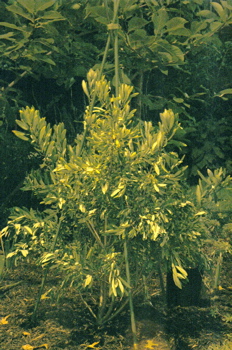
Mystery plant, leaf patternNot sure, I’m starting to suspect it might be a daphne cultivar. The leaf pattern — click on thumbnail at left for a close-up — is similar to others I’ve seen, including the ailing daphne in my own yard, but it doesn’t have the necessary full foliage. If you have a clue or an answer, let me know.

Photographs by Eli. Video via YouTube.

– Before and after

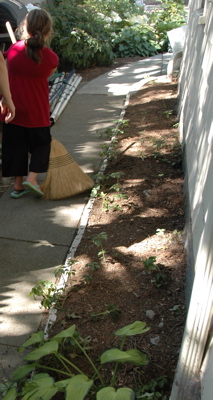
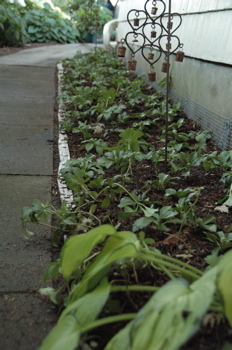
For anyone who is interested in the results of my propagating 100 pachysandra cuttings from my parents’ yard into mine, this post gives an update on the health of the transplants and, at the end, shows how I did it.

The “before” patchThis is also a before-and-after story and an occasion for me to remark on my uneasiness with sudden and dramatic transformations, which this is not. I recognize that, as a culture, we want big and positive change: the new fabulous job that will turn those daily doldrums and interpersonal irritations into personal zest and suitable comrades; the surgery or exercise that will turn my everyday outer self into a “10” (oh, yes, I’ve had those fantasies of ten-ness); the design and construction project that will help a house be all it can be (bigger, better, beautiful). This is prevalent — just type “before and after” into the Google search box and see what you come up with.

A couple of summers ago, driving to Crane’s Beach with my friend Betsy, she asked me what I would do if I won a million dollars. I asked her permission to reframe the question, setting $50,ooo as the limit, because I couldn’t wrap my mind around so much possibility — such an immensity seemed a pressure, an obligation, a weight. She laughed; she agreed; and we played the game. On my list, I put a beautiful coat, well-made shoes, a charitable gift, and a personal chef for a year. Later, I played the game with the kids, and they put items on their lists like “couch for my room,” “video game console,” and “elevator in our house.”

As Jimmy pointed out, as the kids and I were itemizing, any one or two or three ofThe “after” patch, with bells those wishes are ones we could actually afford now. He was right, and I realized — from Betsy’s laughter, from his comment — that the kind of changes that are either most interesting or tolerable to me are incremental ones. Indeed, I’ve become happier with my living room after getting a chair reupholstered from a busy, whimsical print to a green, textured chenille. Work is better on the day I tidy up my office and have a conversation with an eager student. My old clothes look snappier when I’m wearing a new sweater. This kind of change, which is probably most common in most of our lives, isn’t the stuff of dreams or the stuff that sells. Who would pay the initiation and monthly fees to a gym that promised only that working out would help you feel moderately better? Does anyone lie in bed at night fantasizing about updating the sleeve lengths on all their jackets and sweaters? More significantly, are any of such changes representable?

I confess: even though I am capable of ho-hum-to-fabulous fantasies, it’s the small changes in my life, wardrobe, house, hairstyle, garden, career, cafeteria that sustain me.

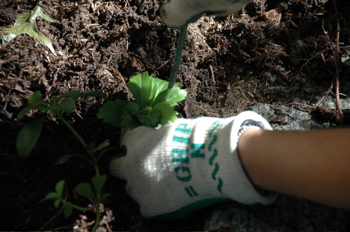
If you would like to follow how I made this incremental change in my side yard, as illustrated in the above Before and After images, please… Continue reading

– Necessary flaws

Bird party on September 19th

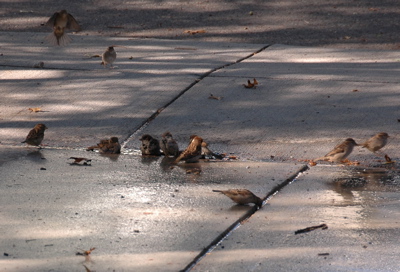
This afternoon I set up the sprinkler, turned it on, and forgot about it. An hour later, Grace pulled me to the window, pointed to the end of the driveway, and said, “I think the birds think it’s a birdbath.” Indeed, there were several little ones, touching down and splashing in the inch or two of water that had accumulated in the seam where our driveway meets the sidewalk.

A few years ago we replaced the cracked and heaving driveway that seemed original to the house (1930s). The paving contractor jackhammered, cleared, and carefully graded a new footprint before pouring a truckload of cement onto a bed of compressed sand and gravel. Jack, the owner, who was on the job constantly, promised a pristine surface, free of the mud- and ice-collecting potholes and cracks that characterized our old driveway. And when it dried, it looked good. And then it rained, and we noticed that “perfection” came with a few flaws, noticeably some shallow dishes in the driveway that collected a skim of water when it rained. We debated calling the contractor back and demanding a touch-up.

I don’t remember why, but we let it go. Today I was reminded of how cosmetic flaws can turn into features, ones that capture run-off from the lawn, bathe birds, delight a child, and, in turn, give me something to think about.

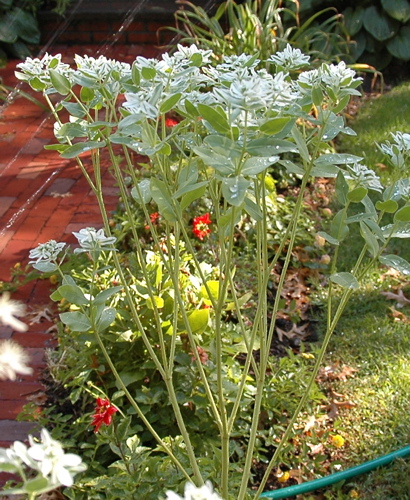
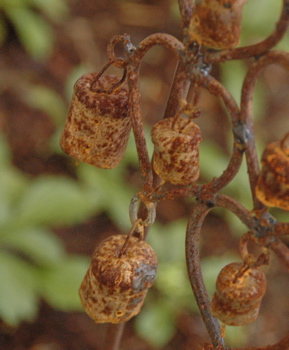
KilimanjaroAnd furthermore, the birds have done a lot of work in our yard, scattering seeds and berries all over the place, causing some annuals — like Euphorbia marginata Kilimanjaro — to come back, unexpectedly and in surprising places, year after year. The birds deserve their afternoon refreshment.

– Nell and a shovel

Nell and big shovel

This is Nell. She sent me this picture today, calling it “My Summer Job.” Until I wrote her a follow-up — “tell me more” — and got her answer, it seemed totally valid to me that Nell, as handy with power tools as she is with organizational consulting, would have a summer job operating construction equipment. Her whole family (mother, father, two brothers) is like that; they make, fix, solve, initiate, teach, and oversee. I met Nell through her mother, my friend “Jane G,” as I think of her. She and I — the two Janes — worked together, along with Nell, at The Albert Einstein Institution, an organization studying and promoting nonviolent actions run by visionary strategist Gene Sharp, in the late 1980s. Nell’s e-mail reminded me of two things I believe: (1) people who are in charge should be the people who know how to do the job, not just manage it; and (2) more people should know about Gene’s work in civilian-based defense and learn about the role of noncooperation and nonviolent strategies in diffusing or ending conflicts.

***

Note: Nell’s summer job was not in construction. Her family recently replaced the septic tank at their lake house.

– Awake at night

I read somewhere once that Freud had a name for it, Mutterschlafen, the light, alert sleep that mothers experience when their children are young and they wake often, needing comfort or milk. Grace has been getting up every night, around 2am, for a couple of weeks now. Possibly it’s allergies or back-to-school anxiety. Usually, she comes to me, and I get up and get her back in bed and sit there for a while until she sleeps again. Then I go back to my own bed and lie there, awake, for hours. Jimmy, sympathetic to my days of interrupted sleep, recently said to Grace, “When you wake in the night, come to my side of the bed, not Mom’s.” She replied, “But Mom is always awake, and you’re not.”

Saturday night, or Sunday morning really, this happened on schedule. I got Grace a tissue for her nose, tucked her in, and tried to go back to sleep. My mind wandered outside to the front yard, where in the day we had dug up some crowded plants, expanded the planting bed, and gave the transplants a wider berth and space to breathe and grow. One shrub we moved — a daphne — we moved against most good gardening advice. Daphne, murkyDaphne doesn’t like to be moved; she’s particular, and she doesn’t like fertilizer or much water either. And, yet, she’s lovely and smells good in the spring and has a graceful, curving upright form. You can only see that form, however, if she’s not crowded by a forsythia, baptisia, and ornamental cranberry. She was happy in her spot; I wanted to put her on the garden stage. Jimmy did the grunt work, digging around the root ball at the drip line and digging down as much. I advised him to use a spade to pry her out; when the job was on the verge of done, I looked over and saw him grab the daphne by the sturdy, narrow trunk and yank her from the dirt. Ouch. Was I mad? No… not that. The feeling was closer to forlorn. I had already decided that when you get someone to help you, you have to give them room to help in his own way, solving problems as he encountered them. Plus, the daphne branches and leaves looked vigorous, and there were plenty of orangey roots. We dug a new spot for her closer to front walk — a starring role for a beautiful specimen — and shoveled dirt back in. I investigated the hole she left behind to see what I could put in her place, and I saw something that made my heart sink: three severed roots, each the diameter of a human aorta, sticking out of the dirt, snapped, useless, separate. Hours later, in my sleeplessness, I replayed all the gardening hours in my head: Where was the mistake? The initial decision itself? My laissez-faire attitude towards oversight? My absorption in my own tasks? Awake anyway, I thought of Daphne, alone at the curb, possibly wilting. I imagined creeping downstairs, putting on my shoes that seem always to be at the front door, and going outside to, at least, monitor her, although there was no action I could take, other than waiting to see how the damage would affect her. I did not go outside. Crazy thoughts are okay; crazy behavior is not.

With the daphne on my mind, I got back to sleep, using a breathing exercise that Lydia taught me. Inhale, then count on the exhale. Breathe in, “one.” Breathe in, “two.” Breathe in, “three.” Breathe in, “four.” My heart slowed down. All day yesterday, Jimmy and I kept checking on her, looking for signs of what, we don’t know. The daphne’s leaves droop; that may be a sign of damage, or simply a sign of fall.Eli dance

***

Thank you, Eli, my night photographer. The pictures are dreams.