– Natatorium

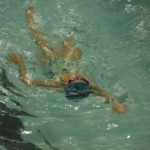
At the pool where Grace swims, and where she learned to swim, I keep being mystified by the inscription that’s visible from the water and the gallery.

Three teaching obligations

“A parent is obligated to teach a child Torah, a trade and how to swim. Talmud, Kiddushin 29a.”

The first time I read it, years ago, I chuckled. What an unexpected combination: the Torah and “how to swim” in the same sentence? I have stared at and thought about the words many times. Now accustomed to them, I try to imagine a history in which the group of three represented the bedrock of a life: scripture, livelihood, and refreshment (or survival?). I’m not sure about the third thing.

Entering the Jewish community center yesterday, Grace said she’s disappointed in one aspect of the swim team: “They’re not teaching us anything.” What do you want them to teach you? “The side stroke,” she answered. Because she doesn’t know the side stroke yet, I guess that by “teach” she means “to introduce to something new.” Perhaps the new is what’s noticeable to her.

As I, however, sat on the bleachers on the pool deck and watched Grace swim with 24 other children, I marveled at the skill of the coach. He structures the hour; he gives directions; he explains the strokes as he demonstrates the moves with his own body; he repeats what he just said; he responds to questions; he encourages the swimmers to keep moving, moving, moving; he gives on-the-spot feedback like “Kick from the hip, not the knee”; he keeps order; and he walks the perimeter, offering encouragement: “Grace, that’s a beautiful stroke. Keep going. Move. Finish on the wall. Everyone, finish on the wall.”

That’s teaching in action. (And isn’t it a pleasure to watch others teach?) The swimmers practice what they know, become more deliberate, deepen their knowledge, and persist, lap after lap.

As I write this, I wonder, suddenly, if the third thing — “how to swim” — has to do with the teaching of the body. Teaching the Torah seems to be an intellectual and spiritual task. Teaching a trade has something to do with the practical. And learning how to swim is about conducting the self, the physical one, buoyantly and alone.
First arm upFour limbs in waterArm up, again

– Sitting still

This drought is hard on living things with shallow root systems. For weeks I’ve been moving the sprinkler around the yard, trying to hit each spot every few days. Around 8 o’clock the other night, I was standing in my driveway, watching the oscillating streams that were illuminated by the street light. On the other side of Puddingstone Road, Steff emerged with her children from the lit foyer, saw me in the mostly dark, and asked in a friendly way if I was watching my grass grow. “Yes… yes, I am.” A simple answer, yet not quite right.

Plant & brick detail, wet

Often in the summer I sit on the front steps, looking at the current state of affairs in the yard: subtle undulation of brick, mix of blooms and leaves, shadow and light on the lawn. Sometimes I look across to the temple, and I check out the greenness of the grass or the alertness of the annuals or the bend in the trunk of the tall white birch, which Dick tends while Rufus, his bulldog, keeps him company. In an hour, creatures might shift a bit, puddles may appear, but nothing much changes — nothing more than this, anyway:

A haiku by Shiki (Japanese. 1867-1902):

The sparrow hops
Along the verandah,
With wet feet.

Our front door, unless we’re asleep, is always open to the storm door, so we can look out. This morning, Grace perched herself on the front steps: Grace, sitting still for a changenot feeling well, sitting quietly. That’s my summer spot. Today I sat inside, on the stairs that go up, and looked out at her looking out. I thought of how a moment freezes when we watch our children, still, like this. Eli told me once that he’s noticed me stand in a doorway and watch the girls, who go to bed earlier than he does, as they lie there. “You like to watch us sleep, right, Mom?” All parents do: It’s the only time, kids, that you stop moving, and that Time stops, going neither forward into your future or looking back over its shoulder at your earlier selves. It stops. I study you, in the absolute present. This is not time expanding, as it does when a person becomes absorbed in the activity of writing or gardening or making music or love. That kind of flow has movement in it, even if the movement makes the experiencer lose consciousness of self and time. What I’m talking about here is Time… pausing. Time bare of verbs.

One by Issa (Japanese. 1763-1827):

How lovely,
Through the torn paper window
The Milky Way.

I was not, then, watching the grass grow two nights ago. More like me, grass, water, dark, warm air, streetlights, and still.

Grace and Jane on front steps—–

Photographs of Grace alone and Grace & Jane by Eli.
Haiku from
Haiku (Everyman’s Library, 2003).

– Awake at night

I read somewhere once that Freud had a name for it, Mutterschlafen, the light, alert sleep that mothers experience when their children are young and they wake often, needing comfort or milk. Grace has been getting up every night, around 2am, for a couple of weeks now. Possibly it’s allergies or back-to-school anxiety. Usually, she comes to me, and I get up and get her back in bed and sit there for a while until she sleeps again. Then I go back to my own bed and lie there, awake, for hours. Jimmy, sympathetic to my days of interrupted sleep, recently said to Grace, “When you wake in the night, come to my side of the bed, not Mom’s.” She replied, “But Mom is always awake, and you’re not.”

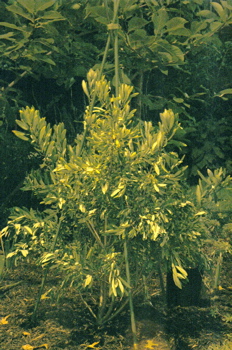
Saturday night, or Sunday morning really, this happened on schedule. I got Grace a tissue for her nose, tucked her in, and tried to go back to sleep. My mind wandered outside to the front yard, where in the day we had dug up some crowded plants, expanded the planting bed, and gave the transplants a wider berth and space to breathe and grow. One shrub we moved — a daphne — we moved against most good gardening advice. Daphne, murkyDaphne doesn’t like to be moved; she’s particular, and she doesn’t like fertilizer or much water either. And, yet, she’s lovely and smells good in the spring and has a graceful, curving upright form. You can only see that form, however, if she’s not crowded by a forsythia, baptisia, and ornamental cranberry. She was happy in her spot; I wanted to put her on the garden stage. Jimmy did the grunt work, digging around the root ball at the drip line and digging down as much. I advised him to use a spade to pry her out; when the job was on the verge of done, I looked over and saw him grab the daphne by the sturdy, narrow trunk and yank her from the dirt. Ouch. Was I mad? No… not that. The feeling was closer to forlorn. I had already decided that when you get someone to help you, you have to give them room to help in his own way, solving problems as he encountered them. Plus, the daphne branches and leaves looked vigorous, and there were plenty of orangey roots. We dug a new spot for her closer to front walk — a starring role for a beautiful specimen — and shoveled dirt back in. I investigated the hole she left behind to see what I could put in her place, and I saw something that made my heart sink: three severed roots, each the diameter of a human aorta, sticking out of the dirt, snapped, useless, separate. Hours later, in my sleeplessness, I replayed all the gardening hours in my head: Where was the mistake? The initial decision itself? My laissez-faire attitude towards oversight? My absorption in my own tasks? Awake anyway, I thought of Daphne, alone at the curb, possibly wilting. I imagined creeping downstairs, putting on my shoes that seem always to be at the front door, and going outside to, at least, monitor her, although there was no action I could take, other than waiting to see how the damage would affect her. I did not go outside. Crazy thoughts are okay; crazy behavior is not.

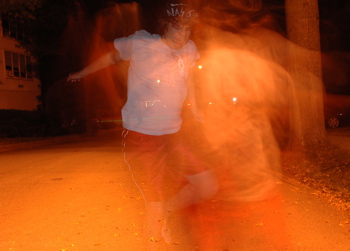
With the daphne on my mind, I got back to sleep, using a breathing exercise that Lydia taught me. Inhale, then count on the exhale. Breathe in, “one.” Breathe in, “two.” Breathe in, “three.” Breathe in, “four.” My heart slowed down. All day yesterday, Jimmy and I kept checking on her, looking for signs of what, we don’t know. The daphne’s leaves droop; that may be a sign of damage, or simply a sign of fall.Eli dance

***

Thank you, Eli, my night photographer. The pictures are dreams.

– What it takes to unmake

On Sunday, I bought dirt, four heavy bags of it. Dirt(Why are dirt and mulch packed wet inside their bags, turning 10 pounds of organic matter into 40 pounds? Seeing that there is no “life” to dirt or mulch — in fact, that it is dead and decomposing matter is kind of the point — the moisture seems a frill, a cosmetic enhancement of sorts.) Wanting to be my own woman, and not appear to be flirting with the outdoorsy, interestingly-tattoed guy at Allandale, I rejected his offer of help with the dirt. As soon as I got the first sack of it perched on my shoulder to carry it across the gravel parking lot to my car, I regretted my unproductive pride. It hurts to be my age and carry that much dirt. Four times. When I reached home, I tiptoed into Bob & Mary’s fenced yard and borrowed a child’s play wagon to cart it from the driveway around to the back.

Last week I offered Eli and his pal Arthur $50 each, plus lunch from Domino’s, to take down our old, metal swingset. Shortly after we bought and installed it, in 1999, the company went out of business. So, over the years, as parts broke, we just removed them, leaving an empty space where, e.g., the gondola once was. In June, one of the young guys who cuts our lawn was chasing his coworker around on a power mower and crashed into the swingset, permanently crimping one of the support legs. Although I pleasantly brought this infraction to the attention of the landscape company owner, it felt pushy to demand redress, seeing that Jimmy and I had known for a while anyway that the swingset was on its last leg and that we would have to dismantle it soon.

While adults are gearing up for fall and back-to-school tasks, children are at loose ends: Camp has ended, family vacation has been endured, and hanging around has lost its June flavor. This, to me, is a perfect time for chores, and only recently did it occur to me that my children are old enough to tackle big ones, Eli puts his back into it.the kinds you might think of hiring someone for: painting, digging, purging, and heavy lifting.
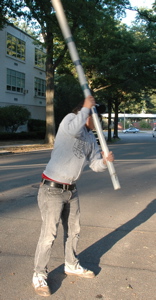
It took two fourteen-year-old boys — the Demolition Department — two days to take down the swingset. On day one they dug the legs out of the ground and disconnected them from the anchors, and on day two they unbolted all the pieces. They worked unsupervised, figuring out the tools and the problems as they went. A hammer and a couple of wrenches were all they needed until the end, when rusted-together sections of the main horizontal crossbar resisted their muscle power. I brought out a hacksaw, and then a power saw. Thirty minutes of application yielded only some shallow grooves in the metal. They put their heads together, ignored common sense, and took turns standing the 12 foot pipe on its end and then letting it go so that it would crash against an old maple. This loosened the rust, but not enough. When last I looked, Eli and Arthur were standing in the road, with the pipe on its end, getting read to let it go onto the pavement. “Boys,” I thought, and left them to their own devices. It worked.
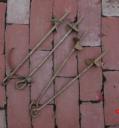
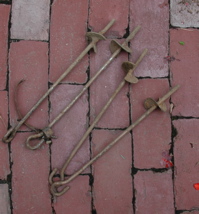
Four anchorsMy bargain with them did not require them to dig up the swing anchors and patch the holes. That task fell to me, but it’s the kind of thing I like to do anyway. The first of the four anchors was a struggle, because I was still working out my removal method: digging around it, cutting tree roots, prying out stones, and shimmying it while unscrewing. Only in extracting all four from the ground did I become confident in how safe they make a swingset. There really was no way the back-and-forth of a swinger would ever have gathered enough force to jerk them out of the ground. And now they’re out, unmoored and, like old teeth, their usefulness used up, so we’ll throw them out.

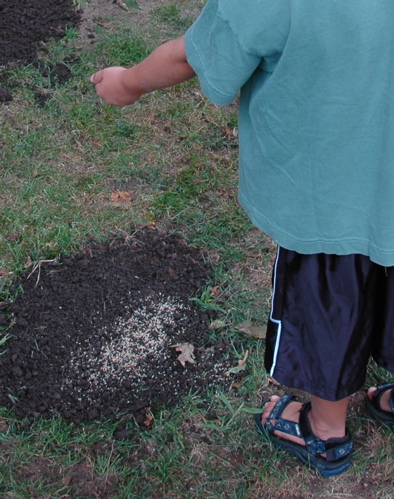
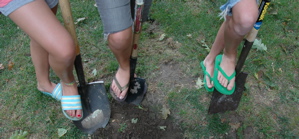
The Girl Squad — Lydia, Mary, and Carolina — were talked into spading up the dirt in the packed down ruts as I harvested all the loose stones and put them into a little rain ditch I’m making under a downspout. Girl SquadThey went on to bigger and better things (surfing videos on Youtube) while I emptied and spread the dirt. Another helper, five-year-old George, joined me just when it was time to spread some grass seed, and I showed him how to sprinkle the seed and then spray with water. I asked George how long he thinks it’ll take before the grass seed sprouts; he paused, and answered seriously, “About seven days.”
Helper and circleRight now there are seven neat, dark circles of dirt and a newly open space in the backyard. Many hours of effort of seven human beings went into undoing a structure that took two men (Jimmy and my father) a whole day to construct. There were costs as well: $120 labor ($50 x 2 teenagers + 20% tip); $21.85 (Domino’s pizza order + $3 tip); and $25.96 ($6.69 x 4 bags dirt). Total: $167.81.

And these are how our late summer days go.

– Back story: essay on parenting

A few days after I met her, at my friend Pam’s 60th birthday party, I got an e-mail from Amy, who, with her husband, Marc, runs Equally Shared Parenting, a website that offers encouragement to and shares resources with parents who “have made (or wish to make) a conscious decision to share equally in the raising of their children, household chores, breadwinning, and time for recreation.” At the party, Jimmy and I had talked to Amy and Marc about our travails in this sphere.In her e-mail, Amy wrote “We enjoyed talking with you, and remember that you felt you were just about equal in the raising of your children,” and invited us to write an essay for their site.

I accepted.

And then I fretted for a day or two. Could I portray our life with children honestly, showing our ongoing yet imperfect attempts to share the work and the rewards, and still fit into the model that Amy and Marc’s project promotes?

I kept returning to that phrase “just about equal” from the e-mail invitation. That became a kind of mantra as I was writing. Those are three truthful words that describe both the shortcomings and the achievements of Jimmy and me as parents. And, even though I shaped the piece around one particular aspect of parenting, the emotional one, those three words — given to me, really, by the editor — motivated my work on the draft and revisions.

ESP published “Family Dance Party” in July.