Restored riches

We were sitting in the living room. Upstairs Eli whooped, and a few seconds later he burst out, “Hey, I found my wallet!”

“Hooray!” we answered, having all been waiting for this moment. A few days earlier, Eli had lost his wallet, and the search for it had been a running narrative in our house: the calls to the places he had visited, the rummaging under the seats of the cars, and the repeated question: “Could you have left it in [x place]?”

He thumped down the stairs, pants on and shirt off. Apparently the wallet was in his t-shirt drawer, which he rarely looks in because his laundered clothes seem to stay in the same basket they travel to his room in.

“I’m so relieved. I knew it was at home somewhere!”

His energy and lightness reminded me of a Kay Ryan poem I coincidentally had read the night before, called “Relief,” and I told him about it and what it made me recognize.

Relief

by Kay Ryan

We know it is close
to something lofty.
Simply getting over being sick
or finding lost property
has in it the leap,
the purge, the quick humility
of witnessing a birth–
how love seeps up
and retakes the earth.
There is a dreamy wading feeling to your walk
inside the current
of restored riches,
clocks set back,
disasters averted.

Still dreamy over his found wallet, Eli said, “Yes. Just last week my friends and I were talking about relief, and how it is the best feeling.” He smiled, and his voice emphasized best. I thought about how relief and happiness, like anger and sadness, might be twin emotions.

A few days later, Jimmy and I went outdoors to pick up all the branches and trash that the disappearing snow has revealed one layer at a time. In our yard we found Dunkin Donuts cups, an ice cream container, scraps of vinyl from the new crosswalk that was scraped up by the plow, a pack of breath mints (empty), snack bar wrappers, and a small-size pizza box. None of these items seemed to originate from our trash. Perhaps our Starbucks cups, strawberry boxes, water bottles, Diet Coke caps, and gum wrappers were found in other yards.

I raked away the leaves from the daisies and euphorbia, which, I observed, are getting their start, and chopped at the islands of snow still holding down branches of the weigela, ilex, and euonymous. Branches freed, the bushes immediately straightened up, not trained by this winter into hunched back-ness, as I had feared.

As I continued to rake around the yard, here and there I saw shoots of crocuses needling their way up. The worry inside me — that winter has been too cold, the snow too deep for the November-planted bulbs to survive and do what they do — flipped instantly, as easy as a coin toss but with the same held breath. They made it!

The way I do the things I do

On drafts, I prefer to handwrite my margin comments and type my summary comments. Writing by hand is (a) faster for me and (b) friendlier for the author, leaving traces of a reader. I have neat handwriting, and I don’t savage a page with my own scribbles, so this works well.

a glossary of sorts

Many of my comments are particular to the content: “These are your objectives, but what problem with this protein — a research one — is at the heart of what you plan to do?” Then there are the moves I make over and over in everyone’s draft, pointing out some aspects of style that could be improved, and I want to leave the responsibility for alteration or correction to the author. They are, quite simply, the ones shown here, and I define them on some spare scrap at the beginning of the hard copy of a draft.

Sure, I have a good vocabulary, feel for style (not just my own), and knowledge of grammar, and I could go the extra step and make all these changes. My hope, though, is that these marks will bring choices or errors to the attention of the author and that s/he will puzzle them out, alone or in a conversation with me.

There is nothing to write.

On the contrary, there is always something to write.

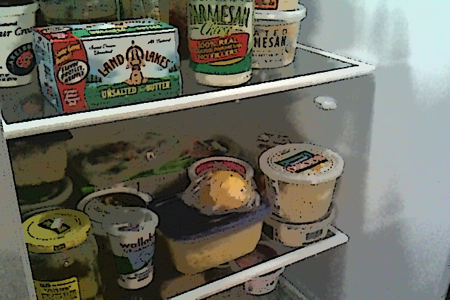
Occasionally a child or teenager will stand in front of the opened refrigerator door and, uh, meditate. With the right hand on the handle and feet planted on the floor, s/he will stand there, silent and contemplative. And finally, if I am sitting there at the table, s/he will say, “There is nothing to eat.” (Full disclosure: I too, as a child, was guilty of perpetrating this on my mother.)

cartoon fridge, this morning. lots of dairy, I just noticed.

“Have an apple,” I say.

No.

“Fry an egg.”

I don’t want an egg.

“Leftover soup. Cheese and crackers. Celery and peanut butter. A sandwich.”

No, no, no, and no.

“Well, you must not be that hungry,” I conclude.

S/he will say, before stomping out of the room: There is never anything to eat in this house!

It seems to me that people who write, either because they want to or because they have to, will occasionally stand in front of the open-doored refrigerators that are their minds and be disappointed that a delectable cake, already sliced and plated, is not sitting there on the middle shelf waiting for them to grab and eat it. Instead, they have to choose a few ingredients and assemble them into something they might want to eat. Often, they turn away.

To that, I say, “Don’t just stand there with the door open!” Instead, do this. Continue reading

The world is strange again.

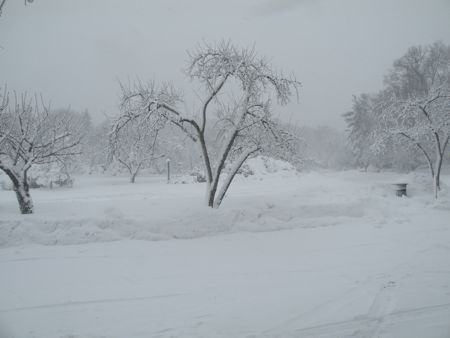
On the morning of the snowstorm, I am awake at the usual time. There’s no rush to get going. Still, I turn on the coffee and check “what happened overnight on the Internets,” as Jimmy would joke.

From my father, I read a gang email to all five of his children, exhorting us to clean off our cars before the temperature drops below freezing. His message may affect each of my siblings differently, but me, I feel watched over in a good way.

I put on my gear and go outside. Jimmy shovels; I clear the cars properly, even their roofs, and then I shovel around them.

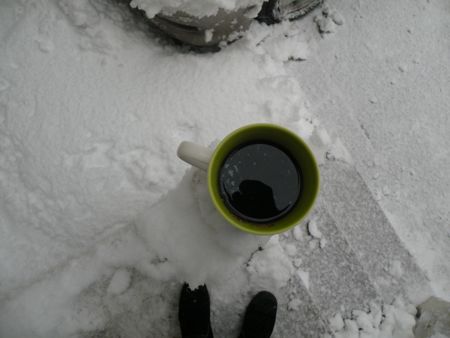
Any mug can be a travel mug, depending on where you're going.

Snow removal from the cars, driveway, and sidewalk takes about 90 minutes. We jam the shovels in a snowbank — it’s great snow for igloo-making, why don’t we make one? — and walk over to the shops at Putterham Circle. Only two are open: the convenience store and Starbucks. While there are no cars in the rotary that feeds the shopping center, inside Starbucks it is steamy with people.

For once, no cars in Putterham Circle.

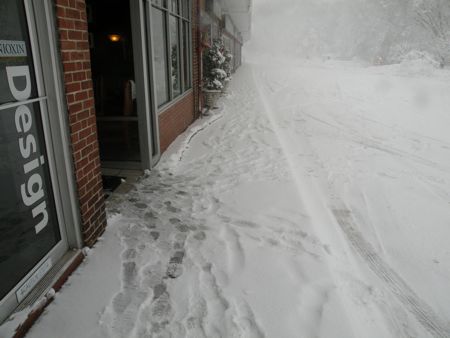
All footprints lead to the coffee source.

Then we walk, lattes in hand. It’s easy to shuffle across the intersection and down South Street. We walk and walk and pass only a few neighbors, here and there, out shoveling or snow-blowing. Ogden Street has not yet been plowed, and on the snow’s surface are chestnuts, still in their pods, that have just fallen.

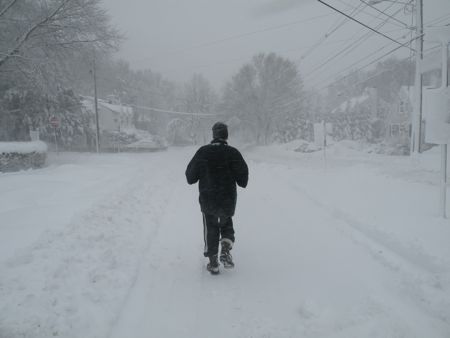
Jimmy walks blithely down the middle of South.

Now, this is still life.

We see these fresh wounds everywhere.

Near Bournewood, we throw our empty cups into a dumpster in a driveway.

As we walk through the hospital grounds, I say, “I think Anne Sexton stayed here. And perhaps Robert Lowell.” Jimmy asks, “And Sylvia Plath?” McLean, in Belmont. Continue reading

The Poet and the Helper

There is a difference between overhearing and eavesdropping.

Overhearing happens accidentally. You’re waiting for your daughter outside a dressing room in Urban Outfitters, and you hear two other teenagers comparing the merits of one pair of skinny jeans over the other. What they say flies like bits of paper through the air, bits you’ll never try to catch.

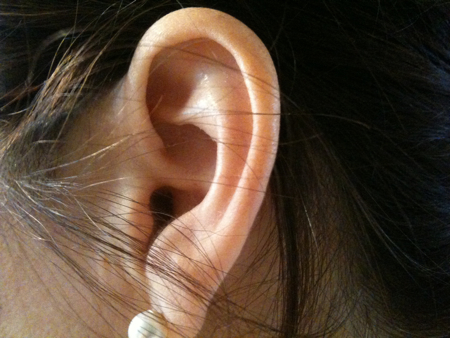
Jane's ear. 5.23.2010. by Grace maybe

Eavesdropping — what spies like me engage in — is deliberate. While I don’t go around eavesdropping on my children’s phone calls or my colleagues’ conversations with students, I feel that public conversations among people who are strangers to me are fair game. I’ll hear a snatch or two of something provocative and, without changing the expression on my face, begin to listen intently and for the record.

On a recent afternoon in a chain coffee shop in my town, for example, I sat down at the communal table. I like the idea of communal tables: it seems easier to sit alone at a table for 14 than it does at one for two. On this occasion, the place was mobbed.  People talked  to each other, and many were on their cell phones doing business. The high school kids who take over the place, doing homework and buying $5 drinks, were in full force.

To my left at the communal table was a young woman on the phone with a wedding planner, and her work email was opened on the laptop in front of her. Her boyfriend, sitting across from her with a laptop open in front of him, kept getting up and sitting down, waiting for their coffees. As I settled myself, they talked about something (him?) that was “demoralizing” her. He, leaning across their open laptops to close the gap, said he did not want her to be demoralized. Continue reading

Attractions of ordinary life

bed to make

Two nights before Christmas, Betsy and I sat at the bar at Legal’s in Chestnut Hill, having a quick drink and bowl of chowder before we went to see The Fighter. That now seems ages ago. For a while she and I talked about our attraction to cinematic portrayals of ordinary life: the food, routines, chores, and even squabbles of the everyday. B. also mentioned the fiction of Alice Munro; I thought of Charlotte Bronte, Jane Austen, Charles Dickens. And yet to say those works are only about the quotidian is to reduce them.

Because we never travel farther than New Jersey during the Christmas week — I’ve never spent my holiday in the Virgin Islands, Costa Rican rainforest, or Hawaii as some families do — and this time we haven’t traveled at all, the last week has been lush with the quotidian. Laundry. Tidying. Mail sorting. Reading. And cooking, especially cooking.

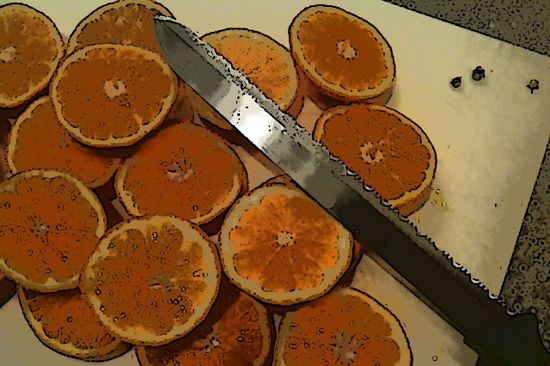
clementines to simmer and preserve

When the hands are busy, the mind is free. As I’ve chopped or made beds or run errands or wrapped gifts that I have since returned, sometimes with a clenched jaw, I’ve been thinking of the pressure on some of us to turn one’s own everyday life into an art form: concentrated, heightened, shareable. I both succumb to and participate in that.

As a child, my favorite bag lunch consisted of two hard-boiled eggs with salt, bread and butter, an apple, and cookies if possible. My own children want “something good” for lunch — and this may be a result of our having occasionally provided the show-stopping lunch — and it’s not enough, for example, to have an apple in a bag. The apple must be cored, peeled, and packed with sliced lemon. (Yes, I initiated that.)

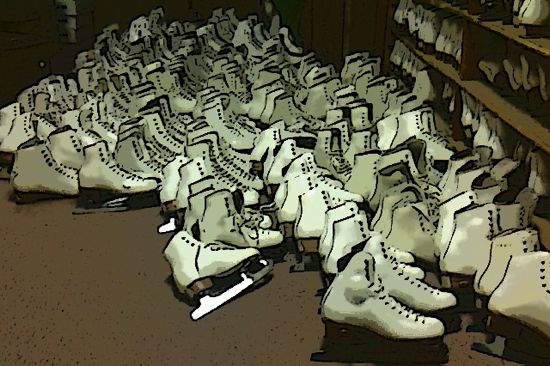
last year's skates to sell, in the back room at the Ice House

Incrementally over time, the bar has been raised for all of us with a stable income. We are surrounded with labor-saving devices — vacuum, dishwasher, clothes dryer, car — and we use them to make more labor possible.  This week, Grace and I drove out to the Ice House to upgrade her skates and get hers and mine sharpened, and then we drove miles back to the rink for skating. Sometimes I long for (or perhaps romanticize) the hours spent on the frozen swamp ice deep in the woods that surrounded my childhood neighborhood. In its surface were embalmed sticks and leaves and air bubbles, which made for a pebbled glide, and here and there boulders and rotted trunks made interesting obstacles that we could do nothing about but skate around or over. Dulled blades were not a concern.

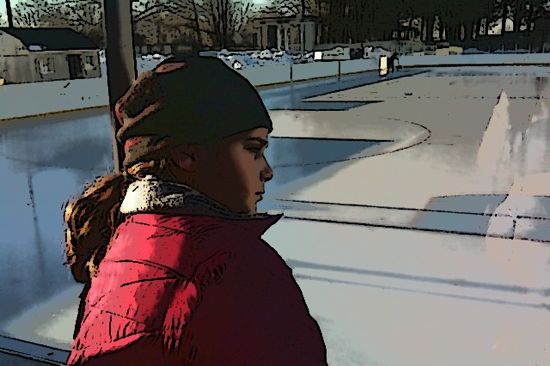
a fine girl to skate with

Once, seeing me crouching in the dirt in the front, my neighbor Gail, who never gardens but knows more the names of plants than I do, said to me, “You’re Martha Stewart.” I think this was a compliment, but I felt it as a stab. To convert everyday life to something that can be packaged, photographed, and sold is not my intention. If this is life, I want to make it into something, for me, yes, but also to share with others.

What causes the clenched jaw is when there is a collision between what I want to make and what others want me to make. Many nights, not very hungry, I’d be happy with a potato and fried egg for dinner. I am even often tempted to make a dish my father invented when we were kids and my mother went to night classes and he had to feed us, normally her job. It is the briefest recipe, not even deserving of a list or adjectives for that matter. Take a package of hot dogs, slice them into coins, saute them until crisp, stir in a jar of Prince or Ragu tomato sauce, and heat through. Boil water and cook a pound of spaghetti. Voila, dinner. My brothers and sisters could attest to how delicious this is, although not much to look at. Would my kids eat it? Maybe once, as a novelty.

Meanwhile, too, you know, much of the human population is malnourished, 40% of the world’s children do not go to secondary school, and the planet’s fossil fuel reserves are boiling down. And still here I am worrying about what I’ll plant in my backyard come spring, and also the expectations that both drive and thwart self-actualization.

to read, to drink

—–

Photographs taken on the iPhone using ToonCamera. Only $0.99.

Fear, girlfriend, and sequin tank top

Sometimes readers land on Leaf Stitch Word looking for answers. WordPress keeps track of the search strings that bring people to a particular blog, and I’ve noticed that what brings people to this one are sometimes in the form of questions. Here are 5 from the past month, with my authoritative replies.

1. What is the number one fear?

The idea of one’s own death or, if one is a parent, the idea of one’s child’s death has to be the number one fear. (It cannot be public speaking, even though a survey of 3,000 people in 1973 claimed so; one skeptical writer debunks that claim. Link.)

2. Who sings don’t you wish your girlfriend were hot like me?

The Pussycat Dolls

3. What is a sentence using the word natatorium?

Samuel, distraught over his mother’s death that winter, spent Sunday afternoons in the natatorium, swimming lap after lap after lap until his mind was as clean as an abandoned shell.

4. Can you get head lice from leaves?

No.

5. How old is too old to wear sequin tank tops? Continue reading

Twelve nouns of Christmas

First supper: father, son, and isomorph

1. Argument

Living room. Fire. I sit on the couch. The girls, opposite me, form the other two points in a triangle. One’s on her Kindle, the other on her  iTouch. I hold open my little notebook, stopped, and say, “Help me think of some nouns particular to our Christmas.”

Lydia: Nouns?

Jane: Yeah, I’m writing something called the Twelve Nouns of Christmas.

Lydia: No. Do adjectives. Twelve adjectives.

Jane: But I’m a nouns person.

Lydia rolls her eyes.

It’s my blog, and I win.

2. Coffee

On Saturday, when we get to Sally’s, Brian calls for coffee, and I second his request. “It’s either that or a nap,” he says, and we can’t exactly nap because we’re at our sister’s house, and it’s Christmas. I tell Brian that I run on coffee and, indeed, my blood volume is 25% coffee. Lydia, who sits between us on the couch and has her head on my shoulder, harrumphs. “Lydia,” I scold her, “Coffee is the source of my optimism.” My brother laughs, which is like a gift, me not normally being the funny one.

3. Data

Michael, during Christmas Eve at my house, describes his work and the many ways he has his finger on the pulse of the web. He starts rolling up his shirt sleeve to show us what will be a surprise to everyone but me. “Is that the GoWearFit?” I ask. “A work friend wears one.” There are two factions in the room: some thinks this is overkill, and some are intrigued. Michael describes its usefulness. For example, it logs how much he sleeps. “Wait a minute,” says Jimmy. “Don’t you know how much you sleep?” Michael answers, “No. You really don’t know how much you’re sleeping until you wear it.” Everyone laughs because Michael is the funny one and because, in this instance, he is so utterly serious, such an advocate of taking a census of his own body. Perhaps this is the way the wired world is heading, and this makes us uneasy so we laugh it away. Continue reading