– Proust, you can have your madeleine.

Our friends were away on vacation, and Lydia was in charge of the cat and fish. She promised to daily feed and water the cat and clean its litter and occasionally to drop a few beads of food into the fish bowl.

One night I helped, and on another night — the last night of cat duty, in fact — I handled it myself. I followed Lydia’s instructions: pat and scratch Storm; refill dry food dish and replace water; scrape 1/3 can of wet food into wet food dish; play with Storm for a few minutes (mouse on string); sift solid masses out of litter cave and discard; wash hands. Easily done. (Interestingly, the cat seemed both to want and not want my company. Is that typical of cats?) Feed fish and otherwise ignore. Also easily done.

I tried once again to play with Storm, by dangling a strip of fabric near his nose. He walked away.

As I sat on the ottoman, not unhappily rejected, I noticed the dried kibble on the floor around the cat dish. I saw an electric carpet sweeper. I thought, “Who would want to come home to a messy cat?” With the sweeper I sucked up the scattered bits. Then I remembered the litter cave in the other room.

In the other room, I turned on the sweeper again and ran it over the floor and edge of the nearby rug. Satisfyingly, the grit whirred into the plastic, tick tick ticking like sand against a window pane. Bent over like that, vacuuming, suddenly time collapsed 30 years, and I was bent over, vacuuming like that, in a neighbor’s house I then cleaned weekly, for money. I experienced again the pleasure of being in someone else’s house when they’re not home, of leaning into the rhythm of a task, of restoring order, of hearing grit fly into plastic. Of the electric hum, and air.

This is still me, I thought. The vacuumer, the order-restorer, not in a hurry and at peace in someone else’s empty home.
– One way to pass time

This is what Grace said, in sequential increments, after I gently asked her to stop reading over my shoulder:

I am just going to lie down on the couch…

and use my mind…

to keep busy…

and make objects move…

and race across the room…

and watch them.

And so I watched eight-year-old Grace, and that indeed is what she seemed to be doing. As she lay on the couch, her head swiveled as though tracking something, and her eyebrows occasionally tented in surprise. Her lips moved, ghost talking.

– Page length

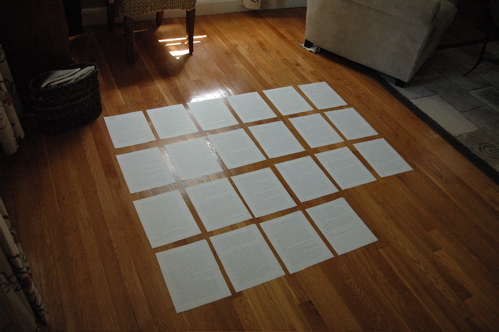
pages500A recent post in Tomorrow’s Professor treats the forces converging on that often irritating but essentially benign student question: “How many pages?”  Here’s the lead:

He said, “How many pages does that paper have to be?”

She said, “As many as it takes to make your case.”

This exchange is pretty common, and annoying. The student is trying to set the boundaries of the assignment and is probably annoyed with the vague response he got from the instructor. The instructor wants the student to learn how to make a good argument, and is probably annoyed that the student seems to be focusing on quantity rather than quality. But there’s a motivational theory that might help each party understand the other.

Teachers, read the full post for insight into students’ impulses for this question, and your own motives for deflecting this question, if you do indeed deflect it. Continue reading

– I surrender.

whiteflag2An ultrasound technician called me “laid-back” yesterday. This seemed, at the moment, not unlike other things people have called me, like “calm” or “safe.”

I could turn this into a boast, I suppose, but I’m not here to write about compliments. It does seem interesting to write about what it feels like, to me, to be calm while under stress.

It feels like surrender.

And that is the short, true answer.

But that makes surrender sound easy. And it’s not. The kind of surrender I want to describe (my kind) — to stress, chaos, noise, demands, surprise, discomfort — takes energy. It’s not like falling onto a couch and flicking on the tv. Continue reading

– All facts

I am a slow eater. Or, perhaps I live with fast ones.

At dinner, I said to the kids, “Slow down, slow down.”

I added, “I just read that people who eat fast are two times more likely to be overweight than people who don’t.”

Lydia: “You read that? Where?”

Jane: “Yes. In my Diabetes Forecast.”

Lydia: “So, it’s a fact.”

Jane: “Yes, and don’t you like facts?”

Lydia: “I love facts. There should be a magazine called All Facts. People would love it.”

Jane: [thinking…] “I agree.”

Lydia: “Like almanacs. Have you ever read the Almanac? That’s all facts.”

She said this with a kind of relish, my fact-lover.

And I’m with her.

– Overused

Here are two words I hope NEVER to see or hear again. (This is what you might consider a hopeless hope.)

TIPPING POINT

Honestly, I don’t even know what that term conveys anymore.

And if I were Malcolm Gladwell, the author who popularized the term, I’d probably be tempted to hide under my bed, with my hands over my ears, and sing “La La La La La La La La La” every time I noticed or heard it in use.

But then I might be under my bed all the time, because that term is EVERYWHERE in the English-speaking culture.

Not because of me, though. Right?

– Eye of the family storm

In the fall of 2004, I participated in a faculty development workshop at Simmons College, where I then worked and taught, on the teaching of writing. There were about 15 of us, and it was led by Lowry Pei and it was great. We got together weekly, we talked about students (in general, not gossipy), we puzzled over how to teach academic writing, and we did some writing, too. Some of it was formal and academic; some of it was free.

I’ve been digging in my archives from that workshop, looking for material. Here’s an excerpt from a 30-minute freewrite I did at 7:30am on a Sunday in November, 2004.  Eli was 12; Lydia 8; and Grace 4.  As I wrote, I tried to let family interruptions become part of the writing, and so I documented them along with my train of thought. Eventually, the interruptions became the train.

Freewrite #6:

I often wait for the perfect conditions within which to write (quiet, long stretch of time, well rested) and those perfect conditions present themselves to me, or I’m able to make them happen not –

–interruption.  Lydia is doing some algebra problems, for fun, that I created for her.  She doesn’t get “2x = 24” – that “x” is unknown and that multiplication is implied.  She thought that “x” meant “double the number” and she came up with 4.  I explain.  She says, “so two times twelve?”  That’s right, because value for x in this instance is 12.

And I only get perfect conditions about two hours per week.  That’s not a lot of time in which to do much.  So, doing things on the fly has to work for me.  I’m attracted to the short form for this reason, or that’s what I want to believe.  Continue reading

– Day one: salute

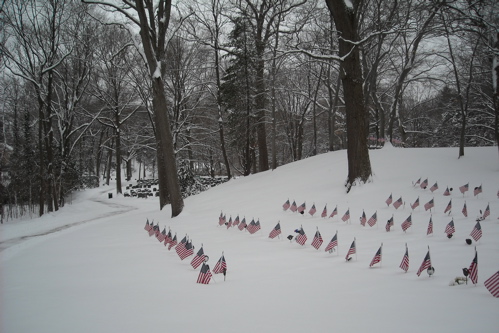
Walnut Hill Cemetery, January 2008.

Walnut Hill Cemetery, January 2008.

These flags, marking the plain graves of veterans in our local cemetery, seem to me to be like the first bulbs of spring, in a way, pushing through as winter hangs on. They remind us to persevere, and look ahead.

I know, I know, my metaphor does not work perfectly, and yet no metaphor does. Still, today I feel the pricklings of hope, as well as the determination of a New England gardener, to roll up my sleeves and make what I can of a new season. What we sow, we sow on old, ancient, and even dead ground, but, still, what grows there can be glorious.

Last night at dinner, the five of us, who watched the Inauguration in five separate locations, talked first about our reactions to the ceremony itself.  And then the talk moved, remarkably, to what we should work on, from the long list of pressing national tasks that clamor for doing.

That Obama’s ethos of work and service reached Jimmy and me, two adults with liberal and even leftist leanings, is no surprise. However, that his message has reached three children, too, is a sign of its power and his tenacity.

I got my shovel out. Gloves are on. Feeling strong. Ready.

– Right, right, right…

I’m of this guilty, too.

There’s this warped conversation filler that people — busy people — use to signal their attention to another speaker and urge that conversation along. I say it’s warped, because listeners are not supposed to supply conversation fillers; normally, the speaker gets to “like,” “um,” and “I mean,” and “ahhhh” her listener to death. A speaker uses a filler to give herself time to think and still hold the floor while she’s formulating the words for the rest of a thought.

However, there’s a new conversation filler in town: “Right, right, right, right…” Sometimes when I’m speaking — and quite clearly and steadily — my interlocutor, who’s supposed to be listening, will interject or, really, voice over my sentence with the rapidly repeated word “right.”

It goes like this:

Jane: I’m wondering if my tendency to wear a shoulder bag rather than a back pack —

Chiropractor: Right, right, right, right…

Jane: — is in part the cause of my impaired neck.

Many people do this, start talking over another person’s sentence. It’s possible that “Right, right, right” is supposed to convey that the “listener” is in sympatico with the speaker.

However, this is how it sounds to me.

Jane: I’m wondering if my tendency to wear a shoulder bag rather than a back pack —

Chiropractor: Hurry, hurry. I know this already! It’s my turn to talk.

Jane: — is in part the cause of my impaired neck.

Dear listeners, it’s okay to make eye contact occasionally, say “hmmm,” nod, and even wrinkle your brow at the person who is talking.  But the right, right, right, is — forgive me, I can’t help myself — wrong, wrong, wrong.

I’ve done it, too, and now I’ll be very careful and stop.

– Dear Ms. Morin

Jan Morin
Leicester High School (1979-1983)
Winslow Ave.
Leicester, MA 01524

Dear Ms. Morin,

My friend Rosemary, writing about her relationship to exercise over her lifetime, looks back on high school gym classes, where “being active meant being an athlete.” It made me think of high school gym class, and that made me think of you.

Ms. Morin, I was never a hardcore athlete and I liked gym class, and I liked it whistle1because you were a great gym teacher. I don’t know if I was aware of your greatness when I was in high school, or if this is only a realization I’ve had since becoming a writing teacher five years ago, but I always had fun in class and enjoyed talking to you. Teachers bring energy to their students, whether positive or negative, and yours was buoyant, humorous, and tough. I can still see your off-kilter smile; I remember your laugh, a whooping cackle.

Gym was one of those classes, as it is today, that was a requirement. We couldn’t get out of high school until we had taken so many P.E. hours.  That means that, unlike on sports teams, where everyone has volunteered to participate, all the students in gym were there to some degree against their own choosing.  Continue reading