– Images

I love the images in these two lines, from two different pieces:

All over the room, like boats softly tooting their horns in a harbor on a foggy night, men were weeping. (Nicholas Dawidoff, “The Man Who Wasn’t There,” New York Times, Sunday, June 15, 2008)

and

At times I was lonely, but it was a bearable loneliness, the way I imagined that a star, brilliant in a Milky Way of other stars, would be lonely. (Walter Dean Myers, “Poets and Plumbers,” What They Found, Wendy Lamb Books, 2007)

I tried to find more lovely sentences from my reading of the past week or so, enough to make a handful or a dozen, but these two kept pushing contenders aside.

The first is from a personal essay on his lost father, and other men without fathers, by a male author; he hears the weeping as he sits in a darkened movie theatre watching the last scene in Field of Dreams. The second represents a moment of self-reflection by Noee, the 17-year-old female protagonist in a short story, who feels distant from the boys and young men who try to attract her attention. Her father is dead, too.

The loneliness of the first-person narrators is made even more piercing, I think, by the beauty with which it is rendered by each writer. There’s something strangely comforting, too, in the idea of sadness shared, distantly, among other boats and other stars.

Is that ethical, to make sadness be beautiful? That’s a seduction. Should sadness be starker, plainer? It has one quality in art, and another in life.

Either, it is a feeling of force:

Sadness drives us to restore attachment and is from an evolutionary point of view an important adaptive emotion. The sadness caused by bereavement is the cost of having been attached, and it may also act as a social signal that is a plea for sympathy.

In these lines, who makes the plea: narrator, or author?  Does it matter? As a reader, I do feel as though someone in these words is reaching out to me.
– Rocks

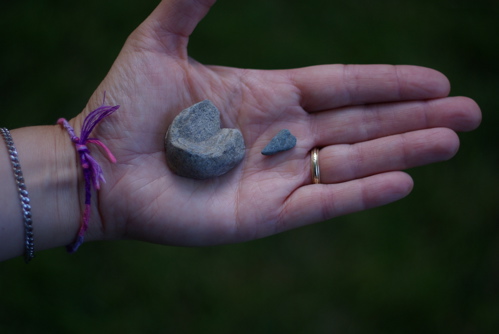
Grace came home with these the other day; she calls them heart rocks.

Heart rocks

Like me, she keeps her head down sometimes, looking for rocks. What, exactly, are we looking for in a rock? There are millions on the beach. Still, a few seem to call out to us: “Pick me, pick me!” We pick them. I look for color, and she, shape.

I live on a street named for the Massachusetts official rock, Roxbury puddingstone.

I grew up in a house across the street from a lot made unbuildable by the presence of a huge, rocky boulder. We called it The Big Rock. It was better than a playground. There were crevices in the rock to hide in, or pretend they were escalators. In neighborhood wars, one party or another claimed the rock. Daring kids, like Sally and Michael, did bike tricks around the rock and tree roots.

Surrounding our neighborhood, which was a figure-eight shaped development built in the early 1960s, was what we called The Woods. In it were acres of trees, streams, and swampy areas that made skating surfaces in the winter. There was The Old Lady who lived in a shack (really); she had a gun. There were stone walls that had tumbled down.

Sermons in Stone is one of my favorite nonfiction books. About the history of stone walls in New England, it’s riveting — history that moves a reader like a poem. I learned why there were so many stone walls in the woods of my childhood (those woods were once farmlands). I learned, too, the measure that makes a city block, and about the Ice Age and the force of glaciers.

In a writer’s workshop, another writer who read my work for the first time pointed out to me that there are a lot of stones in my work, actual and metaphorical. It was not a deliberate effect, and I had not noticed it. It’s funny what happens when someone observes something in your work: You start thinking, “That’s my thing.” And then you write more of it. And then you try not to, so as not to be obvious. And then you give up and go back to it, perhaps with more thoughtfulness.

___

Photograph by Eli, who has new work here. Friendship bracelet by Lydia.

– Opinions

As dinner ended, Lydia, Eli, and I discussed our summer trip. (Grace had wandered off to the television; Jimmy is at a dinner meeting.) Eli is impatient for us to nail down the date and destination. The children have opinions, which enrich but complicate the process.

Lydia (suddenly): I know! Let’s rent one of those coach buses for a few days. What do you think it would cost? It would be, like, a great family vacation. All the Kokernaks could go to New York for the weekend.

Eli (loudly): Lydia! That’s like communism — it sounds like a good idea, but it isn’t.

Back to the drawing board.

– Trees

This link takes you to a moving short piece on NPR by Julie Zickafoose, called “The First Cut Is the Deepest,” about her response when a neighbor decides to cut down a big, sheltering tulip tree that provides privacy between her land and his. My sister Emily, who wrote to me today about her idiosyncratic love of gravel (ok, Em) and who might consider starting a blog of her own, recommended this story to me a while ago. It’s surprising — you think you know how it’ll end, and then it doesn’t.

This picture is the view out the window that’s over the window seat and between two closets in our new bedroom. From anywhere in the room — standing near the door, sitting on the bed, hovering near the window — a person can see the beautiful, mature Japanese maple that our friend Rich estimates is older than the house.

Window seat, maple tree

Looking out, I feel like Heidi from the Johanna Spyri novel for children, which I recall loving as much as this blogger did. This is the same version I read as a child. It seems to me we owned this book, and that it wasn’t borrowed only once from the library, and I read parts of it over and over. Why was I so attracted to stories about orphaned or independent girls who lived in some sort of extreme circumstances that they eventually tamed or softened? (Other examples are Jane Eyre, Little Princess, Secret Garden, Mrs. Mike, the Little House series, all of Nancy Drew, and Tree Grows in Brooklyn.) Perhaps these are the girl versions of the same forces at work in Moby Dick, although, as I told Grace last night after she strangely asked me about the whale, the captain dies chasing his blank nemesis. Heidi, Jane, Laura, and all the rest — they live to tell about it.

– Rights

On a “Bill of Rights,” collaboratively written by elementary school students in our neighborhood afterschool program, I spotted this item, which is my favorite on the list:

We have a right to be helpful and be helped.

Imagine, the same person, child or adult, could be both helper and helpee. Maybe even on the same day. I like that.

– Number one fear?

For weeks, Grace has been preparing for her animal research project, which is the culmination of the second grade curriculum. Out in the garage, with the door open, she constructed over many days a diorama that featured the elephant seals’ habitat. In the basement, on the kids’ computer, she searched Google for “elephant seals” to find what she called “quick facts.” (They are carnivores and eat skates, small sharks, and other fish, by the way.) She talked about an upcoming “oral presentation,” yet the design and rehearsal of that happened entirely at school.

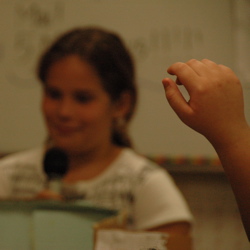
Raised handOn Friday, we went to school, sat in the back of the classroom, and watched Grace and her classmates, one by one, give their presentations. The room was arranged like an auditorium, with a table as podium at the front and the desk chairs arranged in rows. There was a microphone, into which each child spoke as s/he read aloud her prepared remarks. After the formal presentation, each speaker asked, “Any questions or comments?,” and then called on raised hands. Remarkably, what happened during the Q&A is what happens during the Q&A of presentations made by many adults: The speaker relaxed, smiled, and seemed more natural and engaged.

Children have less polish and guile than we do, so there’s something very raw about the behavioral “data” they present for our scrutiny. In this instance, the eight-year-old presenters gave me an opportunity to wonder this: Why does even a practiced, rehearsed professional speaker seem stiffer, less natural, than the same person during the Q&A?

I have always been skeptical of that claim that Americans fear public speaking more than any other fear, even fear of death. This source points to a 1973 survey by the Sunday Times of London that initiated that now wildly-held belief. Of 3,000 respondents, 41% listed public speaking as their number one fear. Hmm. About 1,200 Americans — many of whom might be dead by now — have got a lock on our fears. I, for one, do not fear public speaking over fear of death, or the death of anyone I love, or my fear of woodchippers. Let’s put this survey, and its outdated data, aside and actually examine this fear. Whether it ranks first or tenth, it’s still real. Continue reading

– Conservation

If you ever accidentally dump a bottle of water into your purse or bag, as I’ve absentmindedly done a few times and Grace unwittingly did yesterday, and a notebook gets drenched, take heart: It is possible to save your writing, if not the paper itself.

Grace, notes

Gently tear the wet pages away from the binding, and lay them on top of drinking straws on top of a textureless cloth or mat. Let them dry for a day. Transcribe the stories — Grace, anticipating the end of the school year, has one on “No Homework!” and another on “Weather this Summer!” — into another notebook or file.

– Devil inside

Every teacher has their “duh” moments, and probably at least one per semester. You say something to your class, and it’s immediately apparent by the looks on their faces that you’re so wrong, or uncouth, or just not with it. By being wrong or simply inexperienced, however, you sometimes learn the coolest things.

Like this semester, in my section of the writing component of an introductory genetics course (which was hard for me to teach, as a newcomer to MIT, and hard for the students to get), I had this brilliant idea to make, with the class, a glossary of sorts for the scientific report that each student was writing on a very similar set of experiments. I had noticed, as I was reading their drafts of the report’s introduction, that the student writers varied dramatically in their use of a technical vocabulary. So I stood near the white board, marker in hand, and asked them, “What are the terms and concepts you think you should cover in this report?”

It was a way of them teaching each other — and me, too — the material, and it worked. As I wrote on the board each term they offered, I asked the speaker to say something about the term, “polymerase,” for example. That student might say, “It’s an enzyme in DNA.” And then another student might add, “It’s what causes amplification.” And then I might ask, “What’s amplification?” And so on. Everyone took notes!, without prompting.

I had a question, too, about this one term that cropped up in almost every one of their drafts: “wild type.” Hmm, what’s this? I immediately associated it with other terms I know, like wild card, wild thing, and wild horses. Crazy, out of control, the outlier. I said, “Someone explain to me this term: wild type.”

There was silence. Smiles. Looks around the room. A few giggles.

“Uh, wild type is just basically the version of a gene as it occurs in nature,” explained one student. She was hesitant, not in her knowledge, but as a way to show tact. Another student added, “It’s a gene that’s not mutated.” This is, I gathered, common knowledge (although not, then, to me).

I laughed out loud at myself. Then they laughed. It was a “duh” moment, but it turned out to be a good one, too.

I remembered this today as I was driving home along a winding back road and occasionally checking my speedometer to make sure I was adhering to the limit. And then I was thinking of (a few) people I know who try to respect posted speed limits. And I broadened that category to people I know who honor common courtesies, follow procedures, recognize the importance of Scrabble rules, and so on. Sometimes it can feel like a burden to always remain within bounds. It’s a weird comfort, though, to realize that even though you may not be a wild thing, you’re always the wild type, through and through.

—–

P.S. Does anyone remember “Devil Inside” by INXS? I was a fan of that band in the 1980s, and Jimmy and I went to Great Woods to see them when I was in my mid-20s. Even then, I somehow felt too old to be in that crowd.

– What you remember

Sunday. The water was 52° F. today; the air was 68°. Grace, Elena, and Sarah went into the water the moment we got to Cold Storage Beach; my father stood there, knee-deep, for a few minutes and then dove in. Later, I went in all the way, as promised. I lasted about 10 seconds. Lydia and Karalyn had a swim after they came back from the jetty.

Last year’s Memorial Day weekend was also sunny and warm, “75-80 degrees,” according to my mother’s 2007 datebook. The 2006 holiday weekend was glorious, too, and we went swimming to get a jump on summer. Three times: I’d call that a tradition.

This morning before the beach, and then later at dinner, I surveyed my siblings, their spouses and friends, and my parents, “What do you remember about Memorial Day from when you were a child?” Flags. A commemoration at school. Cemetery visits. Going to the parade. Being a Girl Scout and walking in the parade. An annual get-together with family friends.

Those memories of Memorial Day are like mine. I also remember the first few lines of one of the few poems I ever had to memorize in school, and I recall reciting it, with my classmates, in the paved playground of Leicester Center School, when I was in 4th or 5th grade, during a ceremony in which the flag was unfolded from its formal triangle, then raised to the top of the flag pole, then lowered half-way.

In Flanders Fields (1915)

In Flanders fields the poppies blow
Between the crosses, row on row,
That mark our place; and in the sky
The larks, still bravely singing, fly
Scarce heard amid the guns below.

We are the Dead. Short days ago
We lived, felt dawn, saw sunset glow,
Loved, and were loved, and now we lie
In Flanders fields.

Take up our quarrel with the foe:
To you from failing hands we throw
The torch; be yours to hold it high.
If ye break faith with us who die
We shall not sleep, though poppies grow
In Flanders fields.

John McCrae

I do not remember learning about World War I in school around this time, but we did learn about poppy fields, and veterans’ cemeteries, and flags. We must have recited the poem in sing-songy, childish voices, caught up in the rhythm. I doubt we stopped in the middle of the first line of the second stanza, as a reader should. I read that line now, as an adult, for the first time in more than 30 years, and I wonder, how can you not stop after such a line, “We are the Dead.” That stanza is something, isn’t it?, with all the thudding “d” sounds, starting with that doubled one: dead.

It seemed beautiful to me then, as a child, that image of an endless field of orange poppy heads waving in the sun, a makeshift burial ground transformed. Somber and bright at once. I don’t think I thought of sleepless soldiers under the poppies, or who the speaker of the poem might be or, rather, had been.