Today, finally, it rained.
And I was reminded of my favorite Word.A.Day ever.
Today, finally, it rained.
And I was reminded of my favorite Word.A.Day ever.
Glancing at the CNN headlines this morning, I saw one — “Clinton Crushes Obama” — and experienced this instant, non-processed thought: Oh, what a turn of events! Hillary is falling for Barack’s charm, too.
Perhaps I have been spending too much time in the company of teens and pre-teens, and reading their magazines and FB wall posts, a world in which everyone is crushing (on) someone. A couple of weeks ago, too, some tutor colleagues and I were talking about the phenomenon of the ephemeral tutoring crush, which seems to flare and die in an hour.
Well, at least my impulsive mind finds a sentimental, rather than a violent, meaning for the verb “crush.”
P.S. Go, Hillary!
I look for and appreciate good signage, and I especially study signs on commercial vans, trucks, and cars.
This one turned my head today:
THIS OLD SPOUSE
Handyman
781-444-1###
Simple, clever, complete. Who are you, excellent sign writer?
Months ago, I asked a favor of Y., a student I have known for two years. She is a regular in the writing center, and she was in my composition class last spring. All teachers secretly root for and are attracted to certain kinds of students, and this is something you start to know about yourself, as a teacher, as semesters roll by. A colleague of mine, a steadily productive one, admitted to relishing her work with the “out there,” unpredictable students. And me? This student, Y., is of the kind I have my eye on: hard-working, quiet, smart without fanfare.
I asked Y. to translate for me the scroll that the Chinese father of X., another (former) student, made for me a few years ago, when X. was graduating from her Master’s program. The parents were visiting the United States for the first time, and the daughter asked her father, apparently a skilled calligrapher, to make a scroll each for a few teachers and bring them along as gifts; I was a lucky one. Although fluent in Mandarin, her native language, X. was as unable as I to read the scroll. She explained: “It’s traditional.”
Y., current student (and, yes, her name begins with the letter Y and the former student’s name begins with the letter X), took this on as a project. Once in a while, since I have asked her, she has popped in to the writing center to update me on her progress, to give me a clue or two about the meaning she was finding.
Yesterday she stopped by and asked to meet formally. Y. had heard it was my last day in the writing center, not just for the semester, but for always. We sat down together, and she translated, at length and with plenty of her own commentary on Chinese poetry, the scroll. In four lines, the poem is about what we might, in English, call melancholy. Set at the end of spring, a time of year that intensifies such feelings, it uses the imagery of the garden, grass, and water to evoke an older person’s recollections of “people who are missing” — people who have gone before, grown children who have moved away. “It’s metaphor,” said Y.
There was more for Y. to teach me. She gave me an envelope and said it was okay for me to open it. In her longish farewell note to me, written in careful English and careful Chinese, there were these four characters:
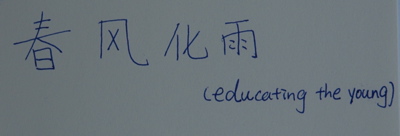
The four characters represent these words: SPRING ** WIND ** TRANSFORM ** RAIN
Y.’s note offered an English translation — “educating the young” is what a teacher does — but her longer commentary on the characters, which she spoke aloud and illustrated on scrap paper, was richer. Let’s see if I can do Y. justice. Here goes:
SPRING seems to be a time of year that suggests both beginnings and the end of beginnings. This is the moment in which a teacher meets her student. The teacher is WIND, which, by its gentle force, TRANSFORMS and disperses the RAIN, which is knowledge. By transforming the rain into droplets that are not too small and not too large, and by dispersing them to the grass (grass, which stands for students, is implied), a teacher teaches.
I am so taken by this, these qualities of teaching and knowledge being powerful and yet ephemeral. I like, too, how the teacher is unbundled from knowledge; there is wind and there is rain; and neither contains the other, although they mingle. Y. shared a new metaphor with me that seemed instantly right.
It’s mid spring in New England. I’m moving on and might never see Y. again, although I don’t know. To each other, we may become, over time, people who are missing. Not gone, not dead: missed.
First of all, this is just to say that the following poem is one by William Carlos Williams that I’ve never really liked. I knew in high school I was supposed to like it, for its straightforwardness maybe, its use of the word “delicious,” but I don’t think I ever did. I do like the sound of “icebox,” yet I don’t like the sound of the word “breakfast” (a stack of consonants and blends!), even though I do like to eat it.
Yet, the title, This Is Just to Say, has been speaking itself to weary me as I stand in front of the sink and look out on ladders in the back yard and see paint splashes in the sink or sit at the kitchen table and hear the builders thumping and singing upstairs, as if our house is their house. This is also just to say I want my house back.
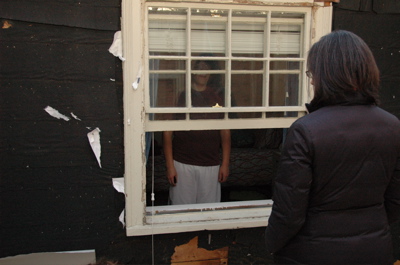
You can read the WCW poem and see if you like it. Then you can read my words crammed into his structure. I know white space is important in his work, but there is no space in my life right now and so no extra space between the lines of my attempt.
I have eaten
the plums
that were in
the icebox
*
and which
you were probably
saving
for breakfast
*
Forgive me
they were delicious
so sweet
and so cold
*
–William Carlos Williams
We have endured
the guys
who are in
our bedrooms
and whom
you were possibly
going
to hire
Pity us
they are industrious
yet such bulls
and so loud
–Jane Elizabeth Kokernak
—-
Picture taken by Jimmy on March 11, 2008.

A student in the college’s funeral service program brought into the Writing Center her paper on organ and tissue donation. Before I read it, I asked her about the assignment, and I also asked if there was anything in particular she’d like me to read for. The assignment, she told me, required her to cover all aspects of the subject — religious, legal, ethical, and technical — in about five pages. When I raised my eyebrows at this, she remarked, “Yeah, it’s a lot to cover in a short space.” And she asked me to read “to see if it’s all right.”
Her writing was all right: clear, grammatical, good paragraphing. As reader, though, I found myself most fascinated by the one or two page technical section, which described how enbalmers remove organs and tissues and then prepare bodies after that, and especially by a paragraph or two on the long bones: the ones in arms and legs (and later I found out, in fingers). Not only did I not have any previous knowledge that these could be donated and transplanted, I loved the sound of the phrase “the long bones.”
I thought of telling her how all the action in the paper was in my favorite section and presenting the possibility of revising around that section. I stopped myself. She didn’t ask me how to write an exciting paper; her feedback request was more practical. In the end, I gave her a compliment about how well she described the hands-on work of her intended profession, and I raised a few questions to get her to sharpen a couple of meandering paragraphs.
Later, on my own and with friend and colleague Jan Donley, I reflected on myself as a demanding reader. How does that affect the way I respond to student writing? To friends’ writing? I hope I have the self-restraint to allow their work to be about what it’s about for them. Do I only exhibit that, however, when the writer is a pretty good one? I fear that, with student writers I consider lesser, I step in and give stronger, more shaping (and possibly diverting) feedback.
As a hungry reader, I am foraging constantly for something good in everything I read, whether it be a bit or the whole thing. I can’t stop thinking of the long bones. The phrase has been ringing in my imaginative ears. I drive around from place to place, and look down at my legs, at the span of my arm from shoulder to wheel, at my fingers. The long bones, the long bones, the long bones.
—-
Drawing by Nadav. Found on Flickr.
Every night Dusty and Honey lie in their twin beds and talk before they fall asleep.
I didn’t write that sentence. I heard it today, in the middle of a broadcast essay by Hillary Frank on This American Life. The story is about two sisters in their 70’s who are not twins but who have lived their entire lives together, buying matching clothes, eating matching foods and snacks, and making a matching life. It’s called “Matching Outfits Not Included,” and you should listen to it. The author/producer gently raises with the sisters the urgent questions of selfhood that gnaw at many of us, and the sisters gently push back. Love, not the self, is their currency.
And I love the sentence. Hearing it, I instantly pictured the sisters, like old girls, in their beds on their backs with blankets up to their chins. I superimposed on their faces the faces of my grandmother and her older sister, Mae, who lived together in later life: bickering, sharing, knitting. As I wrote down the sentence on a pink Post-it note, a beat after it was spoken, I admired the author for saving it until the middle of the piece. It would have been easy to use it as a first sentence — what great names! — like a good pick-up line. But Frank holds onto it, until the moment after she establishes the sisters’ genuine intimacy. And then the sentence brings us, the audience, in closer.
Our house, which is currently undergoing dramatic structural changes, was built in 1938, according to our town’s property records. Nine years ago we bought and moved into it. We have learned much about it and previous owners since then.
At the closing, the lawyer for the bank remarked, as he studied the paperwork probably for the first time, “Oh, I know this house. It’s the bad luck house.” And he told us about financial reversals, domestics woes, and crimes committed in the house.
We learned more about the crimes, especially, a few months after we moved in, at a party that our new neighbors (and now friends), Rich and Julie Ross, threw. A woman was there who had, in high school, dated a boy in the family; she got caught up in an investigation as the local police and the FBI prepared to nab various family members for drug trafficking. They nabbed them.
When I dig in the yard and the shovel hits metal or unearths a buried strip of plastic, my first, impulsive thought is that I’ve come across a stash of money or a bundle of bones.
I haven’t, yet.
The garage walls are punctuated with covered cavities, and I wonder if little bags of cocaine were stored there.
I have found no supporting evidence.
Interior walls of the house were mirrored — beautifully and expensively, like a hotel lobby — when we moved in, and I wondered what was behind the mirrors.
It turns out (we’ve had them all removed, over time), nothing.
Once, as workers took out the old dishwasher and installed the new, we found a lost snapshot of a little girl and a fatherly man, standing together by a little swimming pool in the backyard. They looked happy. Carved into the paneled walls of the finished part of the basement are traces of people who have moved away: “Steve + Joan 70-71.”
Over the years of our ownership, there have been lots of repairs and cosmetic projects in our house on Puddingstone Road, but nothing major until now. Builders are ripping down walls and reframing them into other room configurations. A bathroom floor and tub have made their way into the dumpster; I see grayed, creaky boards where they once sat. Old ceiling plaster has been pried and brushed loose. Shreds of insulation drift down, like ghosts released.
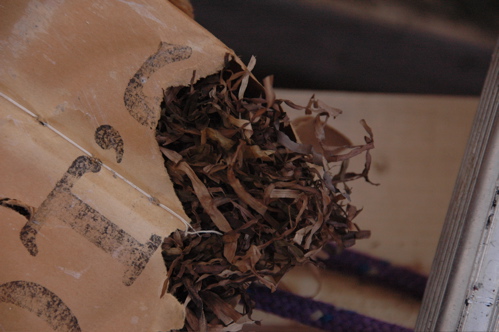
Here’s a picture of the insulation in the ceiling over what used to be Jimmy and my closet:
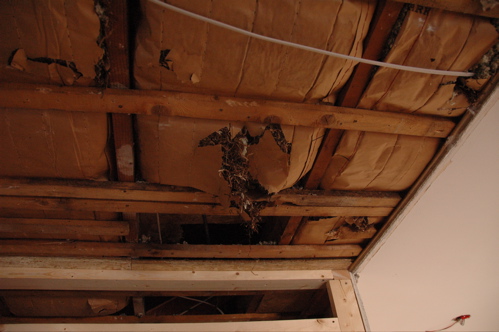
The stuffing, it turns out, is eelgrass, that profuse plant that washes up on ocean beaches all over the world. In 1893, Samuel Cabot, a chemist who graduated from MIT and Switzerland’s Zurich Polytechnicum, having learned that “early settlers had used eelgrass as a crude home insulation,” invented Cabot’s Quilt, clumps of the dried ocean plant stitched between brown paper. A six-inch layer of it is as effective as fiberglass, according to one source. There is a one-inch layer of it in our walls. Brrrr.
On the brown paper is stamped words: Samuel Cabot. Boston. One yard. Cabot’s. Those were the clues that helped me find the story (thank you, Google!) of this curious insulation, which went out of production in the 1940’s, although Samuel Cabot Inc. still exists.
When the foolish, unfiltered banker told us in 1999, at the signing of documents that made this house ours, that “bad luck” was associated with it, I retorted (politely), that it was up to us to “make it the good luck house.”
Although I think it is unfortunate that much of our house remains poorly and archaicly insulated, I am also pleased to discover that the walls around us are stuffed with a kind of leaf, stitched between paper that’s faintly printed with words.
Is that karma or what?
Sometimes a student enters the Writing Center in distress, having been told by a professor that his writing is so “unreadable” that the professor has not attempted, beyond the first paragraph, to read it.
These instances make me think again about the writer’s job, yet even more so about the reader’s. They each must try hard to reach the other. Writer, write hard. Reader, listen hard. Communication is a meeting in a middle place. Not a compromise, though. A meeting.
I like how Joseph M. Williams, the author of perhaps my favorite handbook on style, Style: Ten Lessons in Clarity and Grace 6e (Longman 2000), reflects on a writer’s role in this relationship:
We write and revise our earliest drafts to discover and express what we mean, but in the drafts thereafter, we write and revise to make it clear to our readers. At the heart of that process is a principle whose model you probably recall: Write for others as you would have others write for you. (220)
He says much more about the golden rule and a writer’s obligation, and I wholeheartedly recommend the chapter “Ethics of Prose.” In it, Williams also says this, about the golden rule and readers:
Some readers read less well than others, and some expect more from a writer than their meager investment of time and effort earns them. In fact, just as writers have an obligation to readers, so do we as readers have an obligation to writers: If we assume that writers work hard to say something important to us, we should read thoughtfully and generously, at least until we decide they have given us good reason to stop. (221-222)
Reading and listening — paying attention — to the words of another require generosity: a gift, a gesture. It takes effort to look beyond the lack of clarity in a student’s writing, but if we believe that they are making an attempt to say something important to us (it’s our assignment, after all!), then we should reciprocate. Williams calls such an exchange “fair” (222).
—
A penciled notation on the inside page reminds me that I paid $6.50 at Brookline Booksmith Annex for a used copy of Style. The latest edition, the 9th, is much more. Still, it’s worth it.

The Catalog Card Generator is fun to play with, and the card you make might lend some concreteness to any project that right now seems a wish.
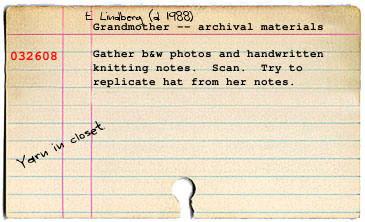
I want to knit a hat from some rather minimalist notes that my late grandmother wrote on the back of a birthday card, and which I recently rediscovered as I thumbed through a box of old knitting patterns and magazines she collected and I added to. And then I want to do something with that experience. (Oh, write about it maybe?) Wanting to do it, however, hasn’t gotten me any closer to actually doing it. I have the yarn and tools. What’s required is making that first move.
Well, I made this card, kind of like a “will do” note to myself. And now I’ve “put it out there in the universe,” as H., a woman I worked with many years ago, recommended that we do with our wishes and intentions.
 leaf stitch word