– Convergence

Last week we saw Ratatouille (Pixar 2007) for the first time. Remy is a French rat who loves fine food; his ambition to become a chef is stoked by imaginative visitations from the late Auguste Gusteau, a once-renowned restaurateur who wrote a book titled

Anyone Can Cook.

Yesterday I was sorting through a pile of non-urgent papers that I’ve been hiding, even from myself, in my top desk drawer at home. I came across a document, “NCTE Beliefs about the Teaching of Writing,” that a colleague asked me to read months ago. My eyes fell on the first belief, in bold type:

Everyone has the capacity to write.

These are beliefs. Like the jolly Gusteau, a person can choose to believe that each individual has the capacity to cook (not to become a great chef, but to cook). Like the Writing Study Group of the NCTE, a teacher can choose to believe that each student can write.

What if, however, a chef or a teacher held a similar belief, and yet also maintained an attitude inconsistent with that belief?

How many times have I heard someone grumble about students (especially incoming ones): “They can’t write”? I don’t think that a teacher, whose work is essentially optimistic, believes that college students do not have the capacity to write. What such a teacher is really saying is that her students’ writing does not meet her expectations, or college expectations, and she is daunted by that, and it brings her down. And yet, I wonder, what power does that attitude (“They can’t write”) have on one’s beliefs about one’s own students and, more so, one’s own teaching?

Once in a while I meet a new student in the Writing Center, and, as I read her writing for the first time, I see that it lacks so much in the way of clarity and sense that I do a quick, internal inventory for any teaching skills I might have to offer her as a writer and I come up almost empty. In such an instance, I do feel daunted — it’s like a stone in my chest — and I even set my sights low, not for the student but for the paper at hand. “Jane, just be an attentive audience. Give the student that.” So, I read and I get her to tell me about it. I don’t always understand her reply entirely, but I usually understand enough of it to have a conversation with her about her personal narrative, or reading of a novel, or thoughts about a historical event. I don’t correct or suggest. I listen, ask, nod, smile.

I have been tutoring S., who is such a writing-challenged student, for more than a year. She continues to make sentences that seem more spoken than written, and her grasp of American English idiom is based on what she hears, not what she reads. (For example, in a paper about a high school teacher, she described that person as being “inch arch” of a learning center. She and I figured out that the teacher was “in charge” of a learning center.) Encouragingly, I also see that her sentences are longer and more flowing and that her papers are more fully developed with detail and discussion. She sustains. And that’s a powerful sign of her growth as a writer, but it might be hard to recognize it if I were ticking off her many errors. And there are many; I do see them (and we are just beginning to work on some).

When another teacher, in genuine moments of fatigue or frustration, says to me, “My students can’t write,” I offer, gently, “They’ll get there.” I do not know what my tutee, S., will do in her writing, in school, and in her life beyond my time with her, but I do believe she will get there.
– Consider the sink

You spend a lot of time in front of it, so you think sometimes that the television or pc is the most important object in the house. And you wish it wasn’t.

Take comfort: You spend a lot of time, too, at the kitchen sink. It is more essential than the screen, and perhaps you even enjoy, like I do, your time in front of it.

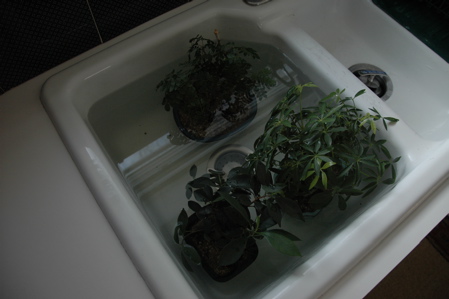
Beyond its usefulness as a trough in which to wash potatoes and dishes, the sink is a player in parts of your life that have nothing to do with food. If, for example, you are an indoor gardener like Jimmy, you give your bonsai their weekly soak in a sink.

Bonsai in sink on snowy day

Paintbrushes get clean there. Women bend themselves over the sink and wash their hair under the kitchen faucet; it’s something we start doing as teenagers and then keep returning to. During the morning rush, teeth get brushed and the last going-out-the-door glass of water gets drunk there.

Because you’re standing there so often, sometimes you kiss at the sink.

Babies have their first baths in stainless steel or white enamel tubs set into the waist-high countertop. Perhaps puppies do, too. When children are toddlers, and after they play in the backyard dirt with the hose, they get carried shoeless into the kitchen, plunked down at the sink, and have their feet and calves and shins washed of mud with the sprayer and by their mother’s soapy, slippery hands.

When children are older still and bring home head lice, they lay their long, sturdy bodies down on the counter and hang their head into the sink for what I call “the treatment.” Here’s an excerpt from an essay I wrote about the experience of nit-picking:

A prehistoric creature with a tough carapace and immense evolutionary stamina, the lice resist the drugstore poison that I massage through my son’s hair, and the next day through my daughters’ hair. Working in the kitchen, I bend their necks over the edge of the sink and rinse the white cream that smells like deodorant – both fresh and chemical – from their hair and their heads, holding the sprayer in one hand and supporting their skulls in the other. Trying to see, I lean over them and into them. My arm or breast through my t-shirt frequently brushes a shoulder, cheek, or, in the case of my son who is standing and not lying on the counter like the girls, a back. The gentle pressure makes us close and I wonder if they are aware of my body and the part that is touching them, as I am aware all the time when I am with them of their bodies and what their parts feel and smell like, how they have grown and lengthened. Their hair straightens and darkens in the stream from the faucet. The children are hypnotized. I wish the running water alone could rid them of parasites.

The window over the sink has, in many houses, the best view. If you’re tall enough to look out, you stand there often, for long periods of time, and stare at the steady trees and grass. You spot the neighbor’s gray cat, which is the exact color of a shadow but for its white feet and snout, and sometimes you see a rabbit shading itself under hosta leaves. And the squirrels, always the damn squirrels. In the winter, you watch a snowman’s creation, a snowball fight, the snow angel parade. There is no “world” out the kitchen window, and so the trance you find yourself in, standing in front of the sink, is local. At night, you try to look out and see only yourself reflected.

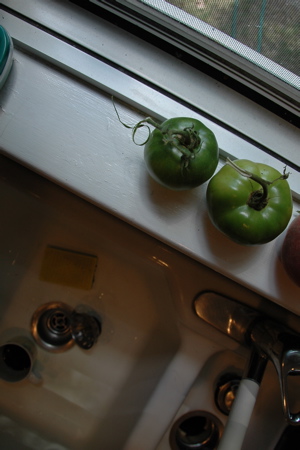
Tomatoes on window sillOn the sill, you keep the shampoo at hand. Someone emptied her pocket of a few rocks and pebbles, and now they belong. In late summer, the green tomatoes soak up the slant of sun. A wedding ring or watch visits occasionally. When the power goes out, you light a candle and place it on the ledge in front of the window and above the sink, for safety and a bit of illumination.

—-

Bonsai picture by me. Tomatoes on sill by Eli.

– Prompted by snow

The view of snow out of a second floor window into our backyard reminds me of other times, in other winters, I’ve stood at the same window and looked out on the same view. These linked memories seem to collapse time and heighten the present moment.

Snow out window, December 14

Yesterday I was the first adult home, and I dug out the driveway. This morning, I dug out a 600-word essay I wrote in mid-winter 2003 and tried to publish, in a local newspaper, in winter 2004. It seems fitting to publish it here today. Yes, it’s about snow, and something more.

—–

Snow Hunger

February 2003

This morning, snow again. The branches of the bare and mature Japanese maple outside the girls’ window is furred with snow, as if the snow had grown there. The lower-growing junipers in the back, planted like fence posts in a line by the neighbors on the border of their yard and ours, are top-heavy with snow, their heads bowed in awe of the maple.

I say out loud to Grace, “Oh, look at the beautiful snow!” Almost three and unstoppable, Grace jumps off the low bed she is dancing on, steps onto the blue stool at the window, and blurts, “Oh, I hungry for it.” Her instant desire, I know, may have more to do with getting the snow into her mouth than appreciating its beauty, but I am instantly touched by her word choice, so more deeply true than “I want to eat it.”

I love the snow and the cold. Especially the snow. Last winter there was none that accumulated, and in this house we wished daily for it, watching the sky out our kitchen window as if we could discern the signs of weather. We wished for freezing temperatures, too, a long string of sub-freezing days and nights.

In December last I bought a backyard skating rink kit, and Eli, Lydia, and I assembled it in the backyard on an afternoon cold enough for coats and gloves but not too cold that it would have been unwise to run the hose for several hours. The water started running into the 17 x 21 foot form in mid-afternoon, and even at 9 p.m. Jimmy and I were still checking the progress of the fill. Moon glow and a backyard light shimmered on the water, yet we could not see well and so had to put a finger in to check how far to the top edge of the frame the water had reached. By our bedtime it was full. We turned off the hose, disconnected and drained it, and coiled it away in the garage for the winter, its last watering task done.

A day here and a day there, temperatures dropped below freezing. Through January, February, and March 2002, however, there was no trio of days cold enough to freeze such a large quantity of water. Nevertheless I loved looking out at that still, shallow pool every morning as I filled the pot to make coffee. I noticed the stray leaf or two that had fluttered down and settled to the bottom, a dark rotting brown against the slippery vinyl white. Some mornings there was a crust of ice; leaves and broken twigs rested lightly on it. Those days gave us hope for even colder weather, for a giant puddle to blossom into a skating surface, for a frosted patch to fill with bright, whirling parkas and a flash of skate blade and the shrieks of the neighborhood children convening in our yard.

The hope for cold and ice — for extreme weather — was the only hope last winter. I also remember sitting on the wooden steps leading from our porch into the backyard a few months earlier, on September 11, 2001. It was a stunning and clear afternoon, and I remember peering at the blue sky, the Japanese maple leaves not yet ready to turn from dark green into their autumn flame, and these words bursting into my thoughts: “I will never be happy again.”

One season later my daily wish for a certain kind of atmospheric condition, and the ice it could bring, lifted me. Better it was, I think now, that a sustained freeze never arrived. There was so much potential in that silent, inexpertly made pool of water.
—–

Picture above, of the view from the window at 8 a.m. today, is by me. Picture below, of the tangle of tree branches seen through the same window, is by Lydia.

Snow on branches, December 14

– Future man of letters?

Scene: outside kindergarten wing today, 2 p.m.  Woman walking with a child who is not her own.

George: Jane, are you going to my brother’s Bar Mitzvah tomorrow? 

Jane: Yes.

George: Would you take notes for me?

Jane: Mmm, okay.  (pause)  Why?

George:  Because I want to tell my teacher all about it on Monday, and my mother is going to be too busy to remember everything.(pause)  So write down everything. And then give it to me. 

Oh, these articulate five-year-olds!  And, at the same time, how wonderful it is to be given an assignment. 

– Longer

Scene: Writing Center. Student and tutor looking together at a paper.

Student: Why did you circle this… and this?

Jane: In a few places you use long phrases, and I’ll bet you could find a way to say it more directly.

Student: Oh, I know. But I sometimes add more words on purpose, so it will make it longer. You know, so it seems like a paper.

Jane: Academic?

Student: Yeah. Teachers seem to like that.

Jane: Hmm.

– Garden for our times

Do you remember the walled, overgrown garden brought back to life by a boy and a girl in F. H. Burnett’s Secret Garden (1911)? The book was a favorite of my childhood, and perhaps the long, restorative story about gardening has something to do with my own attraction to shabby, abandoned patches, as if glory and possibility, like this, await in each one:

The seeds Dickon and Mary had planted grew as if fairies had tended them. Satiny poppies of all tints danced in the breeze by the score, gaily defying flowers which had lived in the garden for years and which it might be confessed seemed rather to wonder how such new people had got there. And the roses–the roses! Rising out of the grass, tangled round the sun-dial, wreathing the tree trunks and hanging from their branches, climbing up the walls and spreading over them with long garlands falling in cascades–they came alive day by day, hour by hour. Fair fresh leaves, and buds–and buds–tiny at first but swelling and working Magic until they burst and uncurled into cups of scent delicately spilling themselves over their brims and filling the garden air. (247)

Lovely, isn’t it? Fresh, new, full of playful life — not unlike an uncomplicated view of the child.

And here’s the garden for our times. It is tended by the 21-year-old Edmond who has been traumatized by witnessing the slaughter of a contemporary war started in England by “The Enemy,” and it appears at the end of Meg Rosoff’s How I live now (2004):

On the warm stone walls, climbing roses were just coming into bloom and great twisted branches of honeysuckle and clematis wrestled each other as they tumbled up and over the top of the wall. Against another wall were white apple blossoms on branches cut into sharp crucifixes and forced to lie flat against the stone. Below, the huge frilled lips of giant tulips in shades of white and cream nodded in their beds. They were almost finished now, spread open too far, splayed, exposing obscene black centers…

The air was suffocating, charged, the hungry plants sucking at the earth with their ferocious appetites. You could almost watch them grow, pressing fat green tongues up through the black earth. (181)

The passage is narrated by Daisy, Edmond’s American first cousin and former lover, also 21, who returns to him after a six-year absence because of the war, which spread beyond the British island to six continents. Like the Secret Garden, this novel, which Meg Rosoff reportedly began writing in the run-up to the war in Iraq, is aimed at a young audience. Rosoff doesn’t shy away from blood, terror, or torture: a man has his face blown off, some civilians are slaughtered and most are displaced from their homes, and children roam the woods and abandoned farms, hiding and fending for themselves. Parent figures are either absent or die off quickly.

How I live now, coverThere’s nothing pastoral about the England in How I live now. Yet this dystopic novel is not without hope. In the end, Daisy joins Edmond in tending his rage-filled garden, and the reader senses that somehow subverting anger into hungry, persistent life offers a way back to what has been in short supply: peace.

– Hanging drop

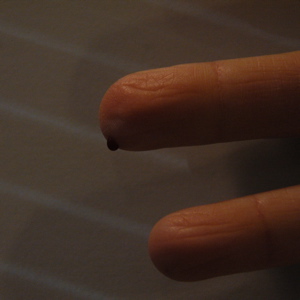
Until I looked at Laura Splan’s watercolors in blood, I hadn’t thought of my own blood as paint or ink. Yet, it is. Many times a day I prick my finger, squeeze a drop of blood from it, and touch the drop to a test strip inserted into a glucose meter. After I’m done with the procedure, my fingertip often keeps bleeding, even though I’ve stopped being aware of it. So, as I put my hand on the mail, or a page of my glucose record log, or the Times, my blood smears and makes it mark. On paper, blood is permanent.

Hanging drop of my blood

Before I drive or teach — two activities during which I don’t want my glucose level to drop precipitously — I check my blood sugar. Once without my noticing it I left a smudged arc across the front page of a student’s paper. As I handed it back to her in class, she noticed it, and she visibly recoiled. “Ach, what’s this?!” Oh, shit, I thought. “I’m sorry, that’s my blood. From my finger. I’m so sorry.” I knew her as a fragile person, intensely worried about her own symptoms. Damn, why couldn’t I have smudged my blood across the paper of one of the nursing students?

Clearly, the traces of my blood on paper are not intentional or artful. Still, Laura Splan’s work put me in mind of them, and I started wondering about what I could do with all those smears. At the same time, I’ve been reading this sparkling, ruminative book, I Am a Strange Loop by Douglas Hofstadter (Brian, you would like this), which has a long section on math theorums and proofs, and I’ve been thinking about how much I loved geometry and calculus in high school and college. But, I didn’t go down the math path when I could have, and that knowledge is rusty and faded.

I’m in a predicament. I can’t draw, but I want to use my blood as ink. And I can’t, really, do math, but I want to use math in some way.

Ah ha! (When I was on staff at Simmons College, I was in a cross-disciplinary workshop on teaching writing in which the participants shared a lot of cool assignments they give to students. Donna Beers, a math professor, would sometimes get her mathematics education students to write what she called a numerical autobiography. At the time, I tried writing mine, but it quickly bored me: age, weight, street addresses, telephone numbers, age of first period, age of first kiss, number of children, favorite number, et cetera. No focus, no shape.) New, better idea — I could attempt to compose a numerical memoir piece, based on my life with diabetes, and I might get Eli, one of our in-house artists, to collaborate and contribute photographs that illustrate measurable moments! (He agreed.)

I even have the draft of a beginning, which is something I cut from another piece I wrote. Its working title, which came to me as I was driving around thinking about this, refers to the many times in a day or week I have to puncture myself. I’d like it to catch the reader’s eye.

—-

Number of Pricks

For several days in the fourth week of February, 1992, I was in the hospital. I was 26 years old and eight weeks pregnant with my first child. I had learned, the morning of the day I was admitted to Brigham & Women’s, that my blood glucose was high, around 300, and that I had diabetes.

By the end of day one I started injecting myself. The nurse offered to do it, but I said, “I might as well start.” She demonstrated on an orange; I jabbed the syringe filled with insulin into the flesh at the back of my arm and plunged. Mechanically, it is not difficult.

That night, lying awake in my hospital bed, I estimated my life expectancy – I chose 76 because it was 50 years beyond my then age and 50 is an easy integer to work with — and I multiplied four injections per day by 365 days by 50 years.

Here’s the equation. Solve for X.

4 x 365 x 50 = X

My thoughts were so scattered that I couldn’t do the simple math in my head. The next day I called my father, the math teacher, who advised against calculations: Do one thing, he said, and then do the next. Don’t count beyond today, or backwards, just take the next injection. Sometimes that trite “one day at a time” advice works; what he said helped.

More than 15 years and 20,000 injections have passed since that first day. And although I have come to take the long view when it comes to diabetes and follow a regimen that I hope will get me to old age with my feet, eyes, gums, and kidneys intact, it is what I do and don’t do during any one day — the increments of insulin dosing, carbohydrate counting, blood glucose checking, aerobic exercising, and portion measuring — that adds up to a life with Type 1 diabetes.

[end of excerpt, beginning of experiment]

—–

Picture of my November 14th fingertips by Eli Guterman

– Tutor as tailor

My writing center colleague, Jane Hirschhorn, published her article, ESL and LD Students: Diverse Populations, Common Concerns,” in the fall issue of Praxis. Grounding her discussion in research and personal experience, Jane describes writing challenges shared by diverse students, and she offers tutoring strategies, with examples, that effectively serve them.

Her key metaphor, incidentally, is tutor as tailor, which reminds the reader that tutoring involves the art of seeing and serving each person uniquely.

– For your eyes only

Pink locking diaryBound diaries and journals have not always been secured by a padlock or hidden between the boxspring and mattress. Thoreau and his Transcendentalist friends, in fact, often wrote them with the knowledge that they would be read, whether in their lifetimes or posthumously.

According to an article in the local Brookline TAB this week (11.1.07), which announces the publication of a new compilation of Thoreau’s journal entries called I to Myself (YUP 2007),

Keeping a journal to share with friends was a far more common activity for people of all educational levels in Thoreau’s era than today. “Back then almost everyone kept a journal, even farmers and definitely educated people,” says [Jeffrey S.] Cramer. People shared their journals. When Thoreau writes in his journal, you feel like he’s talking to you. In his journals he’s definitely writing to a reader.”

Verification for this remark appears in the chapter “Thoreau in His Journal” in the Cambridge Companion to Henry David Thoreau (CUP 1995). Yes, the Transcendentalists were devoted journal keepers who wrote, often, for each other. So were other Concord residents — clergy, teachers, naturalists, businessmen, lawyers, housewives, unmarried women, students, farmers (109) — writing in and keeping journals. About his own massive journals, which were circulated so often they became a kind of “lending library,” Bronson Alcott, the father of Louisa May, wrote that the collection:

…gathers up the fragments, and preserves in transcript, whatever there may be for future value & use, so that nothing of life shall be wantonly contemned or irretrievably lost…. The history of one human mind… would be a treasure of inconceivably more value to the world than all the systems which philosophers have built concerning the mind up to this day. (111)

I ask you, fellow bloggers, are we not participating in a grand tradition? Like our 18th and 19th century forebears, today’s electronic journals are also built on timeless topics — among more contemporary ones like restaurants, sex, movies, and baseball — such as these mentioned in the Cambridge Companion:

• domestic operations;
• reading records;
• travel narratives;
• business;
• notes on changes of seasons or weather;
• medical observations;
• flora and fauna;
• introspective registers;
• private histories;
• political or other social and institutional goings-on; and
• of course, combinations of several, perhaps many, of these. (108-109)

And none under lock and key.

—-

Image of pink diary from Smythson of Bond Street catalog.

– Master/Novice

Since writing the “Wide eyed” post on novices, I’ve been seeing references to newness everywhere.  (Is my unconscious attention looking for them?)

Shirin Neshat, a “visual artist who works primarily in video,” has produced a body of work — Passage (2001), for example — that has garnered prizes and earned permanent placement in the collections of the Guggenheim, the Whitney, and the British Museum (Collins 86).  Although such a project has risks, she’s at work on her first film-length project, an adaptation of a novel by Iranian writer Shahmush Parsipur.  Neshat tells interviewer Lauren Collins that she felt “compelled to make Women Without Men“:

“It got to a point that it was a biennial here, a biennial there,” she said… “I started to get really tired of it. I needed a project that would let me be alone, let me be a beginner again.  I wanted to hide from the art world.  There was a danger that I would lose persepective–the integrity, honesty, and naïveté being washed away.” She pounded her fist against her palm to illustrate a wave eroding the shore. (90)

Historian and cultural critic Jacques Barzun is about to turn 100.  His former student, Arthur Krystal, “first encountered” Barzun in 1970, when Krystal was 22 and a graduate student at Columbia where Barzun, then 62, was University Professor of History; in spite of many differences, the two “hit if off” (Krystal 100).  Remarking on Barzun’s reputation and many accomplishments, Krystal points out a quality in his now friend that differentiates his work, and his stance, from others’:

Barzun regards himself in many respects as an “amateur” (the Latin root, amator, means “lover”), someone who takes genuine pleasure in what he learns about.  More than any other historian of the past four generations, Barzun has stood for the seemingly contradictory ideas of scholarly rigor and unaffected enthusiasm. (94)

I see that my friend and colleague Jan Donley, a writer and teacher, has altered the title of her website’s page on teaching to call it “Learning.”  One of my favorite running conversations with Jan has been on the seeming contradiction of being inside and outside an experience at once.  We’ve talked, for example, about being present in a classroom moment while stepping outside it, so that one can deeply participate and get some perspective, simultaneously.  A kind of duality.  It’s hard, requiring a person to let go and remain steady at the same time.  Now I’m mulling over Jan’s suggestion that, to be a teacher (and a writer), one must be a learner, too.

Which reminds me of a conversation I had last Easter with my father, Stephen Kokernak, about students.  (He was a teacher, a more than good one, of high school math for almost four decades.)  I was venting to him and my sister Sally about how some of my freshman students were not stepping up to the plate: not doing the reading, not bringing the book or homework to class.  My father commiserated as a teacher, and also talked about his own habits in college.  Then he said (something like this): “You know, I think it wasn’t until I became teacher that I finally figured out how to be a student, when I had to learn how to learn.”

To be a master and a novice at once seems key for being a teacher, writer, filmmaker.  Does the inverse work?  To be a student — a learner — must there be opportunities for teaching?

—-

Sources:
Collins, Lauren.  “Voice of the Veil” (Shirin Neshat).  New Yorker, Oct. 22, 2007.  86-92.
Krystal, Arthur.  “Age of Reason” (Jacques Barzun).  New Yorker, Oct. 22, 2007. 94-103.