– This one goes to eleven.

At the end of the spring ’07 semester, my friend and colleague Lowry Pei and I were catching up and talking about some habits that should be basics for writing teachers. The next day Lowry suggested, by e-mail, that we generate a list. We opened a new Google document and became more purposeful. Our motivating idea was to (in LP’s words) “make the statements as direct and concrete as possible, make the list fit on (let’s say) a 3×5 card, hand it out: instant faculty development.” Soon, what started as a conversation became a deliberate collaboration; by the end of August, we had winnowed down and finished our compilation, and published it, simply, as a handout for faculty workshops.

And then we worked on it some more. Just a few days ago, to a broader audience, Tomorrow’s Professor published an expanded version of “11 Things You Could Start Doing Today for the Benefit of Your Students’ Writing.” May it be useful to you, if you teach.

– Games teachers play

Items to keep in your school bag:

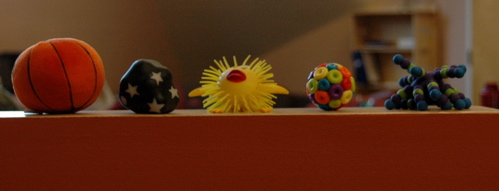
Five toys on ledge

Not by nature a maker of fun, I do like to have fun, and I believe that others need it, too. Do you notice, for example, in a classroom, if the teacher is not providing any chuckles, a student in class will start performing that function? Intuitively, we all know, even if we resist the knowledge, that the Class Clown is essential. Just as every group could use a leader or two, every group could use a fun-maker.

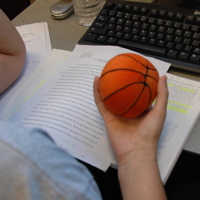
Even a serious teacher like me can design some fun. Props help. A few weeks ago, seeing that my September and October calendars were filled with appointments for visiting classrooms on campus and giving students my brisk “Come to the Writing Center” speech, I bought five toys. Diversely, they squish, boing, and bounce.

I bring them into the room and put them on the desk. Boing!I introduce myself in 15 words or less, and then I ask the students to think for 30 seconds on this question: “What makes writing so hard?” I add: “Every answer is the right answer.” I wait. And then I hold up the first ball and I give my brief instructions: “I’ll throw this to one of you. When you catch it, say your first name, and then tell us what you find so hard about writing.” I toss, a student catches, and the ball makes a surprising, mechanical “boing” sound. He laughs. The group laughs. The catcher answers: “I’m Paul. And getting my ideas down is hard for me.” Yes, I say, that’s challenging, for all writers in fact.

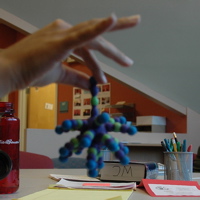
I give another stage direction: “Paul, throw that ball to one of your classmates. It’s someone else’s turn to tell us her first name and what’s hard about writing.” The next person answers. Squish spiderAfter that I introduce a new toy, and then another — they’re getting the hang of it now — and learn a few more things about what makes writing hard for students: “grammar,” “finding the right word,” “thesis” (over and over), “getting the length right,” and “starting.” Within a few minutes, all five toys are in play, and the students seem to have figured out the drill, and they’re looking at each other, waiting for a turn, aiming if they’re throwing, and talking to me and each other. The game, furthermore, is giving me material; I’m not a lecturer, and I get most of my energy from the questions and thoughts that students bring to or make in class. In this case, their responses give me an entrée to a conversation about how 1:1 tutorials in a writing center support students at all stages of the writing process and for any writing challenge.

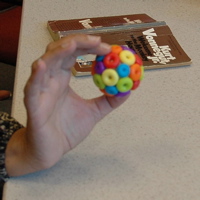
Fruit loop superballIt’s fun with a purpose, I know. In order to teach, a teacher must build some sort of bridge — or, at least, toss a fruit loop superball — between herself and students.

—-

Thanks to Joanne Manos and Kristen Daisy, in the Writing Center that afternoon, for their willingness to “lend a hand” to these pictures of the toys.

– Summer fades

For season-watchers, thoughtful gardeners, and poetry readers, here is an excerpt from Louise Glück’s poem “October,” from her collection Averno (FSG 2006).

4.

The light has changed;
middle C is tuned darker now.
And the songs of morning sound over-rehearsed.

This is the light of autumn, not the light of spring.
The light of autumn: you will not be spared.

The songs have changed; the unspeakable
has entered them.

This is the light of autumn, not the light that says
I am reborn.

Glück’s precision and steady hand remind me that there may be allure in what is plain. Even if it unsettles you. Especially if.

– Potatoes, and other prompts

I like the concreteness of things. Focusing on them while writing also frees me from my vague and persistent thoughts. Put an old key, a knife, an unfamiliar picture, or brooch in front of me, and I feel interest in at least describing the item. That inevitably leads to a connection with my own experience and, sometimes, a new question.

In her handbook, Writing Alone and with Others, which is filled with attractive writing New potatoesexercises, Pat Schneider offers many examples of using objects as “triggers” in her workshops for writers. Sometimes, she places a covered basket of 30 or 40 items on a table, removes the cover, and asks group members to take one or two objects, hold them, and freewrite for 10 minutes or so. Other times, she has multiples of the same item, and hands one to each member, getting them to all start writing from a similar place, as a way of seeing how individual writers will all mull differently over a shell, for example. Some items she suggests, like cinnamon sticks, even have scent.

  • Here are Schneider’s suggestions for a diverse basketful: shaving brush, rusty horseshoe, a ball and jacks, baseball, crocheted doily, piece of frayed rope, bottle of pills (with label scratched so pills become unidentifiable), rosary beads, crumpled cigarette pack, page of scripture written in Hebrew, small teddy bear, broken dish, mirrored compact, man’s pipe, baby bottle, old piece of jewelry, spool of thread with a needle stuck in it, dog whistle, artificial flower, plastic Jesus figuerine, and empty whisky bottle.
  • Suggestions for multiples of same object: mothball (in plastic snack bags to protect hands), piece of penny candy, a nail or screw, a vitamin pill, acorn, torn piece of a map, slice of raw carrot, rock, a small piece of sandpaper along with a bit of cotton, or a long stem of wheat or grass.

Collect some acorns. Buy a bag of wooden clothespins or new potatoes. Make your own object-filled basket. Offer surprise to your students. Or, assemble a collection, put it aside for a few weeks, and then take it out again to prompt your own writing. Surprise yourself.

—–

Picture credit goes to BBC Food.

– Sign in stone

Do you know how an image, from a book or movie or even your own dreams, can enter and then stick in your mind? For days, since reading this passage in If on a winter’s night a traveler by Italo Calvino, I’ve been seeing this hand in stone — my version of it — everywhere:

Monday. Today I saw a hand thrust out of a window of the prison, toward the sea. I was walking on the seawall of the port, as is my habit, until I was just below the old fortress. The fortress is entirely enclosed by its oblique walls; the windows, protected by double or triple grilles, seem blind. Even knowing that prisoners are confined in there, I have always looked on the fortress as an element of inert nature, of the mineral kingdom. Therefore the appearance of the hand amazed me, as if it had emerged from the cliff. The hand was in an unnatural position; I suppose the windows are set high in the cells and cut out of the wall; the prisoner must have performed an acrobat’s feat – or, rather, a contortionist’s – to get his arm through grille after grille, to wave his hand in the free air. It was not a prisoner’s signal to me, or to anyone else; at any rate I did not take it as such; indeed, then and there I did not think of the prisoners at all; I must say that the hand seemed white and slender to me, a hand not unlike my own, in which nothing suggested the roughness one would expect in a convict. For me it was like a sign coming from the stone: the stone wanted to inform me that our substance was common, and therefore something of what constitutes my person would remain, would not be lost with the end of the world; a communication will still be possible in the desert bereft of life, bereft of my life and all memory of me. I am telling the first impressions I noted, which are the ones that count.

It’s not just the image. I love the simple surprises in “mineral kingdom,” “free air,” and “white and slender,” the slant repetition of “desert bereft of life, bereft of my life,” and the narrator’s measured acceptance of the remarkable “thrust out” hand he has seen and what it means to him.

– Being there

On Thursday, a new student, M., came in to the Writing Center for the first time. She had an assignment from her criminal justice class on the rule of law that she “just couldn’t start.” I sat next to her at the computer as she did the first thing: locate a definition for the rule of law. A Wikipedia article popped up; she pointed at it and said, unprompted, “Oh, I’m not gonna use that one. Anyone can write those.” So, she didn’t need too much help from me on research.

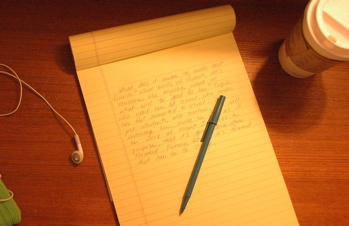
I also noticed, as our time together lengthened, that my usefulness to her was mostly in my presence, and in my occasional murmuring of vague questions like “Well… so… what do you make of that?” or nudges like “Yeah, write that down.” In front of her was a yellow ruled pad, which she kept turning to, writing note after note with a blue pen. Writing pad, pen, other vital stuffAs she wrote, she spoke some version of what she was writing: “Okay, and next I want to say that the rule of law is how it should be, and not how it actually is.” And then she would write and so on, back-and-forth between saying out loud and writing. I sat there, tilting in my chair, content to watch a young woman fill a page and hear her think out loud. Sometimes Sarah, at the front desk and the only other person in the Writing Center at the moment, would overhear and affirm M., who at one point said, “This is so much easier than it was last night, sitting alone in my room and trying to write it.”

Near the end of the hour with M., she wanted to start typing her response to her instructor’s question about rule of law, and would I look over something else she had brought in, a short essay on her educational goals? I sat nearby at the table, with her draft and my pencil. The first few paragraphs covered territory I’ve toured before: Education helps you realize your dreams; Education gets you respect. Some biographical information at the end surprised me. Her parents and friends are trying to call her back home; they don’t support her desire and determination to get an undergraduate degree, head to law school, and be a lawyer. “I have to find new friends,” her essay says, in so many words, in the conclusion. I penciled in the margin: “takes courage.”

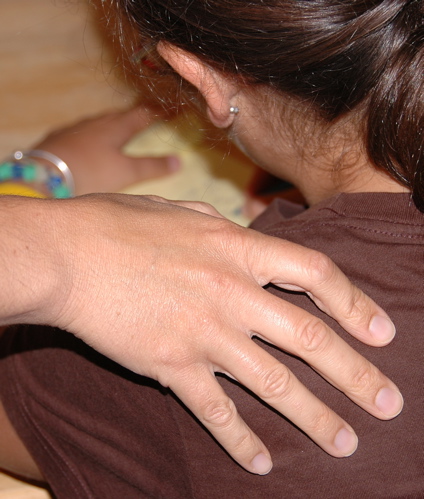
Hand on shoulderTo start out – to get going anywhere – without a companion, well, who among us wouldn’t feel the vastness of what that requires? Writing alone, always moving forward into the unfamiliar… there’s only so much of that one person can manage.

– Back to school

At an orientation for students involved in a bridge-to-college program, in which we offer enhanced, personal support to students who, in high school, were academically shaky, we asked them to put their heads together and come up with a list of characteristics delineating the “ideal instructor.”

What Makes a Good Teacher (according to students)

  • likes questions
  • loves what she or he is teaching
  • hardworking
  • dedicated to helping students achieve
  • active
  • could be fun in class
  • engaged in class
  • is like a friend
  • outgoing
  • is into it

Those items are all exact quotes. My favorite, and the most simply profound, is the last one. Personally, I don’t have a dog-and-pony show and, as anyone who knows me can tell you, I can’t tell jokes. I hope I’m a friend to my students, but I’m not a buddy. What I can do is show my students I’m “into it” — whether I’m in class or a tutorial — by engaging in what I want them to engage in. When they read in class, I read. When they puzzle, I puzzle with. When they write, I write. And I’m into it. Interested in an example? Continue reading

– Feed your head

This curious writing exercise, from Pat Schneider’s Writing Alone and with Others, is unlike any I’ve done before. To begin, I had to put aside my internal language and “blank out,” in a way.

Imagine yourself looking down into a deep well. You are safe, comfortable, looking over the edge and down. You can see the surface of the water far, far down. As you watch the water, allow images to rise to the surface and float there, then recede again below the surface as other images rise. Do this as long as you want, then write whatever comes to you. (70)

I don’t want to say more and risk infiltrating your ruminations with mine. Just try it.

– Dead letter dress

After reading my friend Lauren’s lovely short essay, “Paper Trails,” about the archives left in her care by three deceased relatives, I thought about my own files of cards and letters from people, once dear, who are now dead to me, whether or not they are still living: Aunt Elsie; Ellen, my maternal grandmother; Nicole, a high school friend. I hold one side of what were once active correspondences; absent is the other side, that is, letters from me.

My letters might have ended up in the trash or in a never-opened file cabinet. They’re as gone to me as the person is. Concrete evidence of who I was and what I cared about in, say, 1985, when I still wrote devotedly to the Davenports, a Yorkshire family I stayed with for a month in 1983, belongs to the recipients.

Those long, newsy air letters could, also, have ended up in a daughter’s or son’s hands, as did the checks, diaries, and documents of Lauren’s parents and her old aunt. They could also have ended up in the hands of a stranger, who came across them at an estate sale and who knows neither me nor the Davenports nor any other person I wrote to.

Letter DressIf the stranger were an artist, she might have sewn them into a dress, as Jennifer Collier does with maps, pattern paper, book pages, and old letters and envelopes. In describing Collier’s constructions (which are not made to be worn), Craft magazine’s print version calls them “a great reminder of the way clothes get loaded down with meaning.” I look at this stitched paper dress, wonder about the origin of the letters, and think of the persons — strangers to me, intimates to the letters’ recipients — they stand in for.

– Roam, if you want to

I’ve been going nowhere with a poem I’ve been trying to write, about, of all things, a dirty bar of soap, since this blog began. I had this vague idea about dirt as unavoidable, in a concrete way, of course, but also in a more figurative way, with “dirt” standing in for, um, global injustices. War, for example. The few lines I had put together felt wooden and unsurprising, as if I were assembling a puzzle from a picture on a box. In other words, I was stating the obvious even to myself.

Today I sat down to free write for 30 minutes. I did what my seven-year-old daughter, Grace, tells me to do when she asks for a story and I protest that I don’t have one to tell; she says, “Just say something. Then follow your words.” Her first grade teacher was on to something; this works. Don’t plan; just begin.

I began with the insistent image: dirty bar of soap. And then I meandered. I’ll share an excerpt from my travels:

Dirt dried in the grooves… Bar of soap is dried out, too. Old, unusable, like a piece of soap you’d find in a beach house in May, after many months of that house being closed for the fall, winter, and spring. The soap left in the metal dish in the stall shower, or outdoors in the shower attached to the back of the house and boxed in, for privacy, with fencing. The soap is so dried it has long cracks in it, as if wood. Wet it, and it takes a long moment to activate, to feel slippery in your hand. Slippery is something you’d read in a poem about sex, and this will be one about a dirty and dried bar of soap… Funny, dirty goes with sex. Sex goes with slippery, too, but slippery doesn’t really go with dirty. Dirty is gritty; I see that word and I feel grime in my hands, grit, fine sand, dust. A kind of dirty that starts with the soil, with particles, not with, say, the juice of dripping fruit that has dried on your hand, or chocolate…, or paint… Dirt is less processed a mess; it hasn’t been transformed into something else first before it gets on you, and you feel it.

It blows on, rubs on, sifts, floats down. It could be mud that later dries. It could then dissolve off, in the water of the tub, and then drain out along with. But still it wants to stay: it settles on the bottom of the tub, in a line of silt toward the drain, up high on the tub walls around the bubble line. To get rid of it, use more water. Spray with direction and force. Or find something clean, like a cloth or rag, to swipe at it, rub it down, rub it on to the cloth — transfer.

There is no getting rid of it, ever. Just as no energy is ever created or lost, neither is any dirt…

We collect dust, dirt. Even as we sweep it from the front hall out the front door, dirt from the garden or sidewalk is jumping onto sandals and riding back in.

We try to get it out, as far from the house as we can, by filling the sink or tub with water and soaking it off us. Water pulls some away from our skin… and delivers it down the pipes, under the yard, under the road, down to the parkway, through town via a network of pipes and pumps, to tanks, and back, somehow, to earth, dumped in cleaned loads onto hills, in rivers, on the banks. It creeps back. It creeps back always.

It remains too. Under our nails. In the corners of rooms. Along the thresholds of doors that open in from the outside. In the grooves between the worn floor boards. In the incised word “Dove” in this bar of soap. It’s in my hand; I pick it up, turning the tap. I clean you, child, with the dirty.

I like what I came across as I roamed: the words “transform” and “transfer” appearing in adjacent paragraphs, and the discovery that no dirt is ever created or lost. Dirt sloughs off; dirt creeps back; dirt remains.