Writer’s Dozen: a new series

For several months, I’ve been keeping a list of texts that have meant a lot to me as a writer. Some are as long as a book and are explicitly about writing, in particular about practice, process, and style.  A few of my picks are essay length, and a few are about visual art, e.g., photography and ceramics, yet the authors articulate principles that, in my view, apply to writing.

This list of 13 of my fundamental texts will turn into a new series, Writer’s Dozen, starting with my next post. I am inspired in part by an essay I read recently, by Tom Bissell, called “Writing about Writing about Writing,” in which he takes stock of some staples in the how-to-write section of his local bookstore. It’s a balanced analysis; he finds reasons to both mock and praise the books he features. On my list and his only two overlap: ones by Annie Lamott and Natalie Goldberg. Bissell admits to varying personal interest in the other books he critiques, which include Gardner’s On Becoming a Novelist (his one writer’s-life-changing text), Strunk and White’s Elements of Style, King’s On Writing: A Memoir of the Craft, and Snoopy’s Guide to the Writing Life.

I highly recommend Bissell’s essay. He has a tougher sensibility than I, but the heart of his argument is consistent with my motivation for choosing 13 personally influential texts and commenting on them in my upcoming series. About books about writing in general, Bissell asserts:

Most writers have thoughts about writing as an act, as a way of understanding oneself, or as a way of being, and they are often interesting. I have any number of thoughts about writing, all of which I find incomparably fascinating… A how-to-write book saved my life, then, but it did so existentially, not instructively. Many of the best books about writing are only incidentally about writing. Instead, they are about how to live.

Indeed, my favorite books about writing or art are, in their way, about how to live.

First up: Natalie Goldberg’s Writing Down the Bones, a book that initially disturbed me and then later settled down and found its place in my habits.

—–
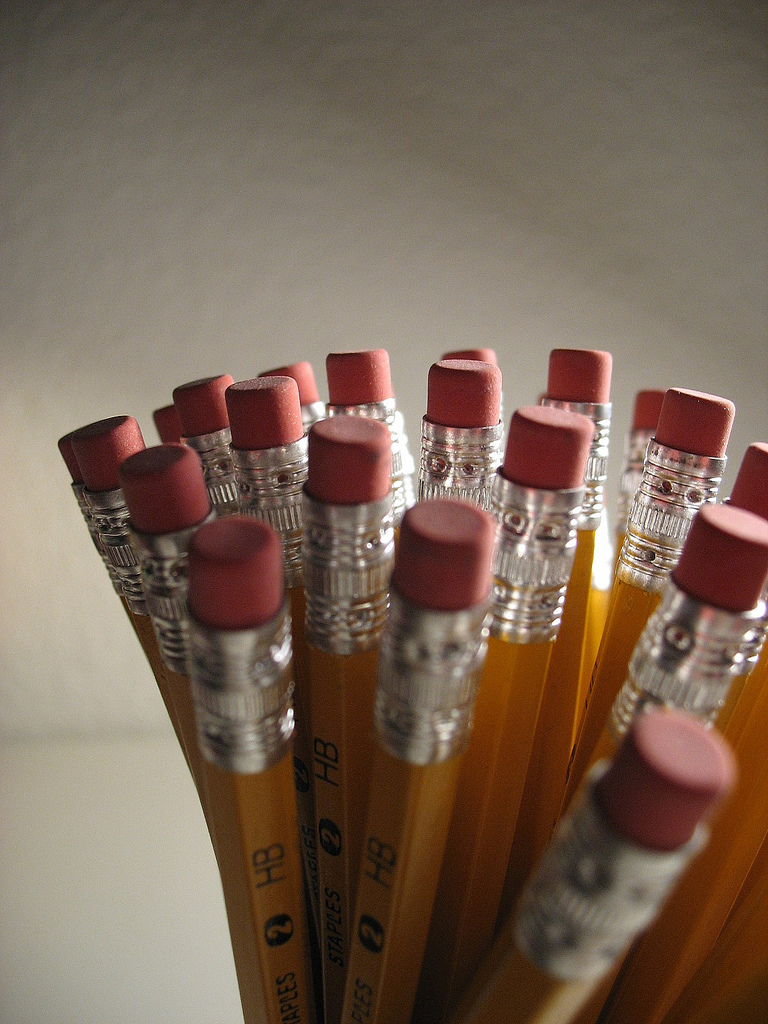
Image, “Pencil Art,” by Nalini Prasana on Flickr via a creative commons license.
Banana tattoo

Eli was home from college for a week. Even when he was quiet he made his presence felt by the traces he left here and there: a skateboard in the mudroom, canvas shoes near the door, and water glasses near the couch and his bed.

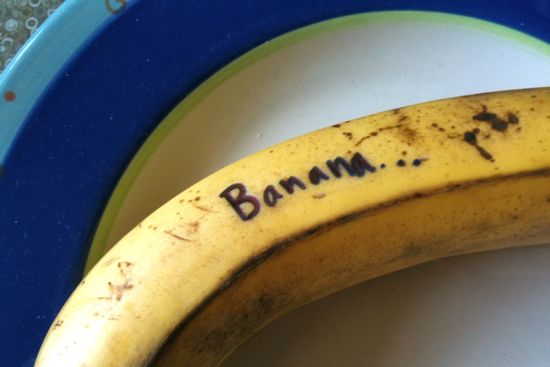
This morning I grabbed the last banana to caramelize for the waffles, and I saw that Eli may have picked up my tendency (and taken it to the next level) to see writeable surfaces in every scrap.

How do I know he wrote “Banana…” on the banana? That’s his handwriting and his sense of humor.

Give me your tired, your poor, your huddled masses

This is the line that goes through my head every time I enter a Registry of Motor Vehicles, as I did yesterday with Lydia to get her learner’s permit.

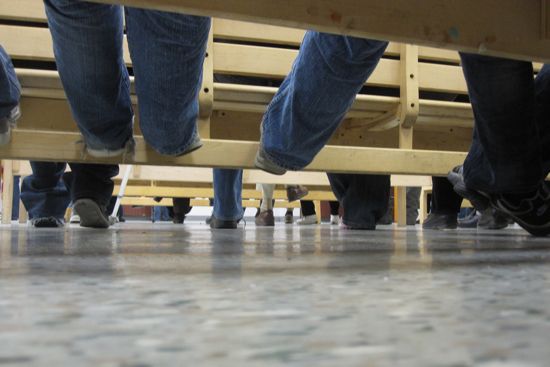
view from the floor, Watertown RMV waiting room, Feb 27 @ 4:23pm

While I don’t think my parents ever embarrassed me*, I do cross that line occasionally with my children. Usually they let me know and stop me from whatever I’m doing.

At the Registry, Lydia wasn’t too happy with me taking pictures of people in the waiting room. (Who knows when I’ll need a portrait of human abjection?) So I moved the camera to the floor.

Missions accomplished: learner’s permit gotten and pictures taken.

*Well, Mom, once there was a weird hairdo.

Turtle dreams and other boxed things

Recently I’ve been thinking about boxes. I turned on the timer (30 minutes), opened OmmWriter (still love it), and I followed my thoughts from one to the next. Here’s the result, without edits, although I did add one link.

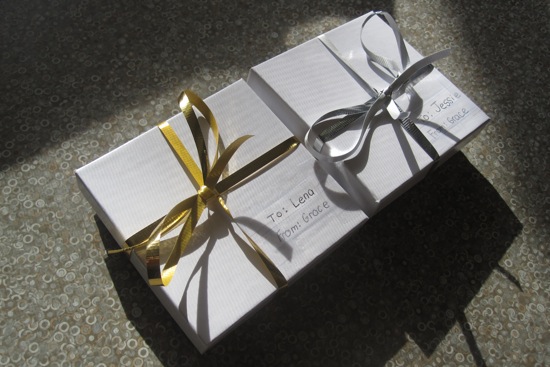
boxes by Grace and photo by me

When I was a child, I loved miniatures things: figuerines, the shoes that came with Barbie, safety pins. Once, at a town fair, I entered a raffle for a green-and-clear blown glass turtle. I paid 50 cents for my ticket and dropped it into a coffee can with a slot cut out from the smoky white plastic, and I hoped and hoped.  It’s possible I bargained with God, in whom I then believed.

I didn’t win that raffle, although I did win a “wash and set” (remember those?) at the town beauty parlor. I tried to trade this prize with the grown woman who won the turtle; she had gray, curled hair, and it seemed likely she’d want my prize even more. She said no. I still picture that glass turtle as it was displayed that day on a circle of mirror placed on the prize table.

I don’t remember if I liked jewelry or not, but I did like the boxes that jewelry came in: small, well made, sturdy, the lid close fitting. The box itself seemed as special as what came in it.

For a while I went through a period of collecting boxes: wood, ceramic, paper. They had to be small. Big boxes seem to not be collectible.

And yet, among the Kokernaks, who all share a love of putting, throwing, or giving surplus things away, there is an appreciation for what we would call a good box, as in, “Keep that. It’s a good box.” Jimmy too says this.

In the spring of 2003, when I was in graduate school and taking a course on teaching writing and visiting classrooms to observe teachers at work, I sat in on my friend Lisa R.’s English course at Wellesley College. That day the students were studying and discussing a Shakespearean sonnet. In her remarks, Lisa revealed how much she herself loved sonnets, “a whole argument packed into fourteen lines.”  Shakespeare loved them for this too, she added.  Some other scholar, she told the students, referred to the sonnet as “a tight box.”  I loved that image, and it gave me a new way to think of sonnets and all formal poetry.

What can one do — how much liberty can one take, what can a writer or person — within the constraints? The thought gives me shivers. Continue reading

She was nice to mice

I’ve confronted squirrels (outdoors) and rats (indoors), and, compared to them, mice are cute… almost.

Children love mice — cartoon ones and real ones — and the first time I discovered one in the house, the children, then ages 4, 8, and 11 and home on a summer day, begged me to catch it and drive it to the nearby farm to let it go. I did. Picture me, in jeans, t-shirt, and Black Dog baseball cap, in the family minivan with two little girls and a mouse in a metal waste basket with a piece of cardboard on top, driving to Allandale Farm and down one of the dirt roads marked with a No Trespassing sign, pulling over, getting out with a metal waste basket with a mouse in it, and gently sending that mouse on its way.

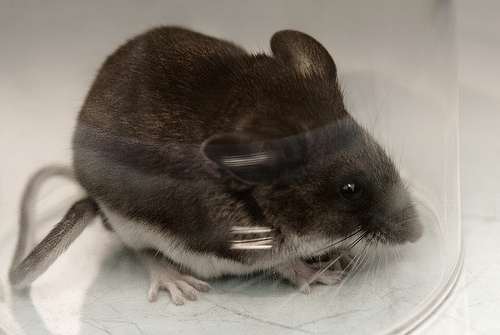
a mouse in an overturned glass, not wastebasket, but same concept

We had mice in the living room one Thanksgiving weekend when we also had guests. I waited until they were upstairs asleep before enlisting Jimmy’s help to catch the mice with my upside-down-metal-waste-basket-and-a-piece-of-cardboard trick. Stealthily I caught two, walked across the street with them in the basket in the middle of the night, and released them near the bushes around the temple, where I suspect they originated because of all the intense catering activity for events at the temple. (The regular appearance of a truck marked Waltham Chemical in the temple driveway was another clue.) I stuffed the holes around the radiator pipes with steel wool, and the incursion at the time was addressed.

For the past few months, we’ve had signs that the mice have returned and this time to the kitchen, most notably under the sink and in the silverware drawer. Their droppings, which resemble flax or black sesame seeds, are the evidence. To deal with the problem, we’ve ignored it. All that we keep under the sink is dishwasher detergent and our plastic recyclables. We moved the silverware in its caddy to the counter.

Weekly, I have been vacuuming the turds and hoping the problem would disappear. Apparently, the mice were not getting the mental messages I was sending them because the turds would inevitably blossom again. “Oh, well, so we have mice,” I would think.

I can tolerate mice more than I can clutter, however, and last week the constant presence of the silverware and all the knives on the kitchen counter pushed me to the limit. Visually and mentally I needed space: a long, horizontal, counter-length stretch of it. I had to confront the mice and take back a sliver of my domestic equilibrium. Continue reading

Baubles in the attic

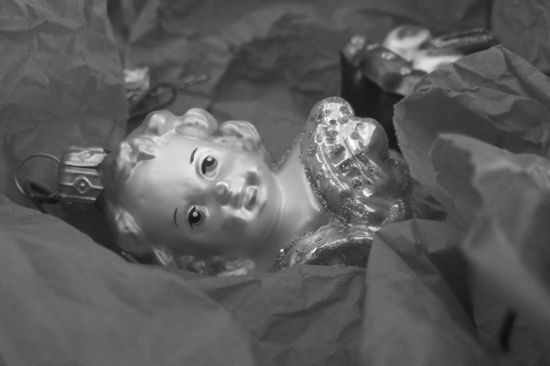
The ornaments are going back into hibernation. Today I took the tree down and put glass icicles, ceramic angels, miniature banjos, and a Santa or two back into boxes.

I left them up a week too long, because last weekend felt like too soon.The tree only went up a week before Christmas. I wonder if it should go up earlier in December and then come down shortly after the holiday, so we can mourn it and wish it lasted longer.

Is there a perfect ratio between anticipation and pleasure? Or, are experiences made more enjoyable by their ending before they are actually over?

Many years ago, a colleague of mine, a practiced dinner-party giver, told me that the perfect dinner party is three hours long. You want your guests to leave “in the middle,” while they’re still having fun. And if you’re at a party, try to tear yourself away at the three-hour mark.

He pointed out, too, that there is a natural lull at around three hours — I’ve tracked this over the years, and he’s right — and neither host nor guest should try to push beyond it, to whip a party up into a second burst. Eventually, the fun dies out, and people leave during a period of awkward deflation.

In writing, one is always advised to begin a story in the middle, after the action has begun. Perhaps endings — in writing, in experience — should be imposed on the action even when the revelers are still holding on.

This, of course, has nothing to do with human life or relationships, which I hope are extended satisfyingly as long as possible. The longevity of life and love: I’m down with that.

But dinner parties, stories, and holidays? Perhaps we must — for everyone’s enjoyment — end them right at the point our guests still wish for them to continue.

This may take firmness and grace.

Out of the spent blossoms of the old year rise our resolutions

Lydia and I were a week into our new running habit and halfway around the reservoir when she asked me, “What are your New Year’s resolutions?”

I had been thinking about my plans for 2012, although I was not sure at that point if they had firmed up enough to be classified as resolutions. But, what the heck — why not put them out there into the universe, starting with my audience of one, and see if making a declaration has an effect?

I went looking for birds to photograph, but found dried hydrangea, tap tap tapping against the porch windows, instead. Jan 3 @ 2pm

“The first one is inspired by yours,” I said to Lydia, who aims for better time management in the new year. Both of us manage to get a lot done, and yet can fritter away our free time mindlessly. “I’m going to waste time in more meaningful ways. Instead of checking up on my friends’ and siblings’ status messages several times a day, for example, I’ll skip that and take a nap or watch a tv show with my family.

“Number two: write fiction. I told Eli about an idea I have for a young adult novel, and he liked it. Also, I want to do more than nonfiction is allowing me to do.” I described my start-up plan, which Eli and I worked out as we sat in the Publick House one night having dinner. During my January break and before classes begin, I’m going to write two pages a day and explore this novel idea. It’s an experiment, and yet I’m totally serious about it.

“The third one I already told you about. This year I’m going to compete in a skating event.” A week before Christmas, Fred (skating coach) had raised the question, and I said I’d do it. I want to. Performing or competing makes you better in a way that skating (or writing or singing or painting) only for yourself does not. It’ll be an entry-level competition for, er, seniors, and a powerful motivator.

Dried ornamental grass, roots in shade and seed heads in sun. Jan 3 @ 2pm

That was it for resolutions articulated between huffs and puffs around Brookline Reservoir. Shortly after, I had dinner with my friends, and Sue told us about her last year’s resolution, which she managed to keep 9 times out of 12: to see her mother, who lives beyond Albany, once a month.  Yesterday I told my mother my fourth resolution: to see my parents once a month this year, alone or with the whole clan, for a long visit for just the afternoon. That’s at most 1/30th of a month. Surely I have the time. We all do.

No middle, no satisfying end

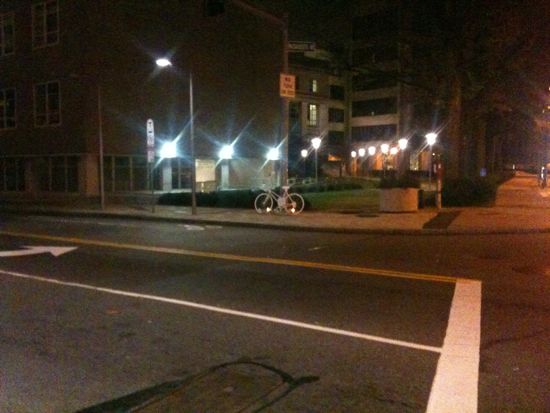
Last night, I drove to Kendall Square to meet my friends Betsy, Sue, and Brandi for dinner at Miracle of Science. It’s the holiday break, so I haven’t been to MIT for several days. Through email, I have been staying in touch with colleagues, and I even heard from one of them that a recent student of ours had been killed on his bicycle at the corner of Massachusetts Avenue and Vassar Street, an intersection I know well and cross on foot at least twice a day. It’s busy; every vehicle and every person converges there.

I drove up Vassar Street around 5:50 pm and past the garage I typically park in. I approached the intersection, thinking of course about the accident and the student Phyo, who had been in the communications module of a chemical engineering class I’m involved in every fall. I thought about the last time I saw him, shortly after his graduation in early June ’10. He was still on campus, raising money for Camp Kesem by selling popcorn and doughnuts in the Stata Center. He had a warm, sparkling smile, and we enthusiastically talked about other grassroots ways of raising money — like selling popsicles on hot days —  and about his new job, which was about to begin.

“I wanted to tell you and Lisa and Professor Hamel that my presentation for the class helped me get the job!” Lisa was my fellow communications lecturer on the course, and Professor Hamel the engineering professor. That fall, we had a small and closely-knit group.

“Great! How so?” I asked.

“In my interview, they asked if I had any presentation experience, and I told them about my final presentation for the class, and they asked me to come back and do it for them. I did, and they liked it, and they offered me the job.” He looked happy and eager. Admittedly, he always did, and this was one of Phyo’s gifts.

I had the green light at the intersection, so I couldn’t stop and sit in the car for a few seconds and contemplate the accident. On the corner, I glimpsed a memorial: a white bicycle and some candles. I parked my car nearby so that after dinner I could walk back to the corner and stand closer to it.

From across Vassar Street, Dec 30, 9:30 pm

After a long dinner and dessert and walk with my dear friends, we embraced and parted. Over dinner, I had told them about the accident. As the three of them got in one car, parked on Mass Ave closer to Miracle, I said I was headed to the memorial. Brandi asked, “Should we go with you? Are you safe?” I smiled inwardly, not afraid of the neighborhood, and thinking it was ironic to be worried about strangers when trucks were a proven hazard.

Honestly, my feelings about Phyo’s death were almost dream-like as I walked back toward the Institute, and I was motivated more by curiorisity: What does the memorial look like? Who made it? How was it personalized? Continue reading

This is obscene, and yet instructive

In celebrity profiles, which often strangely report on what Jennifer Aniston or Mark Wahlberg or Prince Albert has in her or his refrigerator at precisely that moment, I’ve always studied the information and semi-memorized it. Celebrities seem to keep only a few items on hand, and it’s stuff like Evian water, fig paste, a few limes, small batch IPA, and perhaps some luxury brand facial moisturizer.

I have envied these refrigerators, their emptiness, and the uncluttered personal lives they represent.

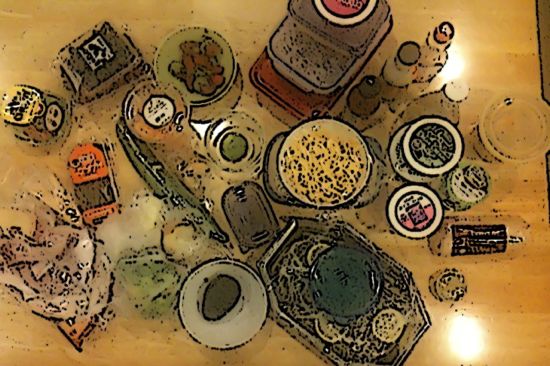
Today, I cleaned out our refrigerator. (Warning: this may be the most prosaic thing you read all week. I may be writing this more for me than anyone else.) I discarded a tall-sized garbage bag full of expired or unwanted food. I analyzed the garbage, in order to learn something about our habits and how we might avoid this clutter and waste in the future.

Array of discarded food, 'toon version

The Things We Wasted:

  • Cooked pasta. From now on, let’s cook only what we’ll eat at one sitting.
  • BBQ sauce and salad dressing, variety. I think we see these in the store, want a taste, and must commit to the whole bottle. And then we revert to using the sauces and dressings we make or favor. No more sampling.
  • Vegetables and fruits. We overbuy, with the intention to eat the Food Pyramid every day. We rarely hit that mark. I miss the old Food Pyramid, in fact, with only 5 to 6 servings of veg & fruit daily. (Who can eat 11?) Continue reading

Wrapped, unwrapped, and wrapped again

1. Not the Martha Stewart way

My life is always about a day behind my plans. When I die, I’ll have a To Do list of 24 hours’ worth of outstanding tasks that someone else will have to tackle.

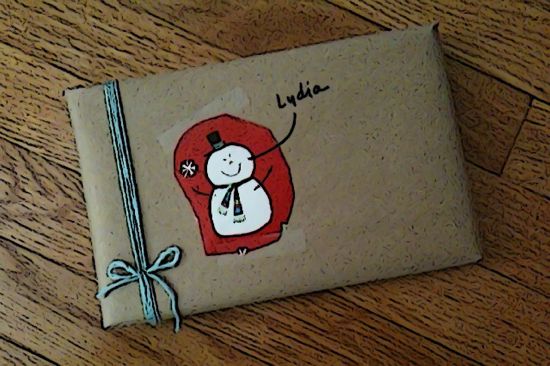
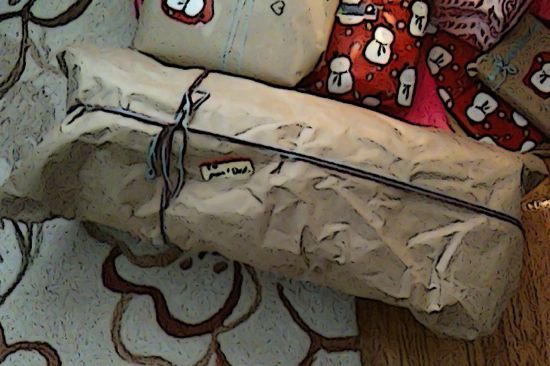
Even though I intended to have all my gifts wrapped by Friday night, on Saturday at midnight I was still sitting on the floor with brown paper — some unfurled from an Amazon box, some repurposed from shopping bags — and tape and a black Sharpie and gifts around me. I did follow through on my plan to wrap with used paper and yarn remnants. I hadn’t thought to buy gift tags, though, and so I had to improvise those at the last minute, using some snowman paper that Jimmy and Grace had on hand.

Beyonce DVD

snowshoes

Continue reading