– Mystery plant: are you ready?

First, watch this brief (one minute) commercial from the 1960s. If you’re at least my age (42), you might recognize the jingle.

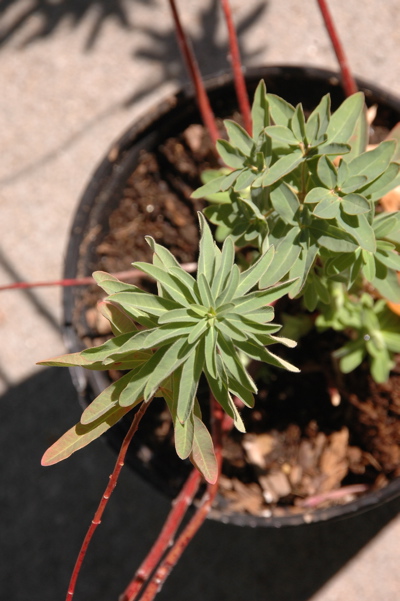
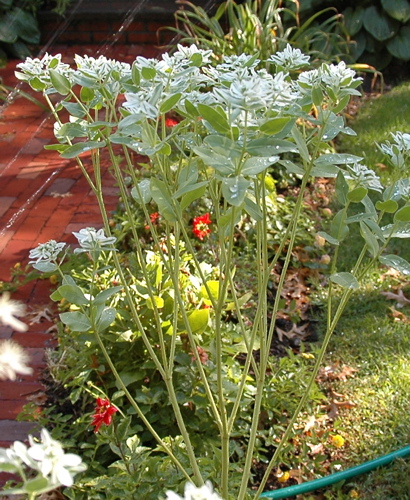
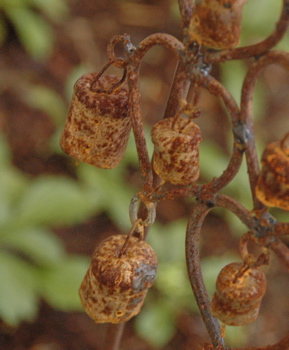
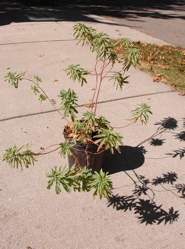
A couple of weeks ago, at Allandale Farm, where I go to feed what Jimmy calls my addiction, Mystery plant, unadornedI bought this plant. It was one of a kind, nestled among other pots of other sun perennials, and unmarked. I asked the guy out back, “What’s this?” He didn’t know. I asked the guy out front, “What’s this?” He didn’t know. I bought it anyway. I felt drawn to it, especially its red branches, and knew I had to have it. It’s not lush or an obvious showstopper, and it sort of reminds me of Charlie Brown’s Christmas tree: twiggy, droopy, and left behind. I’ve been trying to figure out what it is, and, as I’ve been fruitlessly researching plant images, the jingle from the commercial from the board game I played over and over and over again as a young girl keeps looping through my head. I’ve substituted one word. It goes like this, and I sing it to myself: “Mystery plant… Are you ready for your mystery plant? Mystery plant… Are you ready for your mystery plant?”

Mystery plant, leaf patternNot sure, I’m starting to suspect it might be a daphne cultivar. The leaf pattern — click on thumbnail at left for a close-up — is similar to others I’ve seen, including the ailing daphne in my own yard, but it doesn’t have the necessary full foliage. If you have a clue or an answer, let me know.

Photographs by Eli. Video via YouTube.

– Potatoes, and other prompts

I like the concreteness of things. Focusing on them while writing also frees me from my vague and persistent thoughts. Put an old key, a knife, an unfamiliar picture, or brooch in front of me, and I feel interest in at least describing the item. That inevitably leads to a connection with my own experience and, sometimes, a new question.

In her handbook, Writing Alone and with Others, which is filled with attractive writing New potatoesexercises, Pat Schneider offers many examples of using objects as “triggers” in her workshops for writers. Sometimes, she places a covered basket of 30 or 40 items on a table, removes the cover, and asks group members to take one or two objects, hold them, and freewrite for 10 minutes or so. Other times, she has multiples of the same item, and hands one to each member, getting them to all start writing from a similar place, as a way of seeing how individual writers will all mull differently over a shell, for example. Some items she suggests, like cinnamon sticks, even have scent.

  • Here are Schneider’s suggestions for a diverse basketful: shaving brush, rusty horseshoe, a ball and jacks, baseball, crocheted doily, piece of frayed rope, bottle of pills (with label scratched so pills become unidentifiable), rosary beads, crumpled cigarette pack, page of scripture written in Hebrew, small teddy bear, broken dish, mirrored compact, man’s pipe, baby bottle, old piece of jewelry, spool of thread with a needle stuck in it, dog whistle, artificial flower, plastic Jesus figuerine, and empty whisky bottle.
  • Suggestions for multiples of same object: mothball (in plastic snack bags to protect hands), piece of penny candy, a nail or screw, a vitamin pill, acorn, torn piece of a map, slice of raw carrot, rock, a small piece of sandpaper along with a bit of cotton, or a long stem of wheat or grass.

Collect some acorns. Buy a bag of wooden clothespins or new potatoes. Make your own object-filled basket. Offer surprise to your students. Or, assemble a collection, put it aside for a few weeks, and then take it out again to prompt your own writing. Surprise yourself.

—–

Picture credit goes to BBC Food.

– Before and after

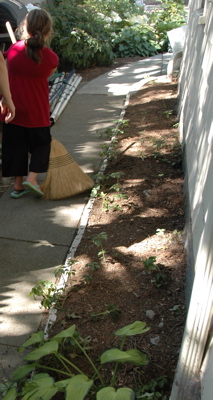
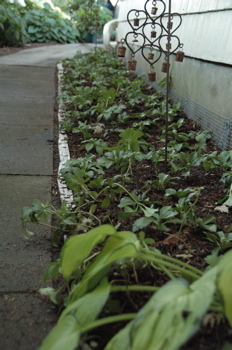
For anyone who is interested in the results of my propagating 100 pachysandra cuttings from my parents’ yard into mine, this post gives an update on the health of the transplants and, at the end, shows how I did it.

The “before” patchThis is also a before-and-after story and an occasion for me to remark on my uneasiness with sudden and dramatic transformations, which this is not. I recognize that, as a culture, we want big and positive change: the new fabulous job that will turn those daily doldrums and interpersonal irritations into personal zest and suitable comrades; the surgery or exercise that will turn my everyday outer self into a “10” (oh, yes, I’ve had those fantasies of ten-ness); the design and construction project that will help a house be all it can be (bigger, better, beautiful). This is prevalent — just type “before and after” into the Google search box and see what you come up with.

A couple of summers ago, driving to Crane’s Beach with my friend Betsy, she asked me what I would do if I won a million dollars. I asked her permission to reframe the question, setting $50,ooo as the limit, because I couldn’t wrap my mind around so much possibility — such an immensity seemed a pressure, an obligation, a weight. She laughed; she agreed; and we played the game. On my list, I put a beautiful coat, well-made shoes, a charitable gift, and a personal chef for a year. Later, I played the game with the kids, and they put items on their lists like “couch for my room,” “video game console,” and “elevator in our house.”

As Jimmy pointed out, as the kids and I were itemizing, any one or two or three ofThe “after” patch, with bells those wishes are ones we could actually afford now. He was right, and I realized — from Betsy’s laughter, from his comment — that the kind of changes that are either most interesting or tolerable to me are incremental ones. Indeed, I’ve become happier with my living room after getting a chair reupholstered from a busy, whimsical print to a green, textured chenille. Work is better on the day I tidy up my office and have a conversation with an eager student. My old clothes look snappier when I’m wearing a new sweater. This kind of change, which is probably most common in most of our lives, isn’t the stuff of dreams or the stuff that sells. Who would pay the initiation and monthly fees to a gym that promised only that working out would help you feel moderately better? Does anyone lie in bed at night fantasizing about updating the sleeve lengths on all their jackets and sweaters? More significantly, are any of such changes representable?

I confess: even though I am capable of ho-hum-to-fabulous fantasies, it’s the small changes in my life, wardrobe, house, hairstyle, garden, career, cafeteria that sustain me.

If you would like to follow how I made this incremental change in my side yard, as illustrated in the above Before and After images, please… Continue reading

– Sign in stone

Do you know how an image, from a book or movie or even your own dreams, can enter and then stick in your mind? For days, since reading this passage in If on a winter’s night a traveler by Italo Calvino, I’ve been seeing this hand in stone — my version of it — everywhere:

Monday. Today I saw a hand thrust out of a window of the prison, toward the sea. I was walking on the seawall of the port, as is my habit, until I was just below the old fortress. The fortress is entirely enclosed by its oblique walls; the windows, protected by double or triple grilles, seem blind. Even knowing that prisoners are confined in there, I have always looked on the fortress as an element of inert nature, of the mineral kingdom. Therefore the appearance of the hand amazed me, as if it had emerged from the cliff. The hand was in an unnatural position; I suppose the windows are set high in the cells and cut out of the wall; the prisoner must have performed an acrobat’s feat – or, rather, a contortionist’s – to get his arm through grille after grille, to wave his hand in the free air. It was not a prisoner’s signal to me, or to anyone else; at any rate I did not take it as such; indeed, then and there I did not think of the prisoners at all; I must say that the hand seemed white and slender to me, a hand not unlike my own, in which nothing suggested the roughness one would expect in a convict. For me it was like a sign coming from the stone: the stone wanted to inform me that our substance was common, and therefore something of what constitutes my person would remain, would not be lost with the end of the world; a communication will still be possible in the desert bereft of life, bereft of my life and all memory of me. I am telling the first impressions I noted, which are the ones that count.

It’s not just the image. I love the simple surprises in “mineral kingdom,” “free air,” and “white and slender,” the slant repetition of “desert bereft of life, bereft of my life,” and the narrator’s measured acceptance of the remarkable “thrust out” hand he has seen and what it means to him.

– Necessary flaws

Bird party on September 19th

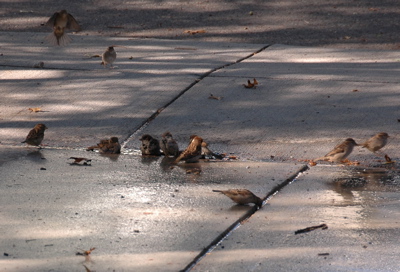
This afternoon I set up the sprinkler, turned it on, and forgot about it. An hour later, Grace pulled me to the window, pointed to the end of the driveway, and said, “I think the birds think it’s a birdbath.” Indeed, there were several little ones, touching down and splashing in the inch or two of water that had accumulated in the seam where our driveway meets the sidewalk.

A few years ago we replaced the cracked and heaving driveway that seemed original to the house (1930s). The paving contractor jackhammered, cleared, and carefully graded a new footprint before pouring a truckload of cement onto a bed of compressed sand and gravel. Jack, the owner, who was on the job constantly, promised a pristine surface, free of the mud- and ice-collecting potholes and cracks that characterized our old driveway. And when it dried, it looked good. And then it rained, and we noticed that “perfection” came with a few flaws, noticeably some shallow dishes in the driveway that collected a skim of water when it rained. We debated calling the contractor back and demanding a touch-up.

I don’t remember why, but we let it go. Today I was reminded of how cosmetic flaws can turn into features, ones that capture run-off from the lawn, bathe birds, delight a child, and, in turn, give me something to think about.

KilimanjaroAnd furthermore, the birds have done a lot of work in our yard, scattering seeds and berries all over the place, causing some annuals — like Euphorbia marginata Kilimanjaro — to come back, unexpectedly and in surprising places, year after year. The birds deserve their afternoon refreshment.

– Being there

On Thursday, a new student, M., came in to the Writing Center for the first time. She had an assignment from her criminal justice class on the rule of law that she “just couldn’t start.” I sat next to her at the computer as she did the first thing: locate a definition for the rule of law. A Wikipedia article popped up; she pointed at it and said, unprompted, “Oh, I’m not gonna use that one. Anyone can write those.” So, she didn’t need too much help from me on research.

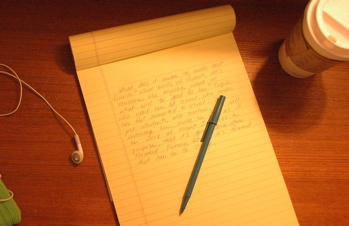
I also noticed, as our time together lengthened, that my usefulness to her was mostly in my presence, and in my occasional murmuring of vague questions like “Well… so… what do you make of that?” or nudges like “Yeah, write that down.” In front of her was a yellow ruled pad, which she kept turning to, writing note after note with a blue pen. Writing pad, pen, other vital stuffAs she wrote, she spoke some version of what she was writing: “Okay, and next I want to say that the rule of law is how it should be, and not how it actually is.” And then she would write and so on, back-and-forth between saying out loud and writing. I sat there, tilting in my chair, content to watch a young woman fill a page and hear her think out loud. Sometimes Sarah, at the front desk and the only other person in the Writing Center at the moment, would overhear and affirm M., who at one point said, “This is so much easier than it was last night, sitting alone in my room and trying to write it.”

Near the end of the hour with M., she wanted to start typing her response to her instructor’s question about rule of law, and would I look over something else she had brought in, a short essay on her educational goals? I sat nearby at the table, with her draft and my pencil. The first few paragraphs covered territory I’ve toured before: Education helps you realize your dreams; Education gets you respect. Some biographical information at the end surprised me. Her parents and friends are trying to call her back home; they don’t support her desire and determination to get an undergraduate degree, head to law school, and be a lawyer. “I have to find new friends,” her essay says, in so many words, in the conclusion. I penciled in the margin: “takes courage.”

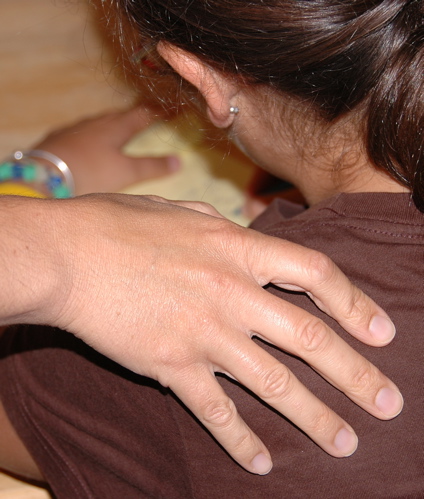
Hand on shoulderTo start out – to get going anywhere – without a companion, well, who among us wouldn’t feel the vastness of what that requires? Writing alone, always moving forward into the unfamiliar… there’s only so much of that one person can manage.

– Nell and a shovel

Nell and big shovel

This is Nell. She sent me this picture today, calling it “My Summer Job.” Until I wrote her a follow-up — “tell me more” — and got her answer, it seemed totally valid to me that Nell, as handy with power tools as she is with organizational consulting, would have a summer job operating construction equipment. Her whole family (mother, father, two brothers) is like that; they make, fix, solve, initiate, teach, and oversee. I met Nell through her mother, my friend “Jane G,” as I think of her. She and I — the two Janes — worked together, along with Nell, at The Albert Einstein Institution, an organization studying and promoting nonviolent actions run by visionary strategist Gene Sharp, in the late 1980s. Nell’s e-mail reminded me of two things I believe: (1) people who are in charge should be the people who know how to do the job, not just manage it; and (2) more people should know about Gene’s work in civilian-based defense and learn about the role of noncooperation and nonviolent strategies in diffusing or ending conflicts.

***

Note: Nell’s summer job was not in construction. Her family recently replaced the septic tank at their lake house.

– Awake at night

I read somewhere once that Freud had a name for it, Mutterschlafen, the light, alert sleep that mothers experience when their children are young and they wake often, needing comfort or milk. Grace has been getting up every night, around 2am, for a couple of weeks now. Possibly it’s allergies or back-to-school anxiety. Usually, she comes to me, and I get up and get her back in bed and sit there for a while until she sleeps again. Then I go back to my own bed and lie there, awake, for hours. Jimmy, sympathetic to my days of interrupted sleep, recently said to Grace, “When you wake in the night, come to my side of the bed, not Mom’s.” She replied, “But Mom is always awake, and you’re not.”

Saturday night, or Sunday morning really, this happened on schedule. I got Grace a tissue for her nose, tucked her in, and tried to go back to sleep. My mind wandered outside to the front yard, where in the day we had dug up some crowded plants, expanded the planting bed, and gave the transplants a wider berth and space to breathe and grow. One shrub we moved — a daphne — we moved against most good gardening advice. Daphne, murkyDaphne doesn’t like to be moved; she’s particular, and she doesn’t like fertilizer or much water either. And, yet, she’s lovely and smells good in the spring and has a graceful, curving upright form. You can only see that form, however, if she’s not crowded by a forsythia, baptisia, and ornamental cranberry. She was happy in her spot; I wanted to put her on the garden stage. Jimmy did the grunt work, digging around the root ball at the drip line and digging down as much. I advised him to use a spade to pry her out; when the job was on the verge of done, I looked over and saw him grab the daphne by the sturdy, narrow trunk and yank her from the dirt. Ouch. Was I mad? No… not that. The feeling was closer to forlorn. I had already decided that when you get someone to help you, you have to give them room to help in his own way, solving problems as he encountered them. Plus, the daphne branches and leaves looked vigorous, and there were plenty of orangey roots. We dug a new spot for her closer to front walk — a starring role for a beautiful specimen — and shoveled dirt back in. I investigated the hole she left behind to see what I could put in her place, and I saw something that made my heart sink: three severed roots, each the diameter of a human aorta, sticking out of the dirt, snapped, useless, separate. Hours later, in my sleeplessness, I replayed all the gardening hours in my head: Where was the mistake? The initial decision itself? My laissez-faire attitude towards oversight? My absorption in my own tasks? Awake anyway, I thought of Daphne, alone at the curb, possibly wilting. I imagined creeping downstairs, putting on my shoes that seem always to be at the front door, and going outside to, at least, monitor her, although there was no action I could take, other than waiting to see how the damage would affect her. I did not go outside. Crazy thoughts are okay; crazy behavior is not.
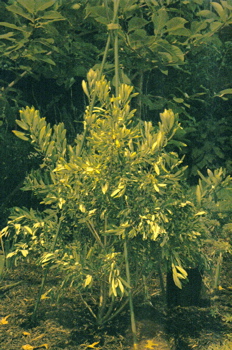
With the daphne on my mind, I got back to sleep, using a breathing exercise that Lydia taught me. Inhale, then count on the exhale. Breathe in, “one.” Breathe in, “two.” Breathe in, “three.” Breathe in, “four.” My heart slowed down. All day yesterday, Jimmy and I kept checking on her, looking for signs of what, we don’t know. The daphne’s leaves droop; that may be a sign of damage, or simply a sign of fall.Eli dance

***

Thank you, Eli, my night photographer. The pictures are dreams.
– From one, many

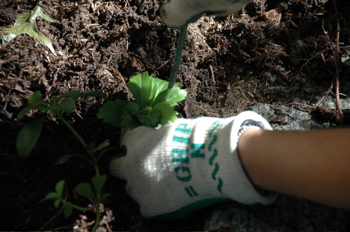
Still not ready to face the empty space in my backyard, even though there’s a small assembly of shrubs and groundcovers standing in line and waiting to be planted, I put the gloves and the old shoes on yesterday and headed out anyway. There is (now, was) a clump of irises in the front that could stand dividing.

I have more been a planter and tender than propagator, and aside from splitting up some hostas, my experience making two or more plants from one is slim indeed. I turned to the web for guidance, and I found instructions, with pictures (even better), by Todd Meier at Fine Gardening magazine.

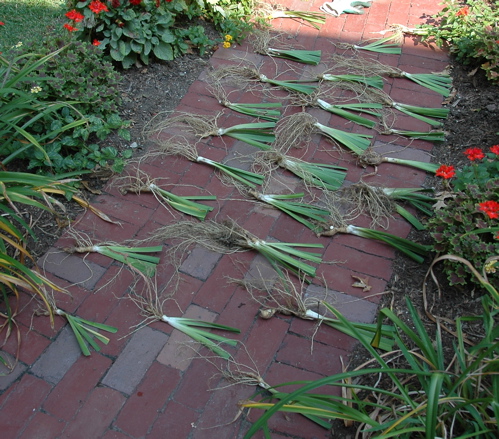
After about an hour of loosening and then prying the clump from the ground, slicing the rhizomes, untangling the hairy roots, and clipping back the greenery to a third so that each cluster of leaves had rhizomes and roots, I found myself with 26 “new” irises to plant. 26 New IrisesI counted and photographed them, then stacked them on the board I cut them on. A neighbor walked by with her dog. “What are those, onions?”

“Nope. Irises. I just dug them up and divided them.”

She has seen me work in the yard many times before; I wonder if dog walkers hold all the lore in the neighborhood. “You seem so knowledgeable.”

“Not really. I had to go on the web and find instructions how to do this, and it was pretty easy.” Besides, she’s a doctor and high up in the commonwealth’s public health department, keeping us all immunized, responding to epidemics and other threats. That seems like knowledge, to me. What I’m doing seems like the careful following of instructions.

“Oh, still,” she says. The dog leads her away. I go back to the task.

At least 15 years ago, I consulted with a counselor at Radcliffe Career Services. Before the appointment, I had filled out a bunch of questionnaires and completed the Myers-Briggs. Knife iconOne exercise was to make, simply, a list of 20 activities I enjoyed. High up on my list was “cutting things,” along with, of course, writing, drinking coffee, and knitting. The counselor was perplexed: “What are we supposed to do with this, ‘cutting things’?” I replied that I didn’t know; it was her exercise, not mine. She had a good nature and laughed. And, even though I have failed, since then, to find a job involving all of the top 10 items on that list, it remains true that any activity involving a knife or sharp scissors is a good one, according to me.

– Blank page fear

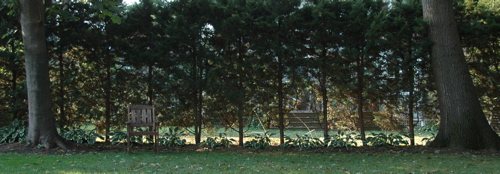
This is the view from my kitchen window. Besides the neighbor’s row of junipers and our drooping hostas, this is the least planted spot in the yard. In the eight years we’ve lived here, since we took down a rotted white picket fence along the back and dug out clots of brush, I’ve stood at the sink and looked and looked and looked at this empty space. Blank space with chairI can’t say that I’ve spent much time imagining what I would plant there; it’s been mostly a focal point for daydreaming about other things. Once in a while, I’ve moved the chair or a bench into view, just to alter the scene a bit. Suddenly, recently, I tired of an empty that’s too empty, and I decided to plant.

Days later, in front of the outdoor cashier booth at the Dennis Agway, with shrubs and ground covers in a wagon behind me and Jimmy having gone to get the car, I said to the woman behind the counter and to Bob who advised me on the plants, “I’m hesitating. I… I have this blank space in my yard and I think I’m afraid to plant it.”

She nods. “Oh, yeah.”

Bob, who I’ve discovered is a retired social studies teacher and now full-time gardener, says, “We all feel it.”

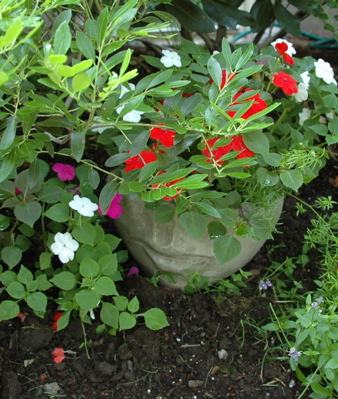
“You just have to put something in the ground.”Half Face 2

“Dig it in.”

“Yeah. Hey? See what happens.”

We all seem resigned to this, and nod at each other. I sign my credit card receipt; Bob wheels the plants out to the car; and I’m on my way.