– Clouds

This is a cool way to kill, I mean spend, some time. Copy and paste the text of your c.v./resume into Wordle. The Wordle tag cloud might teach you something about yourself, or remind you of stuff you already know. Every word in my December ’07 resume makes the cloud below. (Collaborators, you’re in there, too!) Most repeated words are biggest.

And, what the heck, here’s Robin Behn’s “Gray Poem,” well loved by me:

From memory, I would have said that “whale” or “dive” would be among the prominent words in Behn’s poem. But, look at this: “turn” and “fathoms” and a few others are most recurring.

P.S. Thanks to Jimmy for the heads up.

– Images

I love the images in these two lines, from two different pieces:

All over the room, like boats softly tooting their horns in a harbor on a foggy night, men were weeping. (Nicholas Dawidoff, “The Man Who Wasn’t There,” New York Times, Sunday, June 15, 2008)

and

At times I was lonely, but it was a bearable loneliness, the way I imagined that a star, brilliant in a Milky Way of other stars, would be lonely. (Walter Dean Myers, “Poets and Plumbers,” What They Found, Wendy Lamb Books, 2007)

I tried to find more lovely sentences from my reading of the past week or so, enough to make a handful or a dozen, but these two kept pushing contenders aside.

The first is from a personal essay on his lost father, and other men without fathers, by a male author; he hears the weeping as he sits in a darkened movie theatre watching the last scene in Field of Dreams. The second represents a moment of self-reflection by Noee, the 17-year-old female protagonist in a short story, who feels distant from the boys and young men who try to attract her attention. Her father is dead, too.

The loneliness of the first-person narrators is made even more piercing, I think, by the beauty with which it is rendered by each writer. There’s something strangely comforting, too, in the idea of sadness shared, distantly, among other boats and other stars.

Is that ethical, to make sadness be beautiful? That’s a seduction. Should sadness be starker, plainer? It has one quality in art, and another in life.

Either, it is a feeling of force:

Sadness drives us to restore attachment and is from an evolutionary point of view an important adaptive emotion. The sadness caused by bereavement is the cost of having been attached, and it may also act as a social signal that is a plea for sympathy.

In these lines, who makes the plea: narrator, or author?  Does it matter? As a reader, I do feel as though someone in these words is reaching out to me.

– Bloomers

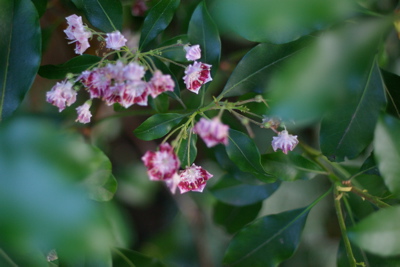
I planted mountain laurel around the perimeter of our deeply shady back yard several years ago. Some I bought from Home Depot and some I mail-ordered from a specialty grower. In the beginning, I watered, and I fertilized. A few died; a few established themselves. The ones that lived grew and branched, yet grew only green. No blossoms, and blossoms was what I was after. After a few disappointing springs, I gave up looking. Their uneven profiles and glossy leaves faded into the blur.

Two of them surprised me in early May. I saw, through the kitchen window and across the yard, what looked like… buds.

In late May, the buds burst. They have persisted through June.

Kalmia, striped

Kalmia, pink

Is flora time like fauna time? If these Kalmia are, say, seven years old, is that akin to a seven-year-old dog being middle-aged?

I ask myself this question because I don’t think I can take any credit for these blossoms. Well, I put them in the ground, and I tried to hurry them along with water and feed. In the end, though, they bloomed when they were ready. Whether early or late, it was according to their own clock and not mine.

Photographs by Eli.

– Rocks

Grace came home with these the other day; she calls them heart rocks.
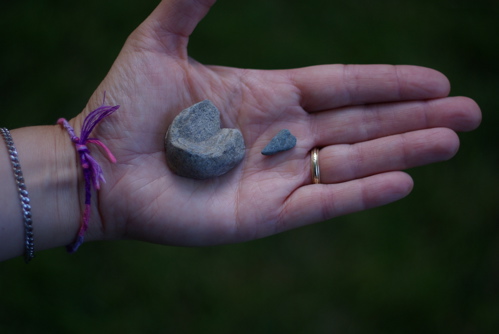
Heart rocks

Like me, she keeps her head down sometimes, looking for rocks. What, exactly, are we looking for in a rock? There are millions on the beach. Still, a few seem to call out to us: “Pick me, pick me!” We pick them. I look for color, and she, shape.

I live on a street named for the Massachusetts official rock, Roxbury puddingstone.

I grew up in a house across the street from a lot made unbuildable by the presence of a huge, rocky boulder. We called it The Big Rock. It was better than a playground. There were crevices in the rock to hide in, or pretend they were escalators. In neighborhood wars, one party or another claimed the rock. Daring kids, like Sally and Michael, did bike tricks around the rock and tree roots.

Surrounding our neighborhood, which was a figure-eight shaped development built in the early 1960s, was what we called The Woods. In it were acres of trees, streams, and swampy areas that made skating surfaces in the winter. There was The Old Lady who lived in a shack (really); she had a gun. There were stone walls that had tumbled down.

Sermons in Stone is one of my favorite nonfiction books. About the history of stone walls in New England, it’s riveting — history that moves a reader like a poem. I learned why there were so many stone walls in the woods of my childhood (those woods were once farmlands). I learned, too, the measure that makes a city block, and about the Ice Age and the force of glaciers.

In a writer’s workshop, another writer who read my work for the first time pointed out to me that there are a lot of stones in my work, actual and metaphorical. It was not a deliberate effect, and I had not noticed it. It’s funny what happens when someone observes something in your work: You start thinking, “That’s my thing.” And then you write more of it. And then you try not to, so as not to be obvious. And then you give up and go back to it, perhaps with more thoughtfulness.

___

Photograph by Eli, who has new work here. Friendship bracelet by Lydia.

– Opinions

As dinner ended, Lydia, Eli, and I discussed our summer trip. (Grace had wandered off to the television; Jimmy is at a dinner meeting.) Eli is impatient for us to nail down the date and destination. The children have opinions, which enrich but complicate the process.

Lydia (suddenly): I know! Let’s rent one of those coach buses for a few days. What do you think it would cost? It would be, like, a great family vacation. All the Kokernaks could go to New York for the weekend.

Eli (loudly): Lydia! That’s like communism — it sounds like a good idea, but it isn’t.

Back to the drawing board.

– Trees

This link takes you to a moving short piece on NPR by Julie Zickafoose, called “The First Cut Is the Deepest,” about her response when a neighbor decides to cut down a big, sheltering tulip tree that provides privacy between her land and his. My sister Emily, who wrote to me today about her idiosyncratic love of gravel (ok, Em) and who might consider starting a blog of her own, recommended this story to me a while ago. It’s surprising — you think you know how it’ll end, and then it doesn’t.

This picture is the view out the window that’s over the window seat and between two closets in our new bedroom. From anywhere in the room — standing near the door, sitting on the bed, hovering near the window — a person can see the beautiful, mature Japanese maple that our friend Rich estimates is older than the house.

Window seat, maple tree

Looking out, I feel like Heidi from the Johanna Spyri novel for children, which I recall loving as much as this blogger did. This is the same version I read as a child. It seems to me we owned this book, and that it wasn’t borrowed only once from the library, and I read parts of it over and over. Why was I so attracted to stories about orphaned or independent girls who lived in some sort of extreme circumstances that they eventually tamed or softened? (Other examples are Jane Eyre, Little Princess, Secret Garden, Mrs. Mike, the Little House series, all of Nancy Drew, and Tree Grows in Brooklyn.) Perhaps these are the girl versions of the same forces at work in Moby Dick, although, as I told Grace last night after she strangely asked me about the whale, the captain dies chasing his blank nemesis. Heidi, Jane, Laura, and all the rest — they live to tell about it.

– Rights

On a “Bill of Rights,” collaboratively written by elementary school students in our neighborhood afterschool program, I spotted this item, which is my favorite on the list:

We have a right to be helpful and be helped.

Imagine, the same person, child or adult, could be both helper and helpee. Maybe even on the same day. I like that.

– Number one fear?

For weeks, Grace has been preparing for her animal research project, which is the culmination of the second grade curriculum. Out in the garage, with the door open, she constructed over many days a diorama that featured the elephant seals’ habitat. In the basement, on the kids’ computer, she searched Google for “elephant seals” to find what she called “quick facts.” (They are carnivores and eat skates, small sharks, and other fish, by the way.) She talked about an upcoming “oral presentation,” yet the design and rehearsal of that happened entirely at school.

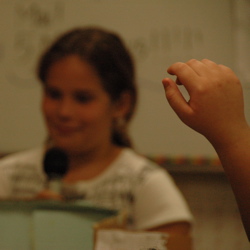
Raised handOn Friday, we went to school, sat in the back of the classroom, and watched Grace and her classmates, one by one, give their presentations. The room was arranged like an auditorium, with a table as podium at the front and the desk chairs arranged in rows. There was a microphone, into which each child spoke as s/he read aloud her prepared remarks. After the formal presentation, each speaker asked, “Any questions or comments?,” and then called on raised hands. Remarkably, what happened during the Q&A is what happens during the Q&A of presentations made by many adults: The speaker relaxed, smiled, and seemed more natural and engaged.

Children have less polish and guile than we do, so there’s something very raw about the behavioral “data” they present for our scrutiny. In this instance, the eight-year-old presenters gave me an opportunity to wonder this: Why does even a practiced, rehearsed professional speaker seem stiffer, less natural, than the same person during the Q&A?

I have always been skeptical of that claim that Americans fear public speaking more than any other fear, even fear of death. This source points to a 1973 survey by the Sunday Times of London that initiated that now wildly-held belief. Of 3,000 respondents, 41% listed public speaking as their number one fear. Hmm. About 1,200 Americans — many of whom might be dead by now — have got a lock on our fears. I, for one, do not fear public speaking over fear of death, or the death of anyone I love, or my fear of woodchippers. Let’s put this survey, and its outdated data, aside and actually examine this fear. Whether it ranks first or tenth, it’s still real. Continue reading

– Hesitation

I went out to do errands. I brought Jimmy’s Nikon (very sharp, with a telephoto lens), because there’s a store sign I pass all the time that’s awkward in a provocative way. I meant to take a picture of the words; I forgot.

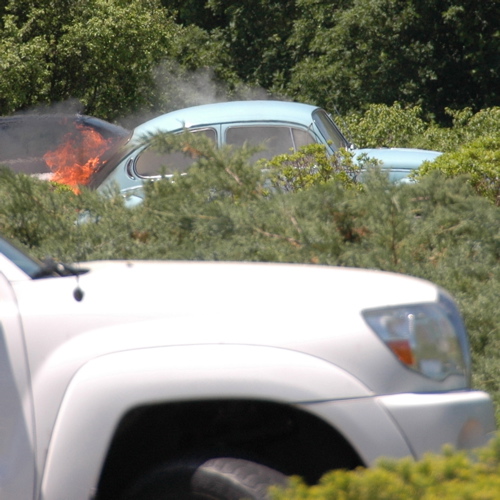
I did, however, see something else amazing: a blue VW bug on fire. It was directly across from me at the intersection of Rt. 1 and the entrance to the Dedham Mall. I was stopped at the red light; the burning, smoking car was in my sight line; and I remembered I had a camera. Opportunity!

I paused. The camera remained momentarily on the seat beside me. I mulled over my situation, step by step. This is what went through my mind:

  1. There’s a burning car. I should take a picture of it. I, for once, have a camera with me.
  2. If I roll down the window, and lean out with the camera, the car might choose that instant — with my luck — to explode, and spray burning gasoline and shrapnel in my direction.
  3. I could get burned, badly.
  4. Could the spraying flames from the exploding VW ignite the fuel in my car? Could I blow up?
  5. How terrible that would be, to be either horribly injured or die, in the act of taking a completely unnecessary picture of a stunning event.
  6. Perhaps I should turn into the parking lot and consider my options.

The light changed. And I turned into the parking lot. Then I took, with me sitting in the open window of the car to get some height and the lens zoomed to the max, this picture:

VW Fire, Rt. 1, June 12, from Uno\'s parking lot

The shot I missed was better: Herbie the Love Bug, looking me in the eye, with flames coming out of his rear end and smoke rising in billows over his roof. I guess I could never be a photo journalist (although I don’t recall ever having wanted to be one). I don’t act fast enough. Even a few seconds of hesitation, which is about what it took to go through that series of thoughts, adds up to a lost chance.

This tendency could explain my not being good at fast-moving multi-player sports.

This habit of pausing to gather my thoughts, however, which drives my kids nuts, could also account for my being pretty helpful in emergencies, as I think Julie, for example, could attest. If you’re with me, and you have a wound that’s dripping blood, I’m not leaping to the mental conclusion that you’re about to bleed out and die. I’m wondering where, exactly, did I stash the car’s first aid kit, and where on your body should I place some gentle pressure to get that blood to stop, and what should I say to you so you won’t worry.