– Earthkeeping

leaf I cut back the clematis dripping from the arbor, the lone sunflower bowing its mildewed head, the daisy stalks, raspberry canes, baptisia.

I raked. I bagged. Here and there, I picked up stray wrappers and bits of paper and bagged those too.

At the end, I dragged the full paper bags to the street, and I swept the front walk of dirt and leaves.

I swept the dirt back into the dirt.

“Something to do,” I thought.

I remembered how my father, when I was a child, would sweep the road in front of our house every spring. There was sand scattered the whole length of it, sprayed in the winter by the town’s sand trucks, which followed the plows. The spring road sweeping was a ritual. It smelled like minerals and sun. We children tried to play in the sandpiles made by sweeping fathers until we were shooed away.

Then and now — why all the sweeping, raking, trimming? And the repetition.

Do we keep the world neat this way, livable? Maybe.

I wonder, rather, if these chores are what we do to keep busy, keep moving, keep our chins up.
– Three new knitters

Yesterday, before a late afternoon dinner at my sister’s house, I taught my two nieces, Elena and Sara, and my oldest child, Eli, how to knit. (My two younger children, Lydia and Grace, are already in the club.)

The three of them picked it up quickly: naturals. It must be in their blood. Eli and Sara even invented their own way of handling the yarn-over step.  I tried a couple of times to guide them in the conventional way, but, when I could see that their idiosyncratic styles were nevertheless effective, I let it be. Continue reading

– An audience’s task

My colleagues and I teach undergraduates the fine arts of writing, speaking, and presenting. In this work, we talk explicitly to students about readers and audiences. Much of our work, in fact, involves making students aware of those people to whom they “transmit” their messages, reports, essays, and research. I doubt, however, that I’ve ever taught my students how to be good readers and audiences themselves, even though I hope I model the habits of a good reader and listener.

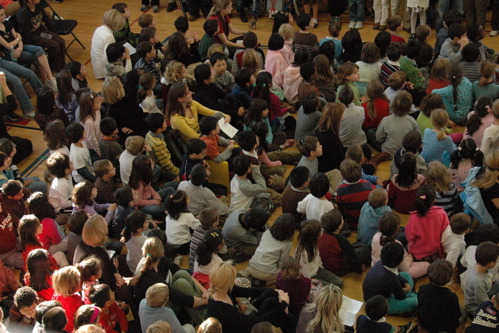
Today, at our neighborhood school, 670 students gathered in the big gym for the annual Thanksgiving assembly. Mr. Cavanagh, the principal and master of ceremonies, communicated a simple message to this young audience: “Be silent and attentive, and if you can’t be silent and attentive, at least be silent.”

School-age audience, 11.26.2008

School-age audience, 11.26.2008

Not in fear, but out of respect for Mr. Cavanagh’s words, they did sit still, and most were attentive. Some children were as young as 5 and some as old as 14. (It’s a K-8 school.) No blurting, no elbowing, no yanking at teachers’ sleeves.

After an hour, Mr. Cavanagh — an experienced educator who probably realized the energy that goes into being a good audience — called for a “one minute wiggle break.” Everyone stood up, stretched, turned to friends and talked, shifted in their places, and sat down again at the signal. The musical and theatrical numbers continued for another 30 minutes or so. The singers and players were wonderful; the audience performed beautifully, too.

– Fight, might, win*

On Saturday afternoon, emerging from the cramped hell of the Government Center MBTA stop into spacious City Hall plaza, I was greeted by a leafletter and activist. He caught me off guard.

Activist: I’m with the American Communist party.  Are you here for the demonstration?

Jane: (silently double-takes at “communist”) Er, yeah.

Activist: We believe that the Prop 8 marriage ban is one of a number of equal rights atrocities in this country.  There are workers’ rights, health care rights–

Jane: (warming up to and interrupting him) I’m with you.

By the way, he looks like a young Jackson Browne. Remember him?

Activist: Are you here because… (long sizing-up pause) of reproductive rights?

Jane: (what? huh?) Well, I’m for reproductive rights — yes, definitely — but I’m here to oppose the ban on gay marriage.

Activist: Great.  Are you willing to make a donation? Here’s our newspaper.

Jane: (hands over five dollars) Yes.

Activist: Thanks. So, basically we believe more and more people must become combative on these issues of rights. We need to step it up, put more pressure on the system.

Jane: (alarmed) Oh, well, I’m basically against violence, so —

Activist: I’m nonviolent, too. I don’t meant violence. I mean we have to organize and fight.

Jane: Okay, yes.

Since Saturday, I’ve been ruminating over that conversation, and the subtle yet important differences between violent and combative.  He’s right. And although I went to the demonstration and was counted, is it enough to stand there peacefully on the sidelines, as I did? Silence, after all, does not speak volumes.

—-

*Regarding my choice of title for this post: One year in high school I was a cheerleader for the basketball team.  Kind of a social experiment that didn’t take.  Anyway, one of our cheers went like this: “We’re gonna F-I-G-H-T; we’re gonna M-I-G-H-T; we’re gonna W-I-N. [pause] We’re gonna fight with all our might to win!”  And while I do NOT equate protesting with mere cheerleading, the word “fight” always fires this connection in my memory.

– Over the edge

I am not obsessed with knitting, as the character in this short video is.  (Keep track of her hair as you watch.)

I may be obsessed, however, with writing. Still, my work on any one thing is woefully slow compared to this lady’s progress on that scarf.  Oh, if only I were able to produce with such speed!

– The knitting student

Today Grace, George, and I had an impromptu and inaugural meeting of Jane’s Knitting Club.  All are welcome.

Because the two of them are a mere 8 and 6 years old, a lot has to happen before knitting begins. Bickering. Bathroom trips. Yogurt. And the unknotting of yarn and the finding of needles.

I smoothed out some mistakes in Grace’s swatch, and I cast on 35 stitches for George’s scarf.  He wanted “a hundred” stitches; I recommended 30 or 40.

They set to work, sitting in chairs in the dining room.  I sat in the living room, where I could only eavesdrop and not observe.  From the frequent scolding of George by Grace, it sounded as though our friend was occasionally sitting on the table, or knitting while pacing. I did not intervene.

After a few minutes, George slid on stocking feet into the living room.  “Jane, will you fix this?” Continue reading