– I am my own handyman.

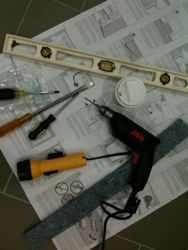
The appliance store delivered the dishwasher; the plumber hooked up the water in and water out; and the electrician powered it. Yet, there it sat, half in and half out of its cubby, waiting for someone to ease it into place, adjust the feet and level the orientation, screw the brackets to the countertop, and install the plastic guard and metal toe kick.

Well, today that someone was me. How frustrating. How ultimately satisfying!

During all that time on the floor, I meditated again on the ratio of time spent mending things to time spent making things. Is this where my creative energy gets spent?  Hmmm.  I felt sorry for myself and all my quotidian concerns for a few moments and then answered my own question: “Not entirely.” This task is simply more finite and results observable than writing or research or teaching. And immediately useful! Finally, a working dishwasher.

—–

P.S. The title of the post is an homage to a wonderful one-actor play, I Am My Own Wife, performed by Philip Leal, which I saw with James Black in Houston in 2007. If I recall, we were the best audience members that night: engrossed, moved. The Houston crowd seemed polite, yet perplexed.

– Grades beep, rattle, and hum.

But grades don’t speak.

It’s report card week in Brookline, and as usual we got a heads-up e-mail from the high school headmaster, prodding us to ask our sons and daughters to hand over their quarterly assessment. “The report card is an important school communication,” he concluded.

One thing every parent of a high schooler knows is how little communication there is between home and school, especially compared to the mountain of notices, bulletins, and newsletters that come our way during the K – 8 years, not to mention the PTO breakfasts and principal’s coffees and “special” events. (For the record: I do like parent/teacher conferences.) Eli is a junior in high school, and I met his teachers once at an open house event. Yes, I had a nice and helpful conversation with a few of them. However, that and a few visits Jimmy made to similar open houses constitute the extent of home/school communication in the last three years. I’m generally okay with that, but I am not okay with grades standing in for communication.

Grades might be aggregated data, and they might even be signals, but, because they lack (a) teachers’ interpretation and (b) opportunity for direct feedback, they cannot be communication. Continue reading

– Draw a picture. Make a sandwich. Teach writing.

Grace comes to work with Jane and finds the art supplies.

Grace comes to work with Jane and finds the art supplies.

During a scheduled hour to discuss their upcoming proposal drafts, I asked a group of 10 chemical engineering students to explain to each other their research projects, the rationale, the experimental design, and prior research. They talked productively for a half-hour and listened to each other with curiosity and asked relevant questions. All good. Certainly, we could have filled the rest of the hour with more talk.

I looked at the classroom’s two white boards and one easel pad and clutch of dry erase markers and Sharpies. I invited them, instead, to draw.

In small groups, they drew branching diagrams of their proposed experiments and explained their plans — and, even more importantly, gaps in their plans — to their peers. I walked around. They asked questions about how they might frame their experimental design in their drafts.

My friend and colleague Lisa had the classroom reserved after me, and she came in five minutes before we finished. Later, on the way to the copy machine, I saw Lisa’s students (in a different section of the same class) sprawled on the floor with big pieces of white paper and clustered around the white boards, drawing and gesturing with hands and markers. Continue reading

– It’s here! It’s here!

The table of contents is here!

Those are the words that rung through my mind’s ear as I opened issue number nine of P•M•S poemmemoirstory and saw my name in the table of contents next to “Little Creatures,” an essay on lice and love.

I was thinking of the early scene in the Steve Martin movie, The Jerk, in which the phone book arrives and Navin Johnson cavorts in joy: “The new phonebook is here! The new phonebook is here!” (Relive it at 1:24 in this trailer.) His name, in print! My name, in print!

Alas, though, it’s only a name. If you want to read my essay on experiences delousing my three children, leave me a comment with your e-mail address and a PDF will be yours.

And if you came here looking for the BEST LICE TREATMENT or a LICE REMOVAL MACHINE, which are among the top search strings that lead people to my blog, then let me give you the information you came for: Continue reading

– Lover of carrots

In my house, I have frequently been called “Lover of Carrots,” or “LoC” for short. Honestly.

And I do love carrots. I eat them raw every day. (My limit is a half-bag of those baby ones.) They taste good; they’re a habit; and — I also realized on Monday, when I felt overwhelmed by every work, house, and family task on my list — the chewing is a release of tension. Mouth exercise?

Perhaps it is not so illogical, then, that I thoroughly loved my raw food/vegan meal at Grezzo Restaurant in Boston, even though I am not currently a vegetarian. And that I had such wonderful company in my friend, and movie partner-in-crime, Betsy Boyle, helped.

– Fragile, dear, and broken

Sometimes, in one of my little fantasy conversations, I imagine saying to the phantom I’m talking to, “I am not a person who breaks things.” I imagine saying this not as a boast but as a deeply held commitment, a promise to myself: I will take care, I will not break. And when I say “things,” I mean everything that can be broken, like dishes, and promises and hearts, too.

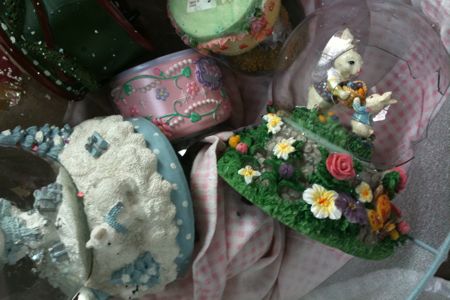
But, of course, I am occasionally a clumsy animal, and I break things. Two hours ago, for example, I broke two snow globes.  This made my daughter cry.

We were on our way to school. Lydia was riding shotgun, and Grace was in the back seat with her backpack, music bag, and a mysterious bundle wrapped in a fleece baby blanket. After I stopped the car in the drop-off line of other cars in front of the school, I reached into the back seat and tried to push this swaddled bundle closer to Grace, who was outside the car now and trying to figure out how to carry everything.

The bundle slipped off the seat onto the floor. I heard a little grind. Grace burst into tears. “You broke them, you broke them, you broke them!” Continue reading

– Anger, on ice

Ice

by Jane Kokernak

In this house
I make the ice. I
fill the tray. Full
rows shimmer and
tremble. Across
to freezer, drops tip
out. All day against
heat a compressor
hums and once snaps
at air. Within, molecules
slower and slower align
until crystal.

Sweating, in one arc
you swing into kitchen,
hands into freezer.
Out comes a matrix
rigid with ice. You
twist. With the crack
of a stick cracking,
matter resists — then
splinters. Your face
relaxes. Your chest
rises and falls with
breath. Water snakes
into cubes:
sighs.

The ice the glass
the water glitter. You
drink. Inside me
solids collide
drift and float.

*

—–

Author’s note: At one time, I was writing poetry like crazy. It seemed to be the way to capture and compress feeling. (The compression was really important to me, as an activity and effect.) Although I don’t think in poems so much anymore, I do believe that the sound of words and prose is important, and when I revise my work, I read it out loud, or read it deliberately in my head. I want to hear the words do something, and I want it to sound like something you could feel. Meaning alone is not enough. Back to this poem: it’s about anger — in particular, how I experience it. A deep freeze. No outbursts or sudden conflagrations for me, just a gathering into this cold black center. An outburst — “the crack of a stick cracking” —  might be more satisfying and productive, if I could pull it off. Can’t. Eventually, it lets go.

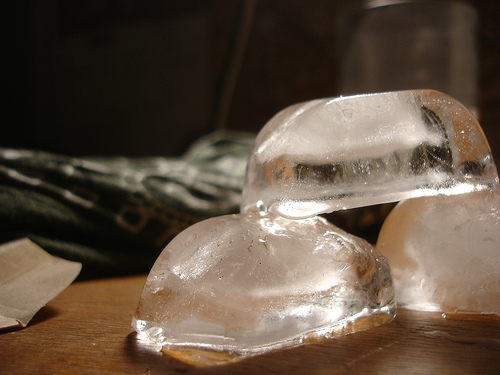
Thanks to Kevin Saff on Flickr for his image “Ice Cubes.”