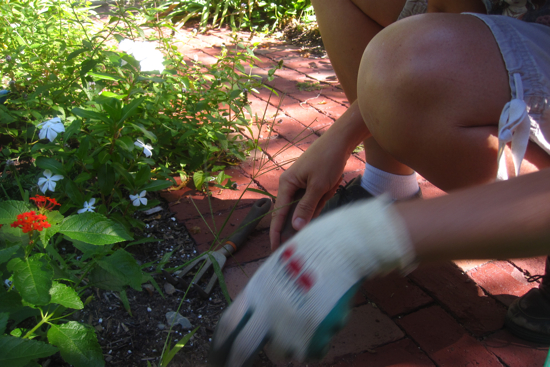
Sweet autumn clematis (link) reaches its full beauty in early September and then lasts. I have a few spots of it in the yard — over an arbor in the front, along both sides of the chimney, and climbing up the neighbor’s fence — and this summer it exceeded its usual proliferation while I wasn’t looking. Suddenly, it seemed to explode into my attention. One day I said to a member of my editorial staff, Grace Guterman, “Please, when you have a moment, go out in the yard and take some photos for me!” I wanted to preserve the lushness. She did.

Also this month I have noticed in the news a proliferation of commentary from writers on writing that surprised me in some way. So that I don’t lose these good finds, I’m going to catalog and excerpt below the three that made the greatest impression on me.
1. Brian Martin recommends that writers train like athletes. Excerpts from his article in Tomorrow’s Professor:
Write for 15 to 30 minutes every day. Yes, that’s it: the core requirement is daily writing, at least five days a week, preferably seven.
Coaches expect their athletes – swimmers, runners and so forth – to train daily. Junior athletes are expected to show up for training every day, at the same time. Swimmers put in the laps and runners put in the miles. This sort of training enables dedicated high school athletes to achieve times better than world champions a century ago.
So what were top athletes doing back then? Those were the days of amateurs, usually from the upper class with spare time and access to facilities, who trained when they felt like it, typically on weekends. Very gentlemanly. But their performances weren’t outstanding by today’s standards.
What about writing? Most academics seem to be operating like the gentleman athletes of the past. They wait until they feel like writing. That usually means when they have a big block of time, or are forced to meet a deadline.
Most academics learn binge-writing from doing assignments in high school or undergraduate years. Binging becomes increasingly dysfunctional as tasks become larger. Writing an essay overnight is possible, but completing a 300-page thesis requires planning and sustained work. Continue reading




 leaf stitch word