I try and try to understand. I study you for clues.

Winston is two years old, a poodle Shih Tzu mix, and a stray. Two days ago we adopted him from the MSPCA shelter in nearby Jamaica Plain. Besides a few health observations made by the shelter volunteers and veterinarian, those are the only facts we know about Winston, who was once named Saint. This is our first dog.

Winston_Grace

Winston and Grace

We study him for clues, trying to discern his “personality,” his preferences and fears, and even the unknowable: his family history. When Grace, Lydia, and I met him for the first time at the shelter, he brought to the bars of his pen a soft calico bone-shaped toy. We took that as a signal to play, as when a dog drops a stick or ball at your feet.  The first toy we bought him, once he was ours, was a soft fleece bone-shaped toy. He holds it in his mouth, brings it to us, but not to play catch, we’ve discovered. He doesn’t let it go; he doesn’t want us to tug at it.

Here comes Winston

Here comes Winston

We’ve discussed at length what this sign might mean. Lydia has deduced the fleece bone is a comfort object, like a child’s pacifier, and says, “I want to know what his life was like. I wish we had more information.” Jimmy, who came with us for the formal adoption visit, has observed Winston at home, and concludes that he was once well-cared for. Winston has some nice habits and deliberate gestures. We don’t know what they all mean yet, but we suspect they are part of a communication system he had with other people.

He’s just a dog, I know. Still our urge to know him — not as a blank slate but as a creature with a history and with an inner, coherent life — is strong.  We desire very much to understand him: through observation, but beyond it too.

Winston_shelter

First meeting: we belong together

Meanwhile, this week I am reading Joan Acocella’s profile in the New Yorker of psychoanalytic writer Adam Phillips. He claims that our deepest urge is to be understood, and he finds this to be a fruitless urge and “our most violent form of nostalgia,” says Phillips. It is “a revival of our wish, as infants, to have our mother arrive the instant we cry out from pain or hunger,” explains Acocella.

I have wished to be known, to be deeply understood.  I am skeptical, however, about Phillips’s reasoning. It’s too Lacanian for my taste. Would we really spend our adult lives driven by desires established in infancy? That contradicts my common sense. (Or perhaps Lacan’s ideas confound my understanding. Also possible.)

My urge to be understood comes from my strong inclination and effort to understand others: Jimmy, my children, the members of my family of origin, my closest friends, and even the occasional colleague or student who intrigues me. This effort to understand — although conducted invisibly and silently — I give as a gift. I want the same one in return.

And maybe we are all doing this all the time: studying each other for clues. Or maybe this effort to understand others is gendered. Or maybe some people, like me, emphasize understanding in their relationships, and others emphasize problem-solving, favors, or action.

I do agree with Phillips that we would be better off in accepting our lives and stop always striving to fulfill its potential.  Good luck with that, though. I both aim for that and find it hard to do.

Winston faces the camera

Winston faces the camera

We do know we will never fully know Winston or get the facts on his family history. We are constructing a new narrative, and in doing so we are envisioning a previous one. We will assign logic and meaning to all the clues and believe at some point that we know our dog. But we will really only know the story we have made of him.

P.S. Yes, I know. He’s a dog. It’s my thoughts about him that interest me, which make me wonder about my thoughts about just about every person in my life.
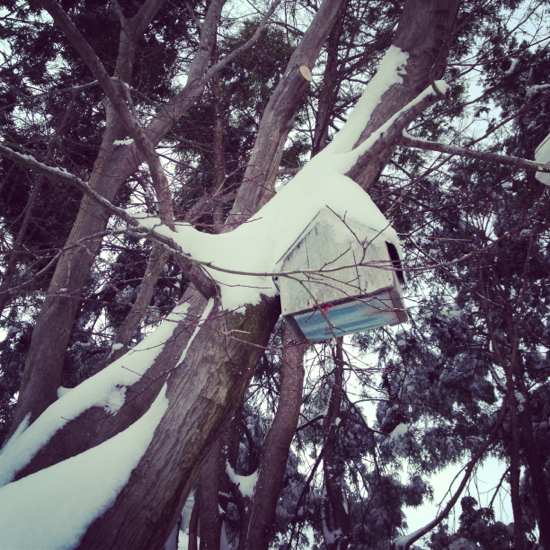
Held in place by snow

The birdhouse, which came with the big tree on our property when we bought it in 1999, has no function. There has never been a bird in it. Once I saw a squirrel in it and another time a full triangle of pizza! I put the two together and deduced that the squirrel had stolen it from garbage and set it aside for later eating.

Snow_birdhouse

It seems banal to take a picture of a snowy birdhouse among snowy branches, but often the everyday items of our lives gain in resonance and beauty when they stand out, visually emphasized by the snow, which obliterates the background.

So much was blanked out in this Blizzard of ’13. Even my neighbors’ yard, which abuts ours, became softer and more lovely to look at in the snow. The dying cypress hedge punctuates the view, indicates where we end and they begin. Last summer, the dying cypress hedge, dried and brittle looking, was only an eyesore and the topic of repetitive unresolved conversations with the neighbors, who own the hedge and don’t want to cut the shrubs down. Isaac and Olga want to leave the hedge there and plant other things in front. Bamboo, for example. In the meantime, to get privacy from us, they have leaned old wooden pallets against the dying hedge and planted junk vines that they have draped on the dying branches. On our side, I have done no more than keep it clean and trimmed. A fence is called for, but expensive.

I imagine standing in their yard and looking past the dried, thinning cypress into my yard: big Japanese maple, recently painted house, no debris in yard. I feel proud — too proud — and resentful. Why do they get my work as a view and I have to look at their clutter as mine?

At one time, when the children were small and we had a swing set and less time for gardening, no doubt there were days of our clutter that they had to look at. Maybe they are more generous, or more clutter-loving, and could look past what was then our stuff and appreciate the activity.

When we meet them in the summer at the property line, they do comment on the children and reminisce about the times they watched them play. “What a nice family,” they say. We have been spied on kindly, I gather.

It’s not them I don’t like. In fact, on days when they set up all their white tables and borrowed chairs, I know their many friends are coming and that the yard will be filled with people visiting, talking, eating, and that the lovely sound of a chorus of voices in the outdoors dark will comfort me as I go to bed.

It’s like the sound of being a child and going to bed while one’s parents and their friends are in the living room or finished basement, playing cards and drinking cocktails and laughing. The sound of both mystery and safety.

Continue reading

Necessary, and ultimately unnecessary, distractions

About 10 years ago, in the weeks leading up to teaching my first writing class ever, I fretted excessively about what shoes I would wear on my first day in the classroom.

I was almost 38 years old, and really I had not ever before obsessed about shoes. But fretting about shoes, in this case, helped me work through a lot of anticipatory fears about my public role in the classroom. I wanted those shoes to be comfortable but not dowdy, fashionable but not eye-catching. I was getting ready for students to stare at me, but not at my feet.

The shoes I wore that first day — in a classroom at Wheelock College that looked over the Riverway — I have forgotten, and I have never thought again about what shoes I would wear in the classroom. That doesn’t mean the shoe distraction was frivolous; it focused my attention and fears on something concrete and manageable that I had control over. And then I got beyond shoes.

In the past couple of months, I have been preparing for my first ever figure skating skills test. (Read about the story and the outcome here: link.) In the lead-up to the actual date, I tried to learn about and think through everything. The social situation itself would be entirely new to me, even newer than being at the front of a classroom. I had never watched anyone else take a skating test, and surely, as a student, I watched teachers teach hundreds of times.

Skating outfits_550_cool

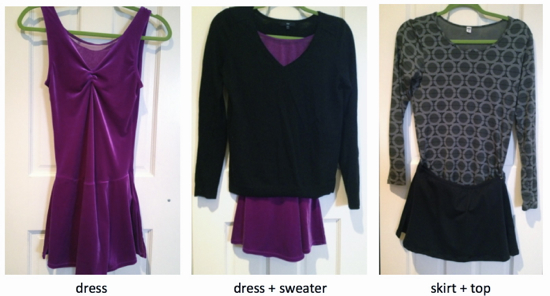
For a while I obsessed about what I would wear. It had to be more than fleece pants and a fleece jacket, which are the skating equivalent of a sweatsuit. But it didn’t have to be as much as a costume, with rhinestones, bright colors, and a theme. I scrolled through the offerings of online retail stores. I looked at skaters’ blogs for advice on what to wear. I ordered three skating dresses (one fit), a skating skirt (nice), and skating tights.

I had options. I didn’t wear any of them.

Two days before the test, my coach reminded me that the test situation would feel new and unfamiliar enough that a new and unfamiliar outfit might not be a confidence builder. He suggested skating pants, a nice sweater, low-key gloves. I went with his advice.

That morning, as I watched the other skaters who tested on the same day, some wearing skirts, I reflected on my outfit purchases that turned out to be unnecessary. But then I thought, maybe they were. Maybe the buying and trying on a skating dress was akin to trying on the identity of “skater.” Maybe the hours of online browsing was a way of wrapping my arms around a really big, overwhelming task. I didn’t know if I could nail the skating, but I do know I can choose and buy clothes online.

I made it through my first skating test ever: link. Next time, I’m wearing the skirt.