
Author: jelizabeth
Where I want to be
Once, on my long path from the parking lot through courtyards and down hallways to my office, I trailed behind an admissions tour group led by a student. I heard him say to the assemblage of parents, prospective students, and tagalong younger siblings, “Our campus isn’t very beautiful. I mean, it’s an urban school.”
Whoa there, I thought. Our campus is amazing. Indeed — domes, arches, windows, low stones walls, high ones, the river over there, surfaces, trees, groundcover, bicycle racks, and silhouettes against the sky — there is always something interesting to look at.
Last Wednesday, after a day filled with 1:1 writing conferences (6 of those) and presentation rehearsals (4 of those), I took a detour back to the parking garage to check out a new outdoor sculpture, Alchemist by Jaume Plensa, that I had noticed from across the street as I hurried back and forth on other days.
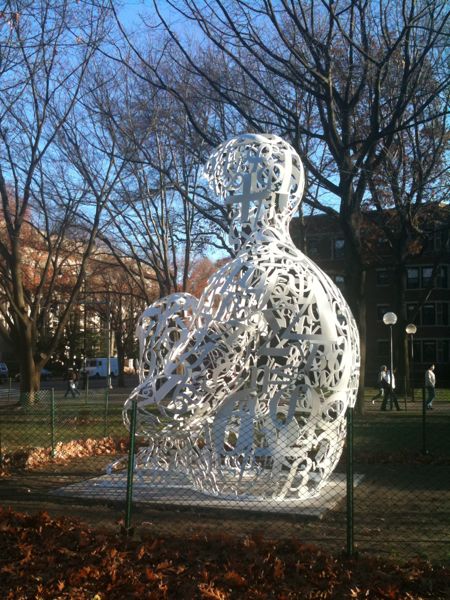
W 11.24.2010 ~3:00pm @W20 MIT
And last night, same sculpture, same impulse. Continue reading
Pleasures and problems of the ideal text
Writing teachers, when they read drafts, have a hard time resisting the temptation of the ideal text. As we read student work, we may be simultaneously reading — or really, creating — an ideal text in our mind of what that draft could become. No doubt this ideal text is based on our knowledge of other texts we have read and perhaps even written ourselves.
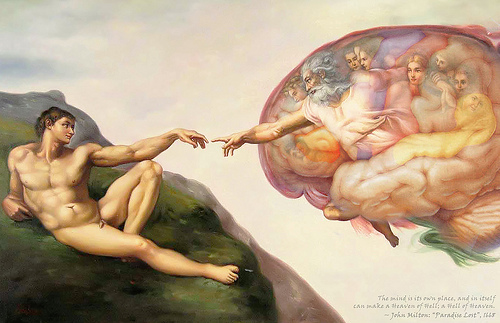
Ideal texts may help us see our students’ work ambitiously, as though all writings hold great potential. Ideal texts may also prevent us from seeing the work for what it is and for what it wants to become, or for what the writer wants it to become. Brannon and Knoblauch (1982) describe how an awareness of ideal texts and the inexperience of students can lead a teacher in a way to “appropriate” her students’ work (158).
The kinds of texts we encounter at school can be more than essays or reports. Oral presentations are texts. Videos. Portfolios. A proposed experiment. In the project labs I am assigned to at MIT as a communications instructor, it seems to me that the engineering and science faculty read or consider their students’ independent design and research projects against some ideal that the faculty themselves conjure in the acts of reviewing and teaching.
This ideal-text creation is largely optimistic, and, at the beginning of the semester, we see only potential. The push is forward. Right around now, though, with only two weeks before the last day of classes, our ideal-text creation machine is seeming a little peaked, which can paradoxically lead to teacherly acts of will and desperation: extra writing conferences, more office hours, and lavish feedback.
There’s another tarnished ideal text we teachers are facing right now and that is this: our own teaching. Perhaps I should drop the communal “we” right here and admit that the tarnished ideal text that I am facing, at this late moment in the semester, is my own teaching. Way back in September, what I planned to accomplish and even be as a teacher was like a vision. And now I hold the reality of my teaching in my hands like a small pile of stones. Certainly, I have amassed something — I’m a better teacher now than I was 7 years ago when I started, and surely this has happened incrementally, including this semester — and yet the gains are modest-sized.
Oh, I’m not completely self-effacing. Not at all. As much as I’m seeing the shortfall in my work, I see too what I have achieved. In fact, nearing the end of the semester can be a weird time of reconciliation. Somehow, by making an account of what I didn’t accomplish, I force myself to look for what I have been doing: 4 classes and 60 students, and it looks like they’ll all reach the finish line intact and with a few flourishes.
I’m starting to reflect, too, on what my students have achieved, as I’m talking to them in meetings and conferences and as I think of them. I am reminded that they are not only the texts that they produce; they are very smart people to begin with who are growing as thinkers and doers, and teammates and teachers. In class, meetings, and peer reviews, I observe them teaching each other more and more. Often, I feel them teaching me.
—-
Image, “Brain of the Sistine Chapel,” by tj. blackwell on flickr.
Yeoman’s work
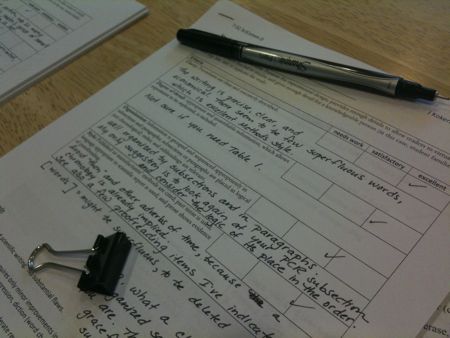
More grading goes on at my kitchen table than eating. And more of my teaching goes on behind-the-scenes than in front of students. The yeoman’s work of draft commenting may take 10 hours for every 1 hour I am actually in the classroom. Yes, sometimes it is lonely. One comfort: my new favorite pen.
Space carved out
It was Wednesday, one hour squashed between other hours and another appointment in a week filled with appointments. In the room, I and my ESL student, whose name is Karma, worked side-by-side on our own copies of the reading. The door to the hallway was closed. Through the wall, we heard a muted piano and, etched on top of that sound, a soprano voice. I counted 12 chairs around the table in our tiny room, and a chalkboard filled one wall and a window another.
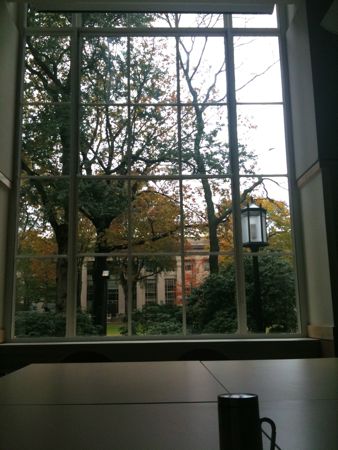
view from room 4-146, Wednesday 11-10-2010 @ 10:55am
This was silence. This was luck. This was like the world saying, Be here now.
The hour was long enough.
How to work a cocktail party like a tutor
Last night Jimmy and I went to what’s called a drinks party and, to our relief, enjoyed ourselves. I realized later, after several good conversations, that what makes me an effective tutor can help me get through challenging social situations. Or vice versa.
 Why are cocktail parties challenging? I mean, I may not be attention-hungry, but I’m not shy. Here’s the problem: so many people, no defined role for me, and no structure.
If those are the conditions — and they are for most parties, except for baby showers which are usually rather annoyingly structured around “games” (and those are intentional quotation marks) — then a person must have a strategy for dealing with the conditions. Otherwise, the impulse is to hide in a corner with the one person you know, clinging to that corner as though it were a berth and you a little boat afraid of being battered by the open sea.
And just as the secret to being a good tutor does not involve being drunk on the task, the seven secrets to party-going success that follow do not involve drinking half the bottle in the first 10 minutes. Continue reading
Telltale art
In July, I got lucky and went to TEDx Boston. My favorite talk was not the expert one by presentation superstar Larry Lessig, but the surprising one by artist Eric Mongeon, on his persistent obsession with what he calls the “dark and thrilling work” of Edgar Allen Poe and his struggle to illustrate and publish Poe’s stories.
What Mongeon says, in part one, about Poe’s work makes me want to return to the stories: “He was writing about fear in uniquely modern terms. All of Poe’s characters experience fear when their fundamental beliefs about their social, personal, or practical situation are somehow invalidated. The world becomes uncertain, because the picture of reality falls out of sync with the experience of reality. And at the root of fear is uncertainty.”
In part two, Mongeon describes a situation he found himself caught in. After years of generating material for his secret Poe project, he realized he was in The Vortex: “A viscious circle of research, rejection, and refinement. It is unrelenting, and it is self-perpetuating because you feel like you’re actually making something.” He soberly adds, “Doing isn’t the same thing as making.”
And finally he knits it all together — Poe’s stories, his own story, fear — deftly.
Original ideas, and a really original presentation. Everything fits: the script, the images, the timing, his clockwork pacing of the stage, and some strategic pauses. Simmering is how I’d characterize this, and worth studying.
Spool prison
They can look out, but they can’t get out.

alley window, upholstery shop, Brookline, MA
This passing of grackles
I am drawn to the notion of what in Spanish is called querencia. It is a special version of an individual’s sense of place, and the word conveys intimacy, deep knowledge, and a pull. I first read about this in John Hanson Mitchell’s book, The Paradise of All These Parts: A Natural History of Boston (Beacon Press 2008).
He describes querencia this way:
Those with a strong feeling of querencia will know the weather of their country, will know the dates of the arrivals and departures of local migratory birds, and the flowerings of trees and shrubs. They will be familiar with the course and names of local rivers and streams, the dates of the seasonal passages of fish, and the location of hidden animal trails, of dens, swamps, hollows, cliffs, and odd boulders or outcroppings. Furthermore, they will know that certain sites within their terrain exhibit almost mystical emanations.
Is it possible to feel this way about an entire state? While I am no expert on Massachusetts, I have lived in it my entire life, and I love it as I do my siblings, and indeed I have known it as long as I have known them. Yesterday, perhaps the most beautiful of all of October’s days, I took a break from my desk and walked outside to have a look at the Charles River, which was roughed up by the breeze. Cars honked across the Mass Ave bridge and the sun glossed the John Hancock Building. Leaves, yellow. Honestly, I felt my heart lift in my chest.
In the past two weeks, in my own yard I have been noting the comings and goings of the migratory grackles. It’s that time again. Although they irritate the air with the sound of one thousand squeaky gates, I am delighted to see them.
Their appearance makes the world seems familiar and surprising too: on one day they scurry like a frightened mob from tree to tree, knocking acorns down onto cars parked in the street, and on another day they choreograph their flight gracefully. Continue reading
The continuum
Sunday night, I couldn’t sleep. I stayed up late to work, one in a long string of staying-up-late nights, and then I couldn’t let go. For two hours I lay in bed and ruminated over the papers I had stayed up to review. Not wanting to fret about insomnia (which only exacerbates insomnia), I occasionally said to myself, “It’s okay. At least I’m resting my body.”
 At 3am, I moved to the couch. I noticed the many ways the lights from the street made their way into the room. I bunched a feather pillow under my head and replayed a couple of weeks of work in my head. And then I thought about the weeks ahead. In no way was I worried or panicking. It was simply as though my brain continued to develop and work on problems even as my body lay there immobile.
At 4:30am, with the same loop of images still playing in my head, I thought to myself: “I am mentally ill.” No, really. It occurred to me that this is what people mean by obsessive thoughts. Leave it to me to have them about drafts, and colleagues, and presentations, and this student and that one, and even that pile of folders on my desk that I keep meaning to put in the shredder bin.
“Ah, no. Not mentally ill,” I thought. “Just fucked up.” I did have enough awareness to step outside myself a bit, look at my thoughts, and recognize how unproductive they are. I wasn’t able to quiet them, but I could reality-test them.
Years ago, my friend Betsy told me and our small circle of friends about the mentally ill/fucked up continuum. This is not unlike the sexuality continuum, although M.I. and F.U. have nothing to do with a person’s sexual identity. Essentially, we are each of us M.I. or F.U., and there are gradations between. Continue reading
 leaf stitch word