No nightlife, no boogie

No doubt there is nightlife and boogie in Toronto, but we didn’t find much of it. That’s probably because we — traveling with children ages 10, 14, and 17 —  weren’t looking for it.

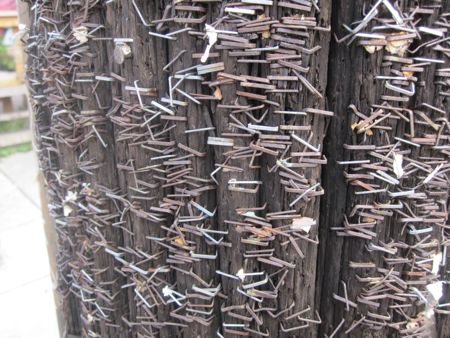
Staples in telephone pole, Kensington Market. By Lydia.

Still, we hoped to have our own brand of fun. And we did. What follows is a handful of highlights from the Toronto leg of our summer vacation, August 10 – 15. (The Cooperstown and Niagara Falls legs are documented in a previous post.)

Leg three: Toronto, Ontario

We drove into the city on a Wednesday afternoon. Lydia, sitting in the way back, observed, “This is another one of those cities with cranes. Like Chicago.” I had to agree.

Another city of cranes.

After dragging our bags into our hotel on Yonge Street, at one time designated the longest street in the world, and feeling daunted by possibilities for What Now?, we walked blocks and blocks to Yorkville Ave. for ice cream. At Summer’s Sweet Memories, Eli and I tried their famous flavor, Toronto Pothole: almonds, marshmallows, chocolate chunks, and peanuts in chocolate ice cream. Later in the week, we went back again, for the same flavor. That was one of my good delicious vacation ideas. Continue reading

Escape from America

This summer marked our third family car trip to Canada. On occasion, we have joked darkly and said that our habit of traveling there is practice for when the U.S. reinstates the draft, and we have to hightail it north to keep Eli and perhaps the girls from compulsory service. Interestingly, during our stay in Toronto I read a biography of Jane Jacobs and learned that she and her husband moved to that same city in 1968 to keep their two sons from the draft, and she easily made it her home for the rest of her long life.

More immediately, though, we love it: a chance to go and be somewhere different, cool, and not America without the hassles of an airport and high price of (five!) airline tickets.

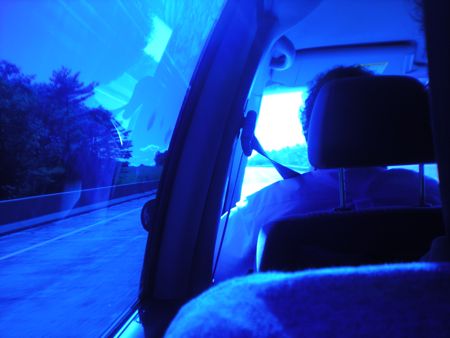
Driving by Jimmy. Back seat photo by Grace.

Plus, before we cross the border, we get to drive through some nice country in Maine, Vermont, or upstate New York and visit friends and stop at some out-of-the way U.S. attractions. This was so on our recent trip through Albany, Cooperstown, and Niagara Falls, on our way to Toronto.

What follows, in this post and the next, is less a summary than an accounting of high, and a few low, lights of our August vacation. Continue reading

Unpretty potatoes and their lessons

There are beautiful ideas, and there is reality.

I learned this from a tutor I was training, several years ago, when I worked in the Simmons College writing program. Her name was Kristin, and she told our group about a time she absolutely could not write a paper, although she had “written it in her head,” and it was perfect. So she went to her professor, and she told him about this perfect, imagined paper and how she was unable to write it. He said to her, “All you have now is a beautiful idea. And beautiful ideas are not writing.” He handed her a lined, yellow pad of paper and looked at the clock. “I’ll be back in two hours. Write,” he said. Kristin sat at a desk in the hallway and wrote. And what she produced was less perfect than what she imagined producing, and yet it was real. The words existed in the world and did not merely float in her head. “There,” the professor said. And the paper turned out to be neither good nor bad, Kristin told us.

If a creative person has high hopes for her work, she must learn to tolerate the gap between the idea and its manifestation.

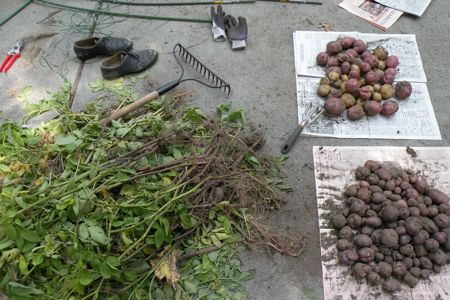
Harvest done. Things arranged.

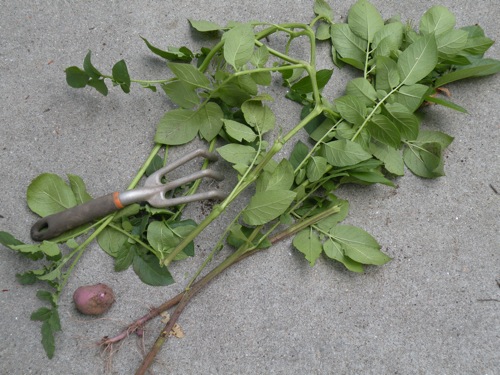
Yesterday I completely harvested my first crop of potatoes. I waited for the soil to dry from a previous rain, and then I clawed around each plant, exposing the stalks to the first potato. One at a time I grasped the plant down near the exposed soil line and pulled gently and with a little vibration, as though wiggling a tooth out. I piled up the stalks on the driveway. I piled up the potatoes — gold, red, and purple — on dry newspaper. My dark shirt absorbed the sun and my scapula were like hot wings. Continue reading

Hiatus

My maternal grandmother, Ellen (Harney) Lindberg, was not a world traveler, but she knew how to take a break: time at the beach, a road trip to Newport to bet on Jai Alai, card parties, golf, and line dancing. The point seemed to be less the destination than the excursion. Fun is wherever you make it.

Ellen Lindberg, some beach, somewhere, 1971

Ellen Lindberg, some beach, somewhere, 1971

Growing up, my mother and father too were creators of excursions. As a family, we never left the country or got on an airplane, but we traveled and camped constantly. We went to more places in the Northeast and around the U.S. than many families with more money. My parents seemed always to want to go and do. In fact, I can recall a few Friday afternoons in the summer when I’d stop at home for a drink or snack, and my mother would say, “Pack up. We’re going camping.” And I and my four siblings would pack up — we knew the drill. Within a couple of hours, off we’d go in our Country Squire station wagon. I remember the excitement of driving the curving roads of New Hampshire or upstate New York and looking for campground “Vacancy” signs. My brothers and sisters and I would race each other to be the first to call my parents’ attention to a place to stay. “There! There! Vacancy!” Beyond whist parties with their friends, or Casino Night at church, this may have been the only gambling my parents ever did.

Last night we — I, Jimmy, Eli, Lydia, and Grace — returned from our break: an extended car trip to Albany (to see friends), Cooperstown (Hall of Fame), Niagara (falls), and Toronto (Red Sox vs. Blue Jays game three, Kensington Market, the world’s only shoe museum, AGO, city islands, and more). I’ll report on that in the next few days.

In the meantime, there are still weeks of summer left, enough time for day trips, boat rides, outdoor meals, and a beach somewhere.

Plunge into illness

My short essay, “Diabetes Diagnosis, Before and After,” appears today in ASweetLife. Link.

Excerpt:

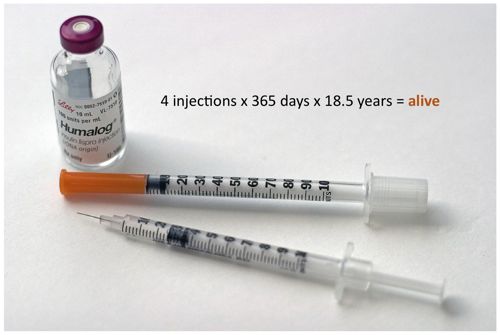
More than 18 years have passed since my diagnosis day; in that time, I’ve injected or bolused insulin at least 26,280 times, and never mind how many units. I’ve pricked my finger and tested my blood almost 40,000 times and counted and eaten more than 900,000 grams of carbohydrates. There have been many moments when the immensity of my task has been so overwhelming that I have stood at my kitchen counter with a syringe or insertion set poised in my uncooperative hand and said to myself, “Jane, just do this one.”

—–

Image of syringes & insulin by DeathByBokeh at Flickr via Creative Commons.

Potato’s first kicks

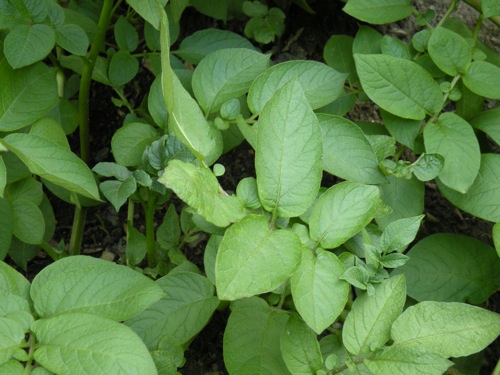
The potato plants are flourishing, and while I have wondered what’s going on underground, I would have been content to wait until the minimum growing period (70 days) had passed. But a member of my potato audience (i.e., a regular passer-by) suggested I have a look. “You might have some — whaddya call them? — new potatoes under there.” She claimed to have a farmer brother in Wisconsin and was therefore a bit of an authority on potato matters.

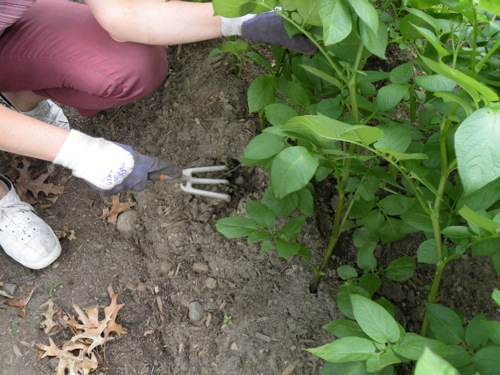
Persuaded, I enlisted the documentary skills of one of my staff photographers, put on some gloves, and grabbed the fork-like cultivator. Gingerly I began digging.

I clawed deeper. The only word for how I felt was expectant. Something, I hoped, had been growing invisibly for weeks, and I was eager for a sign, a fetal kick of sorts. Clump after clump of dirt rolled under the tines. All I saw was dirt and those thready roots.

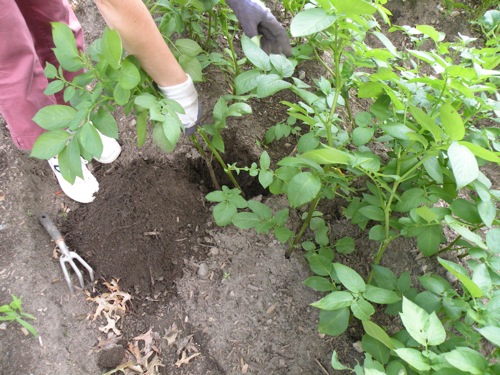
No longer content to let sleeping potatoes lie, I tugged up the bushy plant itself, wondering if this would drop a little spud or two at my feet. Hmmm, no.

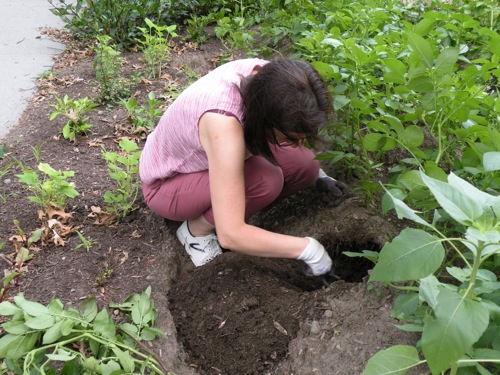
I went back in, like an archaeologist, easing the dirt out of the cavity, trying to feel for lumps I couldn’t see.

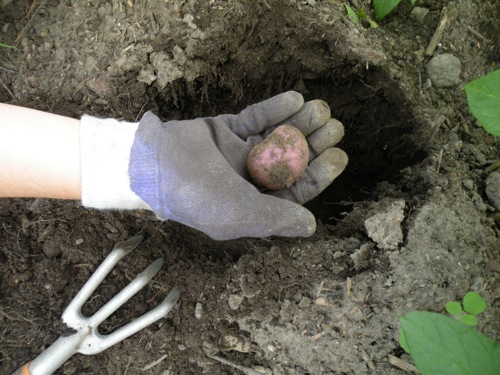
So suddenly that I caught my breath, a red potato rolled into view. Oh, the feeling! Here was evidence. Potato plants really do yield potatoes, and I had arranged the conditions (soil, water, sunny spot, fish meal) under which food — life sustainer! — could grow. A little sign of more to come.

I only dug the one, and then I cleaned, boiled, and ate it — floury, delicious, and mine.

—–

Photographer: Lydia Guterman


Road not taken

While a junior at Wellesley College, I developed a crush on my not-young history professor. These things happen all the time in education — students falling for professors, and sometimes the inverse too — and perhaps even more so in single-sex environments.

It turns out I was more comfortable with my fantasies of conducting a romance with him than I was with the reality. During a moment in his office, it seemed as though Professor Zimmer (a pseudonym) was offering me an invitation, and I, out of good sense or fear or both, turned away.
That was the end of our story, but not the end of the story for me. The crush and the offer and his later, early death have taken root in my imagination, and again and again in my life I have pulled them out to consider them. About the place of this memory in my life I wrote an essay, “Dead and Gone.” The moment when the flimsiness of the crush encounters the cold fist of reality is described here:

The room was still, my body pinned in the chair and in space. Without moving my eyes, I watched the dust sparkle again in the air between us, and I looked at him and I did not look away. This was a test, and I wanted to pass it.

The office was his, and the silence was his to disrupt. “You know, if you ever want to talk about your major, or the class, we could meet again. In the afternoon, or later. We could even go get a beer.” There was a pause. “Sometimes I’m free in the evening.” And he looked at me without looking away.

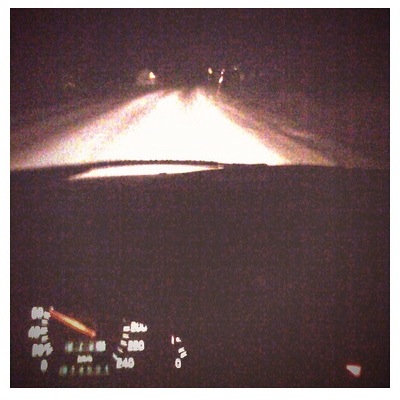
I felt as though I was being dared: dared to be the object of attention, dared to interpret his offer, dared to say, Yes, I’d love to. I sat there, pinned and thinking. And the big billboard of my romantic fantasy gave way and fell into pieces. I saw us meeting in the parking lot near the town grocery store after dark, and him pulling up in the kind of old Volvo that all the professors drove and pushing open the passenger side door and me getting in, and me ducking down below the dash so nobody could see me as we drove and drove and drove away from town to somewhere he would take us. And on the floor of this car I saw all the crap that’s always on the floor of these cars, because as a babysitter for other professors and their children I had driven these cars and ferried children not my own around town in them, and I recognized the bits of cereal and plastic lunch baggies and receipts and the discarded envelopes of mail opened in the car and the gloves and winter grit and the floor mats askew. And I had plenty of time to study this stuff on the floor because my head was tucked down, and there was no view out the window for me, because I was hiding — he was hiding me — and this, I suddenly saw, is how our time together outside of school would be.

“Thank you,” was all I could say out loud. I had no words for whether I would consider history or not, meeting or not, because suddenly I knew that all I wanted was to remove myself from what would only, it seemed then, become sordid. Old car, old motel room in some other town, old dirt.

A few of my readers have seen this essay in draft, and their feedback and encouragement helped shape it. Thank you again.

—-

Photograph, “Volvo Dashboard,” by Jean Pichot on flickr via creativecommons.org
Scourge of the season

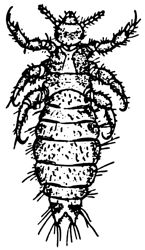
We are well into summer, so it must be time for a head lice outbreak. More and more people searching for “head lice” and “lice treatments” and “nitpicker” and so on have found their way to my blog recently because I have commented on this topic before. And WBUR recently did a story on the parasites.

While lice, at first, are appalling, they are not so disgusting after you get used to them. I describe my fascination with head lice, and the physical closeness they prompted between me and Eli, Lydia, and Grace, in my researched essay “Little Creatures,” which was originally published in P•M•S poemmemoirstory 9. Here’s a taste:

I dip the fine-toothed louse comb into a container of burning hot water and swirl. Captured ones float for a few moments before sinking. The lice are dark enough in the container of water that I can count them. Occasionally the count seems not to add up so I hold the comb up near my eyes to look for bodies trapped like seeds in human teeth and find them there, suspended sideways between the plastic teeth. Their lash-like legs, scurrying in air, seem always to move in this workmanlike way, regardless of footing, unable to take me in as a threat, not afraid of me as a predator in the way that mice are afraid. I make my thumb and forefinger into pliers and close over the head and tail of each and drag it down the space between tines. I feel the substance, like nut meat, and I imagine eating them. I do this enough times so I think always of eating them when they are pinched in my fingers like this. It would be so easy to eat them that I feel drawn to doing it in the way I feel drawn to letting my body go over the barrier at the edge of the falls or on the upper level of an open air parking garage. It’s that close.

I do not eat them. It’s not something that I would do.

—–

Image credit: wikimedia commons.