– What I am thinking about this week

Lee did not ask me or anyone to follow him in writing, but I read his post, and what can I do but be prompted?

Thoughts, especially written-down ones, propagate thoughts. That is one thing I am thinking about right now.

Today in the grocery store I stood in line near an old, yet very well groomed woman. She was tiny and precise: short, thin all over, ironed black shorts and ironed white summer blouse, black framed sunglasses proportioned for her face, short hairdo the color of dried grass with a little pink to it. She paid by check. “I don’t do bank cards,” she said to the clerk. It’s a family-owned grocery store, and they accomodate habits like these. In her cart she had two of many things: two boneless chicken breasts, two russet potatoes, two yogurts. I looked at her left hand, which was bony and veined of course, and she wore two or three bands on the ring finger, one heavy with stones. Her hand seemed to droop, perhaps simply from that fatigue that strikes us all at 4:30pm, but the view of those rings and all the food twins in her cart put this phrase in my head: heavily married.

Revision is an open wound. As long as a piece or project is underway and unfinished, it is susceptible to every influence that comes near it. That’s good, but also hard to experience, and manage. On this, I will have more to say in the future. Continue reading
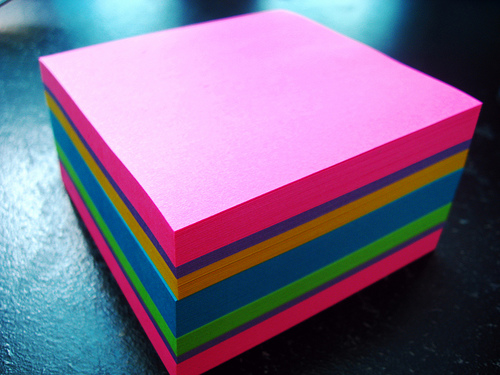
– Bingeing on sticky notes

“Post-it® notes came out when I was in college.” I mentioned this to a group of students as I was passing out stacks of the colored sticky notes, along with a Ziploc® bag full of Sharpie® markers: tools for an article annotation and mapping exercise.

I continued, “In fact, I recall my friend Jeanne buying a pack — they only came in yellow at the time — and her marveling to me at their coolness. Secretly, I was thinking that the little pad with adhesive strips was about the stupidest invention ever: Don’t paper and a piece of tape do a sufficient job?”

How wrong I was, I concluded. “It’s hard to imagine school life today without sticky notes.”

Teachers, not just students, need sticky notes too. In the past few weeks I’ve been thinking through and organizing a presentation, for the WAC International Conference, on “The Professional Poster Session and Its Simulation in the Undergraduate Setting.” I interviewed four PhD students on their first experience as poster presenters at professional conferences in their disciplines, and I had about 80 pages of interview transcripts. That’s a lot of material to boil down into an interesting 15 min and 12 slide talk. So, I decided to walk my own talk, get out the sticky notes and markers, clear off the kitchen table, and sit down and sketch first… with words. Continue reading

– Bought back my own time

In the last couple of months, for various projects, I’ve been interviewing people and recording those interviews for later transcription. Some transcription I’ve done on my own. For every minute of audio, it takes me four to eight minutes to transcribe the dialogue. An hour-long recording could take as many as eight hours to turn a conversation into material for an article or data for a qualitative study. I had a handful of those.

Recently, I wrote about a digital recorder that has been a handy tool in those interviews and a play-back app that makes transcribing more efficient. Now I’d like to give a shout-out to CastingWords, a web-based transcription service. I uploaded .WMA files to their site, chose the 6-day, $1.50 per minute option, and crossed my fingers. In two days, my first transcription arrived in my mailbox. Within six days, the whole order was complete.

I’ve been going through the transcripts. Hooray! They are high quality and accurately capture the text of what was said, as well as the little touches in timing and fillers (“um, yeah”) that turned each digital file into the record of a conversation.

If, like me, you’re ever in a situation where you want to buy back some of your own time (I paid about $340 to conserve about 30 hours of my own time) and subcontract tape transcription to specialists, I highly recommend the staff (really, Mechanical Turk Workers) at CastingWords. The output is excellent, and the manner of doing business with them — entirely via the web — was efficient.

—-

Parking meter image by Lance McCord via Flickr and creativecommons.org.

– Validation

It takes more strength to go slowly.

Said today by yoga teacher Portia. The remark had something to do with the lowering and raising of our legs, but it seemed personally applicable. Like, it’s okay that I can be a slowpoke (in writing, thinking, cooking, reacting, painting, responding, folding, driving, etc.). And that slowness might come from strength, and not a deficit.

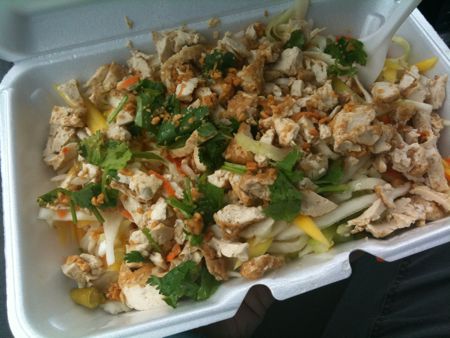
After yoga, there was no Clover Food Truck to get my usual, so I stood in line at Goosebeary’s Food Truck instead. I ate the Mango Salad with Tofu, not quickly. Vegetarian food can be heavenly too, you know.

– Strawberry planter how to

I made my mother a strawberry planter for Mother’s Day, following the directions here, with two substitutions: I used shards of a broken pot for drainage, instead of hydroponic pebbles, and I bought the strawberry plants at the nursery, instead of digging them up from an existing plot.

Putting it together was so straightforward that words are not needed. You can watch the slide show. And if you live near me and want to make one for yourself, you can get everything but the hammer at Allandale Farm.

This slideshow requires JavaScript.

—–

Thanks to Jimmy for the photography and Grace for the help. I created the slide deck in the new WordPress.com slideshow feature.

– My new tool

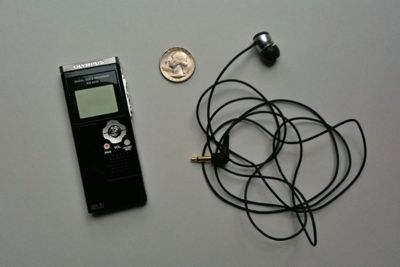
For my telephone interview with physician/author Danielle Ofri, I used my new tape recorder and telephone pickup.

Olympus recorder and telephone pickup

I recommend both: the Olympus WS-331M digital voice recorder (about $100) and the Olympus TP7 telephone pickup (about $20). The pickup is neat. It plugs into the mic jack of the tape recorder, and then the ear bud goes in the interviewer’s ear. As I listened to Danielle, the ear bud recorded what I heard in my ear, or Danielle’s voice, and the recorder’s external mic captured my voice.

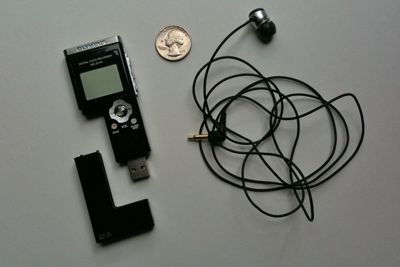
On my sister Sally’s recommendation, I used Express Scribe v 5.02 from NCH Software (free) to play back the audio file as I transcribed it. First, I connected the recorder’s USB terminal to my Mac’s USB port and saved the .WMA file on my desktop. Then I imported the .WMA file into Express Scribe, which allowed for lots of control (speed, volume, start, stop, ff, etc.) as I listened to the file, re-listened to passages, and typed.

Olympus recorder, with USB terminal exposed, and telephone pickup

I actually bought the recorder to tape some interviews I’m doing with students for a teaching-related research study. For that recording situation, nothing more than the recorder and a list of questions are needed. I followed the same procedure for transferring the .WMA files to my MAC, for later transcription.

The only accessory that could improve this experience of recording and transcribing is a foot pedal to control the playback of the recording. I did designate a few hot keys in Express Scribe to speed the frequent stopping and restarting of the playback, but a foot pedal would have saved even more time and hand motions.

A few weeks ago I was a beginner at the recorded interview. This nifty little setup made me feel like a pro.

——

Post script: I almost called this post “My new gun,” as an homage to a great, yet little-seen Diane Lane film called… My New Gun (1992). Marcia recommended it to me years ago. It’s a stealth surprise: weird, suspenseful, sexy.

– Little bursts

During one sustained yoga pose (downward dog), I looked at my hands, fingers splayed on the mat. Wow, I thought. Look at you. I acknowledged them for 45 years of work. No appliance could do what they’ve done and still be so capable.

Later, lying on my back, with my legs straight and feet in the air, I looked at my bare knees and calves, and I liked them. Marvels.

My regular habit, after Wednesday yoga, is to go to the Clover Food Truck on Carleton Street and get a soy BLT, my discovery of the spring. At $5, it’s a perfect food.

Today I sat on a bench next to the parking lot, half in the sun and half out, and ate it. On the bench perpendicular to mine, a young woman and man talked about happiness, and all the pressures in the way of it. She said to him: “There are too many choices. And having to choose work you love, or a person you love, is overwhelming. I read that people are less happy when they know there is other work, or someone else out there.” He said to her: “I said to my therapist that, among all my options, the least disagreeable to me is dentistry.”

One pigeon walked on the cement pavers near my feet. Of course, pigeons do not fear us. It came closer and seemed to stand there, turning and waiting. I looked at its three-clawed feet and stick legs. Do you know they’re pink? A dark rose. The feathers are less gray than a dusky purple, with shimmers of green around the neck.

In Olive Kitteridge by Elizabeth Strout, on the occasion of her son’s wedding Olive thinks about what she knows of loneliness and ruminates, too, on its antidote:

Olive’s private view is that life depends on what she thinks of as “big bursts” and “little bursts.” Big bursts are things like marriage or children, intimacies that keep you afloat, but these big bursts hold dangerous, unseen currents. Which is why you need the little bursts as well: a friendly clerk at Bradlee’s, let’s say, or the waitress at Dunkin’ Donuts who knows how you like your coffee.

Or a sandwich from a truck.

On the way home, I stopped the car for a few seconds where Ames Street joins Memorial Drive. A few pedestrians passed in front of me, which made me turn my head to follow them. I saw a woman holding a toddler, still awake but slumped in her arms, the child’s head lolling on the mother’s shoulder. I remembered the slack weight of a baby against my chest: that closeness, that power. The child held out her own hand and looked at it, turning it palm down, then palm up. She closed her fingers into a little fist and looked at that, too. There was no haste in her movements. She could stare at that hand and turn it over and over, forever.

– Bleach kills bacteria.

“bleach kills bacteria”: that’s what I Googled before taking Boston.com’s advice on sanitizing our clean dishes during the MWRA/Boston area water emergency that began Saturday, May 1 at 6:40pm. I found out that, indeed, bleach kills bacteria quite reliably. And seeing that we’re bathing and washing our dishes too in pond water right now (from back up supplied by the Chesnut Hill Reservoir, a kind of local goose haven), it’s possible there are some robust organisms hanging around the kitchen sink that wouldn’t mind finding a human host.

Here I am, demonstrating the dish sanitizing procedure. Take that, E. coli. You’re not welcome here no more.

Will the bleach solution also clobber the water-born parasite Giardia? I hope so, yet I am not as sure. <gulp>

—-

Update (May 3 afternoon): Since making and posting this video, I have discovered, or been pointed to, various advice for sanitizing dishes after washing them. I’ll summarize:

  • Boston.com recommends using 1/8 t. per gallon H2O and specifies no length of time for the dishes’ submersion in the bleach solution.
  • The MWRA “Consumer Fact Sheet” recommends using 1 t. bleach per gallon H2O and specifies 1 min. for the dishes’ submersion in the bleach solution.
  • Interestingly, earlier on the Massachusetts Department of Environmental Protection site, there was a recommendation to use 1 t. bleach per gallon H2O and a 5 min. submersion time, as a reader (Jeremy) alerted me to. I found that link again, and discovered that information has been changed, to be consistent with the MWRA’s advice. That’s good: a unified message from the government bodies safeguarding our health!

The winning method, therefore, for sanitizing clean dishes, during the boil order, is: 1 t. bleach per 1 gallon lukewarm water for 1 min. submersion.

—-

P.S. Thanks to Jimmy Guterman for videography, and for remembering the boiling point of water: 100° C or 212° F.